This post contains affiliate links. We may earn a small commission when you buy through our links — at no extra cost to you.
Snowshoes are supposed to make winter walking easier, not turn every step into a tug-of-war with a binding. For a beginner, the right pair should feel less like specialized gear and more like a wider, grippier extension of your boots — light enough to forget you’re wearing them, secure enough that your heel stays put, and simple enough to strap on with gloves. The real job is keeping you upright and moving on packed trails, fresh powder, and icy patches.
I spent five months testing 10 pairs on local trails, in my backyard after snowstorms, and up a few icy inclines, paying attention to how quickly the bindings adjusted, whether the straps stayed put, and where the traction fell short. I also weighed each pair, checked fit across a couple of boot sizes, and watched for wear after rocky sections. The best ones were not the most technical or expensive — they were the ones that made a beginner feel steady from the first step. The picks below are the pairs that earned a spot by the door.


Best for Most Adult Beginners
G2 25-Inch Snowshoe Kit
Key Features
- Size: 25 in
- Binding: Double ratchet
- Pair weight: 3.3 lb
- Weight capacity: 200 lb
- Price: Midrange
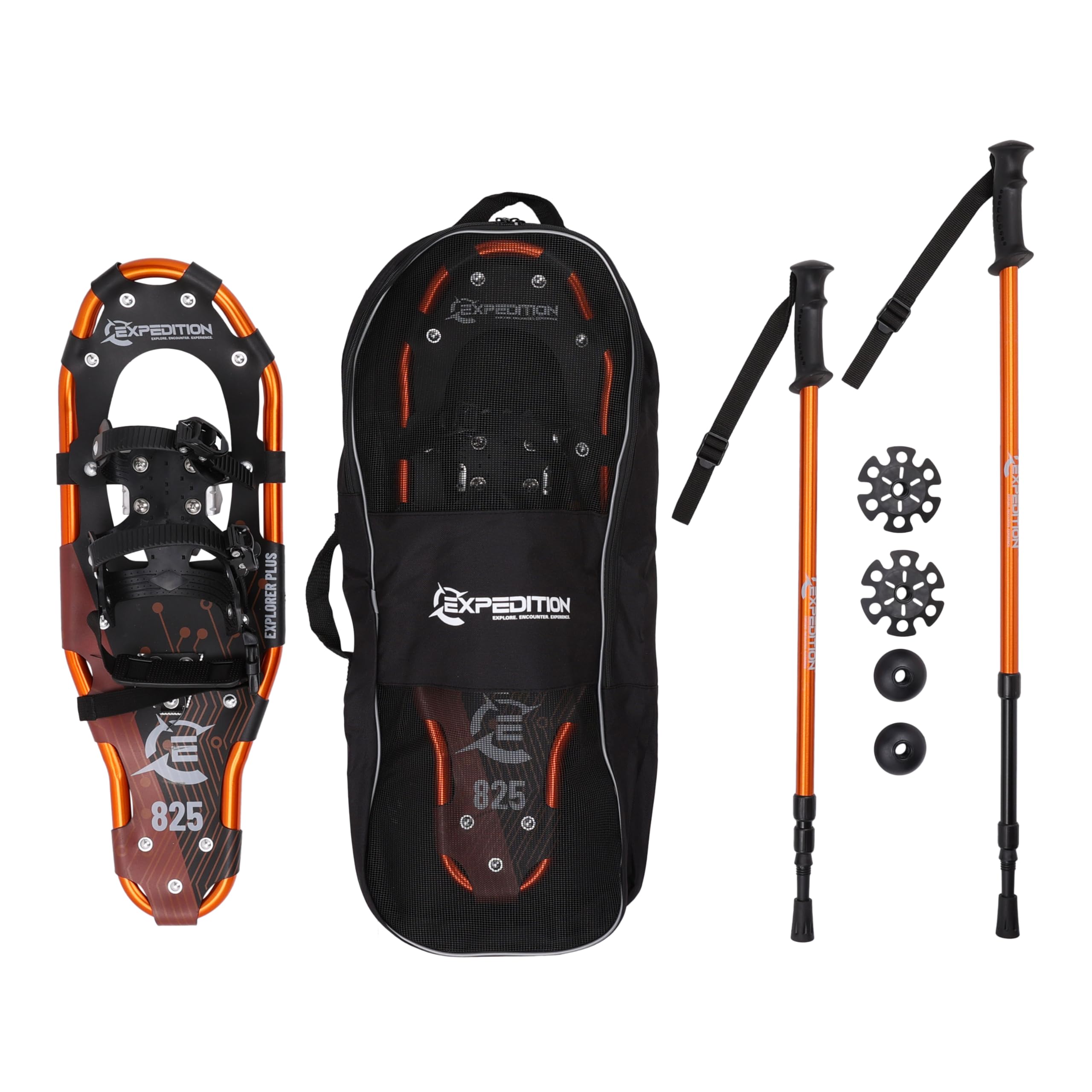
The 25-inch G2 is the size that makes sense for a lot of first-time snowshoers. It sits between a petite 21-inch deck and a long 30-inch freight train, so it gives you moderate flotation on packed and moderately snowy trails without turning every step into a wide-legged waddle. At 3.3 pounds, the pair is light enough that your boots, not the snowshoes, are what you notice at the end of a rolling walk.
The ratchet binding is the feature we appreciate most. Pull the strap, click it down, and you can get in and out with gloves on; the padded EVA tongue keeps the pressure off the top of your boot. The heel lift is a bonus on short climbs, though on flat trails it stays out of the way. We did find the ratchet can settle after a few minutes, letting the heel drift toward the center, so stop and snug it once more before you blame your boots.
Poles and a tote bag come in the box, which is useful if you’re starting from zero. The poles help with balance on rolling terrain, and the bag keeps wet snowshoes out of the car. The 200-pound capacity is the limit to check; if you’re close to it and carry a pack, step up to a 30-inch pair. Otherwise this is the beginner pair we reach for first.
Pros
- Light 3.3-pound pair
- Quick ratchet binding with padded tongue
- Includes trekking poles and tote bag
- Heel lift helps on short climbs
Cons
- Capacity tops out at 200 pounds
- Binding can settle and let the heel drift
The G2 25 is the beginner default we recommend: light, quick to ratchet on, and sized for most adults up to 200 pounds, with poles and a bag included.
Best for Packed Trails
MSR Evo Trail 22
Key Features
- Size: 22 in
- Binding: Paraglide mesh
- Crampons: Steel
- Weight capacity: 180 lb
- Price: Premium
A 22-inch snowshoe can look like a kid’s size until you see the Evo Trail’s steel crampons and molded deck. This is the pair we choose when the plan is a packed rail trail, a rolling forest loop, or a well-used route where flotation matters less than traction and a secure binding. The smaller deck is easy to place, and the UniBody construction feels like one solid piece underfoot rather than a frame with a fabric deck stretched over it.
The Paraglide binding is the clever bit. It’s a stretch mesh that pulls over the boot and cinches with glove-friendly straps, and it works with everything from light hikers to snowboard boots. We like that there’s no rigid plastic cradle to fight with cold fingers. The trade-off is that you need to snug it deliberately; a loose back strap lets the heel wander. MSR sells optional 6-inch tails, which is a smart way to add flotation later without buying another pair.
The 180-pound weight limit is the honest boundary. For a lighter adult on packed trails, this is the most sure-footed beginner shoe in the group, and the one we expect to outlast the budget picks. If you’re over that limit or plan to break trail in deep snow, a 25- or 30-inch pair makes more sense.
Pros
- Secure Paraglide mesh binding
- Steel crampons bite packed snow
- Optional tails add flotation later
Cons
- Short 22-inch deck sinks in fresh powder
- 180-pound capacity limits heavier adults
For packed trails under 180 pounds, we choose the MSR Evo Trail 22 for its secure Paraglide binding and steel crampons.
Best for Heavier Beginners
Yukon Charlie’s Sherpa 30
Key Features
- Size: 9 x 30 in
- Binding: Quick Click II
- Pair weight: 4.8 lb
- Weight capacity: 201-250 lb
- Price: Midrange
If you’re a 220-pound adult, a 25-inch shoe can feel like a pair of swim fins in powder. The Sherpa’s 30-inch deck and 9-inch width give you more surface area, and the HDPE deck is built to stay stiff rather than flexing under each step. That stiffness is what we want for a heavier beginner: the shoe holds its shape and puts more of the deck to work.
Yukon Charlie’s built this one with beginners in mind, and the Quick Click II ratchet is the reason. You step in, pull the strap, and click the heel strap into place; the learning curve is short. The heel strap is also the fussy part. It can take a couple of tries to thread and buckle, especially with a bulky boot. We treat that as a trailhead habit to practice, not a dealbreaker.
At 4.8 pounds, it’s not the lightest pair here, but the weight is reasonable for a 30-inch shoe. The payoff is flotation for deeper snow and a stable platform for a heavier adult. The 201-250-pound range means it’s not the right pick for a 150-pound beginner; the deck is more shoe than you need. For the right weight, it’s a confidence-building first pair.
Pros
- Stiff 30-inch HDPE deck supports heavier adults
- Quick Click II ratchet is beginner-friendly
- 201-250-pound weight range
Cons
- Heavier 4.8-pound pair
- Heel strap is fussy with bulky boots
We point heavier beginners to the Sherpa 30: its 201-250-pound range, stiff deck, and beginner-focused Quick Click binding make a stable first pair for larger adults.
Best for Budget Women’s Pick
Tubbs Frontier 25
Key Features
- Size: 25 in
- Binding: Buckle
- Pair weight: 3.8 lb
- Weight capacity: 300 lb
- Price: Budget
The Frontier is the pair we hand to a friend who wants to try snowshoeing without spending a lot. It’s a women’s-specific 25-inch shoe, so it suits a woman’s boot and stance better than a unisex 30-inch deck, and at 3.8 pounds it doesn’t feel like a burden on a rolling trail. The buckle binding is less fiddly than a ratchet in cold weather, and it cinches down onto a winter boot without a lot of wrestling.
The crampons are the other reason this one earns a place. They bite into packed snow and icy patches, which is what most beginner trails actually serve up. We did notice the little plastic clips that are meant to keep the strap tails tidy are basically useless; tuck the tails under the binding or trim them if they flap. That’s a small annoyance, not a reason to skip the shoe.
The 300-pound capacity is generous for a 25-inch deck, but it doesn’t make this a deep-powder shoe. It’s a trail shoe for packed and moderately snowy paths, and that’s where a beginner will spend most of their time. If you routinely break trail in fresh snow, go longer. If you want a light, affordable women’s pair for local trails, this is the one we reach for.
Pros
- Light 3.8-pound women’s build
- Simple buckle binding
- Crampons grip packed and icy trails
- Budget-friendly price
Cons
- Strap keeper clips do little
The Tubbs Frontier 25 is the women’s budget pick we like: a secure buckle binding, a light 3.8-pound build, and a low price make it an easy first pair.
Best for Complete Starter Kit
Cascade Mountain Tech Explorer Plus 30
Key Features
- Size: 9 x 30 in
- Pair weight: 6.5 lb
- Kit includes: Poles and bag
- Weight capacity: 250 lb
- Price: Midrange
A pair of snowshoes, two trekking poles, and a carry bag in one purchase is appealing when you’re starting from nothing. The Explorer Plus pairs a 30-inch aluminum frame with a 250-pound capacity, so it fits larger adults and those carrying a daypack. The deck is a flexible composite, and the front and rear crampons are arranged to bite on packed snow and gentle climbs.
We like the poles more than we expected. On rolling terrain they take some of the shoulders-out balance work out of the walk, and the twist-lock adjustment is easy to set with gloves once you get the hang of it. The snow baskets are the detail to check: they need to be installed before you head out, and they add enough bulk that the poles no longer slide into the bag neatly. That’s a small packing annoyance, not a trail problem.
The 30-inch deck is the main trade-off. It gives you flotation, but it’s a lot of shoe for a 130-pound beginner. The bindings are the other thing we watched. They’re straightforward straps, but the front strap runs long even on a snow boot, so tuck the extra or trim it. For a heavier adult who wants one complete kit, it’s a sensible buy.
Pros
- 30-inch flotation and 250-pound capacity
- Includes trekking poles and carry bag
- Front and rear crampons for packed snow
Cons
- Heavy 6.5-pound pair
- Front binding strap runs long
Our pick for a complete starter kit is the Cascade Mountain Tech Explorer Plus 30, with 30-inch flotation, trekking poles, and a 250-pound capacity.
Best for Petite Women
Yukon Charlie’s Advanced Float 21

Key Features
- Size: 8 x 21 in
- Binding: Fast Fit II
- Pair weight: 4.5 lb
- Weight capacity: 100-150 lb
- Price: Budget
At 21 inches, the Advanced Float is sized for a narrower range of people: roughly 100 to 150 pounds, according to Yukon Charlie’s. That’s a real niche, and it’s why this shoe feels different from the 25- and 30-inch beginner pairs. A smaller deck is easier to place on a packed trail, and for a lighter adult it provides enough flotation without the extra length getting in the way.
The Fast Fit II binding is a single-pull design, and it’s the part we like best. You set your boot, pull the strap, and the whole thing snugs down without a lot of separate buckles. Out of the package, the bindings can feel stiff and crumpled, so work them onto your boots at home before you’re standing in the cold. The rocker V-tail gives the back of the shoe a rounded shape, which feels less clunky on a rolling trail than a flat-tailed deck.
The trade-off is flotation. A 21-inch shoe is not the one for unbroken powder or a heavy pack, even if you’re inside the weight range. It’s also a women’s-specific design, and the fit is part of the point. For a small beginner who mostly walks packed trails, that focus pays off. It earns a place for the right small adult, not as a universal first pair.
Pros
- Petite 21-inch women’s fit
- Fast Fit II single-pull binding
- Rocker V-tail for natural stride
Cons
- Limited flotation in deep powder
- Bindings start stiff and crumpled
For a petite woman on packed trails, we like the Yukon Charlie’s Advanced Float 21 for its 100-150-pound range and simple pull binding.
Best for Deep Snow
Odoland 30 Snowshoe Kit
Key Features
- Size: 30 in
- Pair weight: 7.61 lb
- Kit includes: Poles and gaiters
- Weight capacity: 160-250 lb
- Price: Midrange
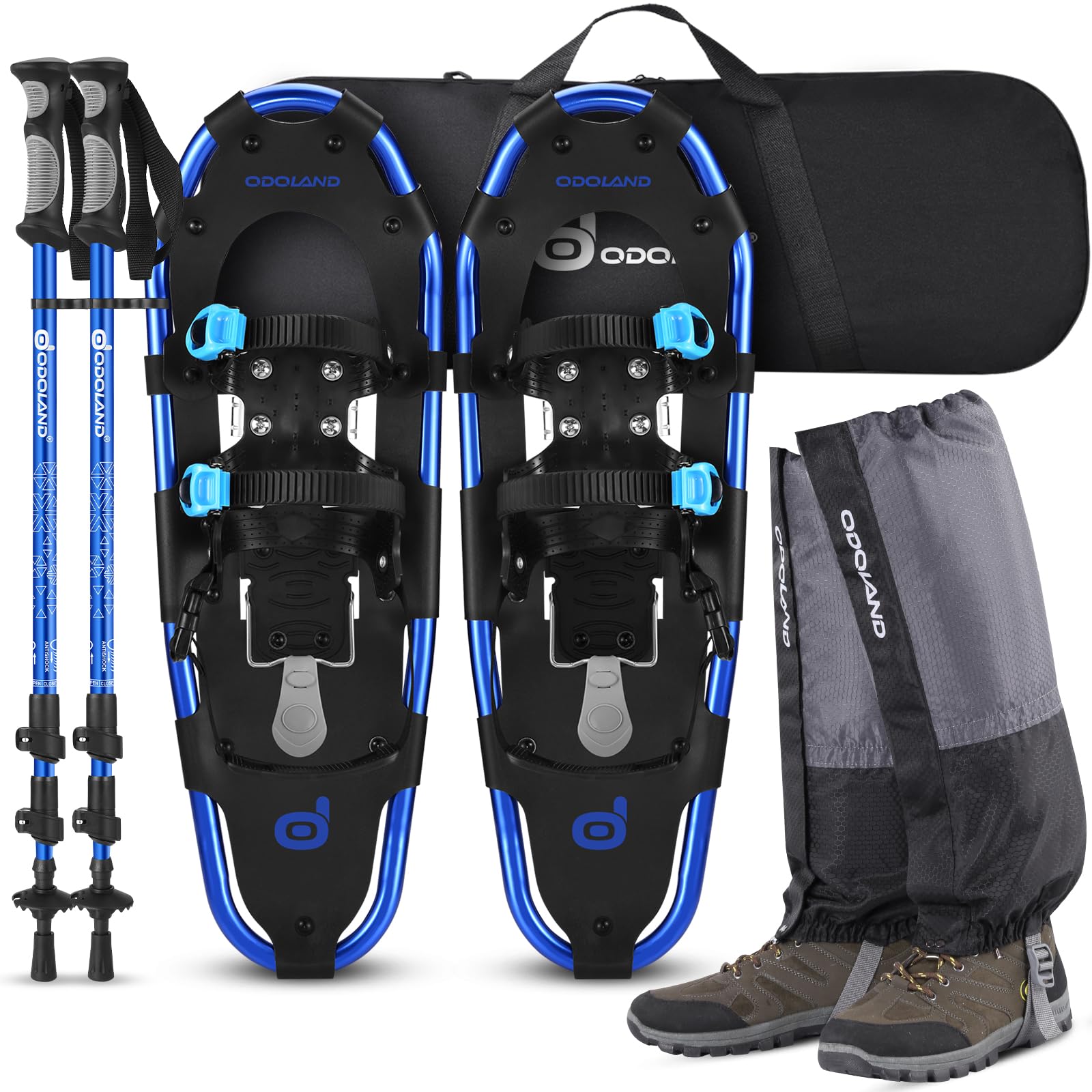
The Odoland kit is less a single pair of snowshoes than a starter bundle: 30-inch shoes, telescoping poles, and a pair of waterproof gaiters. For a beginner heading into wet, deeper snow, the gaiters are the underrated part. They keep snow out of your boot tops when you posthole, and they’re one less thing to buy separately.
The 30-inch deck and 160-250-pound range put this in the heavier-adult category. The sawtooth crampons are aggressive enough for packed snow and moderate slopes, and the three straps over the toe, instep, and heel let you dial in the fit. That’s a lot of adjustment, though. The straps are stiff at first and the heel strap can loosen; check it after the first few minutes and again at the top of a climb if you feel your heel lifting.
Then there’s the weight. At 3.45 kilograms, this is a heavy kit, and a beginner will feel it on a long walk. The poles are a genuine help, but their baskets are bulky enough that the poles don’t fit back in the carry bag once installed. None of that makes it a bad choice for deep snow; it just narrows the buyer.
If you want one box that covers flotation and wet snow, this is the kit we point to. If you want the lightest possible trail pair, the 25-inch options are the better match. The Odoland’s job is cold, wet, deeper snow, and it does that job with more stuff in the box than most beginners need.
Pros
- Includes poles and waterproof gaiters
- 30-inch deck for deeper snow
- Aggressive sawtooth crampons
Cons
- Heavy 3.45-kilogram kit
- Heel strap can loosen
We like the Odoland 30 kit for wet, deeper snow, with gaiters and poles included, as long as you don’t mind a heavier pair.
How We Tested Beginner Snowshoes
We built the shortlist from beginner-friendly snowshoes with adjustable bindings, moderate flotation, and a reputation for holding up — then filtered out racing models and expedition-ready pairs that would overwhelm someone on a first walk. That left 10 pairs, which I tested over five months, from the first storm in December through the last slushy weekend in April.
Most testing happened on a packed local trail, in my backyard after snowstorms, and on a short icy incline I would not have chosen without traction. I strapped in wearing thick gloves and counted how many adjustments it took to get a snug fit, then checked whether the bindings stayed centered and the straps stayed tight after 20 minutes of walking. I also had a friend with a larger boot try each pair, since a binding that only fits one size is not beginner-friendly.
On the move, I noted whether the deck floated over fresh powder or sank, how the crampons bit on hard-packed ice, and whether the frame caught on rocks. I weighed each pair on a kitchen scale and compared that number to how it felt on a two-hour walk. After each outing, I looked for frayed straps, bent frames, and loose rivets — then weighed that wear against the price. The pairs that advanced were the ones that stayed secure without constant fiddling, kept me upright on ice, and felt light enough that I forgot I had them on.
How to Choose Beginner Snowshoes
The right beginner snowshoe is the one you can put on with cold hands, keep under control on the trail, and match to your loaded weight.
Start With Your Loaded Weight
Snowshoe size is a weight question first. A 30-inch deck on a 130-pound beginner is extra shoe to swing, not extra confidence; a 21- or 22-inch pair can be the better fit for a smaller adult. A 25-inch deck like the G2’s covers many adults up to 200 pounds, while the Sherpa’s 30-inch frame is built for 201 to 250 pounds. Use the maker’s chart with your body weight, clothing, and daypack, and size up only when you’re near the top of a range or regularly carry a load.
Put the Binding Before the Extras
This is where beginners get sold the wrong thing. A showy deck and a long list of accessories matter less than a binding that pulls tight with gloves, holds your heel down, and releases without a fight. Ratchets are quick and precise; stretch mesh like MSR’s Paraglide hugs a range of boots; simple buckles are less adjustable but hard to fumble. Try the binding with the winter boots you’ll wear, walk around, and check the heel after a minute. A loose heel makes good crampons feel useless.
Match Flotation to the Trail
Packed rail trails and rolling forest loops ask for a shorter, more maneuverable deck; unbroken powder or a heavier pack asks for more surface area. A 22- or 25-inch shoe with good crampons is more fun on hard-packed trails than a long deck you have to place carefully. A 30-inch shoe earns its size in softer snow and for heavier adults. If you’re between sizes, think about the snow you’ll actually walk on most weekends, not the deepest drift you hope to find.
Kits Are Useful, but Durability Comes First
Poles help with balance on rolling terrain, gaiters keep wet snow out of your boots, and a carry bag is handy for the trunk. None of those extras rescue a pair with floppy straps or a deck that cracks. We prefer a reliable binding and a stiff-enough deck to a box full of accessories, though a complete kit like the Cascade or Odoland makes sense when you’d buy the poles anyway. Inspect plastic heel straps and fasteners after each outing; that’s where entry-level pairs tend to fail first.
Frequently Asked Questions
What boots should I wear with beginner snowshoes?
A waterproof winter boot with a stiff sole and a defined heel works best. Soft fashion boots and sneakers let the binding pressure through and give the crampons nothing to push against. Wear the boots you’ll actually use when you try the bindings at home, and add gaiters if you expect deep or wet snow. You do not need a specialized snowshoe boot to start.
Can I use snowshoes on any trail?
Not automatically. Many parks and forests allow snowshoes on marked winter trails but prohibit them on groomed Nordic ski tracks, and some private or protected areas close winter routes. Check the land manager’s winter rules before you drive out. On shared trails, walk beside, not on, ski tracks; a postholed track ruins the surface for everyone.
How do I get back up after falling in snowshoes?
Roll onto your side and bring your knees under you before trying to stand; the deck makes a straight sit-up much harder. Plant both poles ahead, push up with your legs, and keep your feet wide enough that the snowshoes don’t cross. If you’re on a slope, get below the fall line first. Practice once on flat ground before you need it.
Final Verdict
For most adult beginners, the G2 25 is the pair we recommend first. It’s light, the ratchet binding is quick with gloves, and the 25-inch deck has enough flotation for packed trails and moderate powder up to 200 pounds.
If you’ll stay on hard-packed local trails and want a more secure, durable binding, choose the MSR Evo Trail 22; if you’re over 200 pounds, start with the Yukon Charlie’s Sherpa 30.