This post contains affiliate links. We may earn a small commission when you buy through our links — at no extra cost to you.
The first sign you need snowshoes isn’t a brochure moment—it’s the sudden, thigh-deep drop when a packed trail gives way to unbroken snow. A good pair keeps you on top, but a sloppy binding can have you bending over every quarter mile, and a deck that’s too small will leave you postholing anyway. Snowshoes are a balance of flotation, traction, and fit, and the differences show up fast once you leave the trailhead.
We spent one full winter with 12 pairs, hiking packed singletrack, breaking trail after storms, and climbing icy switchbacks. The keepers were the ones that went on easily with gloves, adjusted over bulky and low-volume boots, and didn’t feel like ankle weights on a long climb. We also paid attention to strap quality and binding durability, because a cheap buckle can end a hike early. Value wasn’t about the lowest price—it was about which pairs still felt solid after miles of snow, rock, and roots. The right pair should disappear underfoot; the picks below come closest.




Best for Icy Backcountry Trails
MSR Lightning Ascent
Key Features
- Max load: 220 lb
- Traction: Steel DTX crampons, 360-degree frame
- Deck size: 8 x 25 in
- Pair weight: 4.33 lb
- Price: Premium
The priciest pair in this guide is also the one we recommend first, and the reason sits under your feet rather than on the price tag. MSR’s 360-degree traction frame puts teeth along the edges of the deck as well as under the toe and heel, so a sidehill traverse across crusted snow gives you an edge to stand on. No other pair here is built that way. On a trail that refreezes between storms, that is the difference between walking and shuffling.
At 4.33 pounds a pair it stops being part of the conversation after the first mile. The Paragon binding is one contouring strap rather than a cage of separate ones, which is why we did not come away with the usual hot spot across the top of the foot, and the fit range runs from a men’s 4.5 to a 15, so a big pac boot goes in without a fight.
The Ergo Televator heel lift flips up under your heel for sustained climbing, and we flipped it up on the long ascents and noticed it most on the way back down, with calves still fresh enough to enjoy the descent. What it is not is a powder shoe: 8 inches wide, 25 long, and rated to 220 pounds, so a heavier hiker or anyone breaking trail in unconsolidated snow will float better on a bigger deck.
Three years of warranty is longer than anything else here, and it says something about how MSR expects steel crampons and an alloy frame to age. Premium money for a snowshoe only pays off on terrain that punishes a cheap one, which is exactly what this pair was drawn for. On flat rail-trails, spend it elsewhere.
Pros
- Edge-to-edge frame grips on traverses
- Steel DTX crampons bite on refrozen ice
- 4.33 pounds a pair, easy to carry
- Three-year manufacturer warranty
Cons
- 25-inch deck floats poorly in deep powder
- Highest price in this set by a wide margin
For ice, sidehills and steep climbing, this is the pair we point you to: edge-to-edge grip the cheaper decks here cannot match, and a binding that does not bruise.
Best for Budget Trail Days
Wildhorn Sawtooth
Key Features
- Binding: Ratchet with heel strap clip
- Traction: Two sets of crampons per shoe
- Deck size: 27 in
- Pair weight: 5 lb
- Price: Budget
The Sawtooth is what we hand someone who wants to try snowshoeing without betting a season on it. The frame is aluminum, each shoe carries two sets of crampons, and there is a heel lift riser for climbing plus a textured pad under the boot. That is more hardware than the money suggests.
What we appreciate most is how little it asks of a beginner. The ratchet binding pulls down over a bulky winter boot, the excess heel strap clips out of the way instead of whipping your calf, and both shoes go on while you are standing in the snow rather than sitting down to wrestle. At 5 pounds a pair it is not the lightest here, but it carries like a boot rather than a flipper.
The one habit it demands is a re-check: the ratchet straps can ease off once a boot settles into the pad, so tighten them again after the first steep pitch. Sizing runs by weight rather than height, so find your number on the maker’s chart with a pack on, since the 27-inch deck we looked at sits mid-line. A year of warranty covers it.
Pros
- Aluminum frame and crampons at the lowest price here
- Heel lift riser eases sustained climbs
- Ratchet binding closes over bulky boots
Cons
- Rear-crampon rivets are the weak point under load
Our pick for a first pair: real crampons, a heel lift and a ratchet binding that goes on over a bulky boot, for the least money in this guide.
Best for Groomed Trail Hiking
Tubbs Wayfinder
Key Features
- Frame: Fit-Step 2.0 with Soft-Tec decking
- Binding: CustomWrap 2.0 dial
- Traction: Recreational toe and heel crampons
- Deck size: 30 in
- Price: Midrange
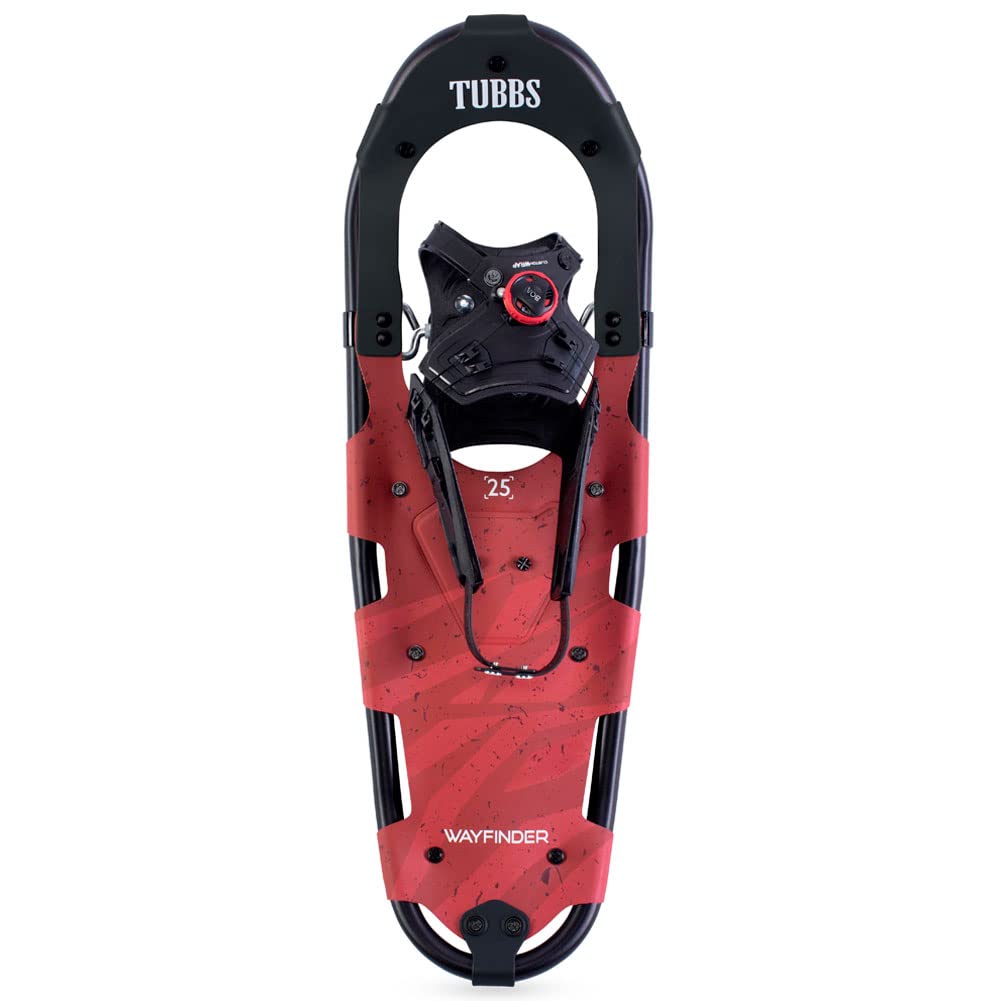
The Wayfinder’s CustomWrap binding cinches with a dial. Twist to tighten, pull the release to step out, and both work with gloves on, with no webbing to thread and no strap to yank when it has frozen stiff. On a cold morning at the trailhead that is the difference between five seconds and five minutes.
Underneath, a Fit-Step 2.0 frame and Soft-Tec decking pair with a rotating toe cord, so the tail of the shoe drops as your heel comes up rather than the whole deck staying flat. It walks like a shoe and not like a plank, which is a large part of why this is the pair we keep coming back to for long, low trails.
Our take: on packed trails, field edges and groomed routes, this is the easiest pair here to live with, and the one we hand to anyone who has hopped on one foot in a parking lot trying to thread a frozen strap. One caution before you commit: try them with your bulkiest winter boot, because the rear strap can run out of adjustment over a very thick heel.
Pros
- Dial binding tightens and releases with gloves on
- Rotating toe cord gives a natural stride
- Works with most winter boots
Cons
- Recreational crampons, not for steep icy terrain
If your winter hiking means packed trails and you would rather not fight bindings in gloves, the Wayfinder’s dial is worth the extra money.
Best for Heavier Hikers
Yukon Charlie’s Sherpa
Key Features
- Binding: Quick Click II ratchet
- Deck size: 9 x 30 in
- Load rating: 201-250 lb
- Pair weight: 4.8 lb
- Price: Midrange
Yukon Charlie’s builds the Sherpa around a hiker rather than a terrain. The 9×30 kit we looked at is rated from 201 to 250 pounds, a band that several decks here top out below, and a 30-inch platform under a heavier body is the difference between floating and postholing with extra steps.
The deck is HDPE, stiffer than the softer shoes near the bottom of this list, and we could feel where that stiffness goes: into forward push through deep snow instead of into a sagging platform. At 4.8 pounds a pair it is light for its size. The Quick Click II ratchet is easy enough with gloves; the Rapid-Lite Flex heel strap is the fiddly part, and it is worth setting once at the trailhead and then leaving alone.
The kit version ships with poles, which adds value without adding anything you have to learn. One year of warranty is the norm in this group. If you have been told to buy a 30-inch shoe and then found that most of the ratings top out below your weight, start here.
Pros
- 30-inch deck rated 201 to 250 pounds
- Stiff HDPE deck pushes through deep snow
- Quick Click II ratchet is fast to set
Cons
- Too much deck for hikers much under 200 pounds
For hikers in the 201-to-250-pound range, this is the deck we recommend: 30 inches of stiff HDPE that floats where a 25-inch shoe digs in.
Best for First-Time Buyers
Odoland Snowshoe Kit
Key Features
- Frame: Aluminum
- Deck size: 30 in
- Load rating: 160-250 lb
- Kit includes: Telescoping poles, gaiters, carry bag
- Price: Midrange
Odoland sells the box as much as the shoe: two 30-inch snowshoes, a pair of telescoping poles running from 25.5 to 54 inches, waterproof gaiters and a carry bag. For a first winter that is one order instead of four, and it is a large part of why this kit stays on our list.
The deck is rated 160 to 250 pounds, which covers most adults, and the aluminum frame carries two sets of crampons per shoe. Three straps run over the toe, instep and heel, so you can shape the fit around a bulky boot instead of cinching everything down and hoping.
Where it gives ground is the strap hardware. The straps need a re-check after the first climb, since they work loose once a boot settles, and the plastic is stiff enough that pushing a tail into its buckle takes real thumb strength. If grip strength is an issue or you always wear thick gloves, set the heel strap before you pull them on and the rest is fine. As a first kit, it is honest value.
Pros
- Poles, gaiters and bag included in one box
- 30-inch deck covers 160 to 250 pounds
- Telescoping poles adjust from 25.5 to 54 inches
Cons
- Stiff straps take hand strength in cold
- Buckles can break under a stiff boot
A sensible one-box start for a beginner: a 30-inch deck rated to 250 pounds, with poles and gaiters included.
Best for Smaller Hikers
G2 Snowshoes

Key Features
- Deck size: 21 in
- Load rating: Up to 150 lb
- Pair weight: 6 lb
- Kit includes: Trekking poles, tote bag
- Price: Midrange
Start with the number that matters: the G2 we looked at is the 21-inch deck, rated to 150 pounds, and that puts it out of reach for most adult hikers. The line is sold in 25, 30 and 36 as well, so the 21 is a small hiker’s or a teenager’s shoe. Within that rating it is a generous kit, with aluminum crampons, a heel lift, a flex pivot bar, trekking poles, a tote bag and six colorways.
The binding is the part we appreciated. The ratchet lifts with one finger, which sounds like a small thing until you are standing in a cold parking lot in gloves, and the EVA foam padding gives your boot something warm and soft to sit against instead of bare plastic. Match the deck to the person first and the rest of the kit is a fair introduction to the sport.
Pros
- One-finger ratchet works in gloves
- Heel lift and flex pivot bar included
- Poles and tote bag in the box
Cons
- Plastic heel strap and buckles are weak points
- Sinks in soft snow off packed trails
The G2 suits a smaller or younger hiker who wants a heel lift, poles and a bag in one purchase, with a ratchet that works in gloves.
How We Tested Snowshoes for Hiking
We started with a broad list of snowshoes sold for hiking, then narrowed it by weight capacity, deck size, binding type, replacement parts, and price. We cut models with vague flotation claims or straps that looked impossible to tighten with gloves on. That left 12 pairs, which we used for one full winter.
Testing happened on local trails, not just in a yard: packed singletrack, fresh powder after storms, steep icy switchbacks, and a few rock-and-root sections where the snow thinned out. We stepped in and out with gloves on, adjusted each binding over bulky and low-volume boots, and noted where straps slipped, buckles bit, and snow balled up underfoot.
On climbs, we watched whether the crampons bit into ice or skated; on descents, we checked if the tails stayed put or tripped us. We weighed each pair before the first hike, carried them on long outings, and inspected straps, decking, and bindings for fraying or cracks. At the end, we compared what each pair cost against how it felt after miles of use—not just on the first outing.
How to Choose Snowshoes for Winter Hiking
Two decisions do most of the work: how much deck you need under your weight, and how much grip you need under your feet. Everything else is comfort.
Size the deck to your weight, not your height
A snowshoe keeps you up by spreading your weight over more area, so the number that matters is you plus your pack. In this group a 21-inch deck like the G2 tops out around 150 pounds, a 25-inch technical shoe like the MSR carries 220, and the Yukon Charlie’s Sherpa in its 30-inch size is rated 201 to 250.
The trap is buying long for powder you rarely walk in. A 30- or 36-inch deck is clumsy to turn on a narrow track and heavy on a flat trail. Match the rating first; go longer only if breaking trail is what you actually do.
Traction is the part you cannot upgrade later
Crampons under the toe and heel are the minimum. What separates the good pairs is how far the teeth reach toward the edges: a 360-degree frame like the MSR’s gives you something to stand on during a sidehill traverse, where a toe-and-heel-only shoe skates sideways.
Recreational crampons, like the ones on the Tubbs Wayfinder, are fine on groomed and packed routes and outmatched on refrozen slopes. If your trails roll and climb, pay for grip. If they are flat and packed, extra bite is weight and wear you do not need.
Bindings you can work in gloves
Most budget shoes use ratchets: quick when clean, fussy when iced, and prone to easing off once a boot settles into the pad, so re-check them after the first climb. A dial binding, like the Tubbs CustomWrap, tightens and releases without threading anything, which matters most in a cold trailhead parking lot.
Whatever the mechanism, try it with the boots you will actually wear. A bulky pac boot can run a strap out of adjustment, and a binding that closes over a sneaker in your kitchen has told you very little.
Weight and kit: what is worth carrying
Pair weights here run from about four and a third pounds to well over seven, and you feel that at the end of the day rather than the start. A heel lift is worth having if you climb: it takes strain off your calves on sustained ascents without adding meaningful weight.
Poles, gaiters, and a carry bag are genuine conveniences, but judge them last. A good set of poles does not rescue a deck that is the wrong size for you.
Warranty and the parts that fail
One year is the standard warranty in this group; MSR’s three years is the exception and worth weighing if you get out often. Failures cluster in the same three places: the rivets at the rear crampon, a plastic heel strap, and a buckle that takes the load when a boot is jammed in.
Inspect those points after your first real outing, while a return is still easy. That inspection tells you more about your pair than any specification will.
Frequently Asked Questions
Can you snowshoe on groomed cross-country ski trails?
Not on the tracks themselves. Snowshoes chew up the corduroy and leave postholes in the classic striding lanes, and nordic centers will usually ask you to walk beside them or take a separate snowshoe loop. Check the signage at the trailhead and stay on the soft snow at the edge of the trail.
Are men’s and women’s snowshoes actually different?
Mostly in binding adjustment and color. In this group the frames are unisex: Wildhorn lists one Sawtooth for men, women and youth, and the Yukon Charlie’s Sherpa is a unisex design. The variable that changes how a shoe walks is deck size against your weight, so spend the money there and on a binding that closes down on your boot.
Do I need gaiters to go with them?
They help more than they look like they would. Every step throws snow onto the boot cuff, and once it melts you are walking in wet socks by lunchtime. The Odoland kit includes a waterproof pair; otherwise any mid-height gaiter works, and waterproof trousers with a cinched hem cover the same gap.
Final Verdict
The MSR Lightning Ascent is the pair we recommend for real winter hiking, because edge-to-edge traction is the one thing on this list you cannot work around later. If your terrain is packed trails and fire roads rather than ice and sidehills, the Tubbs Wayfinder’s dial binding and lower price are the better fit.
And if this is your first season and you want to keep the outlay small, start with the Wildhorn Sawtooth: it gives you a real frame, real crampons, and a heel lift while you find out how much you actually like the sport.