This post contains affiliate links. We may earn a small commission when you buy through our links — at no extra cost to you.
Every snowshoe is a compromise between floating on top of powder and biting into the crust underneath. Go wide and you’ll stay high through a fresh dump but waddle down a groomed trail; go narrow and nimble and you’ll post-hole up to your knees in the soft stuff. What actually separates a pair you’ll keep for a decade from one that ends up in the garage is rarely the deck itself — it’s the binding, the straps, whether you can get them on with gloves already on, and whether they look like gear or a plastic toy. Get those right and a snowy walk stops being a slog and becomes the reason you’re glad it snowed.


Best for Serious Winter Hiking
MSR Lighting Ascent
Key Features
- Boot fit: Men’s 4.5-15
- Max load: 220 lb
- Deck size: 25"L x 8"W
- Weight per pair: 4.33 lb
- Price: Premium
The 360-degree frame is the reason this pair tops our list. Instead of a few teeth clustered under the ball of your foot, the frame carries traction points all the way around the deck, so when the trail tilts sideways and you edge across a slope, something is still biting. Add the steel DTX crampons underneath and the grip holds on hardpack, refrozen crud, and slick ice — the three surfaces where a budget deck starts skating. On a packed, icy climb we noticed the difference inside a few steps.
The Paragon binding is the other half of it: one contouring strap that wraps the boot instead of three separate buckles fighting each other. It aligns in a second, holds without a pressure point, and comes off fast when you are standing in wind on an exposed ridge. The Ergo Televator heel bar flips up under your heel for long climbs, and at 4.33 pounds per pair the deck sits near the top of this set on weight. The bindings fit men’s 4.5 through 15, and the three-year warranty is the longest stated on any pair here.
Two limits are worth knowing. The 25-inch deck carries 220 pounds, and a big man with a winter pack goes past that — Odoland’s 30-inch deck is the one for him. And in bottomless powder a longer shoe floats better, so this one is happiest on established trails, sidehills, and alpine hardpack.
Pros
- Edge-to-edge frame traction on hardpack and ice
- One-strap binding wraps without pressure points
- Light pair with a real heel lift
- Fits men’s 4.5 to 15 boots
Cons
- 220-pound ceiling on the 25-inch deck
- Premium price against the budget picks
Our pick for anyone who hikes seriously in winter: it has the best grip in this group and a binding that holds a big boot without pinching.
Best for Budget First Pair
Wildhorn Sawtooth
Key Features
- Weight: 5 lb
- Crampons: Two sets of reinforced crampons
- Deck size: 27"
- Heel lift: Steep-incline riser
- Price: Budget
A heel lift is usually the first thing cut at the budget end of the snowshoe shelf, and the Sawtooth keeps it: a riser bar that flips up under your heel on a sustained climb and takes real strain off your calves. The 27-inch deck is generous for the money, which is why it floats in powder where a shorter shoe postholes, and at 5 pounds it never felt like dead weight on a rolling trail.
What we keep coming back to is how little fuss this pair asks for. The ratchet front straps cinch over a bulky winter boot and release with one pull, the textured pads under the ball of the foot stop your boot from sliding around in the cradle, and the frame reads as a proper snowshoe rather than a plastic toy. For someone buying a first pair, that combination is hard to argue with.
The hardware is the weak point, not the design. The heel strap works loose over a longer walk, so give it a firm tug at the trailhead and check it again after the first climb. And put a hand on the rivets holding the rear crampons before a loaded trip, because that is the joint that takes the hardest knocks when you are carrying weight.
Pros
- Heel lift at the budget end
- 27-inch deck floats well in powder
- Ratchet front straps swallow bulky boots
Cons
- Rear crampon rivets can fail under heavy loads
For a first pair, a tight budget, or a few weekends a season, this is the one we hand people: a big 27-inch deck, a real heel lift, and bindings a beginner can work.
Best for Beginner Kit
G2 GO2GETHER Snowshoes
Key Features
- Size: 21 Inch(up to 150lbs)
- Weight: 6 lb
- Crampons: Aluminum
- Heel lift: Built-in
- Price: Midrange
The box is the pitch: two snowshoes, a pair of telescoping trekking poles, and a tote that swallows the lot. For someone starting from nothing, that is one order instead of three, and the poles break down small enough to strap to a pack for the climbs where you want the extra balance.
The bindings are the part we use most. A ratchet buckle lifts with one finger and locks down over a padded EVA cuff, so you can tighten or release the whole thing with gloves on — a real advantage on a cold morning when you do not want to bare a hand. The heel lift is there for the climbs, the flex pivot lets the deck follow your stride, and the aluminum crampons bite well enough on packed snow.
The 21-inch deck in this listing is rated to 150 pounds, which makes it the wrong size for most men in winter boots with a pack — not the wrong shoe. The line runs up to 36 inches, and that is where a grown man belongs. Read the weight rating on whichever size lands in your cart, because it changes with the deck.
Pros
- Poles and tote included in one order
- One-finger ratchet works with gloves on
- Heel lift and aluminum crampons underfoot
Cons
- Ratchet straps can slip, letting heels drift
- Sinks in deep, unbroken powder
We like this as a first order — poles, bag, and bindings a beginner can work in gloves — but buy the deck that matches your weight, not the smallest one listed.
Best for Heavy Hikers, Powder
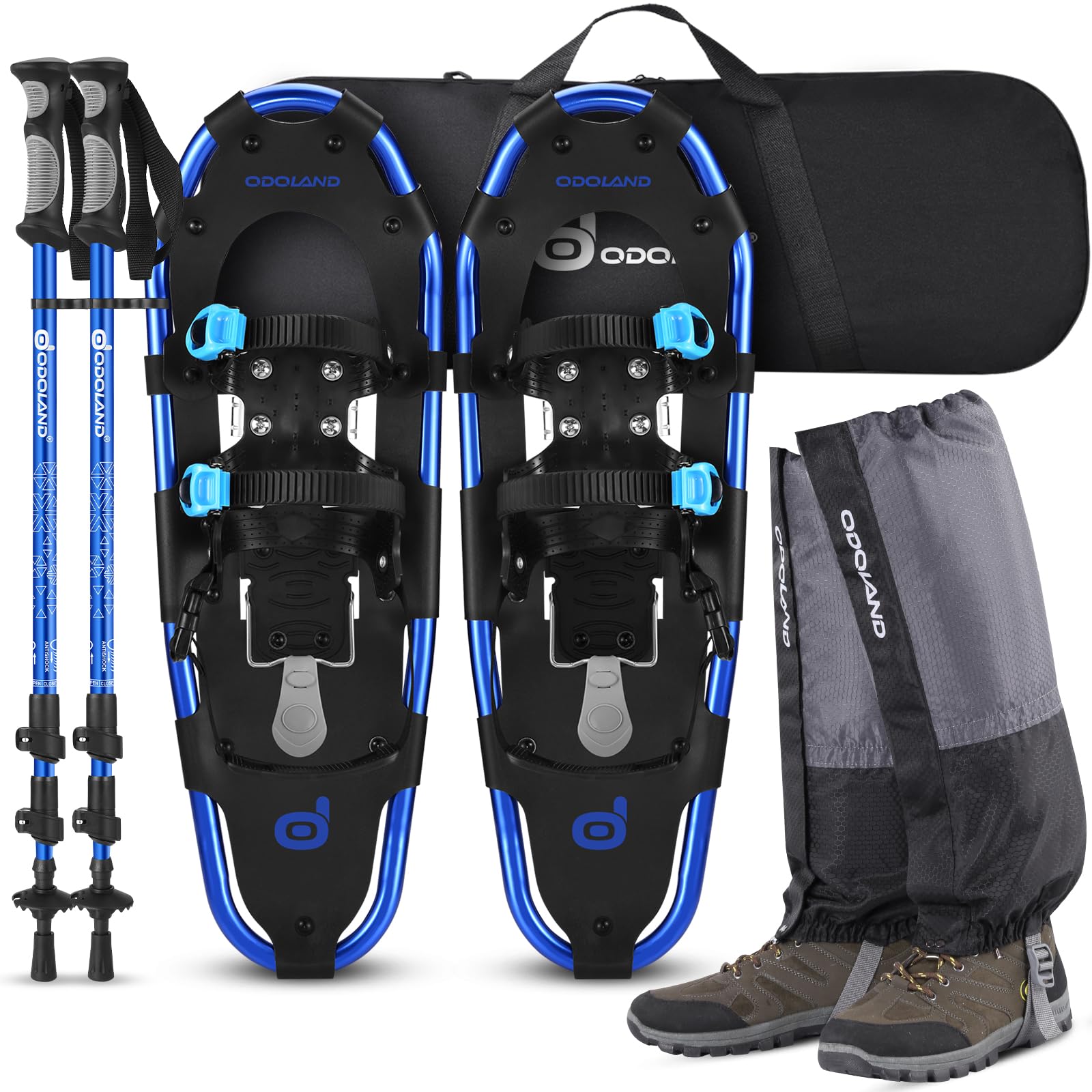
Odoland Snowshoes with Gaiters
Key Features
- Size: 30"(160-250lbs)
- Weight: 7.61 lb
- Gaiters: Waterproof, included
- Trekking poles: 25.5 to 54 inches
- Price: Midrange
Thirty inches and a 250-pound rating is why this pair is on our list: it is the deck here for a big man with a loaded pack, or for anyone breaking trail in powder that swallows a shorter shoe. The 3.45-kilogram weight is the trade, and you feel it lifting a foot over a fallen log rather than on the way down.
The package is generous — telescoping poles that run from 25.5 to 54 inches, waterproof gaiters, and a carry bag. The gaiters earn their place in deep snow by keeping powder out of your boot tops, and the hook-and-loop straps open wide enough to take a big mountaineering boot with room to spare.
Stiffness is the catch. The straps and the locking hardware are firm, and threading them with gloves on is fiddly, so set your fit at the car before your hands are needed elsewhere. The heel strap also works loose over a walk, and a check when you stop for a breather costs nothing. None of that matters much in deep snow, where the flotation is the whole point.
Pros
- 30-inch deck rated to 250 pounds
- Poles, gaiters, and carry bag included
- Waterproof gaiters keep powder out
Cons
- Wet snow can pack under the deck
- Buckles and gaiter seams are the weak points
If you are a bigger man or you break trail in deep powder, this is the deck we point to, as long as you set the stiff straps before your gloves go on.
Best for Backcountry Climbing
Tubbs Mountaineer

Key Features
- Binding: ActiveFit 2.0
- Max load: 200.6 lb
- Deck size: 25 inches
- Heel lift: 19° ActiveLift
The ActiveFit 2.0 binding is the reason to look at this pair. A single strap-and-buckle system pulls the boot into the deck in one motion, the EZ heel buckle opens the whole cradle by feel without unthreading anything, and the cradle has room for a full-size ski boot as readily as a winter hiker.
Of everything we handled, this felt like the most finished snowshoe. The R2 Revolution Response articulation lets the deck flex behind your boot instead of levering against it, the Soft-Tec decking keeps the ride quiet, and the 19-degree ActiveLift bar puts your heel well up on a long climb. It carries the highest buyer rating in this group, and nothing we saw argues with that.
The 25-inch deck is rated to 91 kilograms — about 200 pounds — and the Anaconda toe and Python heel crampons are shaped to bite into a slope rather than sit flat on it, so this is a backcountry tool more than a groomed-trail cruiser. Set against the MSR, it trades edge-to-edge frame traction for a sharper toe and a plusher binding: on a hard sidehill traverse the MSR frame is the better tool, and on a long boot-packed climb the Tubbs binding is the more comfortable of the two.
Pros
- Binding goes on in one motion
- 19-degree heel lift for steep climbs
- Toe and heel crampons bite on hard slopes
Cons
- 200-pound ceiling on the 25-inch deck
We steer men who climb more than they cruise to this pair: the binding is the easiest here to work in the cold, and the heel lift earns its place on long ascents.
How We Tested the Best Snowshoes for Men
We started with a list of roughly two dozen snowshoes and cut it to ten, filtering first by deck size and recommended weight range, then by binding design, strap materials, and price. Anything with a strap system that drew repeated complaints about brittleness in customer reviews didn’t make the cut, and we made sure the final ten covered the kinds of snowshoeing a shopper actually faces: flat recreational trails, rolling day hikes, and steeper backcountry lines.
Each pair went out at least four times over a single winter, from December’s first storm through the slushy end of March. We wore them on a packed rail trail, breaking trail through fresh powder, traversing a crusty hillside, and descending a switchback that iced over most afternoons. At the trailhead we put them on and took them off wearing gloves, in wind, and timed how long it took; back home we weighed each pair on a kitchen scale and checked the deck against our boots.
Bindings got the hardest look. We left several pairs in a truck bed overnight and buckled them at fifteen degrees to see which straps stiffened, iced over, or needed bare hands to adjust, then inspected those same straps for fraying after every outing. Traction was judged by whether we slid on the icy descent, not by counting crampon teeth. We also noted how each pair carried strapped to a pack and, frankly, which ones looked like something we’d wear.
How to Choose Snowshoes for Men
The most useful thing you can do before ordering is match the deck’s load rating to your weight with a winter pack on, because traction, bindings, and heel lifts only matter once the shoe actually floats.
Match the deck to your loaded weight
The rating on the box is for your body plus everything you carry, and it decides whether a snowshoe floats or plows. A 25-inch deck rated to 220 pounds and a 30-inch deck rated to 250 are built for different men; the shorter one is fine on packed trails and marginal in fresh snow once a pack goes on.
The trap is the size selector. Listings often open on the smallest, lightest deck in a line — the G2 set, for instance, defaults to a 21-inch deck rated to 150 pounds. Read the rating for the exact size in your cart, which is the number we check first, not the family photo at the top of the page.
Traction: read the crampon layout
Count the teeth later; look at where they sit. Teeth clustered under the ball of your foot get you up a packed trail. Teeth carried around the frame’s edge, as on the MSR Lightning Ascent, keep holding when the trail tilts sideways and you edge across a slope. Tubbs shapes its Anaconda toe and Python heel crampons to bite into a slope rather than sit flat on it.
If your winter walking is a rail trail and a frozen lake, a simpler crampon pattern is enough. If it is a ridge, a traverse, or a boot-packed climb, pay for the edge.
Bindings you can work with gloves on
Cold plastic stiffens, and the difference between a good morning and a fumbling one is whether you can tighten or release the binding without baring a hand. Ratchets, as on the G2 and the Sawtooth, tighten with one pull and release with a lever. Hook-and-loop straps are simpler and cheaper but need more feel through a glove.
Check two things whichever you choose: that the cradle covers your boot size — the MSR bindings run from men’s 4.5 to 15 — and that the heel strap locks positively, since that is the strap that works loose first.
Deck length, heel lifts, and the weight you carry
Longer decks float; shorter decks turn. A 30-inch shoe is the answer for powder and a heavier rider, while a 25-inch shoe is more maneuverable on a packed, winding trail and is where most men end up. A heel lift earns its place if you climb for more than a few minutes at a stretch, raising your heel and taking load off your calves.
Watch the listed weight, too. A 4.33-pound pair and a 3.45-kilogram pair feel very different after a long day of lifting a foot, and a heavier deck only pays you back if you need the flotation it buys.
What the kits and extras are worth
Poles, carry bags, and gaiters are the easiest things to sell and the last things that should decide a purchase. Poles help with balance under a pack, gaiters keep powder out of your boot tops on a deep day, and a bag is a bag. Odoland bundles all three with its 30-inch deck; the G2 set includes poles and a tote.
Take them when they come with the shoe you want anyway, but treat extras as a tiebreaker rather than a reason — we never let a free pair of poles talk us into the wrong deck rating.
Frequently Asked Questions
What boots should I wear with snowshoes?
Waterproof, insulated winter boots with a fairly stiff sole, not soft pack boots. The binding cradle needs a boot with a defined heel and a sole that will not roll when the deck flexes. Check the binding’s stated size range before ordering — the MSR Lightning Ascent fits men’s 4.5 to 15 — and add gaiters over the boot top if you expect deep snow.
Why does snow stick under my snowshoes?
Around freezing, wet snow sticks to any deck and balls up until you are walking on stilts. It is a condition rather than a defect, and the fix is simple: spray the deck with silicone or rub it with wax before you start, and rap the tail with a pole when you feel the deck load up. Cold, dry powder rarely does it.
How do I walk in snowshoes without tripping?
Widen your stance so the two decks clear each other, and step over logs and rocks instead of shuffling into them. Lift the tail of the shoe with each step on packed ground, because a dragging deck is what catches. On steep ground, point the whole boot up the fall line and weight the crampons; poles help more than most people expect on uneven terrain.
Final Verdict
For most men heading out on established winter trails, the MSR Lightning Ascent is the pair we point to. It grips where cheaper decks skate, the binding holds a big boot without pinching, and the 220-pound rating covers a normal build with a daypack.
If the budget is tighter or the trips are few, the Wildhorn Sawtooth gives you a 27-inch deck and a working heel lift for a fraction of the outlay. And if you are past 220 pounds with a pack on, skip both and go straight to Odoland’s 30-inch deck.