This post contains affiliate links. We may earn a small commission when you buy through our links — at no extra cost to you.
The trouble with running shorts is that the pair that looks best on the hanger is often the one that treats you worst at mile four — riding up, bunching at the waistband, or turning the phone in your pocket into a metronome against your thigh. What you want is a pair that disappears: light enough that you stop noticing the fabric, cut so your stride stays free, and lined the way your legs actually prefer. What you’re buying is one less thing to think about between the first step and the last.
Here’s what I wish someone had told me years ago: the inseam number matters more than anything else on the label, and a 5-inch and a 7-inch pair from the same brand can feel like two different products. Over the past three months, my team and I put 14 pairs through daily runs to see which ones held up — because pockets that don’t bounce, a liner that doesn’t chafe, and fabric that survives a wash cycle matter far more than a good photo. The ones that made the cut are below.


Best for Everyday Running
NORTHYARD Running Shorts
Key Features
- Liner: Unlined
- Fabric: Quick-dry knit
- Pockets: Three zippered
- Inseam options: 5, 7, or 9 inches
- Price: Midrange
Length is the first thing to settle when you buy running shorts online, and the NORTHYARD pair lets you settle it three ways: 5 inches, 7, or 9. That flexibility is why it tops our list. Most of our miles in these went into the 7-inch, which finishes just above the knee, and the 5-inch covers faster days when you want nothing in the way.
Whichever length you pick, the cut is trim without being tight, and it holds that shape on the run: no ballooning at the thigh, no waistband creeping down. Three zippered pockets do the carrying, so a phone, a key and a card all ride zipped shut instead of swinging against your leg — a small thing that decides whether a short is running kit or just shorts.
The fabric is a light quick-dry knit, and what struck us is how little water it holds: soak it and it stops feeling heavy almost at once. It has a slick, technical hand-feel rather than a soft one, which is exactly right in heat and slightly less pleasant when the temperature drops.
Sizing is the one place to slow down. These run small for some builds, so if you’re between sizes, or carrying bigger quads, order up rather than hoping the smaller one stretches into place. The 9-inch option is the sleeper of the three — closer to a gym short, and the one to pick if you want more coverage.
Pros
- Three inseam lengths in one short
- Three zippered pockets for phone and keys
- Quick-dry knit that doesn’t hold water
- Trim cut that doesn’t balloon
Cons
- Unlined, with no built-in support
Three inseam lengths, three zippered pockets, and a trim, quick-dry cut — that combination is why we hand most runners this pair first.
Best for Phone-Carry Runs
Pudolla 2-in-1 Shorts
Key Features
- Liner: Compression with phone pocket
- Fabric: Quick-dry
- Inseam: 5 inches
- Pockets: Back zip pocket
- Price: Budget
The phone pocket on the Pudolla shorts is stitched to the compression liner, not the outer shell, which means the phone sits against your thigh and stays there. No swinging, no hand in your pocket every mile, no armband. There’s a small zip pocket at the back waist for a key, and that pairing is the most thoughtful carry setup in this group.
We think that earns them their place, but they behave as running shorts too: the 5-inch shell doesn’t ride up, the liner holds everything without squeezing, and the pair stays put on longer efforts. If you run with a phone and hate belts, this is the design you want.
Sizing is the caveat. These run small for a fair number of builds, so measure your waist and go up rather than down, and wash them cold and air dry to protect the liner stitching.
Pros
- Liner pocket holds a phone against the thigh
- Back zip pocket for a key
- Doesn’t ride up on the run
- Light, quick-dry shell
Cons
- One inseam only: 5 inches
We like this one for anyone who runs with a phone: the liner pocket pins it to your thigh and the 5-inch shell stays put.
Best for Short 3-Inch Cut
G Gradual 3-Inch Shorts
Key Features
- Liner: Built-in brief
- Fabric: Mesh
- Inseam: 3 inches
- Pockets: Zippered front pockets
- Price: Budget
Three inches is the shortest cut we cover here, and the G Gradual pair is the one that makes the case for it. There’s no fabric to bunch at the thigh, the mesh moves air, and on a hot, hard run you stop thinking about your shorts, which is the whole point. The trade is coverage — this is not the pair for the gym or the grocery store unless you’re happy being seen in a very short short.
Both front pockets zip, which is rarer than it should be at this length: a phone or a key disappears and stays gone. If you’ve never run in a 3-inch short, try it on a short, hot run first — the first mile feels exposing, and the fifth feels like nothing at all.
Pros
- 3-inch cut clears the thigh completely
- Zippered front pockets at a short length
- Mesh dries fast
Cons
- Minimal liner with little support
Our favorite short cut here: a 3-inch mesh shell with nothing to bunch at the thigh and zippered pockets that hold a phone.
Best for Hot-Weather Runs
MIER 5-Inch Shorts
Key Features
- Fabric: Quick-dry
- Inseam: 5 inches
- Pockets: Zippered
- Price: Budget
The MIER shorts are the lightest shell here, and that is the whole pitch. The fabric is thin enough that you feel moving air through it and it dries almost instantly, so it never develops that heavy, wet-shorts feeling on a humid run. It’s also thin enough that pale colors go sheer when wet — wear something dark underneath and it stops mattering.
Pockets are zippered and roomy enough for a phone, with a small key compartment, and the back pocket sits where it doesn’t jostle. For a short at this price, the detailing is better than we expected.
We reach for these on the hottest days of the set. They cost less than our top pick, they pack down to nothing in a bag, and thin fabric is a fair trade for the coolest runs in this group.
Pros
- Lightest, most breathable fabric here
- Dries almost instantly
- Zip pockets fit a phone plus a key compartment
- Costs less than our top pick
Cons
- Inseam runs closer to 6 inches
Our hot-weather pick: the lightest fabric in this group, a phone-sized zip pocket, and a price below our top pick’s.
Best for Budget Summer Miles
AIMPACT Mesh Shorts
Key Features
- Fabric: Silky mesh
- Inseam: 3 inches
- Pockets: Angled hand pockets
- Price: Budget
Cheapest in the group, and the surprise is how little you give up. The mesh is smooth and light, the leg openings are cut generously enough for bigger thighs, and the 3-inch length lands where it should rather than creeping up.
We like them best as a rotation pair: they’re unlined and airy, they dry on the walk back to the car, and at this price keeping a spare in the gym bag costs nothing. Sizing is more predictable than most here, and the size chart held for us.
What you don’t get is structure. There’s no liner, so we carried a key and left the phone behind on runs — no great loss on a short, hot effort, and part of what makes the price possible.
Pros
- Lowest price in the group
- Airy mesh shell
- Leg openings generous for bigger thighs
Cons
- Light colors turn sheer when wet
We recommend the AIMPACT as the budget buy: airy mesh, generous leg openings, and a 3-inch cut that suits bigger thighs.
Best for Longer, Structured Fit
Under Armour Launch 7-Inch
Key Features
- Liner: Built-in brief
- Fabric: Stretch woven
- Inseam: 7 inches
- Price: Midrange
Buy these a size up. That’s the first thing to know about the Under Armour Launch shorts: they run small, you feel it at the waist, and ordering the size you wear in everything else will have you sending them back.
The liner is the second thing. It’s a snug brief, and it’s the most divisive part of the short: if you like a liner, it does its job, and if you don’t, cutting it out leaves the shell perfectly wearable. Decide that before you order rather than after.
The stretch woven shell is the most structured fabric here. It holds a crease, it doesn’t cling, and at 7 inches it gives more coverage than anything else in this group apart from the NORTHYARD’s 9-inch option. That makes it the pair for a cool start, a travel day, or a run that ends at a coffee shop.
Where it lands for us: this is the short to buy when you want length and structure from a name you trust, and you’re willing to size up to get it. If lightness matters more than coverage, the MIER is the better answer.
Pros
- 7-inch coverage with real structure
- Stretch woven that doesn’t cling
- Built-in brief liner
Cons
We reach for this one when we want a longer, more structured short: 7 inches of stretch woven, a liner that does its job, and a fit that starts a size up.
Best for Two-Pair Rotation
Gaglg 5-Inch 2-Pack

Key Features
- Fabric: Quick-dry
- Inseam: 5 inches
- Pockets: Zippered
- Pack size: 2 pack
- Price: Budget
Two pairs in one order changes how you use a short. One goes in the wash, one stays in the drawer, and the midweek laundry panic disappears. That’s the practical case for the Gaglg set, and it’s a better argument than it sounds.
As shorts, they’re a straightforward 5-inch with zippered pockets, a light quick-dry shell, and a cut that sits above the knee without climbing. The pockets swallow a phone and a key fob, and the fabric is soft enough to wear straight off the line.
Our take: buy this set if you want several of the same short without thinking about it — a workhorse for the gym bag and the travel bag. We treat them as rotation shorts rather than the pair we save for race day, and for that job they’re good value.
Pros
- Two pairs in one order
- Zippered pockets
- Quick-dry and light
- Sits above the knee without climbing
Cons
- Front seam can separate with wear
- Sizing runs small for some
A two-pair workhorse we’re happy to recommend: 5-inch quick-dry shorts with zippered pockets, bought as a set so laundry stops dictating your week.
Best for Five-Pair Rotation
HOPLYNN 5-Pack Shorts
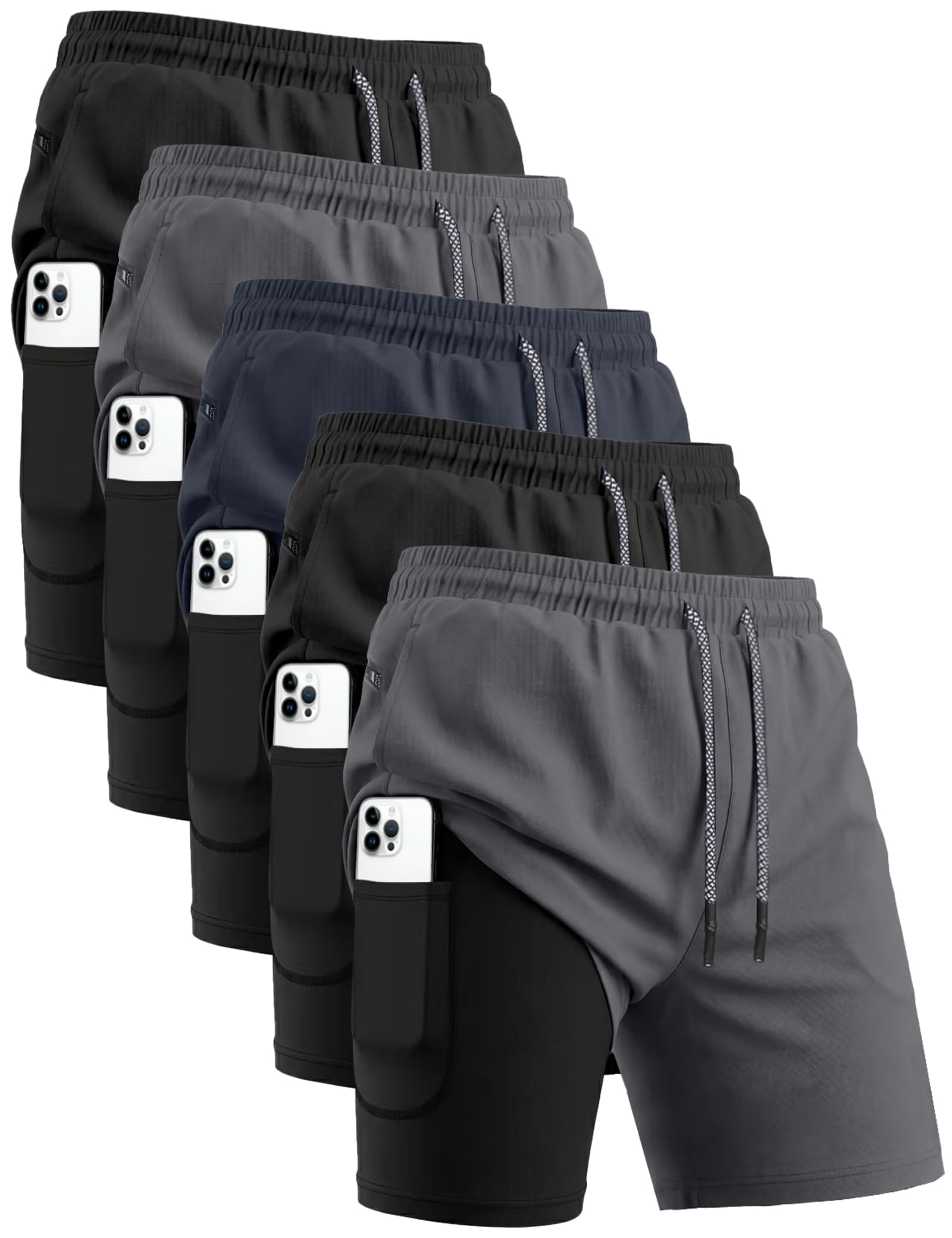
Key Features
- Liner: Compression liner
- Fabric: Stretch, breathable
- Pockets: Front plus back zip
- Pack size: 5 pack
- Price: Midrange
Five pairs in one box is the entire idea: run most days, wash once a week, stop thinking about shorts. If your laundry pile is the reason you skip a run, that alone is worth the order.
They’re a proper 2-in-1, with a compression liner under a light shell and a phone pocket on the liner that grips a large phone in a case and keeps it from swinging. There’s a zip pocket at the back for a key.
Fit is snug in the way a compression-lined short should be, and the liner is what keeps them up rather than the waistband alone. The shell finishes just above the knee and stays there. If you dislike a tight liner, this set isn’t for you — the compression layer is the point.
Per pair, this is the least expensive route in the group, and for a first rotation that’s hard to argue with. We haven’t put enough washes through ours to promise they’ll outlast a more expensive pair, so treat the first few months as the test.
Pros
- Five pairs in one order
- Compression liner with a phone pocket
- Stays up on the run
- Lowest cost per pair here
Cons
- Back zip pocket too small for a phone
We recommend the five-pack if you run most days: it’s the cheapest per-pair route here, and the compression liner carries your phone.
How We Put 14 Pairs of Running Shorts to the Test
We started with a list of about 40 pairs and cut it down on specs alone: which inseam lengths each one came in, whether a liner was built in, how many pockets and where they sat, fabric weight, and price. That left 14 pairs in front of us, bought at retail and run in at least six times each over three months.
The miles were the ordinary kind — easy 5-milers on humid mornings, tempo intervals on the track, a long weekend run, a few treadmill sessions, and a couple of gym workouts. We stuffed the pockets with a phone and keys before a 10-mile run to see whether anything swung, bounced, or slapped against a thigh, and paid attention to where the waistband ended up once we started sweating.
Then the less glamorous checks. Every pair was washed after every run, and we looked at seams, pilling between the thighs, and whether the liner’s elastic gave out by week six. We ordered a second size in a few cases to see whether the chart ran true, judged length by how the hem sat above the knee at a full stride, and held each pair up to a window in daylight to catch thin fabric that turned see-through when stretched. A handful of pairs got worn straight from a run to a coffee shop, which said more about appearance than any mirror check.
Anything that rode up, chafed, or lost its shape in the wash came off the list.
How to Choose Running Shorts for Men
Two decisions do most of the work here: how much leg you want showing, and whether a liner should be doing the support.
Inseam Is the Decision You Live With
Three inches clears the thigh, five sits mid-thigh and is the most versatile, seven finishes just above the knee, and nine is closer to a gym short you can run in. If you’re unsure, start at five; move shorter once you know you like the freedom.
The trap is trusting the number on the listing. A pair sold as five inches can wear closer to six, which is why we flag it when it happens. Check the inseam against shorts you already own rather than against the size letter.
Liner, Brief, or Nothing
A built-in brief replaces underwear and cuts chafing. A compression liner adds support and, on a few pairs here, a pocket that holds a phone flat against the thigh. Unlined shorts let you pick your own underwear and dry fastest, but they need a snug base layer if you’re going long.
The trap is ordering a lined short without an opinion about liners: a snug brief is the single most common thing people cut out. That fix works and leaves the shell fine, but decide which camp you’re in before you buy, because the liner is the hardest part to change later.
Where the Phone Goes
Open hand pockets are for hands. On a run, a phone in one either slaps your thigh or ends up in your fist. Zippered hip or back pockets keep a phone and a key from moving, and a pocket stitched to a compression liner keeps a large phone flatter still.
Deep is not the same as secure — depth stops things falling out, it doesn’t stop bounce. If you carry a phone on every run, buy for the pocket first and the fabric second.
Fabric, Heat, and What Shows Through
Thin mesh moves air and dries in minutes; a stretch woven holds its shape and feels more like a proper short. Neither is better in the abstract: mesh wins in heat, woven wins when you want structure and coverage on a cool start.
The trap with the lightest fabrics is opacity. Pale colors can go see-through once they’re wet, so wear something dark underneath or pick the darker colorway and the problem disappears.
Sizing, Waistbands, and Care
Running shorts are cut closer than casual shorts, and several pairs here run small. Buy by your waist measurement rather than the letter on an old pair, and if you’re between sizes go up and use the drawstring rather than hoping a tight waistband relaxes.
Wash cold, skip the dryer, and check the front seam and the liner stitching after the first few cycles. That’s where inexpensive shorts give out first.
Frequently Asked Questions
Are running shorts worth buying if I already have gym shorts?
Gym shorts are usually a heavier cotton blend with a longer, looser cut and open pockets. Running shorts use lighter fabric that dries faster, carry a phone in a zippered pocket, and put less material where your thighs meet.
If your runs are short and you don’t sweat much, gym shorts are fine. Past a couple of miles, a 5-inch quick-dry pair with a zip pocket is the upgrade that changes the run.
How many pairs of running shorts do I need?
Three is the practical minimum for most people: two in rotation and one in the wash, with a single midweek load. If you run most days and hate laundry, a five-pack covers a week.
Buy the first pair in a neutral color, decide whether you want a liner, then stock up in the same model rather than experimenting across brands.
Will the zippers and liner survive regular washing?
Machine washing is fine; the dryer is what shortens their life. Zip the pockets closed before washing so the pulls don’t snag the mesh, use cold water, and air dry.
Check the front crotch seam and the liner stitching after the first few washes. Those two places fail first on inexpensive shorts, and a seam that’s starting to open is worth repairing early or retiring the pair.
Final Verdict
The NORTHYARD pair is where most runners should start: three inseam lengths to get the fit right, three zippered pockets for a phone and keys, and a quick-dry cut that doesn’t balloon at the thigh. It’s the pair that answers the most questions at once.
If a phone in a pocket bothers you, the Pudolla carries it on the liner instead. And if you want the freedom of a 3-inch short in heat, the G Gradual is the pair that convinced us.