This post contains affiliate links. We may earn a small commission when you buy through our links — at no extra cost to you.
Mountain bike knee pads look simple – foam in a sleeve – but the real test is whether they stay in place when you need them and disappear when you’re pedaling. Many riders discover after a few rides that their pads slide down, trap heat, or just don’t fit as expected.
The problem isn’t the foam technology. It’s fit and coverage. A pad that shifts even an inch can leave your kneecap exposed on a crash, and a tight sleeve that works on the stand can pinch behind the knee after twenty minutes of climbing.
This guide focuses on the dimensions that matter: how the pad anchors to your leg, how breathable the material is, and whether the closure style matches your riding style – not just the brand name or foam type printed on the label.


Best for Trail and Enduro
POC Joint VPD Air
Key Features
- Impact Protection: VPD Air viscoelastic foam
- Weight and Bulk: Light, low-profile
- Closure Style: Pull-on sleeve
- Breathability: Stretch fabric, anti-slip
- Size Accuracy: Inconsistent – check chart
- Price: $$
The VPD Air sleeve uses viscoelastic foam that stays flexible while pedaling and firms up on impact. Riders report no pinching or binding behind the knee – the pad disappears under pants for all-day comfort. The foam starts stiff but softens with body heat after a few minutes, a minor trade-off for the low weight. Crashes are absorbed well, and the fabric resists tearing across multiple impacts, offering decent durability for a lightweight sleeve.
This pad is built for trail and enduro riders who pedal long distances and prioritize low bulk over hard-shell protection. It does not suit downhill or bike park laps – POC’s heavier VPD 2.0 pad is the better choice for that. Fit inconsistency is the main caveat: some riders find the sizing large, others tight, so measure your knee carefully and follow POC’s size chart. If you get the fit right, these pads deliver exceptional comfort and protection for their weight class.
Pros
- Comfortable for all-day rides with no pinching behind the knee.
- Impact protection covers well and absorbs falls effectively.
- Lightweight sleeve that riders forget they’re wearing on long climbs.
Cons
- Sizing can be inconsistent – careful measurement required to avoid loose or tight fit.
- Foam feels stiff initially until body heat softens it.
Trail and enduro riders who value pedaling comfort and low weight will find this pad delivers exactly that. Just double-check your knee measurement against the size chart before ordering.
Best for Budget Trail Riding
Leatt Airflex Pro
Key Features
- Impact Protection: AirFlex impact gel
- Weight and Bulk: 10.6 oz, slim
- Closure Style: Pull-on with silicone grip
- Breathability: MoistureCool + AirMesh
- Size Accuracy: Generally true to size
- Price: $
The Leatt Airflex Pro uses AirFlex gel to keep weight low and airflow high, making it a natural pick for hot climbs where the thicker POC VPD Air would feel stuffy. The silicone grip holds it in place during pedaling, and side coverage reduces crash impact. However, the sleeve material can tear under light use – this suits riders who prioritize breathability and value over downhill-level durability.
Pros
- AirMesh and MoistureCool fabrics keep knees cool on hot days
- Silicone grip prevents slipping during long climbs
- Side coverage adds protection without adding bulk
Cons
- In rocky terrain or frequent crashes, the outer fabric may tear – better suited for smooth trails and careful riders
This is the go-to sleeve for riders who ride in high heat and want breathability without breaking the bank – just keep expectations realistic about its lifespan under rough use.
Best for Aggressive Riding
Demon Hyper X D30
With D3O foam and a Kevlar front panel, the Demon Hyper X D30 offers impact protection that prioritizes coverage over minimalism. Dual hook-and-loop straps keep the pad locked in place during rough descents, making it a strong choice for enduro and downhill riders. Sizing runs small – ordering one size up is advisable – and some seam separation has been noted after extended use, so this pad suits riders who value security over long-term seam durability.
Pros
- Secure fit with dual straps that prevent slipping on rough terrain
- Side and front coverage from D3O foam and Kevlar provides high-level impact protection
- Comfortable during aggressive riding without feeling bulky
Cons
- Runs small – ordering one size up is recommended for a proper fit
- Seam separation can occur after extended use, particularly around the straps
A secure strap-on pad for aggressive riding, but only if you carefully size up and accept that the seams may not outlast the season.
Best for Trail and Xc
G-Form Pro-X3
Key Features
- Impact Protection: SmartFlex (hardens on impact)
- Weight and Bulk: 9.6 oz, very light
- Closure Style: Pull-on compression sleeve
- Breathability: Ventilated foam
- Size Accuracy: Snug – consult size guide
- Price: $$
The G-Form Pro-X3 uses SmartFlex foam that stays flexible while pedaling and hardens on impact, offering a barely-there feel. It’s a compression sleeve without straps, so some riders find it slides down during pedaling. Best for trail and XC riders who prioritize low bulk over absolute security and can accept occasional adjustments.
Pros
- Comfortable compression fit is pain-free and breathable.
- Good impact absorption for trail riding.
- Lightweight and low-profile – easy to forget during rides.
Cons
- Thin fabric can tear after repeated use.
A lightweight, low-profile pad that delivers SmartFlex impact protection for trail and XC riding.
Best for Enduro/downhill
7iDP Sam Hill
Key Features
- Impact Protection: CE Level 2 dual-layer foam
- Weight and Bulk: 0.88 lb, moderate
- Closure Style: Pre-curved slip-on with silicone grip
- Breathability: Mesh rear panel
- Size Accuracy: True to size (limited data)
- Price: $$$
The Seven iDP Sam Hill pads achieve the highest impact standard for soft sleeves, giving enduro and trail riders a legitimate alternative to bulky strap-on pads. The pre-curved compression fit and silicone grip hold the pad securely during aggressive riding, and riders consistently note the lightweight, unobtrusive feel over long days. However, the rear mesh and calf area can tear after a few rides, especially with pedal strikes or rocky terrain. This makes the pads a strong choice for riders who prioritize protection and fit over multiple-season durability – a tradeoff worth accepting given the CE Level 2 certification.
Pros
- Comfortable for long rides with a lightweight feel.
- Secure fit that stays in place during descents.
- High protection level with CE Level 2 certification.
Cons
- Rear mesh and calf area can tear after a few rides on rocky terrain.
These pads are the right fit for riders who want CE Level 2 protection and are willing to replace them after a season of hard riding.
Best for Trail/enduro
Fox Launch D3O

Key Features
- Impact Protection: D3O non-Newtonian foam
- Weight and Bulk: 1.1 lb, heavier
- Closure Style: Slip-on with hook-and-loop
- Size Accuracy: Runs small – size up
- Price: $$
The hook-and-loop adjuster allows a custom fit around the knee, and the D3O foam absorbs impacts effectively. Sizing runs small so ordering one size up is needed, and stitching seams can weaken after months of use – best for riders who prioritize adjustability over long-term durability.
Pros
- Comfortable once broken in with good mobility and no pinching
- D3O foam provides reliable impact absorption in falls
Cons
- Sizing runs small – ordering one size up is recommended
Suitable for riders who want strap adjustability and D3O protection, provided they order a size up and accept possible stitching wear over time.
Best for Trail/enduro
G-Form Pro-Rugged 2

Key Features
- Impact Protection: SmartFlex
- Weight and Bulk: 5.6 oz, very light
- Closure Style: Pull-on with fit-strap
- Breathability: Ventilated mesh back
- Price: $$
The DuraTx outer layer adds abrasion resistance to the lightweight SmartFlex sleeve, keeping the guard planted during rides. The pull-on design with a fit-strap is secure but lacks the full adjustability of strap-based guards. This guard suits trail and enduro riders who want a durable compression sleeve without the bulk.
Pros
- Good secure fit – stays in place on rides
- Comfortable for long periods – breathable and soft
Cons
- Pull-on sleeve design lacks the full adjustability of strap-based guards – may not suit riders who prefer a custom fit around the calf.
Choose this if you prioritize abrasion resistance in a compression sleeve and accept the limited adjustability; it fits trail and enduro riding best.
Best for Trail/enduro
TLD Stage

Key Features
- Impact Protection: Foam (not branded)
- Weight and Bulk: 8 oz, light
- Closure Style: Pull-on with Fitlock band
- Breathability: Mesh rear panel
- Price: $$
The Stage knee guard delivers exceptional comfort and a secure fit via its Fitlock calf band and silicone gripper, making it barely noticeable on long trail rides. The foam padding provides adequate protection for trail and enduro use, though it lacks the branded impact technology (D3O or VPD) found on many competitors. For riders prioritizing comfort over certified foam, this is a strong mid-range option.
Pros
- Extremely comfortable and barely noticeable on the trail.
- Secure fit that stays in place without slipping.
Cons
- Uses generic foam padding rather than branded impact materials like D3O or VPD.
A great pick for trail riders who value comfort and a locked-in feel and aren’t concerned about branded impact foam.
Best for Trail Riding
Fox Enduro D3O

Key Features
- Impact Protection: D3O removable inserts
- Weight and Bulk: 0.5 lb, light
- Closure Style: Slip-on sleeve
- Breathability: Moisture-wicking mesh
- Price: $$
The Fox Enduro D3O offers solid impact protection from removable D3O inserts that you can wash separately, and the sleeve stays put on trails. However, it retains some heat on warmer days, making it less ideal for hot-weather riding.
Pros
- Good protection with D3O inserts that absorb impact in crashes.
- Stays in place during rides without slipping or bunching.
Cons
- Can feel warm in hot conditions, with some heat buildup on longer climbs.
A good pick for Fox fans who want a washable knee guard for temperate trail rides, but not the best choice if you ride in consistently hot conditions.
Best for Downhill/enduro
TLD Raid

Key Features
- Impact Protection: D3O CE certified
- Weight and Bulk: 1.4 lb, heavy
- Closure Style: Neoprene with Fit-Lock band
- Breathability: Limited
- Price: $$$
The Raid delivers top-tier D3O protection and a secure Fit-Lock band that stays put even in hard crashes. The neoprene and abrasion-resistant side padding make it comfortable for a heavy-duty pad. However, the premium price and 1.4 lb weight limit its appeal to downhill specialists — trail riders who climb or budget-conscious buyers should look elsewhere.
Pros
- Secure fit that stays locked during aggressive riding
- Comfortable for a heavy-duty pad with plush neoprene lining
Cons
- Premium pricing raises questions about value for money
Best for downhill and enduro racers who prioritize security over cost — not for trail climbing or budget-conscious buyers.
Best for Casual Biking
Triple Eight ExoSkin

Key Features
- Impact Protection: 8-link foam + Kevlar
- Weight and Bulk: 0.6 lb, light
- Closure Style: Pull-on with Velcro straps
- Size Accuracy: Runs small
- Price: $
The Kevlar-reinforced panel and 8-link foam absorb moderate impacts well, keeping the pads lightweight for casual rides. However, the consistently small fit makes these a better match for skateboarding than mountain biking, where secure sizing is critical.
Pros
- Impact protection for moderate falls without excessive bulk.
- Abrasion-resistant Kevlar panel on the outer cover.
Cons
- Durability can be mixed – stitching and straps may wear with more aggressive use.
A lightweight, budget-friendly option for casual riders who accept a snug fit and moderate longevity.
Best for Light Trail
KALI Strike
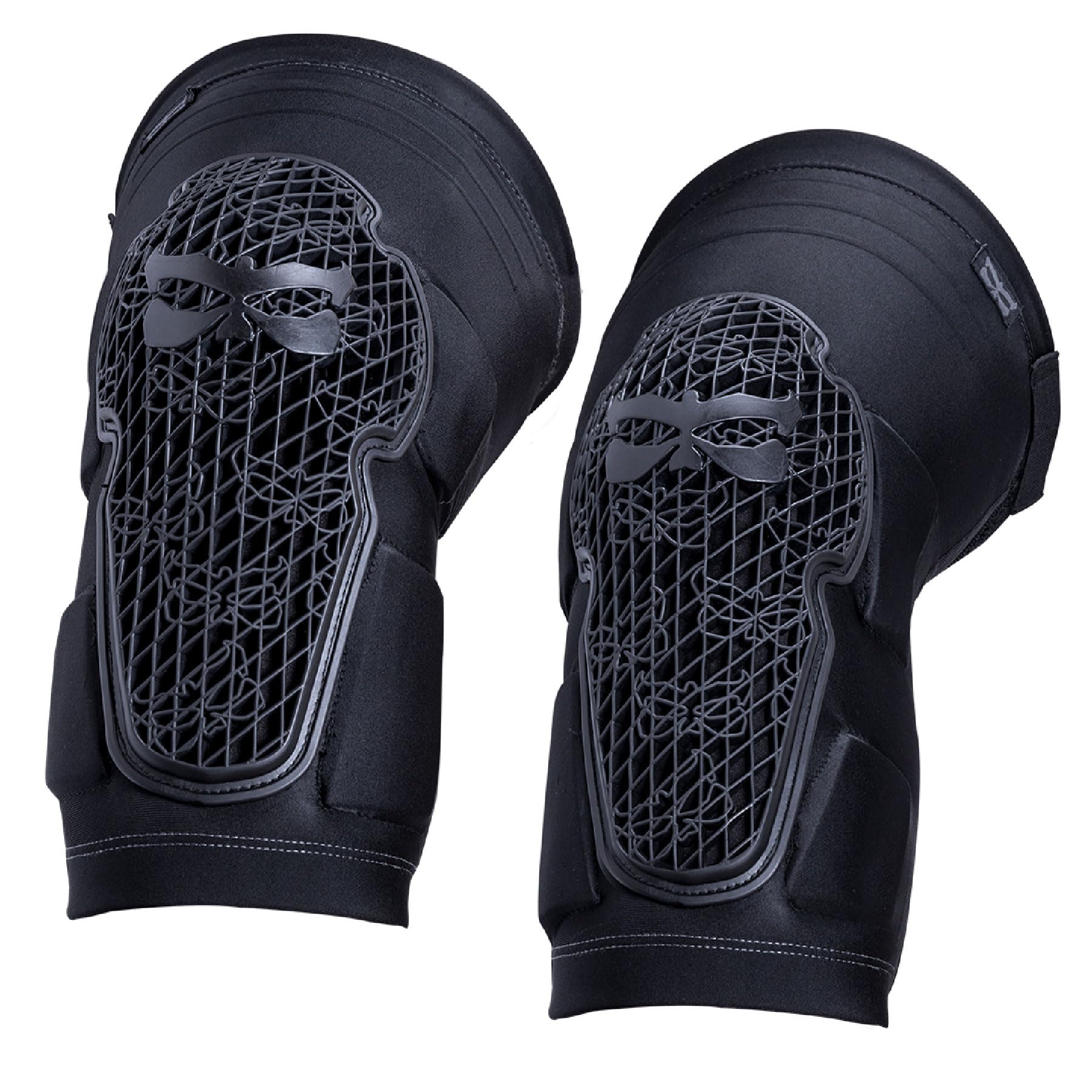
Key Features
- Impact Protection: Xelion + EVA side
- Weight and Bulk: Lightweight
- Closure Style: Slip-on with Velcro straps
- Breathability: Breathable back panel
- Price: $
The KALI Strike provides comfortable knee and shin coverage with an adjustable Velcro closure and non-slip bands, making it a budget-friendly option for light trail riders. Durability is a limitation: seams can separate and elastic may wear out after several rides, so these pads are best suited for occasional, low-impact use rather than frequent or aggressive riding.
Pros
- Comfortable for all-day wear with good airflow
- Good coverage for both knee and shin
Cons
- Seams and elastic may separate after a few rides
A reasonable option for occasional light trail riders who want knee and shin protection on a budget and accept shorter pad lifespan.
Best for Light Trail
Demon Enduro Ultralight

Key Features
- Impact Protection: 10mm EVA + Kevlar cap
- Weight and Bulk: 0.25 kg, light
- Closure Style: Pull-on sleeve
- Size Accuracy: Runs small, inconsistent
- Price: $
The Demon Enduro Ultralight delivers basic knee protection with a Kevlar cap and EVA foam at a budget price, ideal for light trail or BMX. But sizing runs small, the sleeve can slip, and durability is limited – materials may peel within a season. This works for casual riders but not for frequent or aggressive use.
Pros
- Comfortable to pedal in for longer climbs.
- Provides decent impact coverage for casual trail riding.
Cons
- Sizing can run small and fit may be inconsistent – some riders need to size up.
Best suited for riders on a tight budget who only ride light trails occasionally and are willing to size up and accept potential slipping.
Best for Downhill
POC Joint VPD 2.0

Key Features
- Impact Protection: VPD 2.0 (thicker foam)
- Weight and Bulk: 1.45 lb, heavy
- Closure Style: Slip-on with strap adjuster
- Breathability: Poor – hot on climbs
- Size Accuracy: Runs small
- Price: $$$
The POC Joint VPD 2.0 offers the highest protection in the lineup with generous side coverage and a secure fit that stays put on aggressive descents. The bulk and heat retention that make it a poor choice for climbing or warm days are exactly what make it right for gravity-focused riders who prioritize crash safety over pedaling comfort. Sizing runs small, so ordering up is necessary for most.
Pros
- High impact absorption with good side coverage for park laps
- Stays in place during rough downhill runs
Cons
- Bulky and hot – not suited for climbing or warm weather riding
Best for lift-access bike parks and shuttle-assisted enduro where protection matters more than ventilation.
How to Choose
The single most important buying insight: no foam technology compensates for a pad that doesn’t fit your leg shape and riding style.
Impact Protection Type
Foam technologies like D3O, VPD, and SmartFlex all harden on impact, but their real-world performance depends on thickness and coverage area. Thin sleeves (under 10mm) absorb moderate falls but won’t stop a direct rock strike; thick pads (15mm+) trade pedaling comfort for impact absorption.
If you ride technical downhill lines, look for CE-certified pads (Level 1 or 2) with extended side coverage. For cross-country and flow trails, a thinner reactive foam with good coverage is sufficient and keeps you pedaling longer.
Weight and Bulk
Every extra ounce on your knees adds fatigue over a long climb. Lightweight sleeves (under 10 oz) let you pedal naturally, but they rely on foam that compresses more under hard impacts. Heavier pads (1 lb+) use denser foam and thicker shells that stay protective ride after ride.
The hidden trade-off: a heavy pad that wobbles or shifts because of its weight is worse than a lighter pad that stays locked. Balance the number of crashes you expect with the amount of climbing you do.
Closure Style
Pull-on sleeves are the lightest and most pedal-friendly, but they depend entirely on silicone grippers and leg shape to stay put. If you have narrow calves or tapered thighs, they may slide down after a few descents.
Strap-style pads (hook-and-loop or velcro) offer adjustability and a more secure fit for aggressive riding. The trade-off is extra weight and bulk that can bunch behind the knee during pedaling. For enduro and downhill, straps are the safer bet; for trail and XC, a well-fitted sleeve wins on comfort.
Breathability
Thick pads trap heat because foam insulates. If you ride in warm climates or push hard on climbs, look for open mesh rear panels and perforated foam. Sleeves with moisture-wicking liners reduce sweat buildup.
The real-world limit: no pad breathes as well as bare skin. Plan to wear knee pads only during the descent at bike parks, or choose a thinner, well-ventilated sleeve for all-day epics.
Size Accuracy
Sizing inconsistency is the #1 complaint across this category. Many pads run small, and a pad that’s too tight will restrict circulation and slip because it can’t sit properly. A pad that’s too loose slides down immediately.
Measure your thigh circumference (6 inches above the knee) and calf circumference (6 inches below the knee) against the brand’s specific size chart. Order up if you’re between sizes. The five minutes of measuring saves weeks of returns.
FAQ
Why do my mountain bike knee pads keep sliding down?
Sliding usually happens because the sleeve’s silicone grippers don’t match your leg taper, or the pad is too large overall. Measure your thigh and calf circumference and check the brand’s size chart – many pads run small, so a size up may actually fit tighter. Strap-style pads like the Demon Hyper X D30 eliminate this problem entirely.
Are D3O knee pads better than standard foam for mountain biking?
D3O and similar reactive foams offer better impact absorption than standard EVA foam because they harden on impact while staying flexible during pedaling. However, a thick, well-designed standard foam pad can outperform a thin D3O sleeve on hard hits. The certification level (CE Level 1 or 2) matters more than the brand name.
How tight should MTB knee pads be?
They should be snug enough that they don’t move when you squat or pedal, but not so tight that they leave deep imprints or cut off circulation. A pad that requires a fight to pull on will likely be too tight after 30 minutes. If the silicone grippers leave only a light ring, the fit is correct.
Can I wash my mountain bike knee pads in the washing machine?
Most brands recommend hand washing with mild soap and air drying to preserve the foam and silicone grippers. Machine washing on a gentle cycle can degrade the adhesive and cause the foam to separate from the fabric. For pads with removable inserts (like Fox Enduro D3O), you can machine wash the sleeve separately.