This post contains affiliate links. We may earn a small commission when you buy through our links — at no extra cost to you.
Men’s extreme-cold boots are a compromise: the warmest pairs can feel like anchors, and the lightest ones often give up too soon in slush. What you want is a pair that keeps toes warm on a below-zero morning, blocks water at the seams, and still feels comfortable on a long walk or a full day at work. I’ve done the thin-soled commute and the numb-toe dog walk, and the difference is not just warmth—it’s whether you can stride normally instead of picking around every icy patch. Fit matters, since heavy socks change sizing, and appearance counts if the boots need to look reasonable at the office.
Over one winter, we wore nine pairs through below-zero mornings, slushy parking lots, and driveways. We judged warmth without sweaty feet, water resistance at the seams, comfort over hours, fit with thick socks, weight on the foot, and how stitching and soles held up. Value, appearance, and quality separated the pairs that felt purpose-built from the ones that looked the part. The ones below are worth pulling on when the forecast turns serious.



Best for Extreme Cold, Wet
Muck Arctic Pro
Key Features
- Style: Insulated work boot
- Closure: Slip-on
- Listed weight: 6.5 lb
- Water resistance: Waterproof
- Price: Midrange
Six and a half pounds of boot is a real weight to lift with every step, and the Muck Arctic Pro doesn’t pretend otherwise. What that weight buys is the thing we care about most in extreme cold: a waterproof shell that takes slush, wet snow, and a driveway full of meltwater without letting any of it through to a sock.
Warmth is the other half of the case. This is a boot built for standing still in bad weather — waiting for a bus, working at the back of a truck, watching a kid’s practice from the edge of a rink — and it holds heat when you aren’t moving to make your own. That’s the part most winter boots get wrong, and it’s why this one is the default for the worst days here.
Fit is where to pay attention before you order. These run large, and the top of the shaft is snug across a heavy calf, so buy for the sock you actually wear in January rather than the one you wear in October. Getting them off is easier with a boot jack than with a tug, especially when they’re wet.
If your winter is a car, a salted sidewalk, and a warm office, this is more boot than you need and the laced NORTIV 8 below will be easier to live with. If it’s a driveway, a job site, and a dog that insists on the long way round, there’s nothing here we trust more.
Pros
- Keeps feet dry in slush and standing water
- Warm while standing still in sub-zero wind
- Most consistent fit in this group
- Slip-on, with no laces to fumble in gloves
Cons
- Heavy at 6.5 pounds a pair
- Snug across the top of a heavy calf
We recommend the Arctic Pro to anyone whose winter is wet and stationary — it’s the most reliably dry, warm boot in this group.
Best for Walking in Deep Cold
Sorel Caribou
Key Features
- Style: Insulated snow boot
- Lining: Thick felt
- Package weight: 2.34 lb
- Price: Premium
Where the Arctic Pro is built to stand in the cold, the Caribou is built to walk through it. There’s a real sole under your foot and a shape that rolls as you step, and it’s the pair here that looks as good with jeans as it does with snow pants — worth something if the walk ends somewhere other than a woodpile.
Warmth is the reason to buy it. A thick felt liner wraps the whole foot, and the boot is happiest in dry, bitter cold, the kind where the snow squeaks. It’s the pair we reach for when the walk is part of the day rather than something to survive.
Fit is where it splits. The Caribou runs large and the toe box is narrow for a wide forefoot, so size down if you’re between sizes and try them with the socks you’ll actually use. Wear a midweight wool sock rather than your thickest pair: the liner is doing the insulating, and a bulky sock steals the air space that keeps your toes warm.
Pros
- Warm in dry, bitter cold
- Comfortable enough for a long walk
- Best-looking boot in this group
Cons
- Bulky and heavy on the foot
- Rubber shell is the wear point
If you walk through winter rather than stand in it, this is the boot we point you to: warm, comfortable, and the best-looking pair here.
Best for Deep Snow, Value
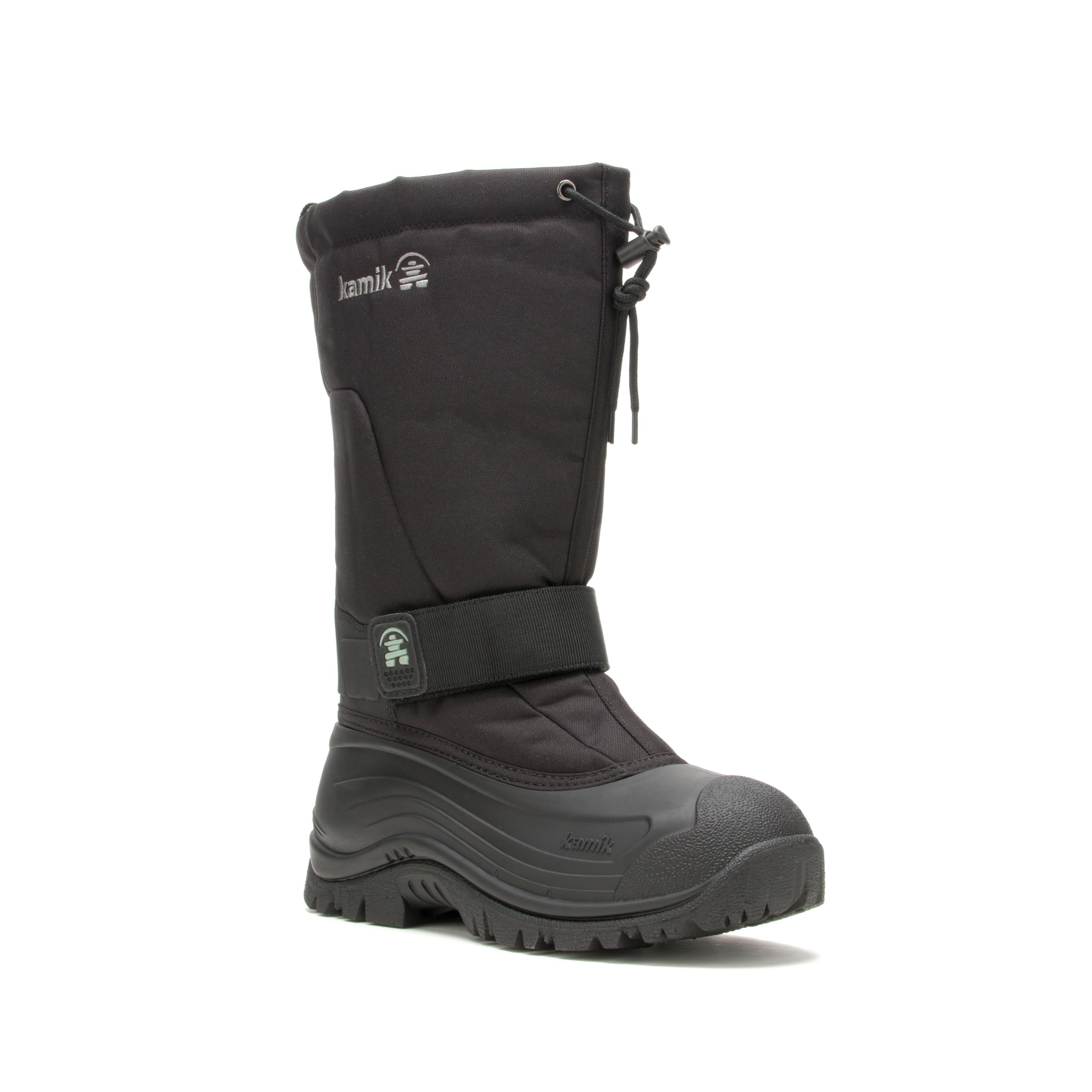
Kamik Greenbay 4
Key Features
- Style: Tall snow boot
- Closure: Buckle fastening
- Water resistance: Waterproof
- Price: Midrange
The Greenbay 4 is the bargain of the tall boots here, and tall is the entire point: the shaft comes up high enough that a knee-deep drift stays on the outside, which is more than the ankle-height hiking boots can manage.
What we appreciate most is how little ceremony there is to putting them on. Step in, fasten the buckle at the top, and go — no laces, nothing to fiddle with in gloves. The shaft keeps powder out while you’re clearing the drive, and the sole has enough bite for a packed, refrozen sidewalk.
Sizing is the catch. These run small and a little narrow, so go up a size if you’re on the line, especially if a thick sock is part of the plan. Sort that out and the rest is simple: they’re the least fussy way here to stay dry in deep snow, and the price leaves room for a decent pair of wool socks.
Pros
- Keeps deep drifts out of the boot
- On and off in seconds, even with gloves
- Costs less than the other tall boots here
Cons
- Upper wets out in wet slush
- Buckle is the weak point
Our pick for deep drifts without the premium — it keeps snow out, goes on in seconds, and costs less than the other tall boots.
Best for Winter Hiking
NORTIV 8 Terrex
Key Features
- Style: Hiking snow boot
- Lining: Fur-lined
- Water resistance: Waterproof
- Price: Budget
If your winter involves walking further than the end of the driveway, this is the boot in the group to take. The Terrex is a snow boot cut like a hiking boot: roomy across the toes, light enough to keep moving in, and lined with a fur that feels warm the moment you push a foot in.
It’s also the best value among the boots you can walk in. Nothing else here gets you a warm, dry, comfortable boot for a five-mile winter walk at this price, and the fit is friendly to a wide forefoot — a rarity in this group, where narrow toe boxes are the usual complaint. Arch support and a cushioned insole mean they’re wearable out of the box, without a breaking-in week.
Wear it with a midweight wool sock rather than your heaviest pair. The boot is already roomy, and a thick sock turns a good fit into a sloppy one that lets your heel lift with every step.
Pros
- Roomy toe box for wide feet
- Fur lining feels warm immediately
- Best value among the walkable boots here
Cons
- Stops short of standing water
This is the boot we hand anyone who walks to work or hikes in winter: warm, roomy, and the best value among the walkable picks.
Best for Slush and Mud
TIDEWE Rubber Boot
The TIDEWE is the only boot here with a comfort rating printed on it: minus 4 to 50 degrees Fahrenheit. That’s the honest kind of specification, because it tells you what the boot is — a cold-weather boot, not a polar one — and it gives you a floor to plan around instead of a promise to trust.
Six millimeters of neoprene, a mid-calf shaft, a reinforced toe, and a kick-off ledge at the heel make it a muck boot in the traditional sense: step in, work, hose it off, and it’s ready tomorrow. The shaft measures 13 inches around, which is why it’s the boot here that fits a heavy calf without a fight.
Read the size chart before you pick a number. The same boot is sold across men’s and women’s sizes and only the 11-to-14 block is labeled for men, so order to the chart rather than to the number on your everyday shoes.
So it isn’t the boot for the coldest week of the year — the Arctic Pro and the Caribou both beat it there — but for the thawed driveway, the muddy path to the shed, and the yard where the dog goes, we keep coming back to it. It’s the pair we hand someone who wants to stop thinking about their feet.
Pros
- Cold rated to a stated minus 4°F
- Six-millimeter neoprene hoses clean
- 13-inch shaft fits a heavy calf
Cons
- Glued soles can separate with hard use
For the messy end of winter, we reach for this one: neoprene that hoses off, a stated cold rating, and room for a heavy calf.
Best for Dry Cold, Budget
ALEADER Snow Boot

Key Features
- Style: Insulated snow boot
- Closure: Hook-and-loop strap
- Water resistance: Waterproof shell
- Price: Budget
The sizing on the ALEADER is the most confusing thing in this guide. The same boot is described as running big and as running small, it doesn’t come in half sizes, and it’s narrower through the middle than the shell suggests. Order from the chart, keep the box until you’ve walked a block, and treat the number as a starting point rather than a fit.
After that, the news is good. The insulated shell holds heat well in dry cold, the hook-and-loop strap means you can get in and out without laces when your hands are cold, and the shape reads as a proper snow boot rather than a work boot — more than a lot of cheap pairs manage.
Dry cold is where these earn their place. Buy them for a cold, dry winter and a tight budget; if your winters come with slush and rain, put the money toward a rubber boot instead.
Pros
- Warm in dry, bitter cold
- Strap closure, no laces to tie
- Looks better than the price suggests
Cons
- Sizing runs big and narrow, with no half sizes
Buy it for dry, bitter cold on a tight budget, and check the size chart twice before you do.
Best for Budget Second Pair
SHULOOK Snow Boot

Key Features
- Style: Insulated snow boot
- Closure: Lace-up
- Listed weight: 2.84 lb
- Water resistance: Waterproof
- Price: Budget
The SHULOOK is the cheapest way here to get a warm, waterproof snow boot, and for a lot of households that’s the entire brief: a second pair by the door, a boot for a teenager whose feet are still growing, something that lives in the trunk from December to March.
It does the basics properly. Snow stays out, water stays out on a wet walk to the shop, the sole grips on a snowy path, and the padded collar and double sole are more than the money suggests. The insoles lift out, which is the easiest fix in footwear if you want more cushioning, and the laces pull the whole boot snug.
These aren’t the boots for a ten-mile hike or a day standing in slush; that isn’t what they’re built for. They’re for the mailbox, the school run, and the shovel — and as a second pair, that’s a fair trade.
Pros
- Warm and waterproof at the lowest price here
- Padded collar and double sole
- Insoles lift out for more cushioning
Cons
- Runs a full size small
The cheapest warm boot here is worth it if you add a full size and keep it for short trips rather than long ones.
How We Tested Extreme-Cold Winter Boots
We started by comparing insulation, sole construction, height, and sizing notes in customer reviews, then narrowed the field to nine pairs across a range of prices. The goal was a mix of heavy snow boots, everyday cold-weather boots, and lighter pairs that could handle a brutal morning without feeling like anchors.
I wore each pair for at least a week of real mornings: clearing the driveway before work, walking the dog on unplowed sidewalks, standing at a bus stop, and taking weekend walks with a loaded backpack. I noted whether toes stayed warm after 45 minutes in single-digit cold, whether sweat built up indoors, and whether the tongue or seams leaked when I stood in slushy puddles and packed snow.
Fit and sizing got their own pass: I tried every pair with thick wool socks, checked toe room and heel slip, and compared the listed size with the actual room inside. I weighed each boot on a kitchen scale and wore pairs for full days to see whether the extra ounces showed up in my calves. By the end of winter, I checked scuffed toes, bent soles, and crushed insulation; appearance got a mirror check with jeans and work pants, and value came down to how often I reached for a pair versus what it delivered.
How to Choose Men’s Winter Boots for Extreme Cold
The biggest decision in extreme cold isn’t how much insulation a boot carries — it’s whether you’ll be standing in the cold or walking through it, because those two jobs want different boots.
Standing Cold or Walking Cold
Rubber and neoprene boots win the standing contest: the shell blocks wind, nothing soaks through, and the boot stays warm when you aren’t generating heat. The cost is weight and stiffness, and six pounds of boot turns a two-mile walk into work. A pac boot or an insulated hiking boot gives up some of that armour for a sole that rolls and a shape that doesn’t fight your stride.
Be honest about your winter. A driveway, a job site, and a dog walk are standing cold; a commute on foot and weekend trails are walking cold. The boots we liked most on a long walk were never the warmest ones standing still.
What Waterproof Actually Covers
Every boot here is sold as waterproof, and the difference is where the water arrives from. A rubber shell shrugs off slush and standing water; a membrane behind fabric or leather keeps out rain and wet snow but can’t help once water tops the shaft. Match the shaft to your worst day: ankle height for cleared sidewalks, mid-calf for a driveway, tall for drifts and a plow’s leavings.
The trap is the puddle: no boot here keeps water out when you step in past the cuff. Waterproof means the boot, not the snowbank.
Fit for the Sock You’ll Really Wear
The most common way to end up with cold feet is a boot that’s too tight. Insulation needs a little air around the toes, and a cramped boot restricts circulation, which is the opposite of warm. We put more weight on fit than on any other line on a spec sheet, and it’s the one thing you can’t judge from a photo.
Size for a midweight wool sock, not the thickest pair you own, and expect the numbers to move: one boot here runs a full size small, another runs large with no half sizes. If you’re between sizes and there’s no half size, take the larger and add an insole.
Reading a Cold-Weather Rating
A comfort rating is a range, and it assumes a sock, an activity level, and a dry boot. It’s still the most useful number on a product page when there is one: minus 4°F tells you this is a cold-weather boot rather than a polar one, and it gives you a floor to plan around.
Warmth comes from trapped air and from staying dry, so a soaked boot loses the argument whatever the label says. Treat the number as the bottom of the boot’s working range, not the middle of it.
Traction on Ice
Lug depth helps in snow and packed slush; on hard, wet ice, no rubber sole here is a substitute for care. Deep blocky tread is what to look for if your route includes a slope or a shaded driveway that stays icy for days after a storm.
If ice rather than snow is your problem, add a traction device that fits over the boot. These soles are shaped for snow, not for a skating rink.
Frequently Asked Questions
How do I stop my feet from sweating in insulated winter boots?
Start with a thin liner sock under a wool one: the liner moves moisture and the wool holds warmth even when damp. Skip cotton, which soaks and then stays cold against the skin. Don’t wear the boots indoors or in the car, and open the cuffs to let them dry overnight. Two pairs rotated day to day beat one pair worn every day.
Can I drive in winter boots like these?
Not comfortably, and not safely in the heaviest pairs. Deep lugged soles and a tall stiff shaft make the brake and accelerator feel vague, and a wide toe box can catch two pedals at once. Keep a pair of ordinary shoes in the car and change before you pull out — it takes twenty seconds.
Do winter boots need re-waterproofing?
Rubber and neoprene shells don’t: rinse the salt off, wipe them down, and let them air-dry away from a radiator. Fabric and leather uppers eventually do — brush off dried salt, then apply a spray-on or wax treatment made for that material once water stops beading. Never dry any boot on a heater or in a dryer, because heat is what cracks rubber and shrinks liners.
Final Verdict
Buy the Muck Arctic Pro if your winter is wet and stationary. It’s the boot here that keeps feet dry and warm with the least fuss, and the one we trust most in slush, standing water, and a wind that finds every seam.
If you walk more than you stand, the Sorel Caribou is worth the step up in comfort and looks. If the walking happens on trails rather than sidewalks, the NORTIV 8 Terrex gets you there for a lot less money.