This post contains affiliate links. We may earn a small commission when you buy through our links — at no extra cost to you.
A rain jacket has one job, and it turns out to be two jobs pulling against each other: keep the water out, and don’t trap you inside your own humidity. Go all-in on waterproofing and you’re clammy ten minutes into a walk; go light and airy and the first real downpour soaks straight through your shoulders. The jackets that work split the difference — sealed seams and a real membrane where the rain actually lands, vents and a cut that lets you swing your arms where it doesn’t. What that buys you is small and specific: you stop checking the forecast before you walk out the door.
I’ve owned jackets that fit like a garbage bag and jackets I couldn’t lift my arms in, so fit was the first thing I noticed on every one of the 12 we’ve worn over the past eight months, from a bike commute in a drizzle to a two-hour hike in proper rain. A detail that surprises first-time buyers: most of these are cut to layer over a sweater, so the size that fits over a t-shirt will swim on you, and the hood either stays put in wind or it doesn’t, with very little middle ground. The picks below are the ones that held up, dried fast, and still looked like a jacket I’d wear to dinner.


Best for Wet-Weather Hiking
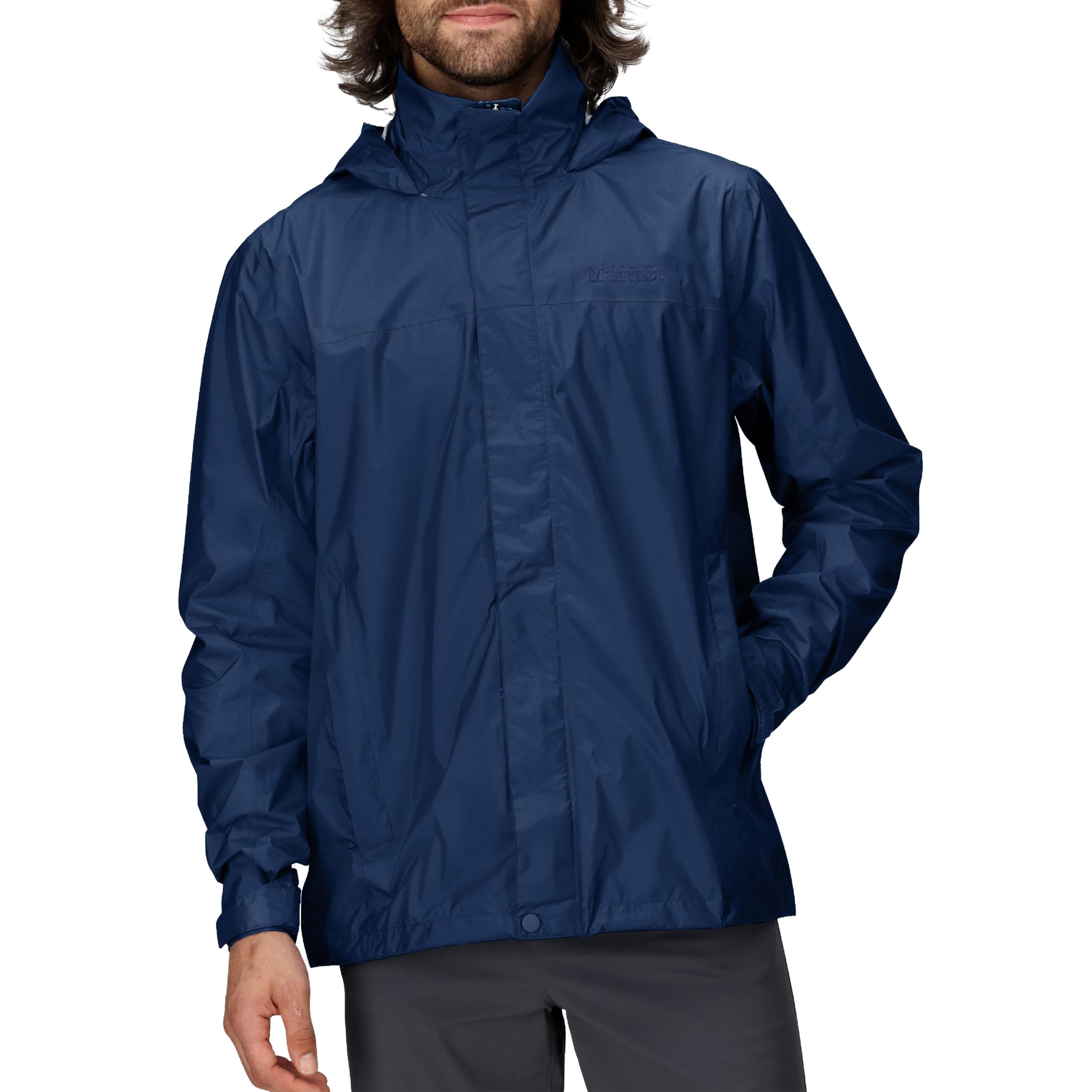
Marmot PreCip Eco
Key Features
- Seams: 100% seam-taped
- Weight: 10.8 oz
- Pockets: 2 zippered
- Waterproofing: NanoPro membrane, PFC-free DWR
- Price: Premium
The specification that settles it is 100% seam-taped. Several jackets here call themselves waterproof; this is the one that also states every seam is taped, over a NanoPro membrane with a PFC-free DWR finish. That combination is what lets it handle an hour of steady rain on an exposed ridge rather than just a passing shower, and at 305 grams it still disappears into a daypack. We noticed the difference most on a windy, wet walk where the cheaper shells in the group started to feel like they were merely holding the rain off.
Ventilation is the other half of the story. Pit zips let you dump heat on a climb without opening the front to the rain, and the hood rolls into the collar when the sky clears. The cut is straight through the body with just enough room for a light fleece underneath, and the two zippered hand pockets are exactly where your hands go when you stop moving.
The compromises are long-term ones. The mesh lining can start flaking after a few seasons of hard use, and we found the sleeves get snug once you add a mid layer. Neither shows up on a weekend trip; both are the price of a jacket this light. If you want the best rain protection per gram in this group and you’ll actually be out in it, the trade is worth making.
Pros
- Fully taped seams over a named membrane
- Pit zips vent heat on the climb
- 305 g and packs down small
- Hood rolls away into the collar
Cons
- Lining can flake after seasons of use
- Sleeves get snug over a mid layer
Our pick for anyone who gets properly rained on: it’s the only jacket here built with taped seams over a breathable membrane, and it weighs next to nothing in a pack.
Best for Everyday Rain
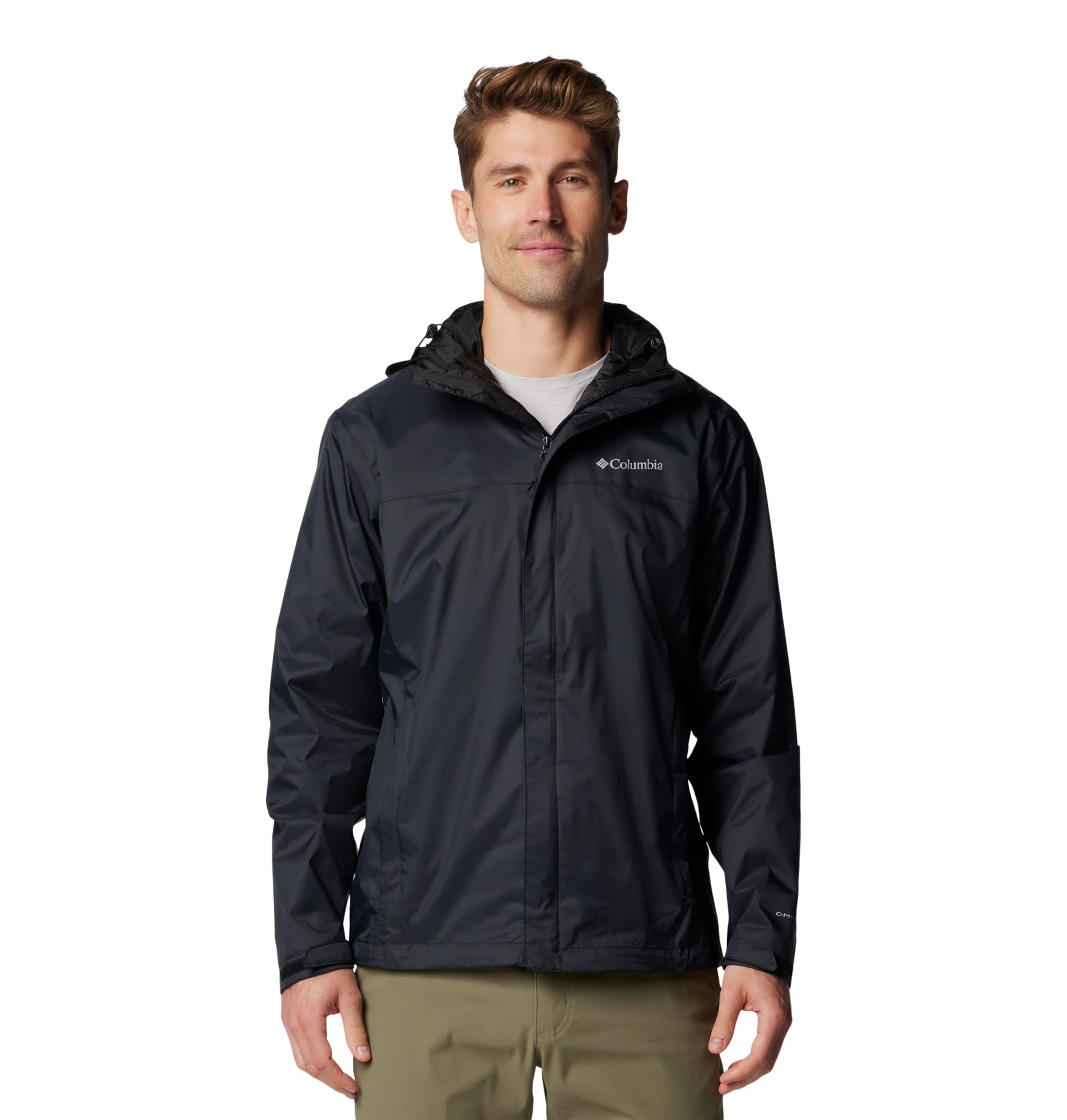
Columbia Watertight II
Key Features
- Hood: Attached hood
- Packing: Rolls up small
- Waterproofing: Waterproof shell
- Price: Midrange
If you want one jacket for the car, the commute and a weekend walk, start here. The Watertight II is the rain jacket most people are picturing when they go looking for one: a hood that stays put in wind, zip pockets where you want them, and a straight cut that layers over a hoodie without looking like a poncho.
What keeps it in our rotation is how little space it takes up. It rolls into a bundle small enough to live at the bottom of a daypack, and it’s light enough that we forget it’s there until the sky turns. Through heavy rain it has kept us dry, and it doesn’t turn into a sauna the moment you start walking — which is not a given at this price.
The cut is generous through the body, which is exactly why it works over a sweater in October; if you’re narrow through the shoulders, size down rather than living with the extra fabric. None of that gets in the way of the job. This is the jacket we hand to someone who wants a rain jacket and doesn’t want to think about it again.
Pros
- Stays dry in heavy rain
- Rolls into a small bundle
- Generous cut layers over a hoodie
- Hood holds in wind
Cons
- Sleeves run long on shorter frames
The jacket we recommend to most people: it keeps you dry in heavy rain, rolls up small in a daypack, and costs far less than the premium shells here.
Best for Cold-Weather Layering
The North Face Antora
Key Features
- Fit: Roomy for layering
- Sizes: Standard and big sizes
- Waterproofing: Waterproof shell
- Price: Midrange
Room is the reason to pick the Antora. Pull it over a hoodie and a fleece and the shoulders still move, which is more than we can say for the trimmer shells in this group. The North Face cuts it in standard and big sizes, so larger frames aren’t forced to size up into a tent.
Waterproofing holds up in the sort of steady, wind-driven rain that soaks everything else on the walk, and the fabric stays soft rather than going stiff and noisy. The pockets are big enough to swallow gloves and a hat. It’s also the best-looking jacket in the top half of this group — we’ve had more comments on this one than anything else here.
One detail worth knowing before you order: the OG purple colorway reads distinctly reddish orange in person rather than on screen. That’s the only surprise. Otherwise it does what the tag says, in weather that would send most people back inside.
Pros
- Roomy enough for a fleece and hoodie
- Waterproof in sustained, wind-driven rain
- Standard and big sizes available
- Soft, quiet fabric and large pockets
Cons
- No insulation — a layer, not a coat
- Sleeves run long
Buy the Antora if you want a shell that swallows a fleece and a hoodie underneath — it’s the roomiest cut here, and it stays waterproof in real storms.
Best for City Commuting
Helly Hansen Dubliner
Key Features
- Hood: Packable into collar
- Weight: 1.44 lb
- Waterproofing: Waterproof, windproof, breathable
- Price: Midrange
Order this one a size up — that’s the short version. The Dubliner is cut close through the chest and shoulders, and we found the listed size fits tighter than the same label in other jackets here. Do that and it’s the best-looking shell in this group: clean lines, no billow, and a finish that reads more coat than kit.
The hood is the detail we appreciate most. It zips away into the collar when the rain stops, so you don’t walk into a restaurant with a wet hood hanging down your back, and the drawcords hold it in place when the wind picks up. Waterproof, windproof and breathable are all claimed, and in light-to-moderate rain it does what it says.
At 1.44 pounds it’s light enough to carry all day, but it isn’t a stuff-in-a-pack shell — it doesn’t compress the way the ultralight jackets here do, and it has enough structure to look deliberate over a shirt. For commuting, travel and wearing around town, that’s the right set of trade-offs.
Pros
- Hood stows inside the collar
- Waterproof, windproof and breathable
- Slim, city-ready shape
- Light enough to wear all day
Cons
- Warmth suits cool days, not winter
Our pick for city rain: a sharp, close-fitting coat with a hood that tucks into the collar, and enough waterproofing for a wet commute or a drizzly weekend.
Best for Travel and Packing
33,000ft Packable Rain Jacket
Key Features
- Packing: Packs into included bag
- Listed weight: 10.9 oz
- Waterproofing: Waterproof shell
- Price: Budget
It arrives in a stuff sack about the size of a paperback, and it goes back into one. That’s the pitch, and it’s a good one: a shell that lives in a daypack or a carry-on and is there when the weather turns. We kept one at the bottom of a bag through a wet spring and stopped thinking about it entirely.
On the trail it’s a wind shell first and a rain shell second. It cuts wind on an exposed stretch and keeps you dry through steady rain, and the fabric is quiet rather than crackly. The side pockets are the weak spot: they aren’t sealed, and anything in them gets damp in a real soaking. A zip bag for your phone solves it.
The cut is generous through the body, with sleeves long enough to cover your wrists when you reach for a handrail, and it layers over a fleece without pulling across the back. This is a spring-showers, travel and summer-storm jacket; it isn’t a winter coat and it isn’t a work coat. As a shell that’s always with you, nothing here beats it.
Pros
- Packs into its own storage bag
- Cuts wind on exposed walks
- Light enough to forget in a daypack
- Quiet fabric that dries fast
Cons
- Seams can give out with hard use
Our pick for travel: it stuffs into its own little bag, cuts wind and rain on a walk, and leaves room in the budget for the trip itself.
Best for Budget Backup
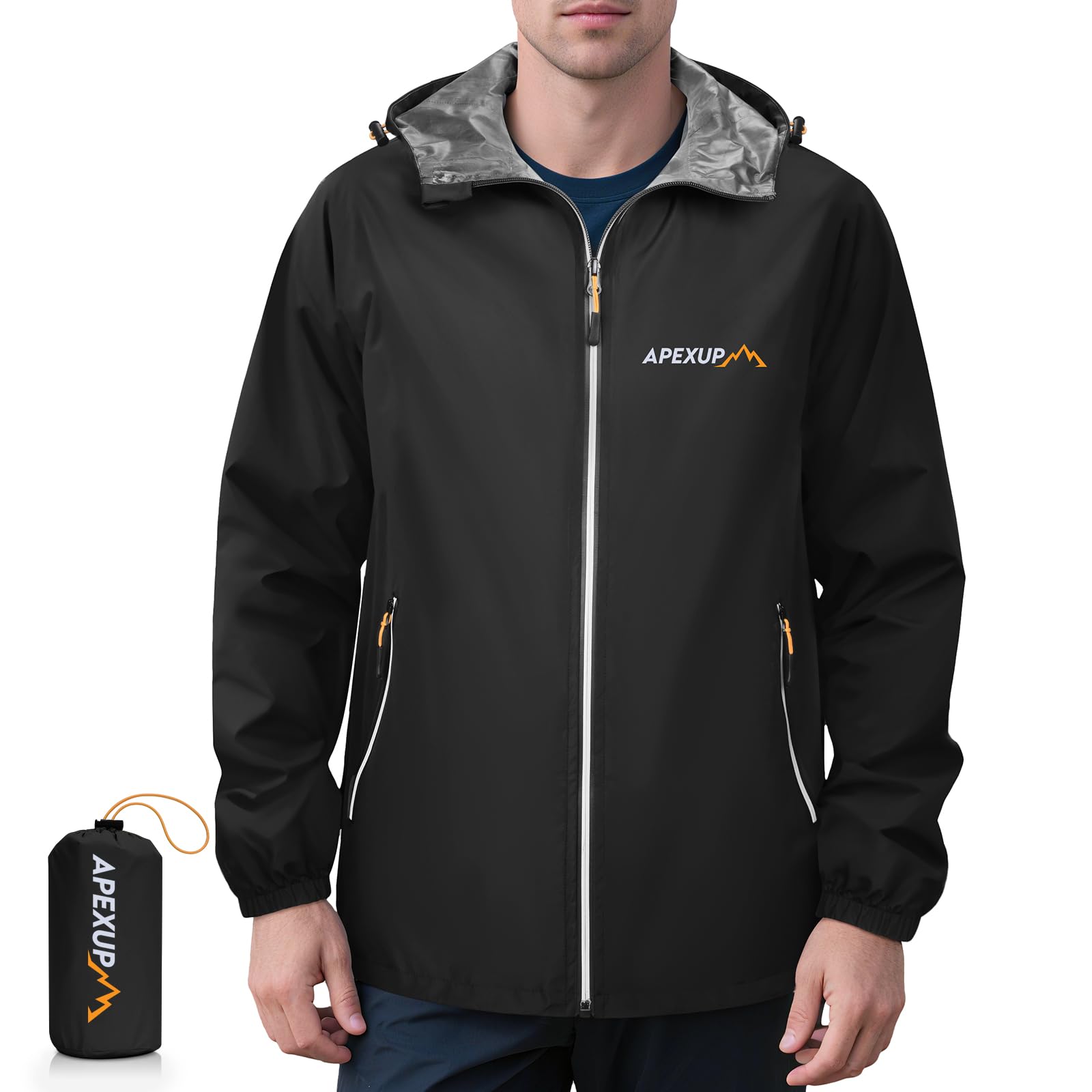
APEXUP Packable Rain Jacket
Key Features
- Packing: Rolls into travel bag
- Pockets: Interior and exterior
- Listed weight: 8.82 oz
- Price: Budget
Cheap rain jackets usually feel cheap. This one doesn’t. At 8.82 ounces it’s the lightest shell in this group, the fabric has a soft, quiet hand, and the hood and cuffs do actual work rather than just existing.
In the rain it holds up better than the price suggests. It kept us dry through a heavy shower and rolls small enough to live in a glovebox, which is where ours spent most of the summer. Where it runs out of road is the all-day soaking: this is the jacket for the shower you get caught in, not a four-hour hike in persistent rain.
Sizing is true and the cut is roomy enough for a sweatshirt, which is more than you can expect at this end of the range. It’s also the jacket we hand to a friend who forgot theirs, which is really the point: a spare that works, kept where the weather can find you.
Pros
- Lightest shell in this set
- Roomy enough for a sweatshirt
- Rolls into its own travel bag
- Handles a heavy shower
Cons
- Gets clammy on a climb
- Neck zip runs rough at first
The cheapest shell here earns its place: the lightest of the group, roomy enough for a sweatshirt, and dry through the shower you get caught in.
Best for Cold Wet Days
33,000ft Fleece-Lined Shell

Key Features
- Hood: Attached hood
- Lining: Fleece
- Waterproofing: Waterproof shell
- Price: Midrange
Most rain shells are a layer you add; this one is two layers in one. The fleece lining traps heat well enough that we’ve been comfortable in it on a raw, windy morning with just a T-shirt underneath, while the outer shell handles the waterproofing.
That combination suits a specific kind of wet cold — the sort that isn’t quite winter. Standing on a sideline, walking the dog in November rain, working outside in a drizzle: this is the jacket you grab when you’ll be outside but not moving fast. We reached for it on flat, cold, wet days and left the ultralight shells in the bag.
Sizing needs attention. It runs small and the sleeves are narrow through the forearm, so if you’re between sizes, or you wear a watch, go up. Do that and you get a jacket that feels tailored rather than baggy, with a hood that stays where you put it.
For standing around in cold rain, none of the unlined jackets here can do the job without a mid layer underneath. We rate it as a specialist: the best of these for stationary cold-weather use, and a jacket to leave behind when the day involves a climb.
Pros
- Fleece lining warms a cold, wet day
- One layer instead of two
- Hood stays put in wind
Cons
- No pit zips and fixed cuffs
A rain shell with a fleece lining is a specific tool: warm enough for a cold, wet morning and too warm for much else — the jacket for a sideline or a wet fall walk.
Best for Working Outdoors
SaphiRose Long Raincoat

Key Features
- Hood: Attached drawstring hood
- Length: Knee-length
- Waterproofing: Waterproof shell
- Price: Budget
Length is the argument. Most jackets here stop at the hip and let the rain run onto your thighs; this one drops to the knee, which is the difference between a wet walk to the truck and a dry one.
It’s a real hooded raincoat rather than a poncho — full zip, sleeves, and a drawstring hood that stays on in wind. The fabric is light, doesn’t have the rubbery smell cheap rain gear gets, and we watched water bead off it instead of soaking in.
The cut is straightforward: roomy enough to pull on over a work jacket, with sleeves that land where they should. It’s a coat you keep by the door rather than one you fold into a pack, and nothing about it pretends otherwise.
For chores, dog walks, a worksite or a few hours on a jetty, that coverage does more for you than any breathability figure. We rate it the best of these for standing out in weather you can’t avoid — provided the work stays light and the coat isn’t asked to be the last one you buy.
Pros
- Knee-length coverage keeps legs dry
- Real coat with zip, sleeves and hood
- Fabric doesn’t smell of rubber
Cons
- Fabric can tear at stress points
- Left-side zipper feels backwards
For anyone who works outside in the rain, the extra length is the point: this coat reaches the knee and keeps the wet off your legs for very little money.
How We Tested the Best Men’s Rain Jackets
We built the shortlist from spec sheets before we ever put a jacket on: waterproof and breathability ratings, whether seams were taped or merely stitched, packed weight, and hood adjustability. Anything with untaped shoulder seams got cut on the spot. That narrowed a long list to 12 jackets, a mix of brands we’ve worn for years and a few we hadn’t, and we bought every one at retail.
Those 12 logged eight months of ordinary weather — bike commutes in a fine drizzle, dog walks before work, weekend hikes, and one memorably wet two-hour climb. In the first week, each jacket went under a shower for five minutes with a paper towel pressed against the shoulders and hood, then we checked whether the towel came out damp. We also wore a loaded backpack on every walk to see how the shoulder panels held up, weighed each jacket dry and stuffed into its own pocket, and noted how it felt on a 45-degree morning versus a muggy one.
Fit and hardware got the same treatment. We tried each jacket over a t-shirt and again over a midweight fleece, and sized up or down wherever a second size was available to see how forgiving the cut was. Every zipper was run up and down 50 times, half of those with cold, wet hands, and we noted snags, catching fabric, and whether the pull tab was glove-friendly. Each jacket was washed twice and checked for fading, pilling, and whether water still beaded on the surface, and we wore the better-looking ones to the office to see if they passed as a normal jacket.
How to Choose a Men’s Rain Jacket
The most useful thing to know is that waterproof on a product page describes a fabric, not a jacket — the seams, hood and zips decide whether you actually stay dry.
Waterproofing is a construction, not an adjective
A waterproof membrane or coating keeps water out of the fabric, taped seams stop it coming through the stitch holes, and a DWR finish makes the surface bead so the shell doesn’t soak and go cold and heavy. A jacket with waterproof fabric and untaped seams is a shower jacket.
When a listing names its membrane and says the seams are taped, as the Marmot PreCip Eco does, you know what you’re buying. When it only says waterproof, we price it as a jacket for a passing shower and plan accordingly.
Match packability to how you’ll carry it
An ultralight shell that stuffs into its own bag earns its place when the jacket lives in a daypack or a carry-on and only comes out when the sky turns. The trade is everything else: thinner fabric, unsealed pockets, fewer adjustments and seams that give out first.
If the jacket hangs by the door and gets worn for the whole dog walk, you aren’t carrying it, so packability buys you nothing. A heavier, better-pocketed coat is the smarter buy.
Buy for the layer you’ll wear underneath
A rain jacket that fits perfectly over a T-shirt is not the same jacket that fits over a fleece in November. Think about the mid layer you’ll actually wear and leave room for it — the trimmer coats here, like the Dubliner, are cut close and reward sizing up, while the Antora swallows a hoodie without a struggle.
Sleeve length is the other thing to check. Sleeves that reach your knuckles are worse in rain than a body that’s slightly short, because wet cuffs wick water up your arms.
The hood and the hem are where cheap jackets leak
A hood that doesn’t cinch down folds back in wind and funnels water straight down your neck. Look for a drawstring or a structured brim, and check whether it stows in the collar if you want to wear the jacket into town without looking like you’re mid-expedition.
At the other end, a hip-length hem puts rain onto your thighs. If you’re outdoors for work rather than walking to a train, extra length does more for you than any breathability figure.
Spend where the money changes the jacket
The step from budget to midrange buys better zips, softer fabric and more dependable waterproofing. The step from midrange to premium buys construction: a named membrane, taped seams, pit zips for venting on a climb.
Above that you’re paying for weight and packed size, which only matters if you carry the jacket rather than wear it. For most people the middle is the sweet spot; if you’re out in sustained rain, the top of this range earns the extra.
Frequently Asked Questions
How do I re-waterproof a rain jacket that has stopped beading?
Wash it first — dirt and body oils are what kill a DWR finish. Use a technical cleaner rather than ordinary detergent, then tumble it on low heat to reactivate the finish. If water still soaks into the fabric instead of beading, a spray-on DWR restores the surface.
The test is a flick of water at the sleeve: beads mean the finish is fine, darkens and soaks in means it’s time.
Is a rain jacket warm enough for winter?
On its own, no. Every jacket here except the fleece-lined 33,000ft shell is an uninsulated layer, so its warmth comes from what you wear under it. Buy a size that fits over a base layer and a fleece and you have a three-season coat; for real winter you want an insulated jacket or a shell over a down mid layer.
What should I do with a soaked rain jacket at the end of the day?
Get it out of the pack and hang it up. A wet shell wadded into a stuff sack overnight comes out smelling of mildew, and the coating doesn’t enjoy it either. Hang it by the hood, dry it away from direct heat, and don’t put it away damp — the inside of a waterproof jacket dries last, so give it a full day.
Final Verdict
For most people reading this, the Columbia Watertight II is the jacket to buy. It handles heavy rain, rolls into a daypack and costs half what our top pick does — and sleeve length is the one detail worth checking before you order.
Spend up to the Marmot PreCip Eco if you’ll be out in sustained rain: taped seams over a breathable membrane are what separate it from everything else here. And if the jacket is mostly for a commute, the Dubliner looks far better doing the same job.