This post contains affiliate links. We may earn a small commission when you buy through our links — at no extra cost to you.
A fishing vest is simple in theory: carry your tackle on your body and keep your hands free for the rod. In practice, the wrong one becomes a sweaty, snagging mess — a zipper that jams halfway, pockets that swallow a fly box but won’t give it back one-handed, a fit that rides up the moment you cast. The right one fixes all of that. It keeps gear sorted and within reach, shrugs off brush, and disappears on your back until you need it.
Over the past eight months, my team and I have worn 12 vests on rivers and lakes, grading each on quality, pocket layout, fit across sizes, lightweight feel, and value. We also tested the details that decide a long day: whether zippers snag with wet fingers, whether seams hold up after brush, and whether one vest can handle fly fishing on Saturday and spin fishing on Sunday. The picks below earned a permanent spot in the truck.

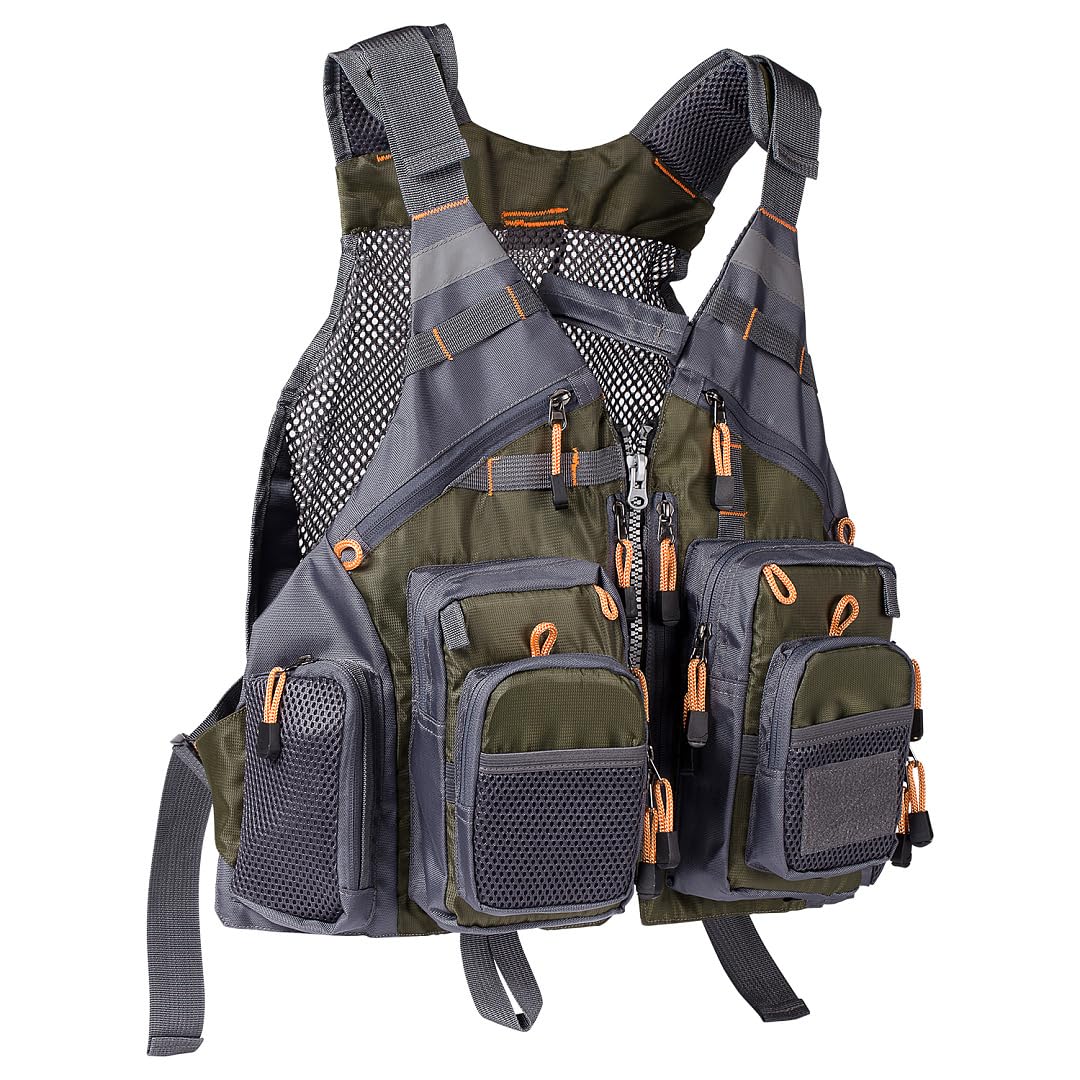


Best for All-Round Fishing Days
Gonex Fly Fishing Vest
Key Features
- Weight: 1.28 lb
- Pockets: 18 (14 zippered, 4 mesh)
- Water resistance: Water resistant
- Attachment points: D-rings, gear loops, line holder
- Price: Midrange
Eighteen pockets is a lot to hang off your chest, but the number that matters is fourteen, the zippered ones. The other four are mesh, which is exactly right for tippet, floatant and anything you want without undoing a zip. That split is what won us over: the front stays flat when the zip pockets are full, and there is nothing on this vest that is a pocket in name only.
Keeping that weight where you put it is the other half of the job, and this vest does it with shoulder straps, a waist strap and a chest buckle. The buckle is the detail we appreciated most. It holds the front steady with the main zip open, which is how you will wear it in heat, and it lets the whole thing go over a wading jacket without a fight. Empty, it weighs 0.58 kg, ordinary for a vest with this much hardware and heavy enough that you notice once every pocket is full.
Attachment points are where it pulls ahead of the cheaper vests in this group. There are D-rings for a landing net, loops for pliers and a line holder, plus a water-resistant finish that shrugs off spray. The fit is one adjustable size rather than a numbered range, so put it on over the layers you actually fish in, take up the shoulder straps, and then load it.
Pros
- 18 pockets, 14 of them zippered
- D-rings and loops for net, pliers, line
- Chest buckle holds it steady with the zip open
- Water-resistant polyester mesh shell
Cons
- Hand wash only
- Front zip runs left-hand
Our pick for most anglers: 18 pockets with 14 zips, D-rings for a net and pliers, and a chest buckle that keeps it steady with the front open.
Best for Deep Wading
BASSDASH Strap Fishing Vest
Key Features
- Fit: Adjustable, unisex
- Package weight: 1.1 lb
- Package dimensions: 9.84 x 7.87 x 3.94 inches
- Price: Premium
Wading deep changes what you want from a vest. Anything hanging at hip level is underwater, and a wet pocket is a heavy pocket. This BASSDASH carries its storage across the front on shoulder straps, so the pockets sit high, there is less fabric to soak, and there is nothing to drag in the current. That is why it stayed in our kit for wet wading long after bigger vests arrived.
The adjustment is generous in a way that is genuinely useful. The shoulder and side straps take it from a large frame down to a much smaller one, so a single vest covers two people, and it layers over a fleece or a wading jacket without cutting under the arms. For a strap vest, the storage is the surprise: a standard fly box disappears into one front pocket, and the rest take spools, leaders and a phone.
The fabric is the trade-off. It dries quickly, but it grabs hooks, so loose flies pulled out of a pocket come out with lining attached. Keep flies in a box and let the pockets carry boxes, spools and leaders. Fraying is the other thing to watch; the material is light, so check the seams now and then rather than assuming they will outlast everything else you own.
Pros
- Pockets ride high, clear of the waterline
- Strap adjustment covers very different builds
- Light enough to wear all day
- Dries fast after a soaking
Cons
- Front zip can catch the fabric
We reach for it when the water is deep: pockets that ride high, an open back, and straps that adjust to almost any frame.
Best for Hot-Weather Days
Raprance Fly Fishing Vest
Key Features
- Fabric: Polyester mesh
- Length: 20.5 inches shoulder to hem
- Pockets: 18
- Water resistance: Not water resistant
- Price: Midrange
Compared with our top pick, the Raprance trades a little structure for airflow. The body is mesh and polyester and it dries quickly, and at 20.5 inches from shoulder to hem it is a compact cut, which suits sitting in a kayak or a boat seat more than standing chest-deep in a river.
We reached for it on the hottest afternoons. Eighteen pockets give you somewhere to put everything, the shoulder and waist straps take up slack over a t-shirt, and the mesh moves air across your back. It has covered hikes and dog walks for us as readily as fishing trips, which is a compliment to how little it feels like gear.
One design detail we did not expect to use as much as we did: the lower front pockets unzip and fold out into a small flat shelf. That is where leaders and loose hooks stop rolling into the bottom of a pocket, and it makes the vest feel thought-through rather than assembled.
Pros
- 18 pockets including fold-out lower pockets
- Mesh body stays cool in heat
- Quick-drying polyester shell
- Adjustable shoulder and waist straps
Cons
- Not water resistant
For hot days on the water we take this one: a mesh body, 18 pockets and a short cut that sits clear when you are in a boat seat.
Best for Budget First Vest
Rizanee Mesh Fishing Vest
Key Features
- Fit: Unisex, adult and youth
- Fabric: Mesh
- Pockets: Multiple zippered pockets
- Price: Budget
At the bottom of the price range sits the vest we point people at when the budget is tight. The body is mesh, the pockets are numerous and zippered in a mix of sizes, and there are enough of them to organize a day’s tackle rather than one tangled handful.
Sizing is the thing to get right. It runs small, and the bigger sizes run short in the body compared with the rest of this group, so go up at least one from your shirt size and check the length if you are tall. Get that right and it sits comfortably over a t-shirt, which is where a mesh vest earns its keep.
We keep one as a spare and it has earned the spot: a big pocket for a phone and keys, small ones for tippet and split shot, and mesh that stays cool through July. If you are kitting out two anglers, this is the one to buy twice.
Pros
- Plenty of zippered pockets in mixed sizes
- Mesh body for hot weather
- Works for travel and hiking as well as fishing
Cons
- Main zip quality is inconsistent
The budget pick we trust: a mesh vest with plenty of zip pockets that keeps you cool and takes a knock without costing much.
Best for Minimalist Wader Fishing
BASSDASH FV08 Fishing Vest
Key Features
- Fit: Unisex-adult
- Style: Compact chest-style vest
- Weight class: Ultralight
- Price: Midrange
Small is the whole idea here. The FV08 is closer to a chest rig than to the full vests in this group, with shoulder straps, a cluster of zippered front pockets and nothing hanging at your hips, and that is what makes it the one we take when the plan is to walk a long way up a stream.
What it holds is a water bottle in the front pocket, a couple of fly boxes, tippet, forceps and a phone. What it does not hold is a full tackle load or a net on your back, and that is the trade you are making. The zips feel solid, the fabric is light, and over waders it stays where you put it instead of swinging.
The one thing to get right is the frame it goes on. It runs small for bigger frames, so check the strap length before you commit and expect it to sit high and snug rather than loose. As a summer vest or a second vest for long walks that is an easy trade; as your only vest, it is not.
Pros
- Compact and light on long walks
- Carries a water bottle up front
- Zips feel sturdy
Cons
- Runs small for larger frames
Our minimalist pick: a compact chest-style vest for anglers who carry a bottle, a couple of boxes and not much else.
Best for Knockabout Spare
Perbai Utility Fishing Vest

Key Features
- Style: Utility cargo vest
- Department: Men’s
- Weight class: Lightweight
- Price: Budget
Plain, light and pocket-heavy, the Perbai is the vest you do not worry about. The two lower side pockets are the roomy ones, the chest pockets take a phone and keys, and the whole thing is thin enough to fold into a boat bag and come out ready to wear.
Fit is the catch. It runs small, so order at least one size up from your usual and two if you plan to wear it over a jacket, and the body is cut short, so taller anglers will find it stops above the belt.
We treat it as the vest that lives in the truck: the one for a spur-of-the-moment hour on the bank, bait and muddy hands included. It costs little enough that a stain or a snagged pocket is not a disaster, and the pockets do the actual work.
Pros
- Plenty of pockets for the money
- Light enough to pack and forget
- Handy for travel and around town too
Cons
A cheap, light vest for muddy short trips and a spare in the truck; size up and do not expect the hardware of our top pick.
How We Tested Fishing Vests
We started with a shortlist of more than 40 vests from established fishing brands, then narrowed it by reading customer reviews, checking size ranges, and filtering out anything that seemed flimsy at the seams or vague about pocket count. Twelve vests made the cut. We spent eight months wearing them on smallmouth rivers, reservoir banks, and a handful of windy lake points — mostly while fly fishing, but also while throwing spinners and bait.
Each vest went through the same loadout: two fly boxes, a tippet spool, forceps, a water bottle, and a granola bar. We noted which pockets we could open one-handed while holding a rod, whether the zipper snagged when our fingers were wet, and how the vest felt after a mile walk in afternoon heat. We wore each one over a t-shirt, a fleece, and a rain shell to check fit and shoulder mobility, and we tested sizes from small through XXL on different body types.
Durability got its own abuse: we pushed through alder and willow brush, sat on gravel bars, and washed each vest at the end of the season to see whether zippers still ran smoothly and seams stayed flat. For value and versatility, we compared what each vest offered at its price point and used the same vest for both fresh and salt water when the design allowed. The vests that scored highest were the ones we reached for without thinking — the zipper moved, the pockets made sense, and the fit disappeared.
How to Choose a Fishing Vest
A fishing vest earns its keep on two things, zips that still run after a season and straps you set once, so start there rather than with the pocket count on the box.
Count the zippers, not the pockets
A vest can advertise sixteen pockets and still be useless if half of them are open slash pockets that dump a fly box when you lean over the side. Zippered pockets are the ones you trust with a phone, a licence or a box of nymphs; mesh pockets are for tippet, floatant and anything you grab without looking. Our top pick runs fourteen zipped against four mesh, and that ratio is worth copying.
The main front zip takes the most load and is the part that fails first in this category. Work it with the vest loaded, not empty.
One adjustable size or a numbered size?
Both approaches sit side by side here. Adjustable vests use shoulder and waist straps to cover a wide range of bodies, which the BASSDASH strap vest and the Gonex both do well, while others come in numbered sizes with a fixed chest measurement. Adjustable is more forgiving over waders and a winter jacket, but only if the straps have real range.
Sizing causes most of the trouble. Several vests in this group run small, so measure your chest over the layers you fish in and go up rather than down. Between sizes, take the larger and pull in the waist strap.
Mesh, drying and weather
Mesh bodies and quick-dry shells matter more than most numbers on the box. A vest that soaks through stays heavy all day, and in summer the difference between a mesh body and a solid panel decides whether you wear the vest or carry it.
A water-resistant finish handles spray and a passing shower. A vest listed as not water resistant soaks straight through to the pockets, so a phone or a licence goes in a zip bag. Let your jacket do the serious waterproofing and leave the vest as storage.
Weight, load and balance
Empty weight tells you very little, because a vest weighs whatever you put in it. A compact chest rig carries a bottle, a couple of boxes and forceps and nothing more; an eighteen-pocket vest invites you to fill all eighteen, and by mid-afternoon that is a pack with no waist belt.
Load the pockets you will actually use and wear it for ten minutes before you decide. Our rule: if you cannot reach it without taking the vest off, it does not belong in it.
Hanging points worth having
Small hardware makes a big difference once you are standing in water. A D-ring at the back holds a landing net, a loop takes pliers, a hemostat keeper keeps forceps where your hand expects them, and rod holder loops give you somewhere to park the rod while you change a fly. These are cheap for a maker to add and awkward to retrofit, so check for them before you buy. Our top pick lists D-rings, loops and a line holder.
Frequently Asked Questions
Can I wear a fishing vest instead of a life jacket?
No. These vests carry tackle; none of them is a personal flotation device, and mesh and pockets do nothing for you in the water. On a boat, in cold water or anywhere a PFD is required, wear the PFD and put the vest over it if it fits, or leave the vest on the seat.
Try the combination on land first, because a loaded vest changes how a PFD sits and closes.
How do I keep hooks and lures from snagging the vest?
Keep loose flies in a box rather than a pocket, and use the mesh pockets for spools, floatant and line. For the flies you are actually fishing, a small foam patch clipped to a D-ring keeps them out of the fabric entirely.
Before you push a handful of lures into a pocket, run a hand around the inside. The lining on lighter vests grabs hook points and does not let go.
Can I machine wash a fishing vest?
Hand wash it. The vests here that list care instructions all specify hand washing, and a machine’s agitation is rough on mesh, coatings and zip sliders. Use cool water and a little mild soap, rinse thoroughly, and hang it to dry out of direct sun.
Between trips, a soft brush and fresh water on the muddy panel is enough, and let the vest dry fully before the zips go back to work.
Final Verdict
Buy the Gonex. It has the best pocket layout in this group, 18 pockets with 14 zips, plus a chest buckle that keeps the front steady with the zip open and D-rings that give a net and pliers somewhere to live.
If you wade deep, the BASSDASH strap vest is the better call: it rides high and dries fast. And if you fish in heat above all else, the Raprance’s mesh body is more comfortable against your back than any solid vest here.