This post contains affiliate links. We may earn a small commission when you buy through our links — at no extra cost to you.
A hiking daypack has to pull off a miracle: carry water, layers, lunch, and a first-aid kit without making your shoulders complain by mile three. The wrong one turns a trail into a slog—straps that dig in, a back panel that traps heat, or a main compartment that swallows your snack so you unpack at the summit. The right one disappears on your back and keeps essentials within reach, whether you’re headed up a local ridge or through airport security for a weekend away.
Over the past six months, I’ve hiked with 12 daypacks on trails and packed each one for a two-night trip to see how it handled travel. Fit and durability separated the field: a pack that felt fine empty often turned sloppy once loaded with a liter of water and a puffy jacket, and flimsy zippers started catching within weeks. The best ones shared a few traits—a hipbelt that transferred weight, pockets you could reach without taking the pack off, and fabric that shrugged off rock scrapes. The picks below cleared that bar.



Best for All-Day Hikes
Osprey Daylite Plus
Key Features
- Weight: 1.3 lb
- Capacity: 20 liters
- Back panel: AirScape
- Bottle pockets: Dual mesh
- Price: Premium
The Daylite Plus earns its place with a back panel that feels engineered rather than sewn on. Osprey’s AirScape ridged foam keeps the pack close to your back without that flat, clammy slab feeling, and the 20-liter body is sized for a full day of water, lunch, and a layer. We also like that it does not look out of place on a commute, which is more than we can say for most hiking packs.
For most hikers, this is the one we recommend. The 1.3-pound weight is reasonable for a pack with real structure, the dual mesh bottle pockets are deep enough to trust on a scramble, and the front stretch pocket swallows a rain shell without a fight. The padded sleeve is a commuting bonus; on the trail, it keeps a map or a tablet flat and out of the way.
The limit is volume. Twenty liters is right for a three-season day hike, but a bulky puffy, a big lunch, and a camera will fill it fast. If your day includes that much bulk, the Maelstrom’s 40 liters makes more sense.
Pros
- Supportive AirScape back panel
- 20L with dual bottle pockets
- Durable recycled fabric
- Doubles as a commuter pack
Cons
- Premium price next to packable picks
The Daylite Plus is our default daypack because its supportive 20L carry works as well on a trail as it does on a commute.
Best for Fast-And-Light Hikes
SKYSPER 15L
Key Features
- Weight: 0.75 lb
- Pockets: 6
- Capacity: 15 liters
- Chest strap: With safety whistle
- Price: Midrange
A 15-liter pack is the right answer when the hike is quick and the load is deliberate. We took the SKYSPER 15L on fast, steep walks where a full 20-liter pack feels like overkill, and its 0.75-pound body disappears on the back. The chest strap with a built-in whistle is the kind of small detail that makes a budget pack feel thought-through.
The two side pockets are the real story: they hold two full 32-ounce bottles, which is a lot of water for a pack this small. Six pockets and four zippered compartments keep snacks, a shell, and a phone separate, and the water-resistant fabric shrugs off drizzle.
What we appreciated most is how little fuss there is: the pack folds into its own pouch for travel, the side pockets are deep enough to re-sheathe a bottle one-handed, and the chest strap keeps the load from swaying on a climb. It is not a pack for a full day of camera gear, but for the hike most people actually do, it is a sharp little choice.
Pros
- Very light at 0.75 pound
- Chest strap with safety whistle
- Holds two 32oz bottles
- Six pockets for organization
Cons
- Tight for bulky winter layers
We like the SKYSPER 15L for fast, light hikes where two big bottles and a shell are all you need to carry.
Best for Winter Day Hikes
Maelstrom 40L
Key Features
- Weight: 2.2 lb
- Pockets: 8
- Capacity: 40 liters
- Rain cover: Included
- Price: Midrange
Forty liters sounds like a weekend pack, and that is the point: the Maelstrom is for the day that does not fit into 20. Winter layers, a family lunch, a first-aid kit, and a thermos can all disappear into it, and the included rain cover means you are not improvising with a trash bag when the weather turns.
We like the feature set for the money: eight pockets, seven zippered compartments, trekking pole holders, and a hip belt that helps carry the load when you fill it. It carries bulky gear more comfortably than a stuffed 20-liter, and the rain cover lives in its own pocket so you are not digging for it. The 40-liter body also tempts you to overpack, so we treat it as a cold-weather and family-day pack rather than the default.
The caveat is durability at the seams when the pack is loaded heavily. We kept an eye on the strap attachments and would not treat this as a buy-it-for-a-decade pack. For occasional big days, it is a practical, affordable way to carry more than a daypack usually does; for a simple summer hike, it is more pack than you need.
Pros
- 40L capacity for bulky loads
- Rain cover included
- Eight pockets and trekking pole holders
- Adjustable hip belt
Cons
- 2.2 pounds empty is heavy for a daypack
We reach for the Maelstrom when a day hike needs winter layers, family gear, or a rain cover, and 20 liters will not do.
Best for Travel Backup
Outlander 20L
Key Features
- Weight: 0.46 lb
- Pockets: 5
- Capacity: 20 liters
- Packability: Folds into inner pocket
- Price: Budget
The Outlander is the pack that lives in your luggage until the day you need it. It weighs almost nothing, folds into its own inner pocket, and opens into a 20-liter daypack with five pockets, two side bottle holders, and a water-resistant nylon shell. That is a useful thing to have when a trip involves a spontaneous hike or a beach walk.
We like the foldability for travel, but the real test is whether it carries comfortably once it is full. The shoulder straps are simple webbing, and a full load reminds you of that; a light day of water, snacks, and a shell is its sweet spot. For a travel backup or a short hike, that makes it an easy recommendation.
The carabiner clip is a small touch we appreciate because it gives the folded pouch a place to hang inside a bigger bag. It packs smaller than a water bottle and costs less than most of the packs here. Just do not ask it to carry a full day of camera gear or a heavy bladder without complaint. It is the one we keep for travel days when a real daypack would be dead weight.
Pros
- Folds into its own pocket
- Very light at 0.46 pound
- 20L with five pockets
- Water-resistant nylon
Cons
- Light fabric can tear under rough use
We keep the Outlander as a travel backup because it folds tiny and handles a light day hike without weighing you down.
Best for Hydration-Focused Hikes
Teton Oasis Trailrunner
Key Features
- Weight: 2 lb
- Capacity: 18 liters
- Rain cover: Sewn-in
- Hydration bladder: 2 liters included
- Price: Premium
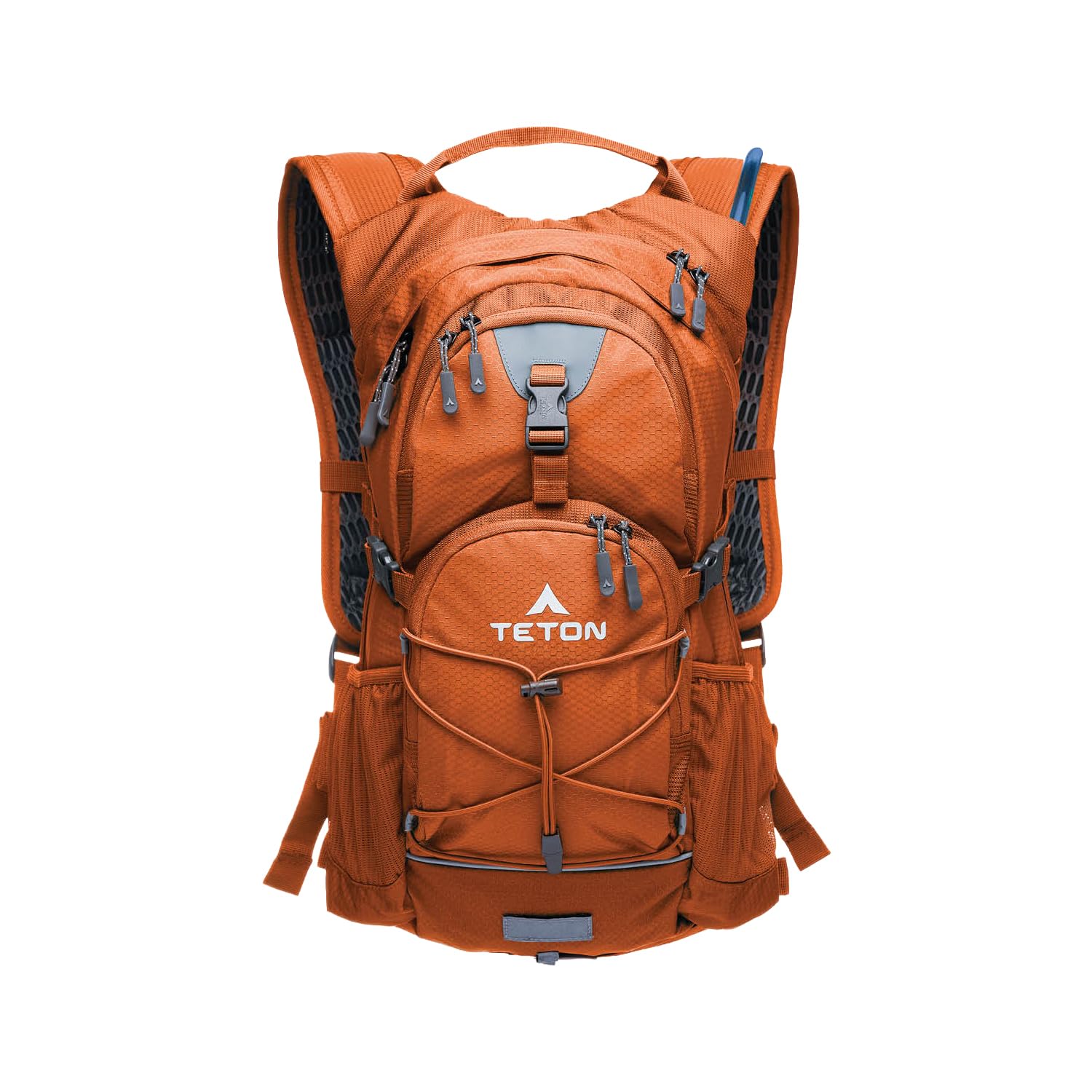
The Teton Oasis Trailrunner is the pack we reach for when we do not want to think about water. It comes with a 2-liter bladder, a wide 2-inch opening for ice and cleaning, and a push-lock bite valve that stays shut in a pack. That alone makes it a better first hydration pack than buying a bag and bladder separately.
The 18-liter body has enough room for a layer, lunch, and a few tools, and the sewn-in rain cover is a genuine convenience rather than a flimsy afterthought. We like the bungee cord on the outside for stuffing a jacket, and the weather-guarded zippers keep trail dust out of the main compartment. With a full bladder, it sits heavier than the packable options here.
The harness is not a universal fit, so try it loaded before committing. For a hydration-first day hike, though, the included bladder and rain cover make it a smart buy.
Pros
- 2L bladder included
- Sewn-in rain cover
- 18L with useful pockets
- Hands-free hydration
Cons
- Waist strap durability is a question mark
The Teton Oasis is the one we pick when we want a daypack and hydration bladder sorted in one purchase.
Best for Gear Organization
SKYSPER 20L
Key Features
- Weight: 1.1 lb
- Pockets: 10
- Capacity: 20 liters
- Water resistance: Water resistant
- Price: Midrange
Ten pockets sounds like overkill until you are on a muddy trail with a phone, keys, a map, snacks, and a layer that needs to stay dry. The SKYSPER 20L turns that clutter into seven compartments, including a hidden back pocket and two side bottle holders, and the anti-theft zipper is a travel feature that also keeps a wallet from wandering on a crowded train.
We found the organization genuinely useful rather than fussy: the main compartment swallows a lunch and a shell, the front pockets keep small items findable, and the trekking pole fixtures are there when the trail steepens. The 20-liter body is a sensible middle ground for three-season use, and the water-resistant fabric handles light rain without soaking through.
The weak spot is where the straps meet the pack. The strap attachment points are the first place to check before you load it heavily, and that is the reason this sits behind the Osprey rather than at the top. If you want a pocket-rich pack for travel and moderate day hikes, it is still a strong choice; just do not treat it as a load-hauler for years of rough use.
What we like most is how easy it is to keep a day’s gear sorted without adding a bunch of stuff sacks. For a traveler who hikes, that is a real convenience. For a dedicated trail pack, the Osprey’s harness is the better long-term bet.
Pros
- Ten pockets and seven compartments
- 20L at 1.1 pounds
- Water-resistant fabric
- Trekking pole fixtures
Cons
- Heavier than ultralight packable options
We like the SKYSPER 20L for travelers who want a place for everything, though its strap attachments need a careful look.
Best for Minimalist Day Hikes
Osprey Daylite 13L

Key Features
- Weight: 1.2 lb
- Capacity: 13 liters
- Material: Recycled 300D polyester
- Bottle pockets: Dual mesh
The Daylite 13L is the pack you choose when you want to carry less, not more. It is a simple panel loader with dual mesh bottle pockets, a sleeve that fits a 2-liter reservoir or a 14-inch laptop, and a recycled 300D polyester shell that feels tougher than its 1.2-pound weight suggests.
We like it for short hikes and fast summit days because there is nowhere to hide extra gear: water, snacks, a shell, and a phone, and you are packed. The mesh back panel stands off your back enough to reduce the sweaty patch we get from flat packs, and the side compression straps keep a half-empty load from sloshing around.
The 13-liter body is the whole point and the main limitation. It handles a half-day hike and a travel day beautifully, but a bulky fleece and a big lunch will crowd it, and it is not the pack for winter layers. For a minimalist hiker who wants one small pack that doubles as a town bag, this is the one we grab.
Pros
- Simple, durable 13L build
- Dual mesh bottle pockets
- Fits a 2L reservoir or 14-inch laptop
- Light at 1.2 pounds
Cons
- Not water resistant
We reach for the Daylite 13L on short, fast hikes where a simple, durable pack and two bottles are enough.
Best for Ultralight Travel
4Monster 16L

Key Features
- Pockets: 4
- Capacity: 16 liters
- Material: 30D nylon
- Packability: Wallet-sized pouch
- Price: Budget
The 4Monster packs down to something you can close your hand around. It is a 16-liter daypack made from 30D nylon, with four pockets, two mesh bottle holders, and a water-resistant finish, and it folds into a wallet-sized pouch. That is the kind of pack that earns its place in a suitcase or under a bike seat, not the one you plan a technical hike around.
For a short walk or a travel day, the size is right: a shell, lunch, a couple of bottles, and a camera fit without turning into a load. The straps are wider than the flimsiest packables we have handled, which helps, but this is still a light-duty bag. We treat it as a spare: it lives in the bottom of a duffel until a day trip calls for it.
The thin fabric is the trade-off. It keeps the weight down and the fold small, and it reminds you to pack light.
What we like most is the honesty of the design: it does not pretend to be a structured hiking pack, and it does the spare-bag job without adding weight. For a travel backup or a short, light hike, it is a smart buy; for a full day with a heavy bladder, choose one of the structured packs.
Pros
- Folds into wallet-sized pouch
- 16L capacity with four pockets
- Water-resistant 30D nylon
- Wider straps than typical packables
Cons
- Seams can stress under heavy loads
Our pick for a spare travel pack is the 4Monster, which folds small and handles short, light walks.
How We Chose and Tested the Best Hiking Daypacks
We started by pulling together 30 daypacks from brands we knew and a few newer names, then narrowed that list to 12 based on stated volume (18 to 30 liters), weight, pocket layout, and price. We wanted a mix that covered fast-and-light summit packs, travel-friendly models with laptop sleeves, and burlier packs for gear-heavy day hikes.
Each pack went on at least three hikes in the same local park system—a steep two-mile climb, a rolling five-miler, and one rainy eight-mile loop—loaded with the same kit: two liters of water, a rain shell, lunch, a first-aid pouch, and a camera. We weighed every pack empty and packed, then noted where the weight sat on my hips and shoulders after an hour. We also adjusted each harness to my 18-inch torso and, where possible, had a taller tester try it to see how fit changed.
For the travel-friendly claim, we packed each pack for a two-night trip and carried it through airport security and onto a train, paying attention to whether it slid under the seat and whether the pockets kept a passport and charger reachable without unpacking. Back home, we checked durability by dragging each bag over a granite slab, yanking every zipper 50 times, and leaving them in the sun for a week. Pockets got a simple test: could we reach a water bottle, snack, and phone without taking the pack off?
How to Choose a Daypack for Hiking
The right daypack is the one that carries your water, layers, and lunch comfortably enough that you stop thinking about it.
Match capacity to the day, not the label
A 20-liter pack is the middle ground for most three-season day hikes: two liters of water, lunch, a shell, and a small first-aid kit fit without much Tetris. Go smaller, around 13 to 15 liters, when you move fast and carry less; go to 35 or 40 liters when winter layers, a camera, or family gear come along. The trap is treating liters as standardized: a narrow 20-liter pack can feel smaller than a roomy 15-liter one, so pack your actual kit before you commit.
Carry comfort is the upgrade you feel by mile five
A pack that feels fine empty can turn into a shoulder ache once it is loaded. Look for a back panel that holds the pack close without a sweaty slab, shoulder straps that curve rather than cut, and a chest strap or hip belt that keeps the load from swaying. Our test loads made the difference obvious: the Osprey Daylite Plus and SKYSPER 15L felt more stable than the simple packables, especially when we picked up the pace. Load any candidate with about 10 to 15 pounds and walk for ten minutes before you decide.
Organization should speed up the trail, not add clutter
The useful pockets are the ones you can reach without taking the pack off: deep side bottle holders, a front stretch pocket for a shell, and a small top or hip pocket for snacks and a phone. The SKYSPER 20L’s ten pockets are great for travelers who like a place for everything, but more compartments can mean more zippers and a little extra weight. Put your water in the side pockets and see whether you can re-sheathe the bottle one-handed; that is the access test that matters most on a hike.
Weather protection and durability: read the fine print
Water-resistant fabric handles drizzle; it does not make a pack submersible, and seams and zippers are where water usually gets in. A rain cover is worth having if you hike in changeable weather, and the Maelstrom 40L includes one. For packable bags, the trade is obvious: the Outlander and 4Monster fold small because the fabric and straps are thin, so keep them for light loads and inspect the strap attachments before a long day. If you carry a heavy load often, pay for structure and stitching rather than the smallest folded size.
Frequently Asked Questions
Can I use a daypack as an airline personal item?
Often, yes, but the airline’s size limit decides, not the pack’s liter rating. A 13- to 20-liter pack is the usual range that fits under the seat; the Osprey Daylite 13L and Daylite Plus are both in that zone, while the 40-liter Maelstrom is not a personal-item pack. Measure the bag packed, not empty, and check your carrier’s limit before you fly.
How much weight can a hiking daypack carry?
There is no universal number, so follow the pack’s stated maximum and your own comfort. The SKYSPER 20L lists a 7 kg limit; most daypacks are happiest with water, food, and a layer, and loads above roughly 15 pounds benefit from a hip belt. Weigh your full kit at home, then carry it around the block before committing to a long hike.
How do I keep a hydration bladder from tasting like plastic?
Rinse the bladder with warm water and a little mild soap before the first use, then let it dry completely with the opening propped apart. The Teton Oasis bladder’s wide 2-inch opening makes that easier. After sugary drinks, repeat the rinse and store the bladder in the freezer between trips if you want to discourage mold.
Final Verdict
For most hikers, the Osprey Daylite Plus is the daypack to buy. It has the rare combination of a supportive carry, a useful 20-liter body, and enough durability to handle repeated weekends without feeling like a dedicated expedition pack. The AirScape back panel and dual bottle pockets are the details that make it easy to live with.
If your day is fast and light, the SKYSPER 15L is the better fit; if you carry bulky winter or family gear, the Maelstrom 40L earns its extra bulk. The Daylite Plus remains the default because it covers the widest range of ordinary day hikes, and the only reason to step away is a load that genuinely needs more volume.