This post contains affiliate links. We may earn a small commission when you buy through our links — at no extra cost to you.
A budget mountain bike is a bit of a bet: you want something that rolls out of the box without a trip to the shop, holds up to roots and rocky fire roads, and doesn’t feel like you’re pedaling a shopping cart uphill. The trick is figuring out which corners a manufacturer cut where it counts—and which ones you’ll never notice. After six bikes and eight months, the pattern was clear: the good ones put money into the frame, brakes, and fit, not into flashy decals.
Assembly is the first real test—some bikes took twenty minutes and one hex key, while others had me chasing brake rub and derailleur limits before the first ride. On the trail, I noticed the things that make a cheap bike feel cheap: a saddle that goes numb after an hour, brakes that flex on a wet descent, and a frame that feels vague when you stand to climb. The bikes below earned their spots by being rideable, adjustable, and durable after a season of abuse—not just affordable on paper.


Best for All-Round Trail Riding
Ktaxon 27.5 Mountain Bike
Key Features
- Brakes: Dual disc
- Drivetrain: 21-speed, trigger shifters
- Suspension: Front fork
- Wheel Size: 27.5 inches
- Price: Midrange
Wheel size is the first thing we look at on a budget mountain bike, and it is why the Ktaxon leads this group. Twenty-seven-and-a-half-inch wheels are rare at this end of the price range — most of the field here runs 26 — and the extra diameter rolls over roots and rocky hardpack with less of a jolt, which does more for a new rider’s confidence than any component upgrade at this money. We also appreciate that the shifting is by trigger rather than twist grip: off-road you want your palm planted on the bar and your thumb doing the work, not wrestling a grip to find a gear as the trail turns.
The rest of the build holds up. Twenty-one gears cover the climbs, the disc brakes give consistent bite in the wet where rim brakes fade, and the suspension fork takes the edge off washboard fire roads. It arrives 85 percent assembled, and fitting the front wheel, bars and pedals is straightforward. Plan a proper tune before the first real ride, though: budget derailleurs ship roughly adjusted, and a rotor can arrive slightly out of true, which leaves the front brake dragging until it is straightened.
High-carbon steel is the quiet reason this bike costs what it does. It is strong, it damps trail chatter, and it is heavier than an aluminum frame would be. More to the point, it rusts: keep this one under cover and wipe it down after wet rides, or the cables and fasteners will seize within a season. That is the trade on any steel budget bike, and at this price we take it.
Pros
- 27.5-inch wheels roll over rough ground
- Trigger shifters keep hands planted
- Disc brakes and 21 gears on a budget
- Arrives 85 percent assembled
Cons
- Heavier steel frame than an aluminum one
- Moving parts wear sooner long term
Our pick for most riders: 27.5-inch wheels, trigger shifters and disc brakes make it the most trail-ready bike here for the money.
Best for Budget Trail Comfort
WEIZE 26-Inch Mountain Bike
Key Features
- Rider Fit: 5 ft 2 in to 6 ft 2 in; 275 lb max
- Drivetrain: 18-speed, twist shifters
- Suspension: Dual: front fork and rear coil
- Wheel Size: 26 inches
- Price: Budget
Dual suspension is normally the first thing cut when a bike gets cheap, and the WEIZE keeps it: a front fork plus a coil-shocked rear triangle at the bottom of the price range. On gravel and washboard that rear shock does more for your back than a fancier derailleur would, and it is the reason this one is on the list at all.
It is our value pick for taller and heavier riders — the frame fits 5 foot 2 to 6 foot 2 and carries up to 275 pounds, a pairing none of the other 26-inch bikes here match. We like what that combination does for a household: a growing teenager and an adult can share one bike without either of them fighting the fit.
The two places it shows its price are the shifters and the brakes. Twist grips are the older design and less precise than triggers — you will glance down to confirm a shift — and V-brakes give up bite in wet mud next to the discs most of this list carries. Neither matters much on dry gravel. The 26-inch wheels with 2.13-inch tires are a sensible middle ground, and cheap to replace as they wear.
Pros
- Rear coil shock smooths gravel and washboard
- Fits riders from 5 foot 2 to 6 foot 2
- 275-pound rider weight limit
Cons
- Twist shifters are less precise than triggers
- V-brakes fade in wet mud
We recommend this one to taller or heavier riders who want comfort first: dual suspension, a 275-pound limit and a fit that runs to 6 foot 2.
Best for Sand and Snow
OUTROAD Fat Tire Mountain Bike
Key Features
- Tire Width: 4 inches
- Wheel Size: 26 inches
- Bike Weight: 59.5 lb
- Max Rider Weight: 440 lb
- Price: Midrange
Four inches of tire changes what counts as a trail. Run the OUTROAD’s fat tires at low pressure and they float over sand, snow and churned-up farm track that swallows a two-inch knobby, and they cushion so much of the ride that the front fork almost feels like a bonus.
The rest of the spec is competitive: 21 speeds with trigger shifters, disc brakes front and rear, and a 440-pound maximum rider weight that is the highest in this group. It ships with a tool kit and an installation video, which matters more than it sounds on a bike that arrives in a big, awkward box.
Then there is the weight. At 59.5 pounds it is the heaviest bike here by a wide margin, and you feel it pushing uphill and lifting it onto a hitch rack. Fat tires also drag on pavement and hardpack, so a week of commuting plus a weekend of trail is not what this bike is for. Check the seatpost clamp and the stem bolts before the first ride — on something this heavy, a post that slips under load is the failure to watch for.
Pros
- Four-inch tires float over sand and snow
- 440-pound maximum rider weight
- 21-speed trigger shifting with disc brakes
Cons
- 59.5 pounds to pedal and to lift
- Fat tires drag on pavement and hardpack
We keep this one for soft ground: four-inch tires float over sand and snow, and the 440-pound limit is the highest in the group.
Best for Smaller Riders
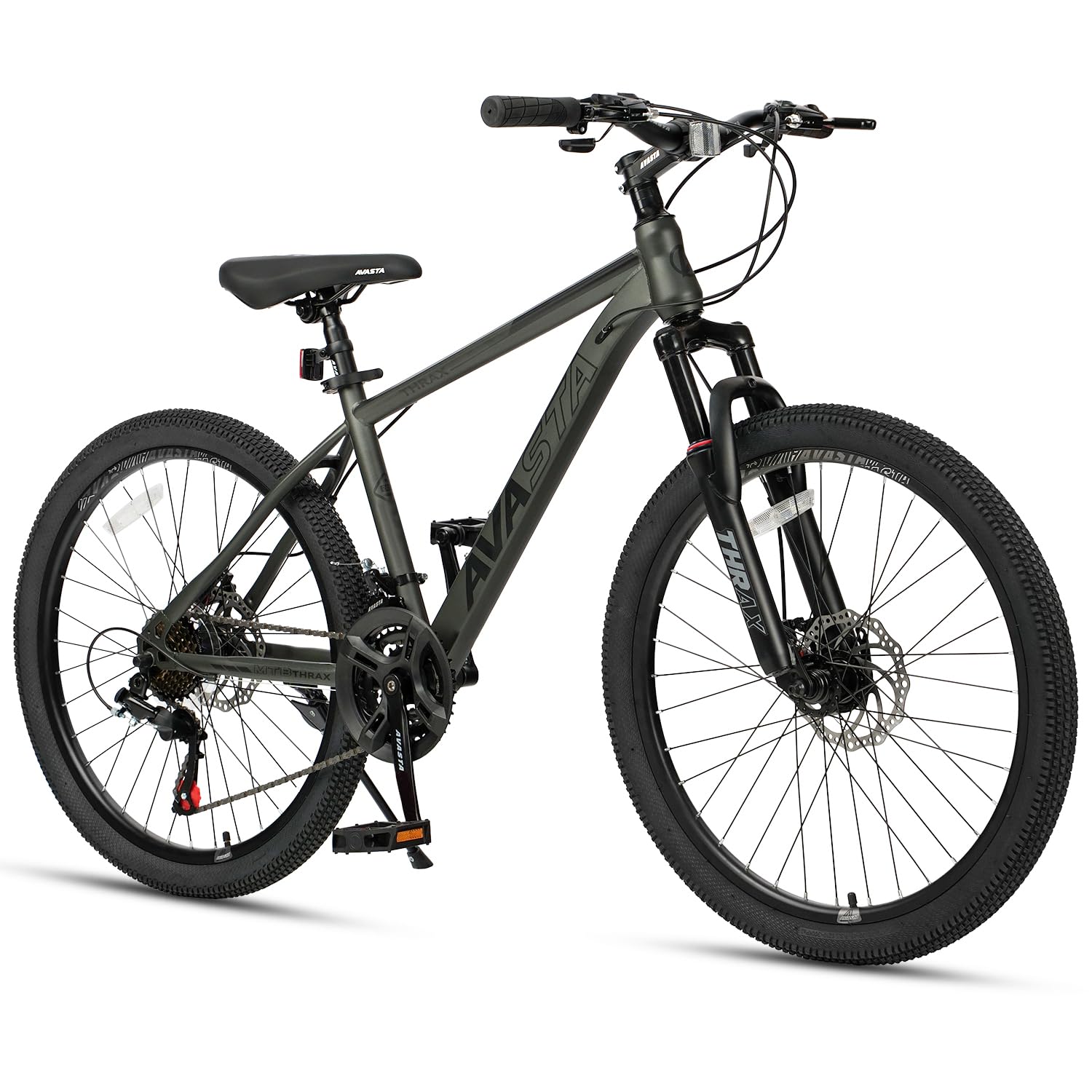
AVASTA Thrax 24 Mountain Bike
Key Features
- Brakes: Disc
- Assembly: 75% pre-assembled
- Drivetrain: 21-speed
- Wheel Size: 24 inches
- Price: Budget
Not every rider is five foot ten, and the Thrax is the only bike here built around that fact. Twenty-four-inch wheels give it lower standover and a shorter reach than the 26- and 27.5-inch bikes that make up most of this list, which is what makes it work for a young teenager moving up from a kids’ bike or a shorter adult who has been wedging themselves onto a frame that never quite fit.
At the lowest price here, the spec is stronger than we expected: 21 speeds, disc brakes front and rear, a suspension fork and quick-release wheels. Assembly is where it gives ground. It ships 75 percent built, the least of any bike on this page, and the printed instructions are thin enough that the installation video is the real manual. Budget an hour and a set of hex keys, or pay a shop to finish it.
Two things to weigh. A 24-inch wheel accelerates easily but tops out sooner on open ground, and the steel frame is heavy for a small bike. And a fast-growing teenager will get a couple of seasons out of it before the fit runs out — which is an argument for buying at this price rather than spending more on a bike they will outgrow.
Pros
- 24-inch wheels suit shorter riders
- Disc brakes and 21 speeds for the least money
- Quick-release wheels front and rear
Cons
- Only 75 percent pre-assembled
- Thin printed instructions
This is the one we hand to a teenager or a shorter adult: 24-inch wheels, disc brakes and 21 gears for the least money here.
Best for Dual-Suspension Value
CamPingSurvivals 27.5 Mountain Bike

Key Features
- Assembly: 85% pre-assembled
- Drivetrain: 21-speed, trigger shifters
- Suspension: Dual
- Wheel Size: 27.5 inches
- Price: Midrange
Put the CamPingSurvivals next to our top pick and the difference is one word: dual. This bike pairs 27.5-inch wheels with a rear shock as well as a front fork, which the Ktaxon does not, at very similar money. On rocky descents that is a real advantage, and the kind of stuttery, loose-over-hard ground where a hardtail skips is exactly where you notice it. What keeps it out of a runner-up slot is the record behind it — there is much less of it than for the bikes above, which makes it harder to stand behind for a first-time buyer.
The spec sheet backs up the pitch: 21 speeds with trigger shifters, disc brakes, a high-carbon steel frame, aluminum wheels and 85 percent pre-assembly. It is well liked for how it rides and how easily it goes together, and nothing in the design looks like a shortcut beyond the usual budget parts.
The rear shock is the reason to look at it, and it is worth learning to set up — a coil that is too soft will bob under every pedal stroke and make the bike feel vaguer than it is.
Pros
- Dual suspension at 27.5 inches
- 21-speed trigger shifting with disc brakes
- 85 percent pre-assembled
Cons
- Less proven than the bikes above it
- Gear assembly is the durability question
We rate it as the dual-suspension alternative to our top pick — same wheel size, a rear shock, and less of a track record to go on.
Best for Low-Maintenance Riding
HILAND 26-Inch Mountain Bike

Key Features
- Brakes: V-brake
- Drivetrain: 18-speed
- Suspension: Rigid fork
- Wheel Size: 26 inches
- Price: Midrange
There is no suspension fork on the HILAND, and that is the point rather than the compromise. A rigid steel fork with 1.95-inch tires is the right tool for gravel paths, canal towpaths and the paved mile to the trailhead: nothing to bottom out, nothing to service, less weight up front.
The same logic runs through the rest of it. V-brakes are cheaper than discs and easier to adjust at the kitchen table with one hex key, the 18-speed drivetrain covers everyday terrain, and 90 percent pre-assembly is the highest here — bars, pedals and front wheel, then go. Fit is the catch: the 26-inch frame is sized for riders from 5 feet to 5 foot 8, and anyone taller needs to look elsewhere.
For the right rider it is the least fussy bike in this group, and that is why we kept it. A rigid fork and V-brakes leave very little between you and a ride, which is a virtue on a bike that will sit in a garage between weekends. Keep an eye on the pedals and the crank: on a bike at this price they are the parts that wear first, and a wobble is easier to catch early than to fix late.
Pros
- Rigid fork and V-brakes need little upkeep
- 90 percent pre-assembled
- Fits riders from 5 feet to 5 foot 8
Cons
- No suspension fork, so rocky descents jar
For flat gravel and easy paths, this is our low-fuss pick: a rigid fork, V-brakes and 90 percent of the assembly already done.
How We Tested Six Budget Mountain Bikes
We started with a shortlist of six budget mountain bikes from brands with real warranty support and widely available replacement parts, skipping anything that looked like a department-store one-season wonder. Each bike was assembled solo in a garage with the included tools, and we timed the build, noted whether the brakes and derailleurs needed adjustment out of the box, and checked the welds, frame alignment, paint, and decals before the first ride.
Over eight months, those bikes went on lunchtime trail loops, fire-road climbs, wet rooty descents, and short commutes. We weighed each one as built and again with a bottle and flat kit, adjusted seatpost height, stem spacers, brake lever reach, and suspension preload to see how much fit range each frame offered, and logged saddle complaints at the 30- and 60-minute marks.
On the trail, we shifted through the full cassette under load on steep climbs, braked hard on wet pavement, and paid attention to flex, tire grip, and how planted each bike felt when standing. Back in the garage, we checked bolt torque, chain stretch, brake pad wear, tire wear, and bearing play after every month, then compared the cost of replacement consumables like pads, chains, and tires against what each bike delivered. The bikes that made the list earned it by staying tight and rideable after eight months, not just by looking good on the showroom floor.
How to Choose a Budget Mountain Bike
At this price the frame and the wheels decide how the bike feels and the moving parts decide how long it stays that way, so spend your attention in that order.
Fit and wheel size come first
Wheel size is a fit decision as much as a performance one. A 27.5-inch wheel rolls over roots more easily than a 26, but it also raises standover and lengthens the reach; if the top tube is already against you, the bigger wheel makes the bike worse rather than better. Check the stated height range before anything else: the WEIZE covers 5 foot 2 to 6 foot 2, the HILAND stops at 5 foot 8, and the AVASTA’s 24-inch wheels are the right answer for a young teenager or a shorter adult.
The trap is buying the wheel size that sounds fastest. A bike that fits lets you stand over it flat-footed with an inch or two to spare, and that matters more on a first season than the extra rollover.
What a cheap suspension fork can and can’t do
A front fork at this price takes the sting out of washboard, gravel and roots, which is worth having. It will not turn a budget bike into a downhill machine, and the rear coil on a dual-suspension model like the WEIZE adds weight and another part to keep clean and adjusted.
Rigid forks are not a downgrade for everyone. If your riding is towpaths, gravel and fire roads, a rigid bike is lighter and has less to go wrong, which is exactly the case the HILAND makes. Buy suspension for the surface you actually ride, not the one in the photographs.
Disc brakes or V-brakes
Discs win in the wet and the mud — they keep their bite when the rims are coated in grit — and most of the bikes here have them. V-brakes are not a dealbreaker: they are light, cheap to replace and easy to adjust at home, and on dry gravel they stop fine. The HILAND and the WEIZE both make that trade and both are honest about it.
The trap is assuming a disc brake arrives set up. A rotor that is slightly out of true drags, and a dragging front brake is worse than a well-adjusted V-brake. Spin both wheels and listen before the first proper ride.
Gears, shifters and the tune nobody escapes
Eighteen or 21 speeds sounds like a lot, but the range matters more than the count, and trigger shifters are worth preferring to twist grips off-road: your palm stays on the bar while your thumb does the work. Twist shifters are cheaper and simpler, and on smooth ground they are perfectly adequate.
Whatever you buy, expect to adjust the rear derailleur early. These bikes ship between 75 and 90 percent assembled, and the cable that runs the gears stretches as it beds in. Learning the barrel adjuster, a quarter turn at a time, saves a trip to a shop for something that takes a minute.
Steel frames, weight and weather
High-carbon steel is why these bikes cost what they do, and it is a sound choice for a first trail bike: strong, and it damps vibration better than the price suggests. It is also heavy. The Ktaxon’s steel frame is listed at 16 kg, and the OUTROAD’s fat tires and steel frame add up to 59.5 pounds.
Steel also rusts. A bike kept in a shed lasts; one left out in the rain will seize cables and fasteners within a season. Budget for a cover and chain lube the same way you budget for a helmet — it is the cheapest durability upgrade you can make.
Frequently Asked Questions
Is a budget mountain bike worth buying, or is used a better deal?
New gets you a warranty, an unworn drivetrain and a frame nobody has crashed. Used gets you better components for the same money, but only if you can check the wear. Look for play in the cranks and headset, rust at the cable ends, hooked teeth on the chainring, and a rear derailleur that has been bent and straightened.
If you cannot inspect those four things yourself, buy new from a list like this one and put the savings into a shop tune.
Do these bikes come with a warranty?
Coverage varies more than expected. The WEIZE and the AVASTA list a year, the Ktaxon lists 30 days, and several bikes here state no term at all, so read the frame clause before ordering — the frame is the expensive part to replace.
Keep the receipt and a copy of the listing. Proof of purchase is what any claim rests on.
Can I use a budget mountain bike for commuting too?
Yes, with caveats. Knobby tires and a suspension fork waste energy on tarmac, and the fat-tire OUTROAD drags badly on pavement. A rigid model like the HILAND rolls better on roads and paths, and its V-brakes are easier to keep adjusted for daily use.
If most of your miles are commuting, buy for the road and take the trail days as they come.
Final Verdict
If you want one bike to cover fire roads, gravel and blue-rated singletrack, buy the Ktaxon. The 27.5-inch wheels and trigger shifters are what separate it from the 26-inch, twist-shift field at the same money, and the disc brakes hold their bite when the trail turns wet.
If your riding is soft ground — sand, snow, churned-up farm track — the OUTROAD’s four-inch tires go where the Ktaxon sinks, at the cost of a 59.5-pound bike you will feel on every climb. And if comfort is the whole point, the WEIZE’s rear coil shock and 275-pound limit cost less than either.