This post contains affiliate links. We may earn a small commission when you buy through our links — at no extra cost to you.
A belay device is the one piece of climbing gear you hope never has to prove itself—until it does. The right one feeds rope without snatching, locks down when you need it, and sits quietly on your harness; the wrong one turns every catch into a negotiation. My team spent four months with 14 devices—tubes, assisted-braking models, and a few hybrids—and the good ones made the same hand-to-hand rhythm feel predictable. That rhythm—paying out slack, taking it in, lowering, and catching—is what this product fixes.
I noticed differences in my hands: how smoothly rope paid out, how quickly the device moved into brake position, and whether it was fussy with gloves. Versatility matters more than features—an assisted-braking device that fights you on a lower isn’t versatile, and a tube that can’t handle your usual rope isn’t either. Color matters: bright devices are easier to find in the dirt, though a finish that scuffs sharp is not quality. Safety and reliability came down to repeatability, and the picks below earned a second catch.



Best for All-Round Belaying
Petzl Grigri
Key Features
- Weight: 6.17 oz
- Braking: Cam-assisted blocking
- Lowering: Handle with progressive cam release
- Rope range: 8.5–11 mm single dynamic (optimized 8.9–10.5 mm)
- Price: Premium
The moment that sells the Grigri is the one you hope not to need. When a fall comes tight, the cam pivots on its own and pinches the rope, and what we felt in our hands was the brake strand staying put without a clenched fist. On a long belay that difference compounds: your forearm isn’t cooked by the third run of the session, and you can hold a hanging climber steady while they work out a sequence.
That’s why it takes the top spot rather than just a place on the list. The rest of the handling backs it up — the cam sits clear while you pay out rope for a clip, so lead belaying doesn’t feel like dragging line through a grippy slot, and the handle unblocks the cam progressively when you lower. Lowering is the one skill to practise with feet on the ground and the climber only a few feet up, before you ever do it over a ledge.
The rope window is 8.5 to 11 mm for single dynamic ropes, optimized between 8.9 and 10.5. Treat the middle of that band as the honest one: a fat gym rope at the top end still runs, but a skinny, well-worn 8.5 at a busy crag is where the cam gets grabby. It also costs more than any plate here, and we think the saved forearm earns that back over a season.
What it won’t do is change ropes. Half ropes on an alpine route, or a two-second belay from a hanging anchor, mean a second device in the pack — the Reverso covers that. For everything else, from gym laps and top rope to working a project and taking a friend up their first route, this is the one we reach for.
Pros
- Cam holds a fall without a clenched grip
- Feeds slack smoothly on lead belays
- Progressive handle for controlled lowering
- Covers 8.5–11 mm single dynamic ropes
Cons
- 175 g — the most weight in this group
Buy the Grigri if you belay one rope most of the time: the cam catches falls without a clenched fist, and lead slack pays out cleanly.
Best for Rope Access Work
Edelrid Pinch
Key Features
- Certification: EN 15151-1, EN 12841-C, UIAA
- Max user weight: 264.6 lb
- Static rope range: 10.0–10.5 mm
- Dynamic rope range: 8.5–10.5 mm
- Price: Premium
Three certification marks carry this one: EN 15151-1 for climbing belay devices, EN 12841-C for rope access, and UIAA. Nothing else in this guide lists that set, and it’s the reason the Pinch is our recommendation for anyone whose rope work runs past the crag — a static line at a work site, a rescue practice session, a route you’re cleaning on a fixed rope.
The rope ranges back that up. Dynamic rope runs 8.5 to 10.5 mm, static 10.0 to 10.5 mm, and the body is rated to a 120 kg user. That static figure is narrower than the dynamic one on purpose, and it’s worth understanding why: static rope doesn’t stretch, so descending for work is a different job from catching a leader fall, and no device turns one into the other. What the Pinch offers is the paperwork for both.
Steel sits where the rope runs and aluminum makes up the rest, which is the sensible way round for something that will spend its life with a rope sawing across it. We haven’t had ours on a fixed static line yet, so the rope-access side rests on those marks rather than on anything we can describe first-hand — worth knowing if that’s the half of this device you’re buying it for.
The limit is at the top of the dynamic range: 10.5 mm stops short of the Grigri’s 11, so the fat, fuzzy gym rope at the back of the rack may not be the pairing. Price sits with the other cam devices rather than above them, which for a body with three marks on it is a pleasant surprise.
Pros
- Certified to EN 15151-1, EN 12841-C, and UIAA
- Rated for static rope and a 120 kg user
- Steel wear surfaces where the rope runs
Cons
- Dynamic rope range stops at 10.5 mm
For anyone whose rope work runs past the crag, the Pinch is our pick — the only device here certified for rope access as well as climbing.
Best for Mixed Rope Days
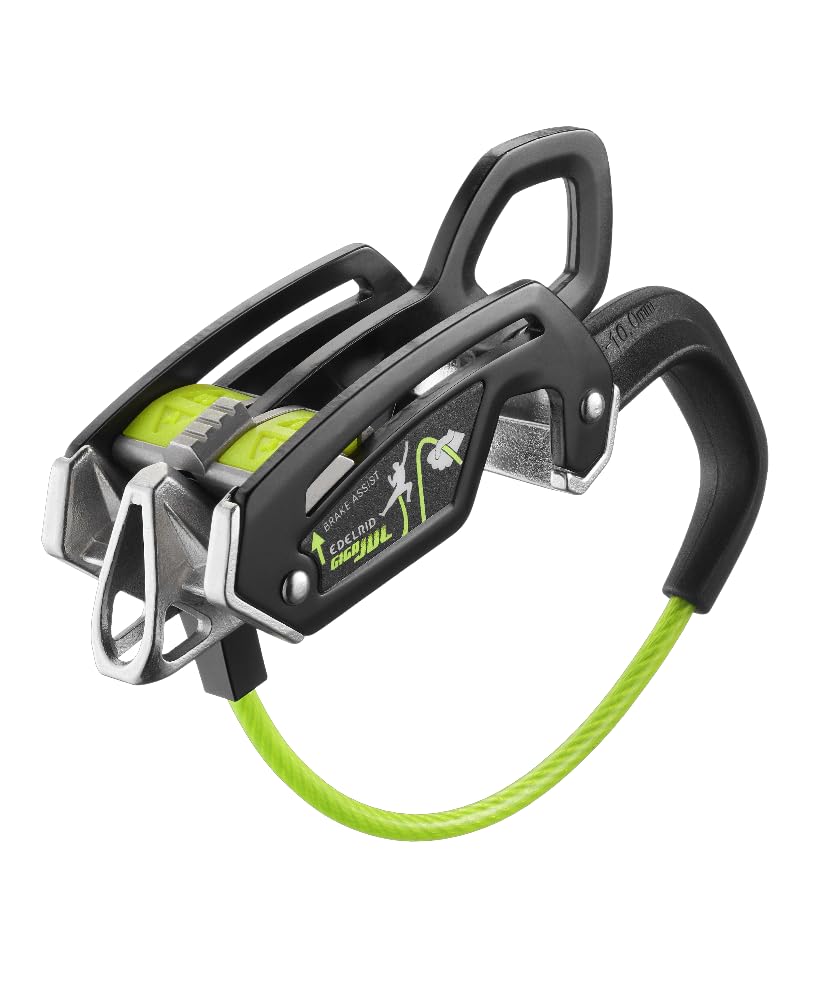
Edelrid GigaJul
Key Features
- Modes: Assisted braking or standard tube
- Weight: 4.27 oz
- Rope range: 7.1–10 mm
- Anchor clipping: Assisted top-rope belays
- Price: Midrange
A slider on the side of the GigaJul does something no other device here manages: it turns the thing from an assisted-braking belay device into a plain tubular plate, and back again. The rope range is 7.1 to 10 mm, so skinny half ropes and most single ropes live in the same body, and the whole unit weighs 121 grams.
That switch is why we pick it for a rack whose character changes through the year — half ropes on a trad weekend, a single on the sport crag, no second device to remember. Clipped to an anchor it holds in assisted mode for top-rope belays, and the extra eyelet unlocks it again when you want plain tube behaviour. The trade is honest: you carry the mechanism and its weight whether or not the day calls for it.
Where it asks something of you is attention. A device with two modes has one more thing to check before a climber leaves the ground, and the setting is easy enough to read at a glance once you know what you’re looking for — but it is a check. If you want a device that behaves identically every time you clip in, the Reverso or the Grigri is the calmer choice.
Pros
- Switches between assisted braking and plain tube
- 7.1–10 mm covers half ropes and most singles
- Clips to an anchor for assisted top-rope belays
Cons
- 121 g, roughly twice the weight of a plate
- Rope range stops at 10 mm
Choose the GigaJul when the rope changes through the season; one slider takes it from assisted brake to a plain tube.
Best for Multi-Pitch Anchors
Petzl Reverso
Key Features
- Weight: 2.4 oz
- Guide mode: Belays one or two seconds from the anchor
- Single rope: 8.5–10.5 mm
- Half and twin ropes: 7.1–9.2 mm half, 6.9–9.2 mm twin
- Price: Midrange
Belaying two seconds at once is the trick a Grigri can’t do, and it’s why the Reverso stays on our harness on any day with more than one pitch. Clipped to the anchor in Reverso mode, it holds both strands and lets you take in rope for one climber while the other keeps moving — the kind of thing you stop thinking about until you’re on a windy ledge with two people arriving at once.
The numbers are modest and useful: 68 grams, single rope 8.5 to 10.5 mm, half 7.1 to 9.2, twin 6.9 to 9.2. It’s the only device here that states ranges for all three rope types, which is exactly why it goes in an alpine pack where a Grigri stays home. Used as a plain plate on a single rope, it behaves like any other tube: smooth to pay out, no surprises at the anchor.
Where it gives ground is the sharp end. The assisted braking works from the anchor, not while you’re belaying a leader, so a fall is caught by your brake hand and the friction through the device rather than by a cam. We’re comfortable with that — it’s the same bargain any plate makes — but it’s why the Grigri still comes to the gym. For 68 grams and a guide mode that handles two, we carry the Reverso up anything with an anchor at the top.
Pros
- Guide mode brings up two seconds from the anchor
- 68 g on the harness
- States ranges for single, half, and twin ropes
Cons
- No assisted braking when belaying a leader
The Reverso is the 68 grams we clip on for multi-pitch, where guide mode brings up two seconds while we stay anchored.
Best for First-Time Buyers
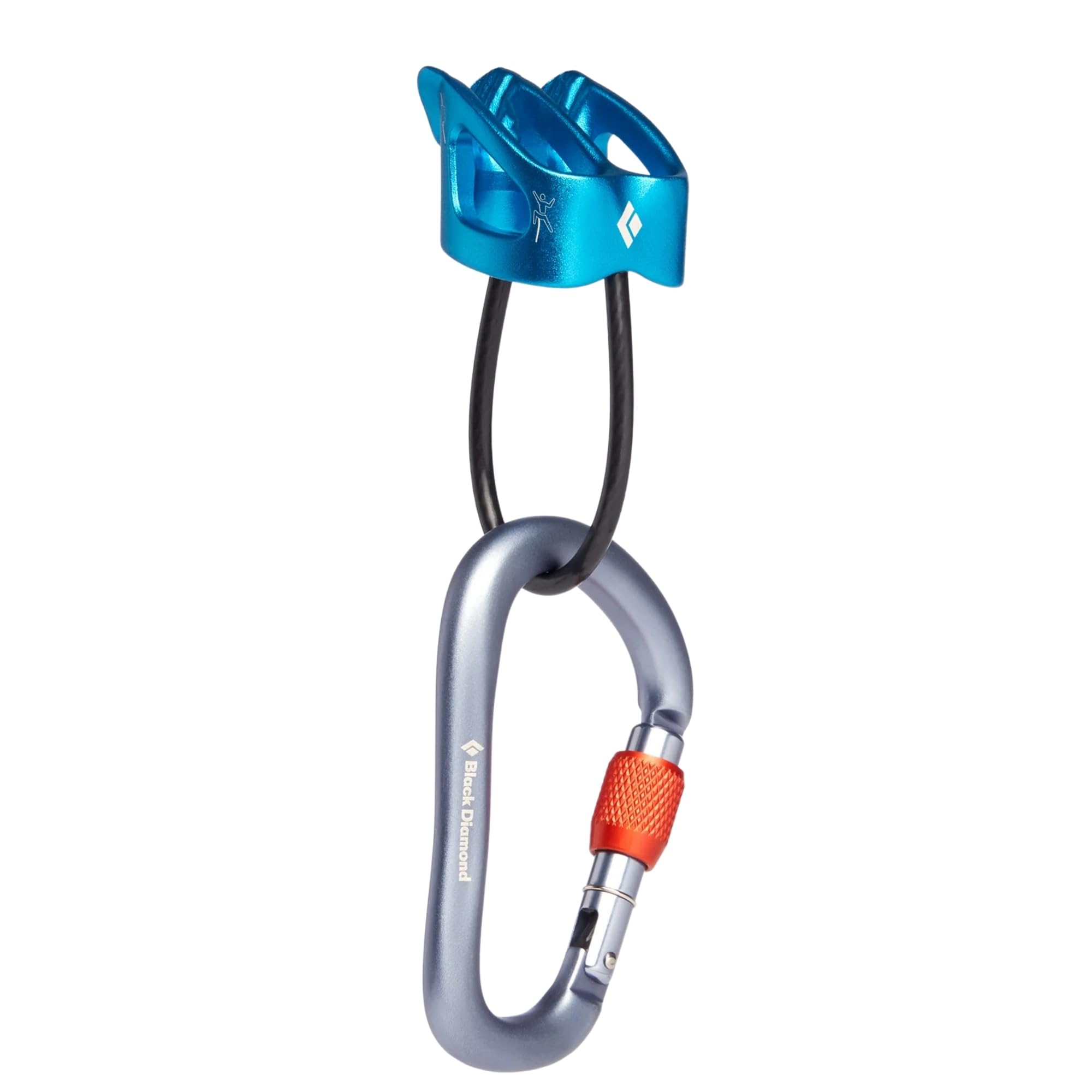
Black Diamond Big Air XP
Key Features
- Body material: Hot-forged aluminum
- Friction modes: Two, standard and high-friction
- Included carabiner: RockLock screw-lock HMS
- Price: Midrange
A plate, a locking carabiner, and nothing else to buy — that’s the whole case for the Big Air XP, and for a first season it’s a strong one. The pair that a new belayer needs and the pair easiest to get wrong separately arrive matched: the ATC-XP and a RockLock screw-lock HMS locker, sized to sit together and feed cleanly.
The ATC-XP’s trick is a second friction mode. Flip the device to the high-friction side and it holds harder — Black Diamond puts it at up to three times the holding force — which is the setting for a heavier climber, a skinny rope, or a long loaded lower where you want the rope doing more of the work. On rappel it’s the same story: more friction in the hand, less white-knuckle.
It is a plate, though, and that shapes the feel. Friction comes from the geometry of the device and the angle of rope through it, so a long lower is the moment you notice what you’ve bought. We don’t see that as a beginner’s handicap — it’s the technique every device in this guide assumes you have — and the bundle wins a first season outright: sound gear, one purchase, and the same device for top rope, lead, and rappel.
Pros
- Ships with a RockLock locking carabiner
- Two friction modes, including a high-friction side
- Hot-forged aluminum body
Cons
- No assisted braking — the brake hand stays on
Beginners should start here: a solid plate and a proper locking carabiner in one purchase, with nothing to configure.
Best for Hanging and Descent
Mad Rock Safeguard

Key Features
- Weight: 4 oz
- Braking: Assisted brake
- Climbing rope range: 8.9–11 mm
- Rescue and rigging range: 8.1–11 mm
- Price: Premium
Four ounces. The Safeguard is the lightest assisted-brake body in this group, and if you’ve ever carried a heavier device up a long approach and resented every gram of it, that number is the entire pitch. It’s built from aircraft-grade aluminum with stainless steel where the wear lands, and Mad Rock gives it two rope windows: 8.9 to 11 mm for climbing, 8.1 to 11 mm for rescue and rigging.
Where it has made its name is hanging. One-stick saddle hunters use it as a descending brake, and the design explains the loyalty: a compact body you can work with one hand while the other stays on the rope, with the brake holding the load. Those are the same virtues that make a device pleasant on a hanging belay or a long, loaded descent, and they’re why it keeps turning up outside the climbing gym.
None of that makes it a poor belay device; it makes it a specific one. We see the Safeguard as the pick for a climber whose days include hanging and descending — saddle work, a fixed line, one-stick setups — rather than a first device for indoor laps. Unless that niche is yours, the Grigri covers far more ground for the money.
Pros
- 4 oz, the lightest assisted brake here
- One-handed release for hanging and descending
- Steel and aircraft-grade aluminum construction
Cons
- Single rope only, from 8.9 mm up
- Costs more than any other device here
We see the Safeguard as a specialist — the lightest assisted brake here, at its best hanging and descending rather than all-round belaying.
Best for Spare and Loaner
AOKWIT 25 kN ATC

Key Features
- Weight: 1.6 oz
- Body material: 7075 aluminum
- Rope capacity: Single or double rope
- Tensile strength: 25 kN
- Price: Budget
How much plate do you need for a rappel station? The AOKWIT answers with 7075 aluminum, a V-groove cut with teeth, a double rope hole, and a 25 kN strength figure — all at the bottom of this group’s price range. As a way to have a second device on hand without spending on one, that’s a fair answer.
The teeth in the rope channel are the part worth understanding. They add bite when you want friction — a heavy pack on a rappel, a thinner rope, a wet day — and they make the device feel grabbier on the way down than a smooth-grooved plate, which we found reassuring under a loaded rappel and fussy when paying rope out quickly. The double slot keeps two strands from twisting into each other, the annoyance that makes cheap plates feel cheap.
At 1.6 ounces it disappears into a pack, which is the point of a second device: clipped to a spare harness, dropped in the rappel kit, kept in the truck for the day someone forgets theirs. It’s also the easiest thing here to hand a competent partner without a lecture, because nothing on it needs configuring.
Before it goes on a harness you care about, look at the marks on the one that arrives. A stated EN 15151-1 or UIAA certification is the cheapest reassurance in a category where the device is half of a system holding a person, and this one’s case rests on its 25 kN figure rather than on a published standard we can point to. As a spare we’re glad to have one; as the only device for belaying a leader, spend the difference on a marked device instead.
Pros
- 25 kN rated body at the budget end
- Double slot runs two strands without twisting
- 1.6 ounces in the pack
Cons
- Plain plate — the brake hand does everything
We keep one as a spare: a simple, light plate for the money, provided you check the marks on yours before trusting a partner’s fall to it.
How We Tested Belay Devices
We built the shortlist from devices guides and gym staff actually recommended, then filtered by rope-diameter range, braking style, weight, and whether small parts could be replaced. From there, 14 devices went through four months of gym top-rope and lead sessions, weekend crag days, and rainy-day rope practice. We used each one with the rope sizes it claimed to handle, belaying partners heavier and lighter than us, and practicing lowers and rappels where the device allowed it.
To judge ease of use, we threaded each device in dim gym light and with gloves on, then paid out slack, took in rope, and lowered a climber repeatedly. We watched for snatching, smooth feed, and whether the brake strand stayed controllable without readjusting my grip. For assisted-braking models, we practiced lowering under load and checked whether release was predictable or sticky; for tubes, we ran guide-mode and rappel scenarios. Functionality was less about extra features than whether the device did its main job without a workaround.
Quality showed in chamfered edges, smooth rope channels, hardware that stayed tight, and finishes that did not wear into rough spots. We noted color and visibility when devices were dropped in dirt or buried in a pack, then checked whether bright finishes hid or exaggerated wear. Reliability was the long game: across all four months, we tracked whether each device locked the same way on the hundredth catch, jammed on a dirty rope, or developed a sticky release. Anything that changed behavior got a second round before we ranked it.
How to Choose a Belay Device
The first decision shapes everything after it: whether you want the device to help hold the rope, or whether that job stays entirely with your brake hand.
Assisted Braking or a Plain Plate
An assisted device uses a cam or a friction lever to pinch the rope once a climber weights it, which is why the Grigri, Pinch, and Safeguard let you hold a hanging partner with almost no grip. A plate — the ATC-XP, the Reverso, and the cheap aluminum descenders — does nothing of the kind: the holding comes from the angle of the rope and your hand on the brake strand.
If you belay indoors a lot, work a project, or regularly hold someone who rests on the rope, assisted braking is worth its weight. If you climb trad on half ropes, or want the lightest thing on your harness, a plate does more of what you need.
Match the Device to the Rope You Actually Climb On
Rope diameter is where most mismatches happen, and the number people check — the bottom of the range — is usually not the one that bites. Look at the ceiling: the GigaJul stops at 10 mm, the Pinch and Reverso at 10.5 for singles, and the Grigri runs to 11. A 10.2 mm gym rope is common, and a 10.5 will not fit every device here.
At the other end, a worn, fluffy single near the bottom of a cam device’s window is where the cam feels grabby on every clip. Read the range against the rope you use most, not the one you plan to buy next.
Weight, Anchors, and Where the Device Lives
Between 68 grams and 175 grams there is a real difference on a long approach and almost none in a gym. What matters more is where you belay from. A device with a guide mode — the Reverso, and the GigaJul clipped to an anchor — brings up one or two seconds while you stay tied in at the top of a pitch, which is the whole game on multi-pitch terrain.
If your climbing is single-pitch, that feature is dead weight on your harness. If it isn’t, it’s the reason to own a second device rather than a bigger one.
Marks, Standards, and the Rest of the System
Look for a stated standard on the body: EN 15151-1 for climbing belay devices, UIAA, or EN 12841-C for rope-access work. The Pinch lists all three, and it’s the only device here that does. A raw strength figure tells you the body won’t break; it doesn’t tell you the device was built and tested to a published belay standard.
The device is also only half the system. The other half is a locking carabiner that lets it sit square and the rope run clean, which is why a bundle that includes one is a better first purchase than a bare plate.
Practise the Lower
Every assisted device here has a release that has to be feathered, and the first time most people lower with one, they do it too fast. Build the habit early: with your partner’s feet on the ground and the device a few feet up, lower until the handle’s travel feels predictable.
The Grigri releases its cam progressively through the handle, and the Pinch and Safeguard work on the same principle. A plate has no release at all — just the angle of the rope and your brake hand. Ten minutes of practice beats any amount of reading.
Frequently Asked Questions
Can I rappel with a belay device?
Most devices here are belay and rappel tools. The plates — the ATC-XP, the Reverso, and the aluminum descenders — are the classic choice, especially when you want to run two strands and keep them from twisting. An assisted device can descend too, but it needs its own method and takes practice to feather.
Whatever you use, add a friction hitch above the device so a released brake hand isn’t the end of the story, and set the whole system up with someone experienced before you weight it.
Do I need a special carabiner for a belay device?
Yes, and it’s the piece people forget. You want a locking pear-shaped carabiner — an HMS — so the device sits square and the rope runs freely; a small D-shaped locker can load the device off-axis and make every lower feel stiff.
Screw-locks are lighter and simpler, twist-locks are quicker to check with one hand. The Big Air XP ships with the RockLock, which is the right shape and already matched to the plate.
How do I know when a belay device is worn out?
Run a fingernail along the rope channel. A light polish is normal; a groove deep enough to catch the nail, a burr, or a sharp edge where the rope turns means retire it. Those edges abrade the rope and change how the device feeds.
On a cam device, also check that the cam swings freely and returns on its own. A device is cheap next to the rope it’s chewing through.
Final Verdict
For most climbers the Petzl Grigri is the belay device to buy. The cam catches a fall so your hand doesn’t have to, it pays out lead slack without a fight, and its 8.5 to 11 mm window covers nearly every single rope you’ll meet. Learn to feather the lower and it will outlast several of those ropes.
Two buyers should look elsewhere. If your days end with two seconds to bring up from an anchor, the 68-gram Petzl Reverso and its guide mode earn the switch. If your rope work includes a static line and a height, the Edelrid Pinch is the one carrying the marks for it.