This post contains affiliate links. We may earn a small commission when you buy through our links — at no extra cost to you.
The first week in a barefoot shoe is a negotiation. Your heel stops landing first, your toes spread into space they didn’t know they had, and your calves file a complaint. I made that switch after a summer of numb toes in stiff, tapered sneakers and never went back, but I’ve also watched friends buy a pair, love it for a week, and quietly shelve it because the fit pinched or the ground suddenly felt too much like, well, the ground. A good barefoot shoe fixes exactly that: wide enough at the toes that your foot lands flat, thin enough that you feel the pavement without wincing, and finished nicely enough that you’d wear them somewhere other than a trail.
Here’s what nobody tells a first-time buyer: the transition takes weeks, not days, and a pair that feels magical in the store can turn punishing at mile three. Over the past eight months, my team and I have worn 14 pairs through commutes, grocery runs, gym sessions, and long aimless weekend walks. A few looked sharp and started separating at the heel within a month; a few were so light they slid on wet pavement. The picks below are the ones that held their shape, stayed comfortable past the novelty phase, and didn’t make us feel like we were walking on ice.
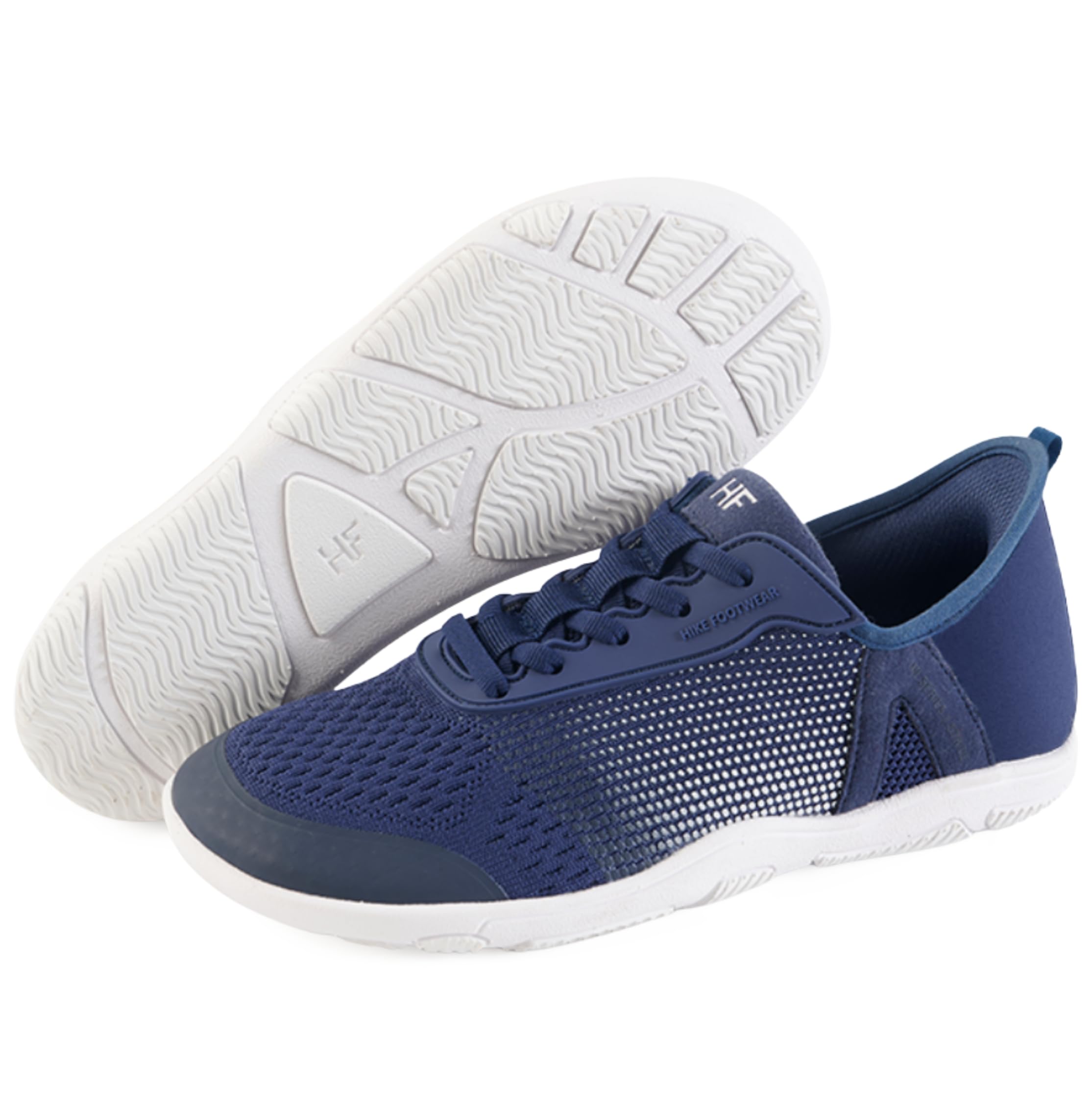


Best for Hiking and Walking
Hike HF Stride
Key Features
- Model: HF Stride
- Closure: Slip-on
- Toe Box: Wide toe box
- Shoe Type: Hiking shoe
- Price: Premium
The slip-on label on the Hike HF Stride is the first thing we question. We expected a hands-free shoe; what we handled was a lace-up in slip-on clothing. That matters if you want a shoe for quick errands, less so on trail, where a secure midfoot is worth the extra step.
What earns it the top spot is the combination of a wide toe box and a flat, stable ride that still lets you feel the ground. We kept reaching for it on mixed paths because it feels planted without feeling stiff, and the roomy front gives your toes somewhere to go on descents. The shoe is at its best when the day mixes pavement and dirt; it is not a gym-first design.
Fit is the main thing to settle. The HF Stride can come up short for long toes, so start with the larger size if you are between sizes. Once you have the length right, the wide front does the rest.
The shoe also looks tidy enough for a cafe stop, which is not something we can say for every trail shoe here. The HF Stride is the one we pack for a weekend that mixes a town walk with a dirt path, and that is exactly the balance most women need from a barefoot shoe.
Pros
- Stable, ground-feeling ride for mixed paths
- Wide toe box with room to spread
- Strong everyday-to-trail versatility
Cons
- Premium price compared with budget picks
We recommend the Hike HF Stride as the best all-around women’s barefoot shoe for walkers who also hike: it pairs a wide toe box with a stable, ground-feeling ride for mixed terrain.
Best for Gym and Everyday
MIFAWA Cross-Trainer
Key Features
- Drop: Zero drop
- Toe Box: Wide toe box
- Best Use: Gym, hiking, walking
- Shoe Type: Cross-trainer
- Price: Budget
The MIFAWA is the pair we reach for when the plan is lifting, a treadmill session, or a day of errands. It costs little enough to be an experiment, but it does not feel like a throwaway. The flat platform and wide toe box make it a natural gym shoe: your toes can spread under load instead of bunching, and the shoe stays out of the way when you change direction.
What stood out on longer wear is how much the insole matters. The stock one is flimsy enough that we swap it for a firmer footbed before a long walk, and that small change makes the shoe feel much more planted. Sizing is the other thing to sort out; the MIFAWA can come up short in length, so go up if your toes touch the front in your usual size.
For rocky ground, the Hike HF Stride is the better call. For the money, the MIFAWA is the best gym-first option here, and it earns its place by keeping the fit wide and the ride flat. It is a budget shoe in the best sense: the money goes into the shape that matters.
Pros
- Flat, wide platform for gym work
- Very affordable for a barefoot trainer
- Easy for errands and home wear
Cons
- Outsole and upper can wear quickly
For gym days and a first barefoot pair, the MIFAWA is our value pick: it is flat, wide, and ready for lifting, and it costs far less than the hiking-focused picks.
Best for Casual Slip-On Wear
HOBIBEAR Canvas Slip-On
Key Features
- Drop: Zero drop
- Upper: Canvas
- Closure: Slip-on
- Toe Box: Wide width
- Price: Midrange
The HOBIBEAR is the pair that makes the least fuss. The canvas slip-on has a generous opening, and you can get it on with medium socks without wrestling with a collar. That makes it the shoe we leave by the door for school pickups, desk days, and errands where you are in and out of the car.
It is a casual shoe, and it knows it. The canvas upper has almost no structure, which keeps it light and easy to fold into a bag but leaves you feeling the ground on rough paths. We like it for pavement and indoor days, not for a serious hike.
What we appreciate most is the value: it looks and feels more considered than its price suggests, and the soft upper is comfortable against bare feet. The off-white canvas is the one to think about if you work around dirt or oil; this is a casual fabric shoe, not a shop-floor shoe.
Pros
- Easy on and off with a roomy fit
- Lightweight canvas feels casual
- Strong value for an everyday shoe
Cons
- Sizing can run large
For casual days when you want a barefoot shoe you can slip on and forget, the HOBIBEAR is our pick; the roomy canvas upper is easy to live with around town.
Best for All-Day Walking
Hike HF Signature
Key Features
- Sole: Flexible
- Toe Box: Wide toe
- Best Use: Daily walking
- Traction: Non-slip
- Price: Premium
The Hike name promises trail time, but the HF Signature is really a walking shoe. On pavement, that is a good thing: the flexible, lightweight build is near the top of this set for all-day comfort, and the wide toe box keeps the fit relaxed. We wore it for long indoor days and easy errands, and it never felt like a shoe that needed breaking in.
It is not a trail shoe. The thin sole and minimal structure get overwhelmed on gravel, and the shoe gives you little arch or ankle support. For a rail trail or a park path, fine; for rocky ground, choose the HF Stride.
The thing that sold us is the weight. It is light enough to forget you have it on, which matters on a day when you are on your feet from morning to evening. It also looks neat enough for casual work settings. If you want a dedicated pavement walker and do not need trail protection, it is a sensible step up from the budget picks.
Pros
- Lightweight enough for all-day wear
- Wide toe box with a relaxed fit
- Neat enough for casual workdays
Cons
- Premium price for a simple walking shoe
The HF Signature is our pick for women who want a lightweight, wide barefoot shoe for all-day pavement walking; it is a walking shoe, not a trail shoe.
Best for Budget Trail Walks
StoneLiquid Hike Barefoot
Key Features
- Design: Barefoot
- Traction: Non-slip
- Shoe Type: Hiking shoe
- Department: Women’s
- Price: Budget
The StoneLiquid is the budget shock of the group: it costs the least and still feels like a real barefoot shoe. It is light, easy to get on, and comfortable enough for short walks and errands. We came away thinking it is the best cheap pair for someone who wants to try barefoot shoes without committing. The soft upper is forgiving on a foot that is new to this shape.
The laces are the first thing we change; the stock ones feel flimsy, and a better set makes the shoe easier to live with. It is at its best on a park path or a quick dog walk. The shoe does not pretend to be a mountain shoe, and that is fine as long as your walks stay short. If you want one pair for a rocky trail and a town day, spend more on the HF Stride.
Pros
- Low-cost way to try barefoot shoes
- Light and easy to put on
- Comfortable for short walks
Cons
- Thin sole and minimal support on rough ground
The StoneLiquid is our best budget barefoot shoe for short walks and casual wear; it is light, easy on, and a low-risk way to try the category.
Best for Everyday Casual Style
Barezoey Casual Sneaker

Key Features
- Drop: Zero drop
- Toe Box: Wide toe box
- Best Use: Everyday walking
- Shoe Type: Casual sneaker
- Price: Midrange
The Barezoey is the pair we reach for when we want a barefoot shoe that looks like a sneaker and comes in a color that is not gray. The color range is one of the most playful in this set, and the soft, lightweight build makes it an easy everyday walking shoe.
It is a casual shoe, not a trail shoe. The zero-drop sole and soft upper are comfortable on pavement and around the house. The shoe is not built for long hikes or runs; keep it for casual days and errands.
We also like the value: it sits in the middle of this group but feels more considered than its price suggests. The toe box is roomy without looking clownish. It is the one we wear when the shoe needs to look like a shoe, not a recovery tool.
Pros
- One of the strongest color selections here
- Light and flexible for everyday walking
- Roomy toe box without a clunky look
Cons
- No half sizes, so the fit is less precise
The Barezoey is our style-first everyday pick: a light, wide barefoot sneaker for pavement and casual wear, with a color range that makes it easy to reach for.
Best for New Barefoot Wearers
Bare Frog Walking Sneaker

Key Features
- Toe Box: Wide toe box
- Best Use: Walking
- Shoe Type: Casual sneaker
- Department: Women’s
- Price: Midrange
The Bare Frog is the easiest shoe in this group to recommend to someone who is barefoot-curious but nervous about a rock-hard sole. It has more cushioning than the purist picks, and the soft, flexible upper bends with your foot instead of fighting it. That makes it a good transition shoe.
The toe box is genuinely roomy, and the upper has enough give that wide feet will not feel pinched. The cushioning is the surprise: it takes the edge off pavement without feeling like a conventional sneaker. It is still a barefoot shoe, so the ground feel stays intact.
For new barefoot wearers, we like it for errands and short walks; for longer trail days, the HF Stride is the more planted choice. It is also one of the better-looking options here, with color choices that do not scream orthopedic. The Bare Frog is a gentle way into a flatter shoe, and that is exactly why it earns a place.
Pros
- More cushioning than the purist picks
- Flexible upper and sole for natural movement
- Comfortable for daily walks
Cons
- Sizing can run large
- Minimal arch support
The Bare Frog is our pick for anyone new to barefoot shoes or wanting a softer, flexible everyday pair; its roomy toe box and cushioned feel make the transition easier.
How We Tested Barefoot Shoes for Women
We started by reading through hundreds of customer reviews and filtering for the specs that actually define the category: a heel-to-toe drop of 4 millimeters or less, a toe box wide enough to let the toes splay, a thin stack height, and a flexible sole you can fold in half. Anything with a stiff shank, a rocker bottom, or a built-in arch bump got cut, since a shoe that props up your foot isn’t really barefoot. That left 14 pairs, from minimalist everyday sneakers to cushier trail-oriented styles.
Fit came first. We traced our feet on paper and laid each shoe’s insole over the outline to see whether the widest part of the foot lined up with the widest part of the shoe, then noted whether the upper pressed on the little toe or left a thumb’s width of room. We checked arch support by pressing into the footbed to feel whether it was flat, quietly contoured, or removable, because several "barefoot" shoes sneak a bump in. To test slip-on ease, we timed getting each pair on one-handed with a tote bag in the other hand and the laces left tied.
Then we wore them for eight months, in the places these shoes actually live: the walk to the office, the grocery store, an hour on the treadmill, uneven park trails, and a couple of long airport days. Each pair was weighed on a kitchen scale once the box was gone, and we noted how balance felt on gravel, on wet pavement, and standing on one foot mid-conversation. We logged blisters, hot spots, and whether our feet felt battered or fresh after a five-mile walk.
At roughly 50 and 150 miles per pair we checked the flex point for creasing, the outsole at the ball of the foot for wear, and the heel collar seams for fraying, then hand-washed the ones the maker said could take it. We wore each pair with jeans, wide-leg trousers, and dresses to judge how they read off the trail, and weighed the cost against how many months of steady wear we got. The pairs that survived all of it are the ones below.
How to Choose Women’s Barefoot Shoes
The first decision is not the brand—it is how much shoe you want between your foot and the ground.
Fit Comes Before Everything Else
A wide toe box is the point of a barefoot shoe, but width without length is useless. Measure your foot at the end of the day, then leave roughly a thumb’s width in front of your longest toe. Sizing across this set is not consistent: the HOBIBEAR runs large, the MIFAWA runs small, and the Hike models sit closer to standard. We treat the size on the box as a starting point and check toe room first. If you are between sizes, go with the fit that lets your toes lie flat rather than the one that feels snug.
Zero Drop Is a Transition, Not a Switch
Zero-drop shoes put your heel and forefoot on the same level, which changes how your calf and Achilles work. If you have worn supportive shoes for years, do not wear a barefoot pair for a long hike on day one. Start around the house and on short walks, then add distance as your feet adjust. We like the Bare Frog for this phase because its cushioning takes the edge off pavement without turning into a conventional sneaker. The StoneLiquid is the opposite end: light and cheap, but very thin underfoot.
Match the Sole to the Surface
A barefoot sole is flexible by design, but flexible is not the same as grippy or protective. For gym work, a flat, thin sole is an advantage: it keeps you close to the floor for lifting and balance work. For trails, look for a hiking-specific shoe with a more deliberate outsole and a little more underfoot defense. The Hike HF Stride is the trail-leaning pick here; the MIFAWA is the gym-leaning one. A canvas casual shoe like the HOBIBEAR is for pavement, not scree. Do not assume the barefoot label makes a shoe trail-ready.
Check the Closure and the Wear Parts
Slip-on is a useful convenience, but it is also the most overused phrase in this category. The Hike HF Stride is called a slip-on and still has laces to tie, so do not buy it expecting a hands-free shoe. If easy on and off matters most, the HOBIBEAR is the more honest choice. Durability is the other place to look: budget shoes often save on the insole or outsole. The MIFAWA’s insole is flimsy enough that we replace it, and its outsole is better for gym floors than daily trail miles. Factor in a replacement footbed if you walk a lot.
Frequently Asked Questions
What socks should I wear with barefoot shoes?
Start with a thin, seamless sock, or a toe sock if your toes rub. Thick socks can change the fit enough to make a roomy shoe feel tight, so try the shoe with the socks you plan to wear. If you need cushioning, a lightly padded sock is a better fix than sizing up.
Can I run in women’s barefoot shoes?
Some minimalist runners do, but the picks here are aimed at walking, hiking, gym work, and casual wear. The Barezoey is a casual sneaker, not a running shoe, and the Hike models are built for foot traffic rather than speed. If you want to run, start with short intervals on smooth ground and build slowly; choose a running-specific minimal shoe if you get serious.
How do I clean barefoot shoes?
For canvas uppers, spot clean with mild soap and a soft brush, then air dry away from direct heat. Knit or mesh shoes can be hand-washed, but do not put them in a dryer; heat can warp the sole and shrink the upper. Stuff the shoe with newspaper while it dries to hold its shape.
Final Verdict
The Hike HF Stride is the pair we recommend first. It gives you the wide, flat barefoot feel without turning every trail into a balance exercise, and it is the most convincing all-rounder here for a woman who walks in town and hikes on weekends.
If your week is mostly gym floors and errands, the MIFAWA is the smarter spend, and the HOBIBEAR is the easier casual slip-on. The deciding advantage for the HF Stride is trail-ready stability; if you do not need that, save your money and choose the simpler shoe.