This post contains affiliate links. We may earn a small commission when you buy through our links — at no extra cost to you.
A beginner kayak has one job: make you feel steady enough to enjoy the water, not like you’re balancing on a pool toy. I’ve watched first-timers tense up the moment a boat wiggles, and that’s usually where cheap inflatables lose people—soft floors, flimsy seams, and a pump session that feels like a workout before you even launch. The right inflatable fixes that: it packs into a car trunk, inflates without a fight, and tracks straight enough that you can relax and paddle.
Over eight months, my team and I paddled nine inflatable kayaks on calm lakes, slow rivers, and a weekend camping trip where we inflated them twice a day. We focused on what beginners notice: firm floors, valves that seal without cursing, and how easy the packed boat is to carry from car to water. You don’t need to spend a fortune for a solid beginner kayak, but the cheapest options often skimp on seams and floor stiffness. The picks below made us feel stable, safe, and genuinely happy to paddle.


Best for Solo or Tandem
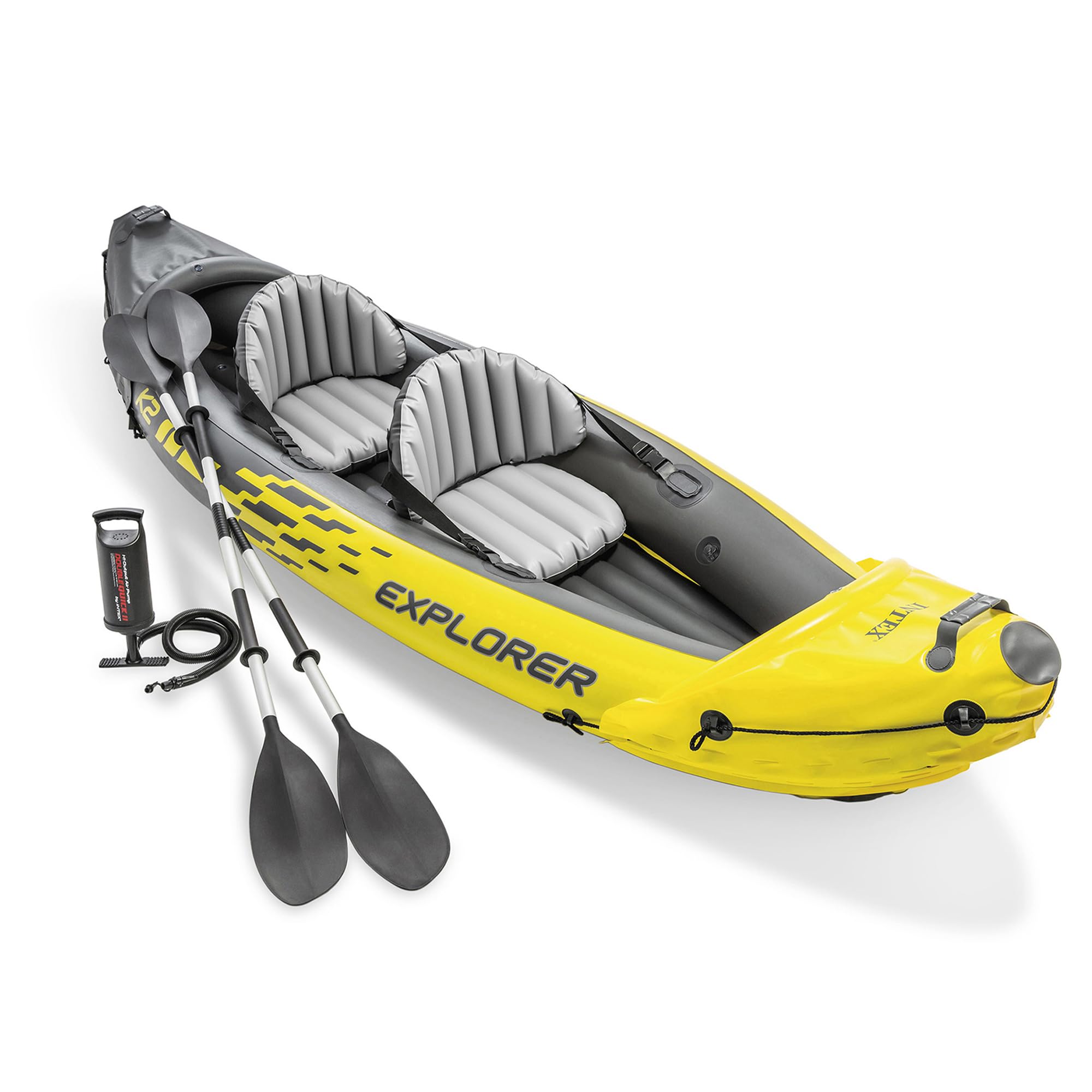
Intex Explorer K2
Key Features
- Boat weight: 35 lb
- Included kit: Two paddles, pump, two seats
- Inflated size: 123 x 36 x 20 inches
- Maximum capacity: 400 lb
- Price: Budget
The Explorer K2 is a two-person kayak that makes sense for a beginner household because it still paddles solo. At 36 inches wide and rated for 400 pounds, it gives two paddlers room to sit without shoulder-bumping, and it leaves space for a cooler or a dog between the seats when you go alone. That width is why we put it first: a first season is mostly about feeling settled, and the Explorer has more margin for a wobble than the narrower solo boats here.
Setup is the other half of the beginner equation. The kit includes two paddles, two inflatable seats, a high-output pump, and a carry bag, so there’s no immediate shopping list beyond a PFD. The Boston valves make the fill-and-close routine straightforward, and the boat packs into a car trunk without a roof rack. At 35 pounds, it’s a two-hand carry to the launch, not a backpack.
The Explorer is also the most flexible boat in this group. Paddle it solo and you get a stable platform with room for gear; add a partner and the 400-pound rating still leaves a sensible margin. The 36-inch beam is the detail we keep coming back to: it gives a nervous first-timer room to shift without feeling the edge.
Pros
- Tandem capacity with solo flexibility
- Wide 36-inch beam adds confidence
- Complete paddle-and-pump kit
Cons
- Front seat lacks proper back support
We recommend the Explorer K2 as the beginner boat that can carry a partner, a dog, or extra gear without becoming a handful on calm water.
Best for Solo Lake Days
Intex Challenger K1
Key Features
- Boat weight: 26 lb
- Included kit: Paddle, pump, seat, skeg
- Inflated size: 108 x 30 x 13 inches
- Maximum capacity: 220 lb
- Price: Budget
At 26 pounds and 9 feet long, the Challenger K1 is the boat we reach for when the water is a short walk from the car and no one else is coming. It’s a solo cockpit, 30 inches wide, with a removable skeg and a low-profile hull. That low deck makes it easy to paddle, but it also means the Challenger feels more like a sit-in kayak than the wide, barge-like tandems here.
We like it best as a first solo boat for calm lakes and mild rivers. The package includes an 86-inch paddle, a high-output pump, an adjustable seat with backrest, and a cargo net; the pump and paddle mean a beginner can go from box to water without another order. Inflation is quick, and the boat rolls up into its bag for an apartment closet. This is the boat we hand to a friend who wants to try kayaking without committing a garage wall to it.
The Challenger tracks well enough with the skeg in place, and the cargo net is a small thing we appreciated: it keeps a dry bag off the wet floor without adding a deck hatch. We came back to it for short evening paddles because it takes less effort to launch than the tandem. The 9-foot length is easy to swing into a trunk, and the whole package dries quickly on a line.
Pros
- Light 26-pound solo package
- Paddle and high-output pump included
- Quick to inflate and store
- Removable skeg improves tracking
Cons
- 220-pound capacity excludes larger paddlers
- Narrow 30-inch hull feels tippy at first
If you paddle alone and want a compact kit that sets up fast, the Challenger K1 is the boat we hand to a first-timer.
Best for Fishing and Gear
Bestway Koracle X1
Key Features
- Boat weight: 16.1 lb
- Included kit: Paddle, pump, fins, bag
- Inflated size: 112.2 x 36.22 x 22.44 inches
- Maximum capacity: 331 lb
- Price: Midrange
The Koracle X1 is the only boat here with a rod holder, and that single detail changes the kind of beginner trip it suits. It’s a 9-foot-4 solo kayak with a 36-inch beam, a 331-pound capacity, and a built-in backrest, plus four footrests that let a shorter or taller paddler find a brace. The layout is more fishing cockpit than rec kayak: a net in front, elastic cord in back, oar clasps, and two removable fins.
We think it’s a smart first fishing kayak because the fishing gear is built in rather than bolted on. The rod holder keeps a line in the water while you adjust position, the wide deck gives you room to move a small tackle box, and the 331-pound rating leaves enough margin for a solo angler and gear. At 7.3 kg, it’s light enough to carry under one arm, which is a surprise for a boat with this much built-in storage.
The Koracle is not the fastest hull here, and that is a fair trade for the fishing layout. The bow and stern handles make it easy for one person to haul it up a ramp or for two people to carry it to the water.
Pros
- Rod holder and fishing layout
- 331-pound capacity and wide deck
- Light 7.3 kg hull
Cons
- Single-action pump takes more strokes
We like the Koracle X1 for beginners who want to fish: its wide hull, rod holder, and four footrests make a day on the water feel planned rather than improvised.
Best for Light Solo Paddling
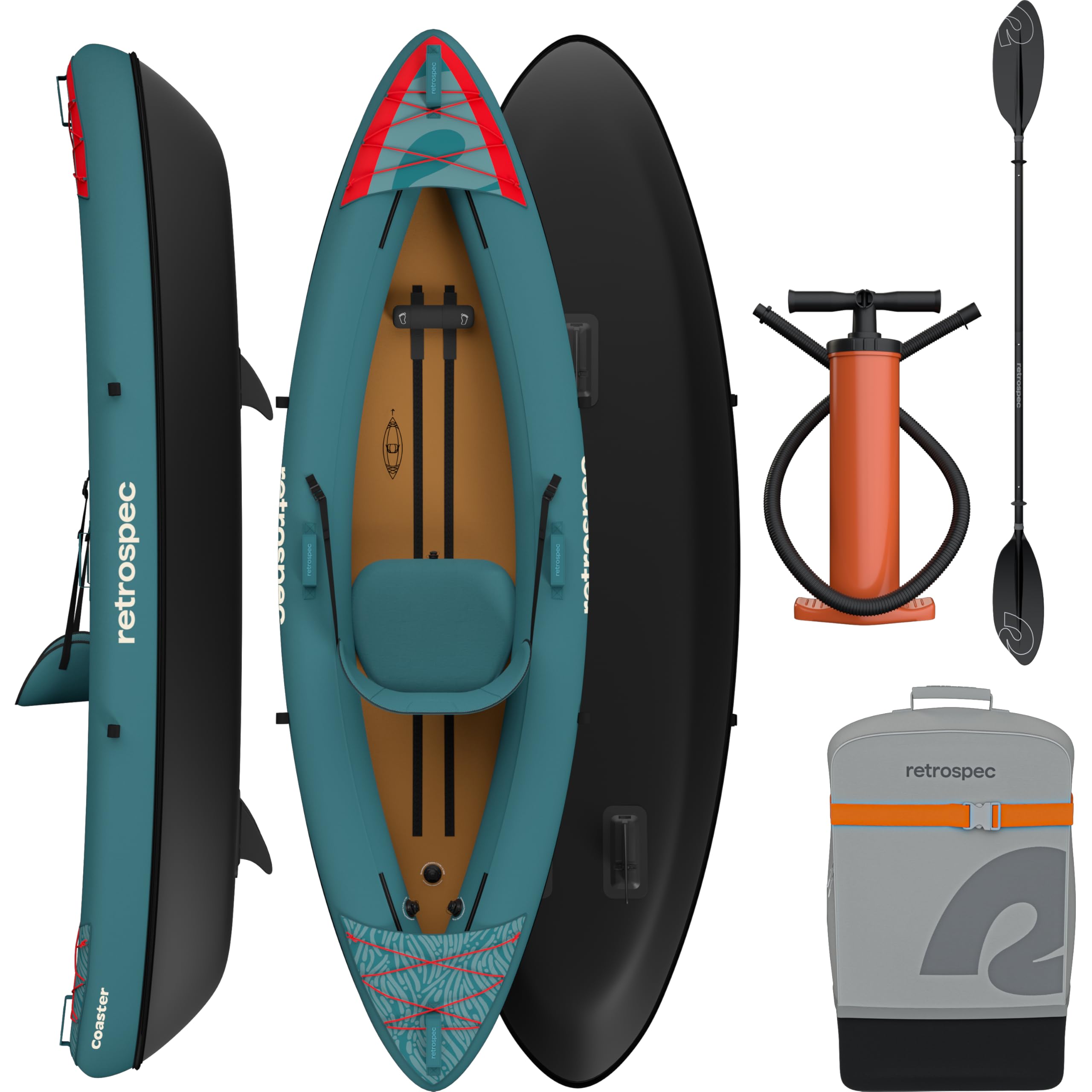
Retrospec Coaster Single
Key Features
- Boat weight: 23 lb
- Included kit: Pump, paddle, fins, bag
- Inflated size: 118 x 37 x 10 inches
- Maximum capacity: 220 lb
- Price: Premium
The Coaster Single is the solo boat here that carries like a backpack, with a 23-pound hull, a backpack-style bag, and a 37-inch beam. That width gives it a roomy, stable feel for a solo boat, and the three removable fins let you tune tracking. The cockpit is 9 feet 10 inches long, with enough room for a small dog or a dry bag at your feet.
We choose it for paddlers who want a roomy solo cockpit and a backpack carry. The dual-action pump, paddle, footrest, and carry bag are included, so it’s a complete package. On the water, the fins are the detail we noticed most: they make the boat track straighter when you’re covering flat water, and they come off for shallower launches.
The Coaster’s finish is the part that justifies a look: the material feels rugged to the touch, the bottom has a shield from bow to stern, and the backpack has room for extra gear. It is a solo boat, so don’t expect to add a second paddler. The bottom shield is the detail that matters at a gravel launch, where a thin floor would show every scrape.
Pros
- Light 23-pound solo hull
- Wide 37-inch beam for stability
- Three removable fins aid tracking
- Backpack bag and dual-action pump
Cons
- Premium price versus the Intex picks
The Coaster Single is the solo kayak we choose when you want a roomy cockpit and a backpack carry in one complete package.
How We Tested the Best Inflatable Kayaks for Beginners
We built the shortlist by scanning beginner-focused inflatable kayaks from established brands, then filtering for weight capacity, packed size, number of air chambers, and price. We ruled out boats that needed a roof rack or an electric pump to be practical, and we leaned toward models with adjustable seats and removable fins. That left nine kayaks, which we tested over eight months.
Most of our paddling happened on calm lakes and slow-moving rivers, plus one weekend camping trip where we inflated and deflated each boat twice a day. We timed inflation with the included hand pump, noted whether valves seated easily, and carried every packed kayak from the car to the launch—sometimes a quarter mile—to judge portability. On the water, we paddled for at least an hour per session and shifted our weight side to side to check initial stability.
For durability, we inspected seams and floor material after every few outings, dragged hulls gently over gravel launches, and left boats inflated in the sun between paddles. We also watched the fun factor: how quickly a beginner could get moving, whether the seat stayed comfortable, and if the kayak tracked well enough to feel relaxing. Value came down to what was included—pump, paddle, carry bag—and whether the materials felt like they would last more than a season.
How to Choose a Beginner Inflatable Kayak
The right beginner kayak is the one you can carry, inflate, and feel settled in before you think about speed.
Match the hull to the water
Most beginner kayaking happens on a calm lake, a slow river, or a protected bay, and the hull should make that easy. A wider beam, around 36 inches, gives you more secondary stability and room to shift without feeling the edge; the Explorer K2 and Koracle X1 lean that way. A narrower solo boat like the Challenger K1 cuts through the water with less effort but feels livelier at first. We prioritize width for anyone who is nervous, paddling with a child, or carrying a dog. A beginner kayak is not a whitewater boat, so save the moving water for later.
Buy capacity for your body plus gear
Maximum weight is not a suggestion. A 220-pound solo rating like the Challenger K1 or Coaster Single leaves little margin once you add a cooler, a dry bag, and a dog; a 400-pound tandem like the Explorer K2 gives two adults room to sit and still carry lunch. We look at the capacity as a whole-boat limit, not a per-seat number. If you are near the top of a solo rating, move up to a wider boat or a tandem used solo. Seat support matters too: a thin backrest is fine for an hour and tiring by the third.
Treat setup as part of the boat
The best beginner kayak is the one you will actually launch. A complete kit with a paddle, pump, seats, and carry bag saves a second order; the Challenger K1, Explorer K2, and Coaster Single all include those basics. Weight matters more than packed length: 23 to 26 pounds is a one-person carry to the water, while 35 pounds is a two-hand haul. We also check the pump. A dual-action pump fills faster, while a single-action hand pump takes more strokes. Compact means it fits a car trunk, not that it disappears into a backpack.
Use the skeg or fins
Tracking is what keeps a beginner from zigzagging across the lake. A removable skeg or fin set holds the stern in line, and the best boats here give you a choice: the Challenger K1 and Explorer K2 use a skeg, while the Koracle X1 and Coaster Single use removable fins. We install tracking gear for open water and pull it up for shallow launches or rocky shorelines. Without it, a short inflatable wanders with every stroke. The trade-off is maneuverability; fins make turns lazier, so leave them off if you are threading tight coves.
Care for PVC and seams
Vinyl inflatables are tough, but the seams and floor are the parts that fail first. We inflate a new boat at home, leave it overnight, and check every chamber before the first trip. Carry it to the water rather than dragging it over gravel, and keep it out of a hot car when inflated. A patch kit handles a pinhole; a seam that lets go early needs a closer look before the next launch. Store the boat clean and dry, loosely folded, and out of sun. That routine does more for lifespan than any advertised material claim.
Frequently Asked Questions
What should I wear for a first kayak trip?
Start with a properly fitted personal flotation device, then add quick-dry layers, water shoes, and sun protection. Dress for the water temperature, not the air, because a calm lake can still be cold. Test the PFD fit before you launch: it should stay put when you lift it by the shoulders. Leave cotton at home.
How do I get in and out without tipping?
Use a stable bank or shallow water, place the paddle across the boat behind you for support, and sit down low and centered rather than stepping in. Keep your weight over the middle, and have a partner hold the boat if the shore is slippery. Practice in waist-deep water first. Standing in an inflatable kayak is how beginners end up swimming.
Do I need to spend more for a beginner kayak?
Not to start. The budget boats here include a paddle, pump, and seat and handle calm water; midrange money buys a fishing layout or more capacity, while premium money buys a lighter solo hull. Put the savings into a good PFD and a dry bag first. Move up only when you know your water and how far you carry the boat.
Final Verdict
For most beginners, the Intex Explorer K2 is the boat we recommend: it has the width, capacity, and complete kit to make a first season easy, and it can carry a partner when you want one. If you’ll always paddle alone, the Challenger K1 is the better fit and the one to choose before you spend more on a solo hull.