This post contains affiliate links. We may earn a small commission when you buy through our links — at no extra cost to you.
The dead zone never announces itself. One minute you’re texting from the trailhead, the next your phone is a flashlight with a camera, and the rest of the hike happens entirely off the grid. A satellite messenger fixes exactly that: it puts a two-way conversation — and, if things go badly, an SOS button tied to a real rescue coordination center — in your pack, well past the last cell tower. I’ve carried one on every backcountry trip for years, and over the past eight months my team and I have put nine of them through canyon hikes, offshore runs, and a genuinely cold week above treeline.
Here’s what first-time buyers get wrong: the device is the cheap part. The subscription is what keeps you connected, and a budget messenger on a $30-a-month plan can cost more over three years than a pricier unit on a $15 one. The other fork in the road is whether you want a standalone screen-and-keyboard device or a palm-sized puck that leans on your phone for typing — both work, they just get awkward in different ways when your fingers are cold. The picks below cover both camps, and each one survived a full season outdoors.

Best for All-Round Backcountry Use
Garmin inReach Mini 2
Key Features
- Size: 2.04 x 1.03 x 3.9 in
- Display: 1.27 in monochrome, sunlight-readable
- Navigation: TracBack routing, digital compass
- Battery Life: 336 hours
- Price: Premium
Three things make the inReach Mini 2 the device we point most people toward: two-way texting, an SOS button that reaches a staffed response center, and enough on-board navigation to retrace your steps to the trailhead. It packs all of that into a body 3.9 inches tall and about an inch wide, small enough to ride in a pack lid and be forgotten until you need it. The 1.27-inch display is a sunlight-readable monochrome panel, which is exactly the job a satellite device needs done: signal strength, battery, and the message you are about to send.
The balance is what sold us. Garmin rates the battery at 336 hours, and for a unit this size that is a long runway, enough for a week of twice-daily check-ins without hunting for a charger. TracBack routing and the digital compass are the quiet wins: when fog drops and the trail vanishes, you get a heading while standing still and a breadcrumb line back, with no phone dug out of a pocket. We were also impressed by how well it stands alone; presets and SOS go out from the device itself, while the Garmin Explore app takes over the jobs that benefit from a real keyboard, like longer messages and route planning.
Against the Messenger below, most of the extra outlay goes into navigation, a readable screen, and independence from your phone. If you already carry a phone with downloaded maps and a power bank, that is money you can keep in your pocket. For anyone walking terrain they do not know, we think it is the right call, and ours lives next to the first-aid kit as a matter of habit rather than planning.
Pros
- Two-way texting plus interactive SOS
- 336 hours of rated battery life
- TracBack routing and a digital compass
- 3.9 inches tall, sized for a pack lid
Cons
- Topographic maps and route planning need the phone app
We recommend the inReach Mini 2 as the default satellite messenger: two-way texting, an interactive SOS, and real navigation in a unit that disappears into a pack lid.
Best for Budget Two-Way Messaging
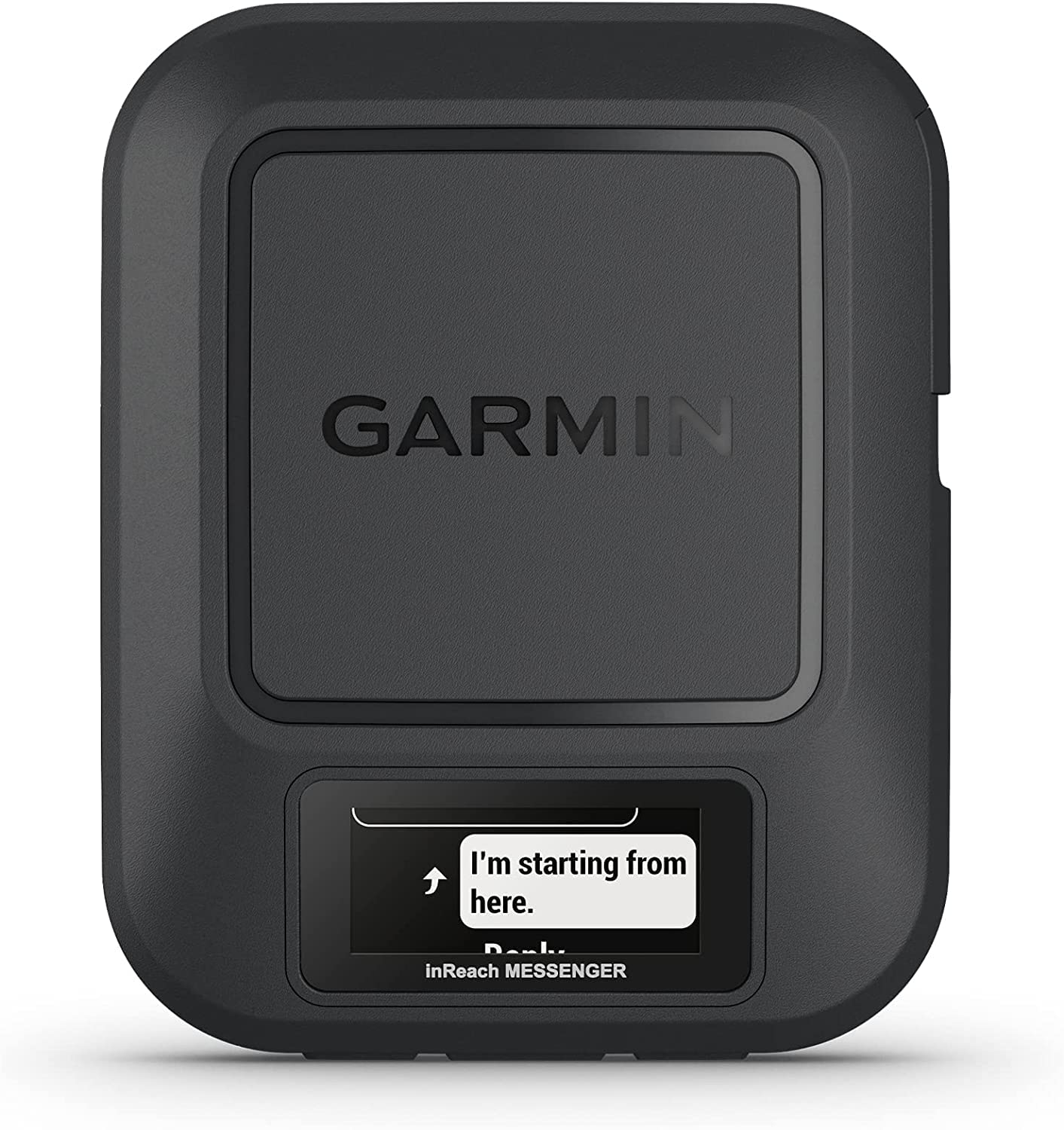
Garmin inReach Messenger
Key Features
- Weight: 4 oz
- Display: 2.74 cm monochrome
- Messaging: Two-way text, group messaging
- Battery Life: 28 days
- Price: Midrange
The Messenger is the cheapest way into two-way satellite messaging in this group, and it gets there by dropping the map. There is no navigation, no compass, no terrain, only a small screen for signal, battery, and whether your message left. What survives is the part you cannot do without: text in and out over satellite, an interactive SOS, preset check-ins that do not count against your allowance, and group chats through the Garmin Messenger app.
Twenty-eight days of rated standby is the figure that changes how you pack. No charging brick, no power-bank negotiation at camp, no deciding whether the messenger or the headlamp gets the last of the battery. Because the app is the interface, the Bluetooth handshake is the step to nail down at home rather than at a trailhead; done once, the two work together well, with you typing on a real keyboard while the device finds the sky.
Where it makes the most sense is a kit that already has a navigator in it: a phone with downloaded maps, a handheld GPS, or a paper map and the skill to read it. On a long trip with no resupply, a month of standby is worth more than a screen you rarely open, and that is the case where we take the Messenger instead of the Mini 2 and put what we save toward a better plan.
Pros
- Lowest-cost two-way messaging in this group
- 28 days of rated battery life
- Group chats through the Garmin Messenger app
- Four ounces in a hip pocket
Cons
- Status screen only, so real messaging needs a paired phone
The inReach Messenger is our pick for anyone who needs messaging and SOS but not maps: two-way texting and a month of rated battery for the least money here.
Best for Phone-Free Check-Ins
SPOT Gen4

Key Features
- Power: Replaceable batteries, included
- Weight: 5.01 oz
- Network: Globalstar satellite
- Tracking: Updates while moving and stopped
The Gen4 is the one device here that does not care whether you brought a phone. Clip it to a pack, hold the check-in button, and a preset note with your coordinates goes out over the Globalstar network; hold SOS and the alert goes to emergency services with your position attached. No pairing, no app, no charging routine either, because the batteries are replaceable, which is one less thing to think about on a long trip.
Everything about the Gen4 runs one way, and that is the entire design. Your family gets an ‘I’m OK’ and a map pin; a tracking trail updates whether you are moving or stopped; in a real emergency the SOS goes out with coordinates. What does not happen is a reply coming back to the device, so there is no asking whether the road is open, no confirming that someone saw your message, no conversation to manage at all.
For a teenager’s first backpacking trip, a solo hiker on well-marked trail, or anyone who wants a panic button and nothing else, that is plenty, and the simplicity is why the Gen4 is the device we never have to remember to charge. The two Garmins tell you more and let you say more, and they cost more for it. The one caution is setup: activation runs through the website, so do it at the kitchen table rather than in a trailhead parking lot.
Pros
- SOS and check-ins with no phone or app
- Tracking updates while moving and stopped
- Replaceable batteries, no charging routine
Cons
- Status LEDs only, with no screen, map, or text
We like the SPOT Gen4 for phone-free simplicity: a beacon that sends check-ins and SOS on its own, as long as you do not need a reply.
How We Tested the Best Satellite Messengers
We built the shortlist by mapping the category instead of shopping it. That meant sorting devices by which constellation they ride — a global network, a regional one, or a proprietary one — then filtering for true two-way texting, an SOS that routes to a professional rescue coordination center, and at least one plan under a set monthly ceiling. Anything that could only fire off a preset one-way message got cut in the first pass. Nine devices made it through, and we tested them for eight months.
Then we took them outside. We sent messages from canyon bottoms with almost no sky view, from dense pine cover, and from a moving boat, timing how long each took to go from send to delivered and noting whether the reply arrived as a threaded conversation or a fresh inbox item. We typed 120-character messages one-handed in gloves, paired each device to a phone to see how long setup took from unboxing to first message, and watched how often a message queued instead of sending when the horizon got tight.
Portability and battery got measured rather than eyeballed. We weighed every unit with its case and carabiner, then carried them in hip pockets and pack lids for weeks to see whether buttons got bumped or screens scratched. We ran each one from full charge with tracking at the default interval and logged the battery percentage hourly, and we left them out in the rain and in a pocket full of keys. For value, we tallied the device price plus two years of the cheapest plan that actually includes unlimited messaging, because a capable radio on an unusable plan isn’t worth carrying.
How to Choose a Satellite Messenger
Two questions settle most of this decision: does the device need to receive messages, and should it navigate on its own or lean on your phone?
Two-Way Messaging or a One-Way Beacon
A satellite messenger pushes a short packet up to a constellation; a two-way device then waits for an acknowledgement and whatever reply comes back. That difference decides what the device is for. A beacon like the SPOT Gen4 tells someone where you are and can call for rescue, while a two-way messenger lets you answer a question: whether to wait, whether the pass is open, whether the symptoms you are describing need a doctor. If anyone at home will worry, or you walk solo in country where a decision could go either way, pay for two-way. Watch the wording in listings, because ‘messaging’ sometimes means preset notes that only travel one direction.
Budget for the Subscription
Every device here needs an active satellite subscription before it will send anything, and that plan is where the real running cost sits. Plans are shaped around message allowance and tracking interval, and on the Garmin devices the preset check-ins do not count against your allotted texts, which stretches a modest plan further than it sounds. Work out a year of service before you commit to hardware. A cheaper device tied to a richer plan can end up costing more than the reverse, and a device with a lapsed plan is a paperweight with a carabiner on it.
Battery Life Is a Function of Tracking
A rated battery figure is only as good as the mode behind it. Two check-ins a day and a location ping every ten minutes are wildly different loads, and the same device runs for weeks on the first and days on the second. The Messenger’s month of standby comes partly from having no display or navigation to feed; the Mini 2 spends some of its reserve on a screen and a compass. Decide how much tracking your people at home actually need, read the number again with that interval in mind, and carry a power source on trips longer than a few days.
Navigation, Weight, and What You Will Carry
If your phone is your map, a communicator without navigation is the lighter, longer-lasting choice, which is the inReach Messenger’s whole argument. If you would rather not bet a route on a phone battery, the Mini 2’s TracBack routing and digital compass walk you back along the line you came in. Weight follows the same logic. Four ounces disappears into a hip pocket, and the device you barely notice is the one that goes on the short trips where things actually go wrong.
Frequently Asked Questions
Will a satellite messenger work under trees or in a canyon?
These devices need a clear view of the sky, and heavy canopy or a slot canyon can delay a message or stop one going out entirely. Step into a clearing or onto a ridge, hold the unit up with the antenna clear, and wait for the sent confirmation before you put it away. Tracking points taken under trees will lag the same way, so send your evening check-in from camp rather than from the middle of a forest.
What actually happens when I press the SOS button?
The alert goes out with your coordinates to a staffed response center, which messages the device to work out what kind of help you need and then coordinates with local rescue services. Set up your plan and your emergency contacts at home, before you need any of it, and keep the battery topped up on the way in.
Do not press SOS to see whether it works. Send a check-in or a test message to a friend instead, because a false alert pulls real rescuers off a real call.
Can I take one to another country?
Coverage is one question and permission is another. These networks reach far beyond cell service, but some jurisdictions regulate or prohibit satellite communication devices, and the rules vary by country. Check the destination’s requirements before you fly, confirm your plan works where you are going, and leave the device at home if the country prohibits it.
Final Verdict
Our recommendation for most hikers is the inReach Mini 2. It texts both ways, raises an SOS that a staffed center answers, and still walks you back to the trailhead if your phone dies in the rain, and that combination is worth the premium over a plain communicator.
If you already carry a navigation setup you trust, the inReach Messenger handles the same messaging for less and lasts a month between charges. The SPOT Gen4 is the right buy only if you want a beacon and nothing else.