This post contains affiliate links. We may earn a small commission when you buy through our links — at no extra cost to you.
Glamping tents promise the romance of camping without the part where you sleep on a rock. The catch: one with real beds, standing room, and a pretty silhouette can still wobble in wind, leak at a seam, or need two people to pitch. What you’re really shopping for is a shelter that sets up without a fight, stays dry, and leaves enough floor space to move once the air mattress is in.
Over eight months, we pitched seven glamping tents in backyards, at a state-park campsite, and through one memorably wet weekend. We timed setup and take-down, watched how each one handled rain and wind, checked whether the inside felt as roomy as the footprint promised, and asked whether the whole package felt worth the garage space. The best ones made the trip feel easier, not like a second job.


Best for Couples, Small Families
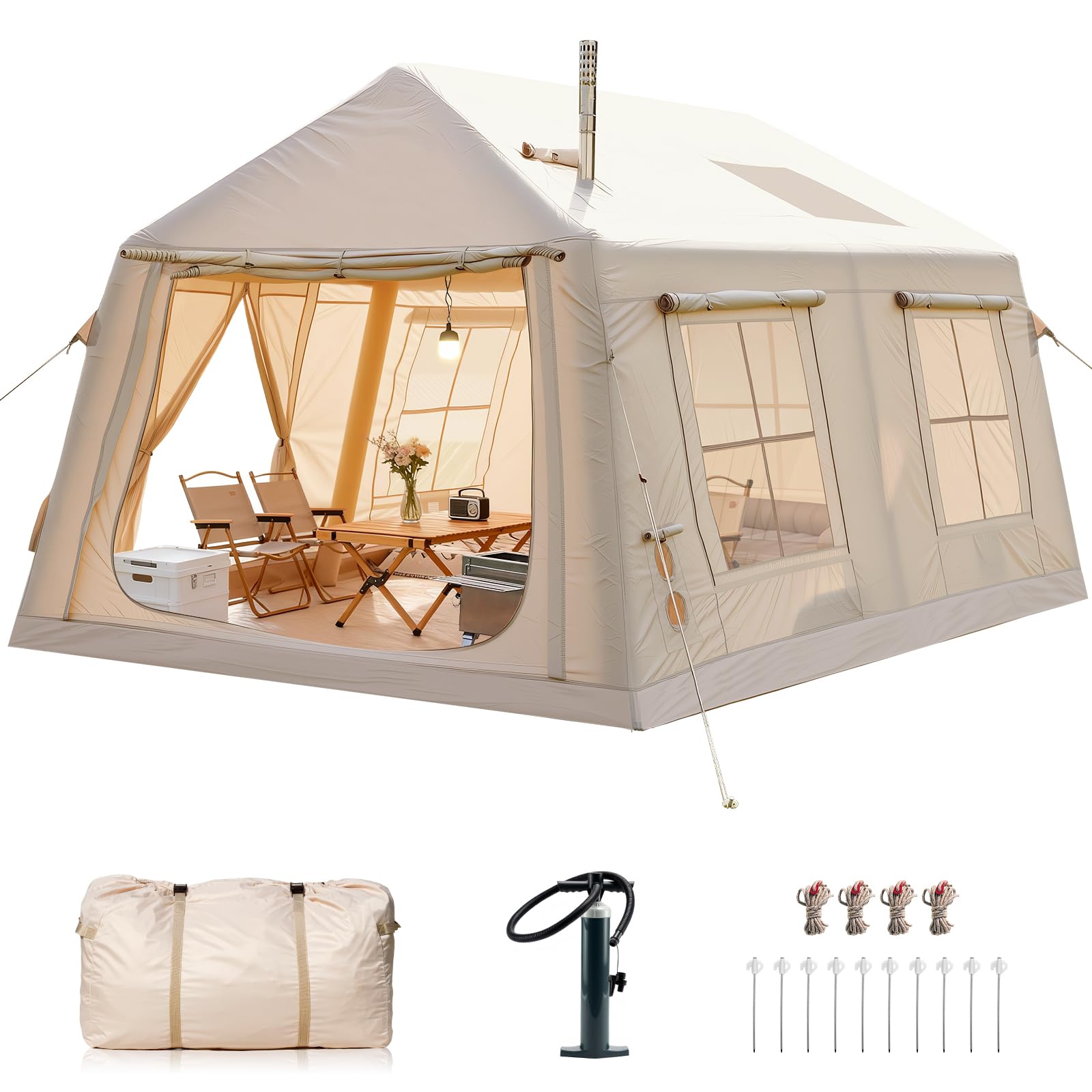
WildFinder 6P Inflatable
Key Features
- Sleeps: 6
- Stove jack: Yes
- Peak height: 79 in
- Packed weight: 31 lb
- Price: Midrange
A clear panel across one side of the roof and a stove jack in the wall are the two features that turn a big tent into a room, and this inflatable has both. The skylight is PVC with a privacy cover that rolls over it, and the jack takes a wood-burning stove when the forecast turns. Around the walls, mesh panels and two doors give the interior the through-draft that keeps condensation off a cold morning.
Of the tents here, this is the one we keep coming back to for a weekend that should feel like a room rather than a shelter. Setup is a pump, not a pole puzzle: the PVC air beams fill through dual valves with the included high-pressure pump, and the sleeves over the beams take the abrasion that would otherwise work at the seams. There are 79 inches of headroom at the peak, and the 420D Oxford shell carries a PU 3000 mm coating and UPF 30+ protection.
Two things to know before you commit. A clear roof panel is lovely at night and a greenhouse at noon, so the privacy cover earns its keep on a sunny afternoon rather than a rainy one. And at 31 pounds this is a car-camping tent — nobody is carrying it a mile in. Neither bothers the glamping brief, which starts with parking close anyway.
Pros
- Skylight and stove jack in one tent
- Pumps up without a pole puzzle
- 79 inches of standing height
- 420D Oxford with PU 3000 mm coating
Cons
- Skylight needs its cover in strong midday sun
- 31 lb packed, so it stays near the car
Our top pick for couples and small families: a skylight, a stove jack, and 79 inches of headroom, inflated with a pump instead of threaded poles.
Best for Big Families
CORE 9P Instant Cabin
Key Features
- Floor: 14 x 9 ft
- Sleeps: 9
- Setup time: 2 min
- Peak height: 78 in
- Price: Midrange
Fourteen by nine feet under a 78-inch ceiling is a small bedroom, and that is the number that decides this tent. It takes two queen air beds with a walkway between them, or four adults on cots with gear pushed against the walls, and the hanging divider splits it into two sleeping spaces when one of you wants to read. We think it is the fastest way to a genuinely roomy camp, and the tent to buy when the guest list keeps growing.
The frame is the trick. Poles come pre-attached and telescope into place, which is why the maker claims two minutes and why we raised the shell without a second pair of hands; the rainfly is the step that rewards a taller helper. At 27.6 pounds it stays a car-camping tent, and the 3-season build with a 1200 mm coating, taped fly and sealed seams is aimed squarely at summer and shoulder-season trips.
That coating is the lightest in this group, so pitch the fly taut and run the guylines whenever rain is coming — this is not the tent to leave out through a three-day soaker. Give it a dry weekend and a big family, though, and it is the least fuss here.
Pros
- Two queen air beds with a walkway
- Pre-attached poles raise in about two minutes
- Divider splits it into two rooms
- 126 square feet of floor for the money
Cons
- Poles can bend when wind hits the long side
The quickest route to a big family camp: a 14-by-9 floor, a two-minute frame, and two queen beds with room to walk between them.
Best for Bug-Free Lounging
UNP 8P Tunnel with Porch
Key Features
- Floor: 20 x 9 ft with 6 ft porch
- Sleeps: 8
- Peak height: 80 in
- Waterproofing: 1500 mm
- Price: Budget
Twenty feet of tent, and six of those feet are a screened porch. That porch is the reason to pick this one: it is where wet boots, the cooler and two camp chairs go, with mesh on three sides so you can sit out through a drizzle without inviting the mosquitoes in. Families who treat the tent as a base rather than a bedroom get more out of it than the 14-foot sleeping area alone suggests.
Inside, the sleeping end is 14 by 9 feet with 80 inches of headroom, enough for two air mattresses and standing room to change. Eight steel poles, 19 stakes and a 1500 mm coating hold it all up, and four oversized windows plus a mesh ceiling keep the air moving; on a warm night that mesh is the difference between sleeping and lying there listening to yourself breathe.
For families who want to sit outside without being eaten alive, this is the pick of the group. Budget a slow first pitch, though: a tunnel only stands once every stake is in, so set the corners first and work along the sides. And the listing calls it four-season; with this much mesh, we treat it as a warm-weather tent and pack accordingly.
Pros
- Six-foot screened porch with mesh on three sides
- 180 square feet including the porch
- 80-inch ceiling over the sleeping area
- Mesh ceiling keeps condensation down
Cons
- Twenty-foot footprint needs a long pitch site
- Written setup steps are thin on detail
A family base camp with a six-foot screened porch — the most liveable square footage here for sitting out a drizzly evening.
Best for Canvas and Cold
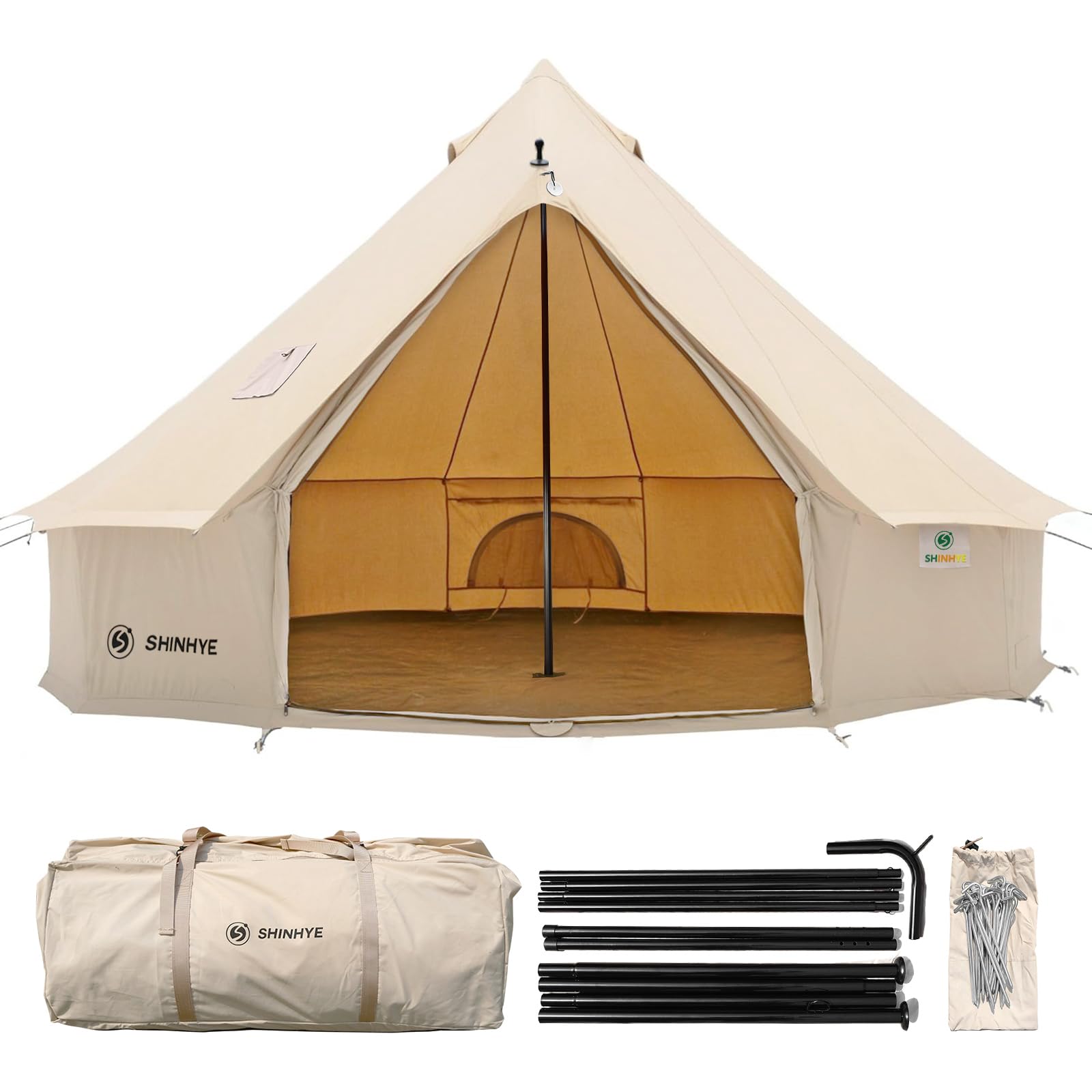
ShinHye 3M Canvas Bell
Key Features
- Diameter: 9.8 ft
- Peak height: 7.22 ft
- Sleeps (3M): 2
- Waterproofing: 5000 mm
- Price: Midrange
The walls are 1.9 feet tall and the peak is 7.22 feet, which tells you exactly where you can stand: the middle. A bell tent is a cone, so standing room is a circle at the centre that shrinks fast as you move out. What you get for that is 9.8 feet of diameter, 97 square feet of floor, and a shape that sheds weather instead of catching it.
The canvas is what won us over. Cotton breathes where coated polyester does not, so cold nights are less likely to leave the walls running with condensation, and the PU 5000 mm finish with a sewn-in PE groundsheet handles real rain. The stove jack is what makes it a four-season tent rather than a summer one, and the 13 guylines are what keep it steady in a blow; skip them and the whole thing leans.
This 3M size is listed as a two-person tent, and that is honest — a double bed and a stove fill it. ShinHye sells four sizes, so if you want the family version, size up rather than squeeze in. It goes up on the centre pole in about 15 minutes and packs down to something one person can shoulder, and it makes a campsite look deliberate in a way no nylon cabin here does.
Pros
- Breathable cotton canvas limits condensation
- 5000 mm coating and sewn-in groundsheet
- Stove jack extends it into winter
- Classic bell shape looks the part on a site
Cons
- Standing room only in the centre circle
- Canvas has to go away dry
The canvas tent to buy if you want a stove jack, real breathability and a campsite that looks the part — in this 3M size, for two.
Best for Year-Round Camping
Ytaoeo 8P Inflatable
Key Features
- Floor: 13 x 9 ft
- Sleeps: 8
- Peak height: 6.5 ft
- Stove jack and AC port: Yes
- Price: Premium
At 40.7 pounds this is the heaviest tent here, and the weight is buying capability: a stove jack for a wood stove in February and an AC port for a portable unit in August. No other tent in this group has both. We think that combination is what earns it a place — plenty of tents handle a cold snap, and plenty vent a hot afternoon, but very few are set up for either end of the calendar.
The 13-by-9-foot floor and 6.5-foot ceiling make a comfortable room for two with a real bed. The 8-person label is the one to discount, since two queen mattresses fill the width with no floor between them, so treat four as the working number. A divided curtain splits the interior into two spaces, the included pump gets it up in minutes, and the PU 3000 mm shell with UPF 50+ handles sun as well as rain.
Air beams are the trade. There are no poles to thread and nothing to fall back on if a beam loses pressure overnight, so inflate it at home before a trip, check that the valve seals seat properly, and guy it out even when the sky looks settled.
Pros
- Stove jack and AC port for year-round use
- Divided curtain makes two rooms
- Large mesh windows on both sides
- Included pump inflates it in minutes
Cons
- Heaviest packed weight here at 40.7 lb
- Beams can lose pressure at the valve seals
The only tent here with both a stove jack and an AC port, for campers who need one tent to work in February and in August.
Best for Two-Person Luxury
FUNWAKE 6P Inflatable

Key Features
- Floor: 118 x 83 in
- Sleeps: 6
- Seasons: 4
- Peak height: 81 in
- Price: Premium
Four to six people, says the listing; 118 by 83 inches of floor says two adults, a bed, and the bags. That gap is worth knowing before you order, because a tent that is right for a couple is a poor one for a family of five. Read it as a generous two-person room and the rest of the package starts to make sense.
What you are paying for is the fabric and the light. The air beams are TPU rather than PVC, which the maker rates as odorless and recyclable, and the skylight is a large TPU panel with a privacy cover across one side of the roof. Peak height is 81 inches, so even a tall camper stands up straight, and the shell is 420D Oxford with a PU 3000 mm coating and UPF 50+.
TPU rather than PVC is the detail that sells it, and the 4-season rating puts shoulder-season nights in scope rather than a stretch. Setup is the pump-and-valve routine with no pole bag to lose, which we appreciate on a trip where the light is going. It sits in also-consider because the money buys materials and headroom rather than floor space.
Pros
- TPU beams rated odorless and recyclable
- 81 inches of headroom, the tallest peak here
- Large TPU skylight with privacy cover
- Four-season rating with PU 3000 mm and UPF 50+
Cons
- Sleeps two to three, not the four to six claimed
- Costs more than our top pick with less floor
For a couple who wants a tall, bright four-season air tent, this is a lovely thing; the four-to-six-person label is optimistic.
How We Chose and Tested the Best Glamping Tents
We started by reading owner reviews and spec sheets, then narrowed a long list to tents that could sleep at least four, had a published peak height we could stand up in, and came from brands with a track record for replacement parts. We ruled out anything that needed a trailer or a permanent platform. The final group was seven tents, and we used each one for at least two outings over eight months, rotating them through a backyard, a state-park campsite, and an open field on a breezy weekend.
On arrival, I timed setup solo from the moment I opened the bag to the last stake, and noted where I needed a second person. For air-beam models, I timed inflation with the included pump and checked firmness again after dinner and first thing in the morning. Take-down got the same clock, including whether the tent folded back into its bag without a wrestling match.
We subjected each tent to a 10-minute hose test and, when the forecast cooperated, a full rainy night; afterward we ran a hand along seams and pressed paper towels into the floor corners. To judge space, we set up a queen air mattress, two camp chairs, and a duffel bag, then walked the perimeter without stepping over anyone. Durability showed up in small ways: zipper snags, pole-sleeve wear, stretched guy lines, and scuffed fabric after repeated packing. We also asked camping companions for honest reactions to each tent’s look and compared what each one included—porches, blackout panels, room dividers—against what it asked us to spend.
How to Choose a Glamping Tent
The tent that makes a campsite feel like a room is chosen on floor plan and fabric, not on the person count printed on the box.
Standing Room Is About Shape, Not Just Height
Two tents can both claim seven feet of ceiling and feel nothing alike. In a cabin, the walls are close to vertical, so most of the floor is usable standing space. In a bell, the roof is a cone: full height exists only in a circle at the centre, and the walls drop to knee height at the rim. The ShinHye’s 1.9-foot side walls are the honest version of that trade, and its 7.22-foot peak does not mean you can stand anywhere.
Look at the angle of the wall in the photos, not just the peak figure, and ask where you’d actually stand to pull on trousers on a cold morning. A cabin with 78 inches over the whole floor beats a taller tent with a narrow standing column.
Count Beds, Not People
Occupancy figures are written for sleeping mats laid shoulder to shoulder with nothing else inside. A queen air bed takes 60 by 80 inches, so two of them need roughly a 10-by-10-foot clear floor before a single duffel comes in. That is why a 14-by-9 cabin feels full with four people and why a 9.8-foot bell tent listed for two is being honest about it.
Work out your beds first, add a couple of feet at the foot of each for gear, and treat the advertised capacity as a ceiling rather than a plan. If the number on the box is the reason you’re buying, measure the bed you actually own.
Air Beams or Poles
Inflatables trade a pole bag for a pump: a few minutes and no threaded shock cords, which is worth a lot when you arrive in the rain. The trade-off is that the structure is only as good as its valves, and a slow leak overnight has no pole to fall back on. Pole tents ask for more staking and more patience, and a tunnel needs every stake before it stands at all.
The deciding question is your sites, not your patience. Choose air if you pitch late and often on sheltered ground; choose poles if your pitches are exposed, or if you plan to keep the same tent for a decade and want a repair you can do yourself.
Waterproofing, Seams, and What Four-Season Means
Hydrostatic head is the number to compare. Around 1200 mm keeps off ordinary rain, 1500 mm is a sensible floor for a family tent, and 3000 mm and up is what you want if the tent will be out in real weather. The coating is only half the story; seams, the rainfly, and a taut pitch do the rest, which is why the best-coated tent here can still feel damp if it is pitched sloppily.
Four-season is a looser term than it sounds. Mesh walls and a summer fly do not become winter kit because a listing says so. Solid fabric, a stove jack, and a low profile are what actually stretch the calendar, and condensation is the thing that ends most cold-weather trips early.
The Extras Worth Paying For
A skylight is the most photogenic upgrade in this category and the one with the clearest catch: a clear panel becomes a solar oven at midday, so a privacy cover is part of the feature, not a freebie. A screen porch is the better deal for most families, because it adds liveable space without adding sleeping space you have to heat or ventilate. A stove jack pays off only if you will genuinely carry a stove — the jack is the cheap part of that decision.
Frequently Asked Questions
Is a glamping tent worth it over a regular camping tent?
If you drive to the site and want to stand up inside, yes. Ceiling height, mesh area, and floor space are what change a trip, and none of them survive a lightweight-tent design brief. The cost is weight: the tents here run from 27 to about 41 pounds packed, so anything beyond a short walk from the car turns into a chore.
The rule of thumb is distance, not luxury. If you carry gear more than a couple of hundred yards, take a backpacking tent and leave the glamping tent for base camps.
Can I leave a glamping tent up all season?
Some people do, and canvas bell tents are the ones built for it, but UV, wind, and mildew all get a turn over a long season. A tent left standing should be guyed out properly, checked after every storm, and have its seams re-proofed once a year.
Cotton canvas has to be bone dry before it goes into storage — pack it damp and you will meet the mildew before your next trip. Check the campground’s rules as well, since many limit how many consecutive days a unit can stay up.
What do I need to run a wood stove in a tent?
The stove jack only solves the hole in the wall. You also need a stove sized to the tent, the matching pipe, a heat-resistant mat for the floor, and a carbon monoxide alarm. Buy the alarm before the stove, not after, and keep the stove the clearance its maker states from every fabric surface.
Test the whole setup outside on a calm day first. A stove you have only read about is not one you want to light for the first time on a freezing night.
Final Verdict
The WildFinder is the glamping tent we point most people to. A skylight and a stove jack give it the two features that make a tent feel like a room, the pump does the work on a wet evening, and 79 inches of headroom means nobody is dressing lying down.
Change one requirement and the answer changes. If you need to sleep six on real beds, the CORE’s 14-by-9 floor is the better buy, as long as you accept its lighter weatherproofing. If you want canvas, a stove jack, and a tent that looks deliberate in a photograph, the ShinHye is the one.