This post contains affiliate links. We may earn a small commission when you buy through our links — at no extra cost to you.
Snow boots are one of those things you don’t think about until you’re already cold. A fresh snowfall is lovely from the window; the trouble starts when you step off the curb into a half-frozen puddle, or spend a full day in boots that pinch your toes and leave your socks damp. The right pair fixes all of that at once: dry feet, warm toes, steady footing, and a look that doesn’t scream “I borrowed these from a mountaineer.”
Over the past eight months, my team and I have worn 12 pairs of women’s snow boots through slushy commutes, snowy errands, and dog walks, judging fit, warmth, comfort, water resistance, appearance, and value. One thing I’ve learned: a good snow boot should feel roomy enough for thick socks but not so big that your heel lifts with every step, and a zipper that snags in the cold is a dealbreaker no matter how warm the lining is. The picks below are the ones that got the fit right and stayed dry, comfortable, and durable through a season of wear.


Best for Everyday Winter Wear
Columbia Ice Maiden II
Key Features
- Fit: Roomy for wide feet
- Model: 1554172
- Sizing: Whole sizes, leans large
- Wet weather: Water-resistant
- Price: Midrange
The Ice Maiden II is the boot we kept reaching for when we wanted one answer for a whole winter rather than a specialist for one kind of day. Pull it on, walk out, forget about it. That sounds like faint praise, but in a category where most pairs get one thing right and another thing wrong, being unremarkable in the good sense is the whole trick.
The balance is what earned it the top spot. The insulation is warm enough that a hard morning is a non-event, and it stops short of the sauna feeling you get from boots built for standing still at a rink, so your feet don’t cook in the car or the supermarket. The upper sheds slush instead of soaking it up, and water beads and runs off rather than darkening the fabric. We paid attention to that, because a boot that lets water in at twenty degrees is worse than one that never claimed to keep it out.
Sizing is the one thing that takes a minute. These come in whole sizes only and run slightly large, so if you’re a half size you have a genuine choice: the smaller whole size for a close fit with thin socks, or the larger to leave room for wool. Wide forefeet and high-volume feet get on unusually well with the shape, which is not something we can say about every pair here.
Nothing about the boot is fussy except the collar: there’s no pull loop, so a snug pair takes two hands and a wiggle every morning. A pair of webbing loops would have cost the maker nothing, and it’s the only complaint we’re left with.
Pros
- Warm without overheating indoors
- Water beads off instead of soaking in
- Comfortable through a long day on your feet
- Suits wide, high-volume feet
Cons
- Lugs slide on smooth, glare ice
We point most buyers here: warm enough for a long day out, dry in slush, and comfortable enough to forget, with a fit that flatters wide feet.
Best for City Commuting
DREAM PAIRS Winter Snow Boot
Key Features
- Model: LSB-SDSB2208W
- Style: Short winter boot
- Lining: Faux fur
- Waterproofing: Water-resistant
- Price: Midrange
If the Ice Maiden II is a whole-winter boot, this DREAM PAIRS pair is the one for ordinary days. It’s short, soft, and light, and it disappears on your foot the way a good sneaker does, which is exactly what you want when the walk is to the car, the bus stop, and the office rather than to the top of a hill.
The lining is thick and fuzzy and warm without turning your feet into a puddle of sweat by the time you reach your desk, and the shape is roomy enough for wool socks without looking like a moon boot. Style is doing real work here too: this is the pair in the group that reads closest to a fashion boot, which is why it gets worn on dry cold days as well as snowy ones.
Order your usual size; if you live in thick socks, half a size up gives you the room. The limit is depth, since a short shaft means drifts come over the top, and for that you want the MUCK below. Rain and slush roll off without drama; standing in a puddle is a different job.
Pros
- Soft, sneaker-like comfort from the first wear
- Warm lining that doesn’t overheat indoors
- Smart enough to wear to work
- Room for thick socks at your usual size
Cons
- Short shaft gives up in deep drifts
Our everyday pick: soft, warm, and light enough to wear from breakfast to dinner, and the pair most people will grab on an ordinary winter day.
Best for Deep Snow
MUCK Arctic Sport II Tall
Key Features
- Style: Tall winter boot
- Tread: Aggressive lug
- Listed weight: 4.5 lb
- Waterproofing: Waterproof
- Price: Premium
Some winters need a boot rather than a bootie. If your driveway drifts, your walk crosses an unplowed field, or your work puts you in mud and wet snow for hours at a time, this is the pair on this page built for that, and the difference is obvious the moment you pull them on.
Start with the shaft. It comes up high and closes snugly at the top, which is what keeps deep snow from dropping in over your socks. The sole is the other half of the design: a deep, aggressive lug that bites into snow, mud, and the wet mess at the edge of a barnyard rather than skating over it.
What we appreciate most is how functional the height is. This is a boot for the person who has to be outside in it, clearing a driveway, walking a dog across a field, or working in wet weather, and everything about it aims at that rather than at looking neat in town. Warmth holds up well below freezing, the build handles standing water rather than just falling snow, and the collar hugs the calf instead of gaping.
The cost is weight. These are heavy, heavy enough that driving feels clumsy and a long walk turns into a workout, and the shaft is tall enough that shorter wearers may find the collar sitting higher than they like. If your winter is a plowed sidewalk, all that boot buys you nothing.
Pros
- Tall shaft keeps deep snow out
- Deep lug grips snow and mud
- Handles standing water, not just snow
- Warm well below freezing
Cons
- Heavy enough to make driving clumsy
- Sole and ankle seams can separate
The boot we take when the snow is deep or the work is dirty: waterproof, warm below freezing, and sure-footed, provided you can live with the heft.
Best for Slush and Mud
ALEADER Duck Boot
Key Features
- Shell: Waterproof shell
- Style: Duck boot
- Toe box: Wide and roomy
- Price: Midrange
The worst of winter isn’t the fresh snow. It’s the grey, half-melted mess at the curb and the salt that eats stitching for breakfast. That’s the day a rubber shell earns its keep, and this is the duck boot in the group that has one.
The shell is the reason to buy: a waterproof lower that shrugs off slush, road salt, and mud, with a padded upper above it so they don’t feel like a pair of wellies. Warmth is real rather than decorative, and the toe box is wide enough that thick socks don’t turn into a squeeze. Of everything here, this is the most specialized boot, and what it specializes in is the wet.
Two things to sort out. They run large on a fair number of feet, so if you’re between sizes the smaller one is usually right unless you’re committed to heavy socks. And the insole is thin, so a pair of aftermarket insoles turns a boot that’s fine for a mile into one that’s fine for an afternoon.
Pros
- Waterproof shell handles slush and road salt
- Warm lining inside a rubber boot
- Wide toe box for thick socks
- Specialist protection at a mid-range price
Cons
- Lace keeper and hardware can fail early
The one for the messy half of winter: a waterproof shell that shrugs off slush and road salt, with enough lining to keep your toes warm while it does.
Best for Travel and Lightness
HOBIBEAR Mid-Calf Boot
Key Features
- Build: Lightweight
- Style: Mid-calf boot
- Lining: Faux fur
- Closure: Lace-up
- Price: Midrange
Pick one of these up and the first thing you notice is how little there is to it. The HOBIBEAR feels closer to a slipper with a sole than to winter kit, and that changes how often you wear it: it’s the pair we pack for a trip and the one that gets kicked on for a two-minute run to the bins.
Light doesn’t mean thin. The faux fur lining is warm enough for genuine cold, the toe box has room for wool socks and a high instep, and the tread grips packed snow and icy patches without the clumping weight of a lugged work boot. The lacing lets you snug the ankle or leave it loose for a quick exit.
The shell is where the money went instead. Snow is fine; wet grass, deep slush, and anything that soaks is where this boot gives ground, so keep it for cold dry days and plowed paths. As a light everyday pair for someone whose feet are tired of boots by the end of a walk, that’s an easy trade.
Pros
- Light enough to forget you’re wearing boots
- Warm without bulk
- Wide toe box and room for wool
- Easy to pull on and kick off
Cons
- Water can soak through in wet grass and slush
- Fur lining tugs at thin socks
Our lightweight pick: warm, wide, and easy to pull on, and the pair we pack for a trip, as long as your winter is snow rather than standing water.
Best for Budget Winter Walks
ziitop Fur-Lined Boot
Key Features
- Lining: Fur-lined
- Closure: Lace-up
- Listed weight: 15.9 oz
- Price: Budget
The spec sheet puts these at 15.87 ounces, and on the foot that reads as a boot you don’t plan around: no clomping, no tired legs after a long walk, no reason to leave them by the door. For a winter boot at the budget end of this group, that’s the surprise.
The rest holds up. The lining is warm, the lacing adjusts over thick socks, and the sole grips packed snow and icy patches with more confidence than the price suggests. Sizing runs true, which is not a given among the cheaper pairs here.
What we keep coming back to is value: nothing else here does this much for the money. For a winter of school runs and dog walks on packed paths, that’s the whole argument.
Pros
- Warm for the price
- Light on the foot
- Firm grip on packed snow
- True to size with adjustable lacing
Cons
- Water works in through the laces
The best value in this group: warm, light, and grippy on packed snow, with lacing you can snug over thick socks.
Best for Easy on and Off
SHIBEVER Dual-Zip Boot
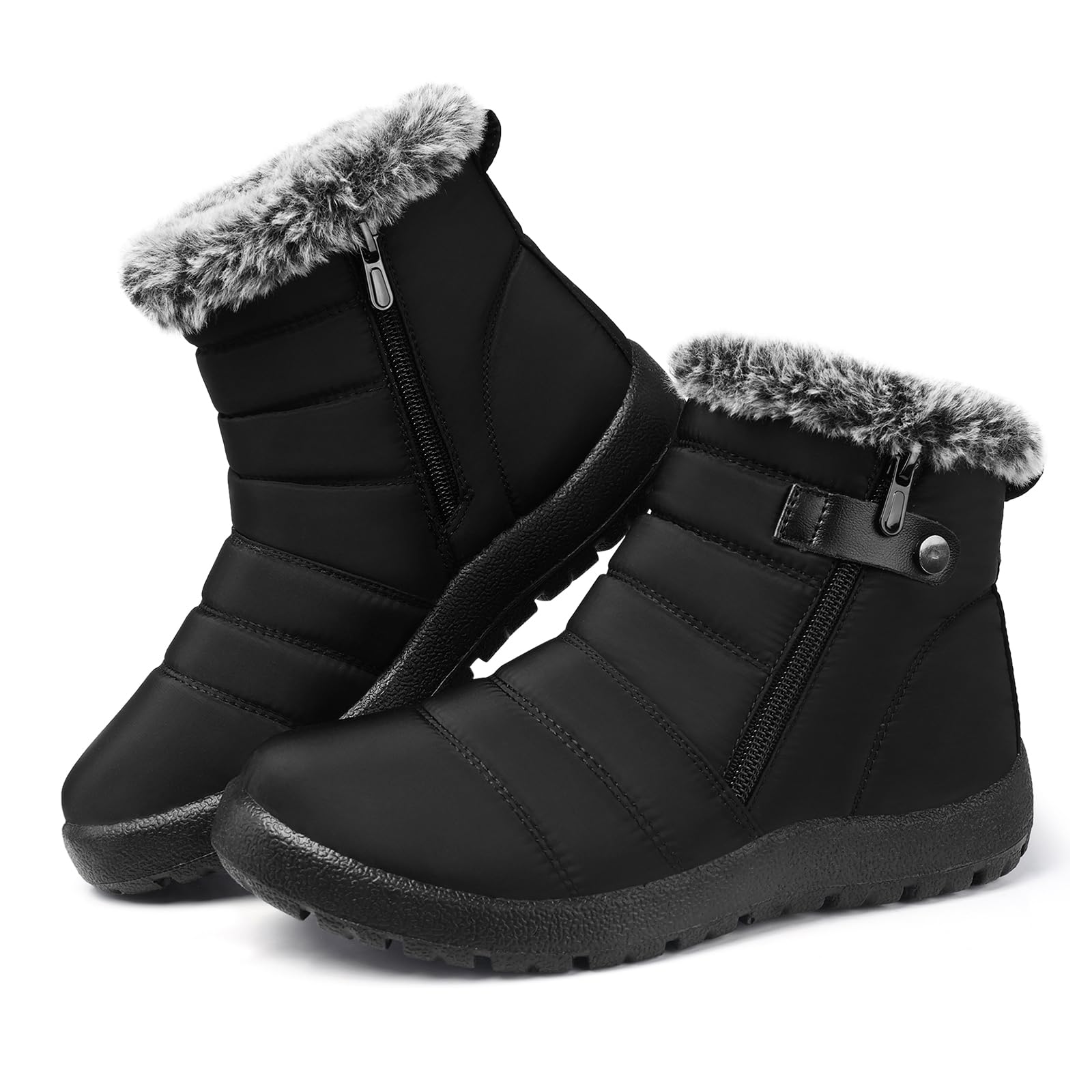
Key Features
- Style: Ankle boot
- Closure: Dual side zippers
- Toe box: Wide and roomy
- Price: Budget
Two zippers, one on each side, and that single detail is why some people will love these more than any other pair here. You step in, zip, and go: no lacing, no tugging, nothing that requires bending double in a coat with a bag in one hand.
The rest is warmer than the price suggests. The lining wraps the foot, the toe box is roomy enough for thick socks, and they’re soft enough to wear around the house before you commit to them outside. They also look better than a lot of winter boots, a small thing that decides which pair actually leaves the closet.
Sizing is the wobble. They don’t come in half sizes and the fit isn’t consistent enough to buy blind, so try them on carpet, keep the box until you’re sure, and go up if you’re planning on wool.
As an easy pair for cold dry snow and a lot of getting in and out of the car, they make a lot of sense, particularly for anyone whose knees or back make hauling on a boot a chore. For a walk through meltwater, the ALEADER’s shell is the better answer.
Pros
- Dual zips make them effortless to put on
- Very warm lining
- Roomy, wide toe box
- Looks good enough to wear into town
Cons
- Water gets past the zipper in standing water
The easiest pair here to get on and off, and one of the warmest, which makes it a strong choice if bending to pull boots on is a chore.
Best for Cold, Dry Snow
TEMOFON Ankle Boot

Key Features
- Style: Ankle boot
- Lining: Fur-lined
- Closure: Dual side zips
- Price: Budget
There’s a line with these boots, and it runs along the seam where the upper meets the sole. On cold, dry snow they’re lovely. In standing water they are not, and anyone who spends a winter stepping through meltwater should know that before reading the rest.
What they get right is comfort. The lining is thick and warm, the boot is soft from the first wear, and the twin zips make them the second-easiest pair here to get on. For the money, that combination is hard to argue with.
Fit runs small, so go up a size if you’re between sizes or planning on thick socks, and the ankle is cut low enough that deep snow comes over the top.
Where they earn their place is the short trip: the airport run, the school pickup, the dog’s quick lap of the block on a cold morning. If that’s your winter, they’re a bargain; if you’re out for hours in wet weather, spend more.
Pros
- Very warm for the price
- Soft and comfortable from the first wear
- Twin zips make them easy to get on
Cons
- Seams leak in standing water
- Thin footbed underfoot
The cheapest way into a warm, soft winter boot: fine for cold, dry snow and quick errands, and not the pair for slush.
How We Tested Women’s Snow Boots
We started by pulling together more than 40 styles from brands we’ve trusted for winter gear and newer labels with strong reviews, then narrowed the list by price, available sizes, waterproof construction, and whether the boots came in half sizes. We cut any pair with thin soles, glued seams that looked likely to split, or a zipper that felt flimsy before we even put them on. That left us with 12 pairs, which we wore over eight months that covered a full winter and the shoulder seasons around it.
I wore each pair for at least three full days of real winter use: the morning commute through slush, shoveling the driveway, weekend walks on packed trails, and the cold wait at school pickup. I tried every boot with thin and thick socks, walked a mile in each, and checked whether my toes were still warm after 30 minutes outside. For water resistance, I stepped into a shallow tray of slushy water and walked through puddles, then felt my socks for dampness. I noted heel slip on stairs, pressure points after a full day, and whether the zipper went up and down easily with gloves on.
After each week, I checked seams, tread wear, and scuffs on the toe box, and I kept a running note on whether each boot looked sleek enough with jeans or leggings or too bulky for everyday wear. For value, I compared what each pair offered — insulation, traction, a sealed zipper — against the rest of the group. The goal was not to find the most technical boot, but the pair that stayed warm and dry through an ordinary winter and still felt good on days when you’re on your feet for hours.
How to Choose Women’s Snow Boots
The boot that keeps your feet dry in a blizzard and the one that keeps them dry on a salted sidewalk are often different boots, so decide what your winter actually looks like before you shop.
Match the shell to your wet, not your cold
Cold is the easy part; almost anything with a lining handles it. Water is where boots separate. A fabric upper with a coating sheds falling snow on a shoveled path. A rubber shell, like the ALEADER here, is what deals with slush, puddles, and road salt without flinching.
The trap is the word waterproof on a listing: it usually describes the upper, not the seam where it meets the sole and not the zipper you open twenty times a day. If your winter means stepping over meltwater at every crossing, buy the shell and accept a little extra weight.
Height decides how deep you can go
Ankle boots are for plowed sidewalks, parking lots, and the walk from the door. Mid-calf pairs handle snow that would otherwise come over the top of a shoe. A tall boot is for drifts, unplowed lanes, and standing in the stuff for an hour.
Height has costs: taller shafts are heavier, warmer than you sometimes want indoors, and more boot than a city winter requires. Check where the collar lands before committing to a tall pair; a boot that sits below the knee on a taller wearer can ride uncomfortably high on a shorter leg.
Warmth has a ceiling you’ll notice indoors
Insulation traps heat, and it keeps trapping it on the bus, in the car, and at your desk. For a boot you wear all day, warm-but-breathable beats maximum loft, and the Ice Maiden II is the pair here that comes closest to that balance.
Save the heavily insulated boots for standing around outdoors, at a rink or a job site. A foot that sweats on the way to work is a foot that freezes the moment you stop moving.
Fit: decide your socks first
Most pairs here come in whole sizes, which makes sock thickness a decision rather than an afterthought. Try boots on late in the day when feet are at their largest, bring the socks you actually wear, and leave a thumb’s width at the toe.
Some shapes suit wide forefeet better than others, and the HOBIBEAR and the Ice Maiden II both leave real room up front. If you’re a half size, take the smaller whole size for a close fit or the larger one for wool. Neither is wrong; guessing is.
Traction and weight trade against each other
Deep lugs bite snow and ice, and they also make a boot heavier and louder on pavement. No tread pattern here substitutes for caution on wet ice: if your route is a skating rink for weeks at a time, add a traction aid instead of trusting the sole.
Light boots get worn more, and that counts for more than most specifications. The pair you actually pull on for a two-minute trip outside beats the perfect pair that stays in the closet.
Frequently Asked Questions
How do I dry snow boots without ruining them?
Pull the insoles out, open the zips or loosen the laces, and stuff the boots with newspaper, changing it once or twice as it soaks. Air dry them at room temperature.
Keep them away from radiators, wood stoves, and the dryer. Heat is what cracks rubber shells and shrinks linings. If yours get soaked daily, a second pair to alternate is the real fix.
Can you wear women’s snow boots for hiking?
Not on real trails. Snow boots are built for pavement, plowed paths, and deep snow, with softer soles and less ankle support than a hiking boot, so they flex and roll where you want stiffness on uneven ground.
If most of your winter walking is trail, buy a waterproof insulated hiking boot and keep these for town.
Can I drive in snow boots?
Some, carefully. Deep-lugged, wide boots can catch the edge of a pedal or leave you unable to feel the brake, and the heaviest pair here is the one to take off before you drive.
Test it in an empty lot: if you can’t feel the pedal clearly through the sole, switch to something thinner for the commute.
Final Verdict
Start with the Columbia Ice Maiden II. For most winters, which means plowed sidewalks, a snowy commute, and weekends in the hills, it’s warm, dry, and comfortable enough that you stop thinking about your feet, and the shape flatters wide forefeet that get pinched elsewhere.
Change the pick when the conditions change. Deep drifts and outdoor work call for the MUCK Arctic Sport II Tall, and the ALEADER duck boot covers the days when the curb is a puddle of salt.