This post contains affiliate links. We may earn a small commission when you buy through our links — at no extra cost to you.
The first real snow is magical for about ten minutes — then you step off the curb into a half-frozen puddle and spend the rest of the day with wet socks and numb toes. A good winter boot is what separates a season spent outdoors from one spent scurrying between heated buildings. What you’re really paying for is a dry, warm foot at 4 p.m., after slush and salt have had all day to work on it.
I’ve owned boots that looked beautiful in the box and turned into a soggy sieve by February, so I’m a hard sell. Over the past five months, my team and I have worn 12 pairs through commutes, school drop-offs, and long dog walks in everything from wet sleet to single-digit cold, judging warmth, comfort, fit, durability, and how the zippers held up along the way. One thing I’ve learned: a roomy toe box matters more than a thick lining — cramped toes go cold no matter how much insulation you pile around them. The picks below are the ones we kept reaching for even when we didn’t have to.


Best for All-Round Winter Wear
COOJOY Waterproof Mid-Calf Boot
Key Features
- Lining: Fur pile
- Weight: Lightweight
- Shaft height: Mid-calf
- Waterproofing: Waterproof upper
- Price: Midrange
A mid-calf snow boot usually arrives heavy and stiff, and this one doesn’t. The COOJOY is lined in a thick fur pile that runs the whole shaft rather than stopping at the footbed, so the height that keeps snow out is also the height that keeps your calves warm — and it stays light enough to walk a mile in without feeling like you’re wearing a bucket.
Where it surprised us was underfoot. Cheap snow boots are usually where grip gives up, and this pair held on refrozen sidewalks and packed snow without the skating we braced for. Warmth is the headline, though: the lining is the real thing, and it kept our feet warm on the raw, windy days that get through a thinner boot. Coverage, heat, and traction together are what make it the default for an ordinary winter.
The one place to slow down is the fit. Sizing leans small, and if you plan on thick wool socks, a half size up is the safer order. Do that and there’s very little here you have to compromise on.
Pros
- Mid-calf coverage without the weight
- Fur lining runs the full shaft
- Sure-footed on ice and packed snow
- Warmth that holds in real cold
Cons
- Water protection trails its warmth and grip
The pair we point most buyers toward: full mid-calf warmth, light on the foot, and the surest all-round grip for the money.
Best for Icy Sidewalks
HOBIBEAR Waterproof Snow Boot
Key Features
- Lining: Faux fur
- Closure: Lace-up
- Shaft height: Mid-calf
- Waterproofing: Waterproof upper
- Price: Midrange
Icy sidewalks are where budget winter boots expose themselves, and this is the pair we trust most on them. The lugged outsole bites on refrozen slush and wet brick, and it does that from a boot so light you stop noticing it three blocks in. Warmth comes from a faux-fur lining that runs the length of the shaft, and it stayed comfortable on a long cold walk instead of turning into an oven once we picked up the pace.
The lacing is the detail that sold us. It runs high enough to snug the ankle, so you can loosen it for a thick wool sock and tighten it for a narrow foot, and the boots still pull off at the door without untying. Sizing lands true to size for most feet, which makes ordering simple. This is a city and suburb boot — cleared paths, school runs, sleet, and the icy patch at the bottom of the driveway.
Pros
- Grip that holds on refrozen ice
- Light enough for a long walk
- Pulls off without untying
- Room for thick socks
Cons
- Waterproofing can falter in wet grass
If your winter is icy sidewalks and cleared paths, this is the pair with the surest footing here.
Best for Trail and Town
ANJOUFEMME Hiking Boot
Key Features
- Style: Ankle hiking boot
- Weight: Lightweight
- Waterproofing: Waterproof upper
- Price: Midrange
A snow boot keeps weather out; a walking boot gets you somewhere. This is the only boot in the group built for the second job — an ankle-height hiking boot with a firmer midsole, a lugged outsole, and lacing that reaches toward the toe. You feel the difference on the first block of uneven pavement, because the boot resists instead of rolling with whatever is under it.
That build pays off on the days when the walk is the point. Feet stayed warm on cold mornings and dry through wet grass and muddy patches, and the width left room for a thick sock without pinching across the ball of the foot. On longer routes it’s the firmer sole you notice, holding your arch up long after a soft snow boot would have you shuffling.
It is a roomy boot, so narrow feet want a thick sock to fill the volume; if your feet are wide, that room is a gift. The trade-off for the support is that these are heavier and more purposeful than a pull-on, which is why we keep them for walks that deserve them.
Pros
- Real hiking sole and ankle support
- Stays dry on wet ground
- Roomy enough for thick socks
- Comfortable over a long day
Cons
- Sole separation appears with hard use
The one here built for walking rather than waiting, and the boot to pick when winter means trails, long dog walks, or a commute on foot.
Best for Deep Snow
DREAM PAIRS Waterproof Mid-Calf
Key Features
- Lining: Faux fur
- Closure: Side zipper
- Shaft height: Mid-calf
- Waterproofing: Waterproof upper
- Price: Midrange
Deep snow is a coverage problem before it’s anything else, and this boot solves it the simple way: a mid-calf shaft, a warm faux-fur lining, and a side zip so you’re not wrestling with laces in a cold garage. Snow stays out at the ankle, which is the whole reason to own a boot this tall instead of an ankle bootie.
For shoveling the drive and walking the dog through drifts, it does the job comfortably. We appreciated that the lining runs the length of the boot and that the sole is cushioned enough for a mile of scraped pavement. Water is the caveat: slush and shallow puddles are fine, but standing water at the seam is where these can soak through, so treat them as a snow boot rather than a rain boot.
Sizing runs a touch generous, which is welcome if you live in thick socks and less so if you’re between sizes. It’s also a lot of boot for a city block — for a short walk on cleared ground, a lighter pair will feel better.
Pros
- Mid-calf coverage for deep snow
- Warm lining through the whole shaft
- Comfortable on shoveled pavement
Cons
- Zip pulls can break within weeks
A warm, tall snow boot for driveways and drifts — buy it for coverage, and keep an eye on the zip.
Best for Commuting
SHIBEVER Fur-Lined Ankle Boot
Key Features
- Style: Ankle bootie
- Lining: Fur-lined
- Closure: Side zipper
- Waterproofing: Waterproof upper
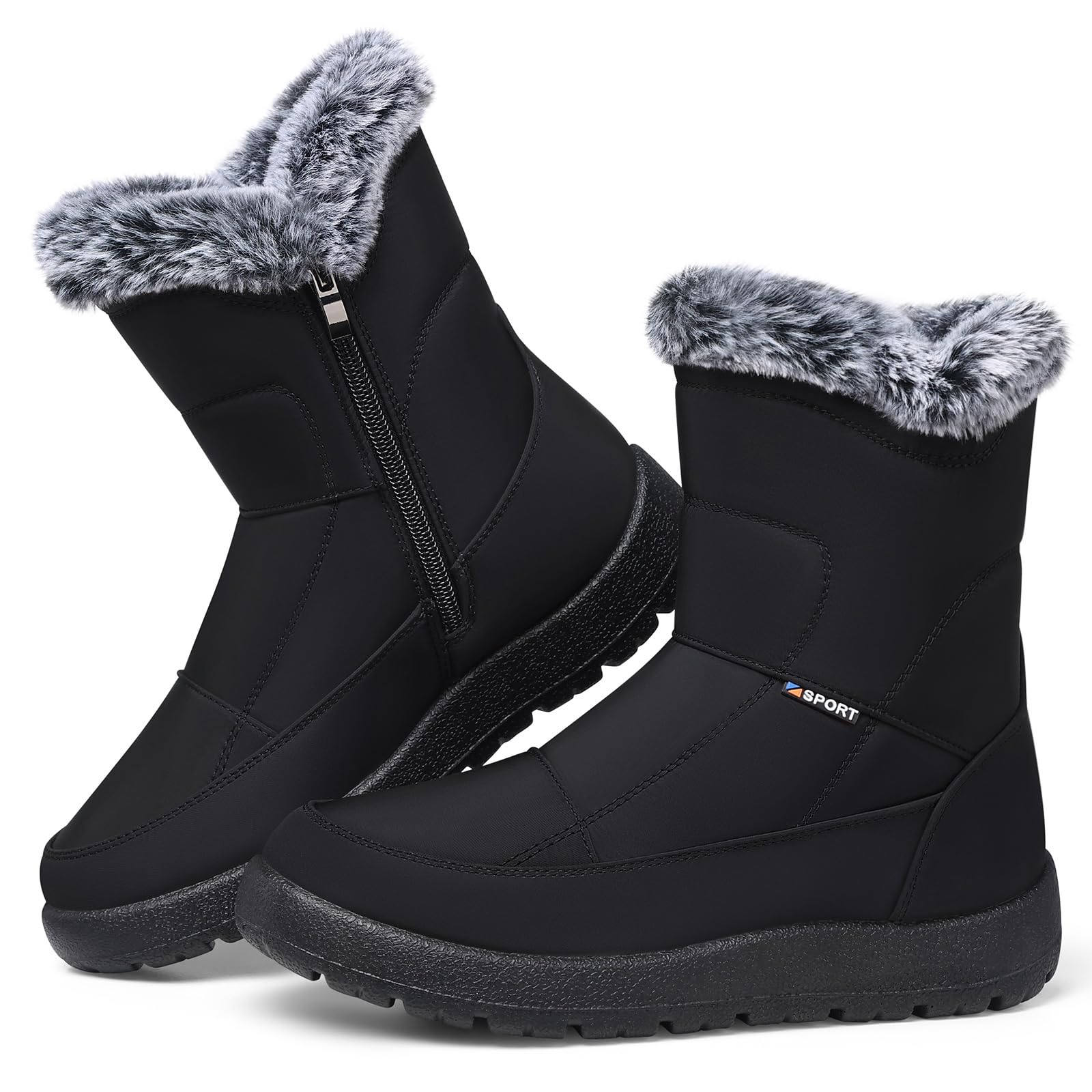
Heavy snow is where this ankle boot earns its place: feet stayed dry through a slushy, snowing commute, and the boot is light enough that you don’t feel like you’re wearing a snow tire. Warmth is generous for the bulk — the fur lining is thick and soft, and the ankle height is enough for cleared streets and plowed lots. We minded how little room the shaft leaves for tucking jeans, but it’s the boot you leave by the door for the school run.
The fit is the thing to get right. It runs narrow through the middle of the foot, so if you’re between sizes or planning a heavy sock, go up rather than hoping it gives. Wide feet should start somewhere else in this group, and anyone whose route crosses a shaded, icy hill should too — this is a snow-and-cold boot, not a winter-hill boot.
Pros
- Keeps feet dry in heavy snow
- Warm without much bulk
- Quick side-zip entry
Cons
- Soles are not dependable on ice
A light, warm ankle boot that keeps feet dry in heavy snow, and the easiest of these to pull on for a morning commute.
Best for Dry Cold Days
BEARPAW Emma Short

Key Features
- Style: Short classic pull-on
- Upper: Suede
- Lining: Wool
- Price: Premium
There’s a reason this boot has the following it does, and it isn’t weather protection — it’s the feel. A suede upper over a wool lining is warm the second you slide your foot in, closer to a slipper than to a snow boot, and on a cold dry day nothing else here is as pleasant to wear. We kept coming back to it for the short errands where warmth matters more than tread.
Order up, because the sizing runs small and a thick sock makes it worse. And be realistic about what it is: suede has no place in slush, and the sole is a flat casual sole rather than a winter lug, so this is a boot for the driveway, the school lot, and a walk in the cold — not for a hike in the snow.
Pros
- Wool lining that holds heat
- Slipper-soft from the first wear
- Short shaft slips on under jeans
Cons
- Soles can crack or separate
The coziest boot in this group: real wool warmth for dry cold days, provided you size up and leave it home in slush.
Best for Everyday Casual
DREAM PAIRS Suede Mini Boot

Key Features
- Style: Mini snow boot
- Upper: Genuine suede
- Lining: Faux fur
- Price: Budget
Genuine suede is rare at the budget end of this group, and it’s the first thing you notice here: a soft nap, a clean short shape, and a look that reads like a boot from a more expensive shelf. There’s a pull tab at the back that makes them easy to tug on, and the fur inside is warm straight out of the box.
On a dry, cold afternoon they’re lovely — warm over jeans or leggings, short enough to wear with everything, and light on the foot for errands. What they aren’t is a snow boot, whatever the name says, so keep them for clear pavement and sharp air rather than a melting sidewalk.
Two practical notes. Sizing is inconsistent, with some pairs coming up large and others tight across the toe, so try them with the socks you’ll actually wear. And watch the sole bond at the side — that’s the failure to catch in the first month, while returning them is still easy.
Pros
- Genuine suede upper
- Warm for dry cold days
- Slim enough for jeans and leggings
Cons
- Suede soaks through in wet snow
Buy this one for looks and warmth on dry winter days, not for a snowbank — the suede is beautiful and it will not forgive a puddle.
How We Tested the Best Winter Boots for Women
We started by gathering every women’s winter boot we could find with a genuine waterproof claim, then narrowed by insulation type, shaft height, size range — half sizes and wide widths included — and price, so the final list mixed budget picks with investment pairs. That left 12 pairs, which we wore for five months, from the first cold snap through the last gray snowmelt.
Every pair ran the same routine: a 20-minute walk to the bus through slush, a full desk day to see whether feet overheated indoors, and a weekend tramp through unplowed snow. We checked our socks at the end of each wet-weather day and noted where dampness appeared first, usually the toe seam or the tongue. Fit got its own pass — three testers with different foot widths and calf sizes wore the same pair and reported where it pinched, slipped at the heel, or rubbed.
Durability was a matter of deliberate abuse. We scuffed toes against curbs, flexed each boot 50 times at the ball of the foot to look for cracking, and zipped and unzipped side zippers with gloved hands, watching for snags, skipped teeth, and gaps that let cold air in. We also weighed each pair and carried it in a tote on a commute, since a boot too heavy to walk in stays in the closet. Appearance counted too: we wore each one with jeans, leggings, and a midi skirt before deciding whether it was a boot we’d actually leave the house in.
How to Choose Women’s Winter Boots
Start with the weather on your actual route, not the picture on the product page — the boot that handles a plowed sidewalk is a different boot from the one that handles a drifted driveway.
Match the shaft to the snow you walk in
Shaft height decides more than any other single feature. A mid-calf boot like the COOJOY or the DREAM PAIRS keeps snow out when you’re clearing the drive or breaking trail to the car; an ankle or mini boot stops at the ankle, and a drift goes straight down your sock. If your winter is mostly cleared pavement and a cold walk to the train, the shorter boot is easier to walk in and easier to wear with jeans. If you routinely step into snow above the ankle, buy the taller boot and accept the bulk.
Waterproof is a spectrum, and closures are the weak point
Every boot here is sold as waterproof, which means the upper sheds rain and snow — not that it survives a puddle. Seams and closures are what fail. A side zip is the fastest way in and out and also the most exposed spot on the boot, where water, grit, and a bent pull tab do their damage; a lace-up seals better but takes longer. Suede, even genuine suede, is a dry-cold material, so keep those pairs for cold days without slush.
Traction and weight pull against each other
Deep lugs grip ice and packed snow and make a boot heavier and clumpier on dry pavement; thin, flat soles feel light and skate on a refrozen sidewalk. If your route crosses a bridge, a hill, or a shaded stretch that stays icy all week, put traction first — the HOBIBEAR is the surest here, and the ANJOUFEMME trades some warmth for a hiking sole. If you’re on cleared ground most days, a lighter boot is kinder to the mile you actually walk.
Leave room for socks without sliding around
Thick wool socks change fit by about half a size, and several boots in this group run small. Order for the socks you’ll wear: if that’s a heavy wool sock, take the half size up and check that your heel doesn’t lift when you walk. Too tight is colder than slightly roomy, because circulation warms feet more than lining does. Width matters too — the ANJOUFEMME is the roomiest here and the SHIBEVER the narrowest.
Know what fails and check it while you can still return
Soles separating from uppers and zip pulls breaking are the two failures that turn up across this whole category, and both show themselves early. Walk a few miles in a new pair while the return window is open, tug the zip past its stiff point, and look at the bond line around the toe. Treating a new pair as a trial rather than a purchase is the best insurance in this category.
Frequently Asked Questions
How do I keep my feet warm without sweating through the afternoon?
Wear a thin merino or synthetic liner sock under your wool sock, and don’t wear the boots indoors or in the car — the lining that traps heat also traps sweat, and damp feet chill fast. If your toes go numb, the boot is more likely too tight than too thin; try a thinner sock or a half size up before blaming the insulation.
Do new winter boots need to be treated before wearing them?
Only suede needs it. Spray a suede protector on a pair like the DREAM PAIRS suede mini or the BEARPAW before the first wear and reapply through the season; synthetic and faux-fur uppers don’t need treatment, and no spray turns a dry-weather boot into a waterproof one. A little wax on a metal zip keeps the pull running smoothly.
Can I hike in winter boots?
For a packed trail and a couple of miles, yes — any mid-calf boot here manages it. For uneven ground, distance, or anything with a climb, wear a real hiking boot: the ANJOUFEMME is the only one here built that way, with a firmer sole and ankle support. Soft-shafted snow boots roll on rough ground and rub on the descent.
Final Verdict
Most winters, buy the COOJOY. It covers the ankle, holds heat, and grips ice without the clomp of a work boot, and the only thing to think about twice is the sizing. If your routes are icy and long, the HOBIBEAR has the better sole. If winter means a trailhead in January, the ANJOUFEMME is the one built for it — and if you just want warm feet on dry cold days, the BEARPAW is the cozier answer.