This post contains affiliate links. We may earn a small commission when you buy through our links — at no extra cost to you.
The night the transformer down the street blew, I learned exactly how bad a phone flashlight is at lighting a room: you hold it in your teeth, it throws a hard white beam at one wall, and the shadows handle the rest. A good rechargeable lantern fixes that. It pushes light out in every direction, sits on a table or hangs from a tent loop, and doesn’t require a drawer full of D batteries to switch on. What it does require is a battery that’s still alive when you finally reach for it, which is where most of them quietly fall short.
Over the past eight months, my team and I have kept a dozen rechargeable lanterns charged, drained, dropped, and hung in places where the light genuinely mattered: tents, a damp basement, a few long outages, and one very dark garage. The pattern is clear. Brightness numbers on the box tell you almost nothing by themselves, and a 1,000-lumen lantern aimed straight up is less useful than a 300-lumen one with a frosted globe that fills a room. Below are the ones that got the balance right: real output, light that spreads, and a battery that holds a charge between outings.
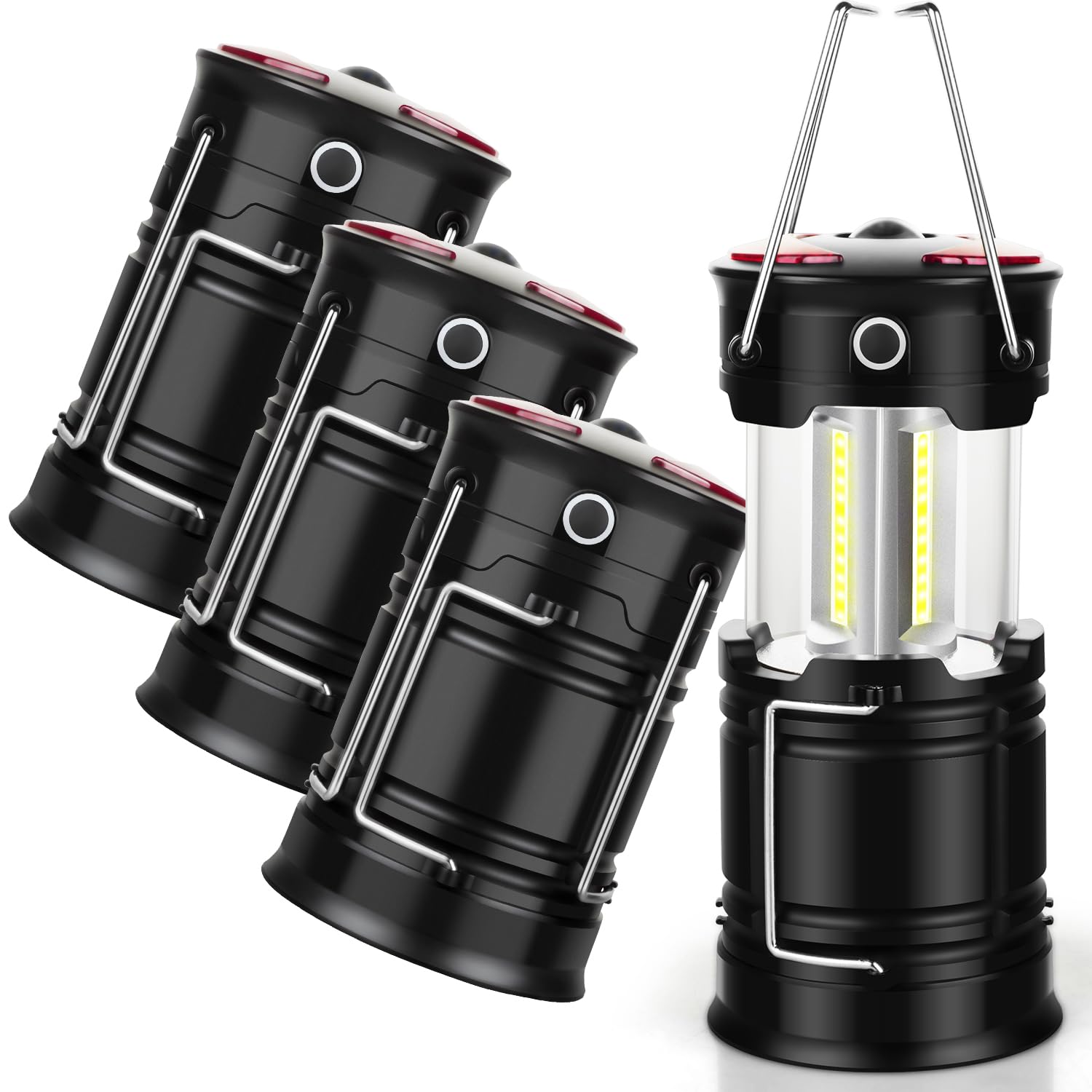

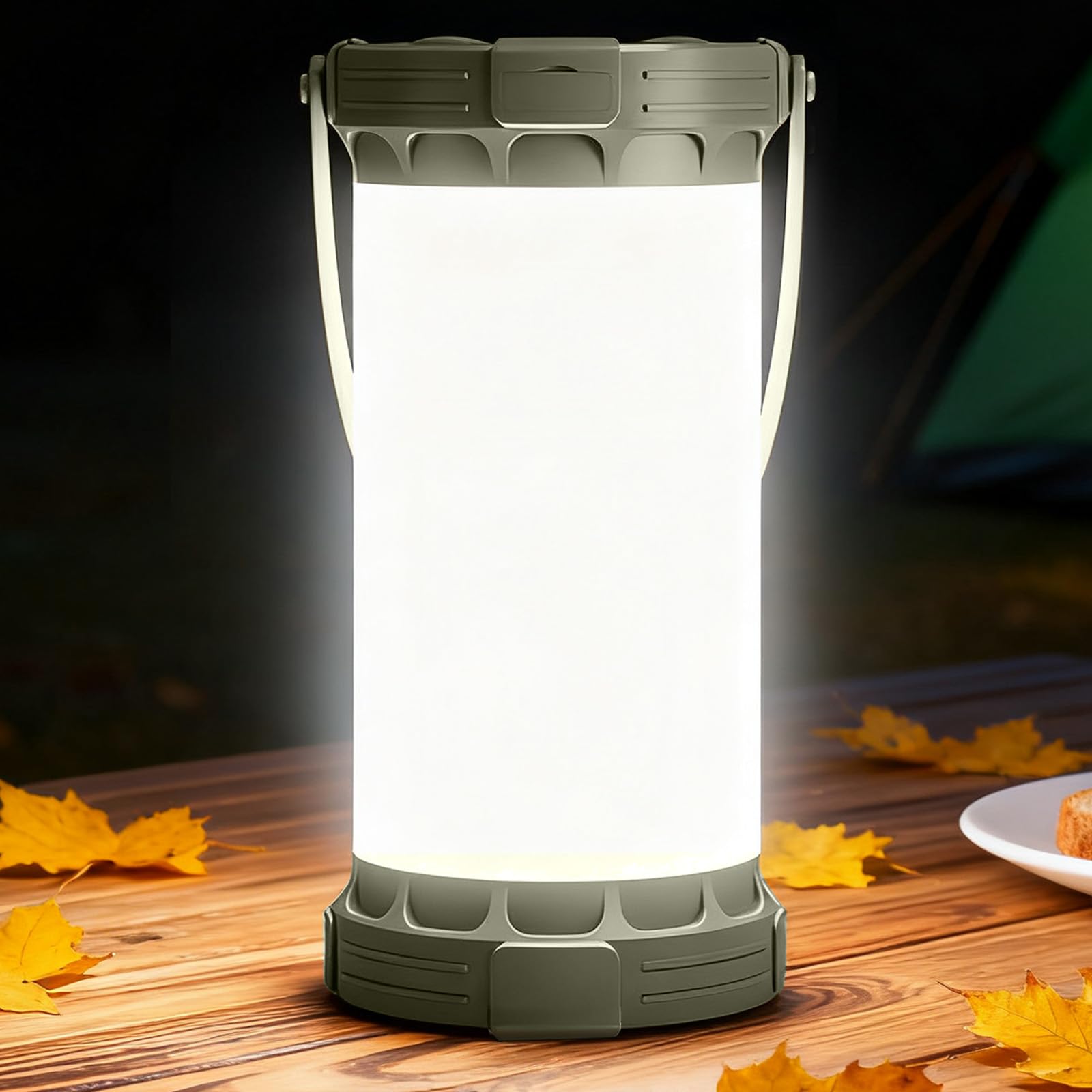


Best for Family Camping Kits
EZORKAS 4-Pack Lanterns
Key Features
- Power: USB rechargeable + 3 AA backup
- Pack count: 4
- Light spread: 360 degrees
- Water resistance: Water resistant
- Price: Midrange
Four lanterns for roughly what one good light costs is the headline, but the detail that put this pack on top is smaller: each lantern runs on a built-in USB-rechargeable cell and still has a bay for three AA batteries. That matters because rechargeable lanterns fail in one predictable way. The cell stops holding charge, and the whole light becomes clutter. Here the lantern keeps working on alkalines, which is why we point people toward this pack first when they’re building an outage kit.
The foursome earns its place in ordinary use, too. One inside the tent, one in the kitchen drawer, one in the car, and one for whoever is feeling their way down the stairs. Pull the collapsible handle up and the light comes on; push it back and the body shrinks down for packing. Strong magnets in the base hold it to a fuse box or a car hood when both hands are busy, and the lantern is light enough to hang from a tent loop by its handle.
What it is not is a thrower. The COB panel spreads light in every direction, which is exactly right for a tent ceiling or a picnic table and wrong for picking out a trail marker across a field. We treat that as the trade for a light that fills a space evenly instead of dazzling one spot, and it is why this one lives on the shelf by the door rather than in the pack.
Pros
- Four lanterns cover home, tent, and car
- AA fallback keeps them alive when the cell dies
- Magnets and a folding handle free both hands
- Collapses down to pack flat
Cons
- Water resistant only, not rated for heavy rain
- AA backup needs batteries you supply
The one we recommend to most people: four USB-rechargeable lanterns with an AA fallback, a magnet base, and enough light for a tent or a dark hallway.
Best for Tent and Cabin
Lepro 1000LM Lantern
Key Features
- Battery: 4400mAh lithium-ion
- Runtime: Up to 12 hours at 300 lumens
- Max output: 1000 lumens
- Water resistance: IP44
- Price: Midrange
Switch this Lepro to its warm setting and it stops behaving like a work light. The 3100K mode is why it’s our pick when you want one lantern for a picnic table or a cabin shelf rather than a four-pack: cool white, warm white, a blend of both, and a flash mode all sit on one button, and the dimmer runs from a low glow up to the full 1000 lumens.
Two hooks are the detail we appreciated most, one on the cap and one on the base. Hang it upside down from a tent loop and the light spreads across the floor instead of hammering the ceiling, which is the difference between a lantern you tolerate and one you leave on all evening. There’s a power bank output as well, so a flat phone on a two-night trip becomes an inconvenience rather than the end of the evening.
Brightness costs runtime, as it does everywhere in this category. The quoted 12 hours belongs to the 300-lumen warm setting, and the top of the dimmer drains the 4400mAh cell much faster. The cell is also what turns a good lantern into a dead one, so run a full charge-and-drain cycle in the first week and use the year of warranty if it quits early rather than discovering the problem on a dark night.
Pros
- Warm 3100K light suits tables and tents
- Hooks top and bottom for hanging upside down
- Doubles as a phone power bank
- Dims from full output to a low glow
Cons
- Twelve-hour runtime only at the 300-lumen setting
Our favorite single lantern: warm, cool, and blended light from 1000 lumens, a hook at each end, and a power bank for your phone.
Best for Backpacking and Hiking
Glocusent C12 Lantern
Key Features
- Weight: 10.5 oz
- Battery: 5000mAh
- Runtime: Up to 200 hours on low
- Max output: 1500 lumens
- Price: Budget
At 299 grams, this is the lantern that goes in the pack rather than the car. The Glocusent also quotes 200 hours on its lowest setting, which is the number that matters when you’re rationing light across a three-day walk and the tent is the only place to be after dark.
The 1500 lumens at the top end are real, and slightly alarming inside a tent. Five brightness steps and three color temperatures let you come down to something you can sit beside without squinting, and the 5000mAh cell is quoted at 12 hours at maximum, so a full evening of bright light doesn’t leave you guessing. There’s a red SOS strobe, a power bank output, and USB-C charging, which means one cable covers the lantern and the phone.
It’s a small light, about 3.4 inches across, so it reads as a personal lantern rather than a site light. Treat the top brightness as a burst for setting up camp rather than something you leave running, and the runtime math works out in your favor.
Pros
- 299 grams, light enough to justify carrying
- Up to 200 hours quoted on low
- Three color temperatures and five brightness steps
- Power bank output and USB-C charging
Cons
- Sits on a surface with nothing for hanging it
Our backpacking pick: 299 grams, USB-C, three color temperatures, and a low setting that runs for days rather than hours.
Best for Maximum Brightness
AYL 1800LM 2-Pack
Key Features
- Battery: 4400mAh
- Max output: 1800 lumens
- Pack count: 2
- Water resistance: IP44
- Price: Premium
Eighteen hundred lumens is the highest figure in this guide, and it changes what a lantern can do. This one lights a whole room, a canvas cabin tent, or the space under a car hood without being aimed at anything in particular, which is the sort of light you want when the power has just gone and you’re still working out what happened.
The rest of the design is sensible rather than clever: a metal body with rubber feet that don’t slide, a handle you can hang it by, four modes with dimming, and separate warm and daylight settings. Two come in the box, which is rather the point. The second one lives in the basement or the trunk, and you stop thinking about it until the night you need it.
Weight is where we drew the line. At 1.16 kg apiece these are car-camping lights, not something you carry up a ridge, and the top mode is a five-minute setting for pitching camp rather than an all-evening one. Run it at the middle setting and the 4400mAh cell has a much easier night, which is how we use ours.
Pros
- 1800 lumens lights a room or a work site
- Two lanterns in the box
- Metal body with rubber feet that stay put
- Warm and daylight modes, all dimmable
Cons
- 1.16 kg each, so it stays near the car
- Some units stop accepting a charge
The brightest light we recommend, and the heaviest: buy it for a camper, a garage, or a blackout kit where a second lantern pays for itself.
Best for Wet Weather
AlpsWolf T80G
Key Features
- Weight: 0.8 lb
- Battery: 3600mAh
- Max output: 800 lumens
- Water resistance: IP65
- Price: Budget
Four lights in a 0.8-pound body is the pitch, and it mostly holds up: a spot beam for the trail ahead, a lantern for the tent, a flashlight for walking out to the wash pit, and a red strobe for the roadside.
IP65 is the specification we care about most here, and it’s the highest rating in this guide, dust-tight and able to take a proper rain shower. That’s what makes this the one to take when the forecast is bad, and it’s a real distinction from the splash-rated lights that make up most of this list. A strap and a Type-C cable come in the box, and the 3600mAh cell is quoted at up to 12 hours.
At 800 lumens it gives up a lot of brightness to the AYL and the Glocusent, which is the trade for a light this small and this tough. The beam is where it earns its keep: 1,640 feet of reach is enough to find a trailhead sign, a tent you left behind, or whatever the dog has decided to investigate.
Pros
- IP65, the highest water and dust rating here
- 0.8 pounds and easy to stow
- Spot, lantern, flashlight, and red strobe
Cons
- Charging faults turn up in some units
- 800 lumens trails the 1500 to 1800 lumen picks
Our pick for wet weather and hands-busy work: IP65, 0.8 pounds, four light roles, and a spot beam with serious reach for the size.
Best for Long Outages
Lepwings Solar Lantern
Key Features
- Battery: 6000mAh
- Runtime: Up to 80 hours
- Charging: Solar and USB-C
- Max output: 280 lumens
- Price: Midrange
A solar panel on a lantern sounds like a gimmick until the third day of an outage, when every USB brick in the house is flat. Leave this one on a porch railing or a windowsill and the 6000mAh cell refills itself; USB-C is there for the fast top-up before a trip, and a full charge that way is quoted at as little as three hours.
The light itself is warm at 3000K and dimmable from 60 lumens up to 280, so it behaves like a table lamp rather than a work light. At the bottom of that range the runtime is quoted at up to 80 hours, and there’s a power bank output for a phone. For a blackout that stretches past a day, this is the one that keeps going without a wall socket.
The single-button control is our main quibble. It cycles through brightness levels and can take a couple of presses to land on off, which is irritating at two in the morning in a quiet tent. It becomes second nature after a few nights, and at 1.3 pounds this is a shelf-and-table lantern anyway rather than something you carry far.
Pros
- Solar panels recharge it without a socket
- Up to 80 hours quoted on low
- Warm 3000K light with touch dimming
- Works as a phone power bank
Cons
- 280 lumens is modest for a group site
The one for a long outage or an off-grid basecamp: solar top-up, warm dimmable light, 80 hours on the lowest setting, and USB-C when you need a fast fill.
Best for Spotting and Searching
ropelux HC-262

Key Features
- Runtime: Up to 10 hours
- Max output: 1500 lumens
- Beam distance: 500 m
- Water resistance: IP54
- Price: Budget
Five hundred meters of beam is what separates this ropelux from every other lantern here. Lamp heads front and back, side lights, eight modes between them, and a 1,500-lumen main beam with a reach that makes a tent lantern look like a candle.
It’s the light that goes with us when something needs finding outside the lit area: a noise in the trees, a boat coming in, the far end of a field. The handle rotates 180 degrees so the body sits flat on a table when you want to use it as a lamp, IP54 covers rain, and the three-year warranty is the longest in this guide.
The beam is narrow enough that you still want a lantern for the tent ceiling, and at 1,500 lumens this is a light for a purpose rather than a light for ambience. For the job it’s built for, finding things at a distance in the dark, nothing else here comes close.
Pros
- 1500-lumen spot beam with long reach
- Eight modes across front, back, and side lights
- Three-year warranty, the longest here
- Handle rotates 180 degrees for table use
Cons
- Ten hours to a full charge
The light for looking across a field: a 1500-lumen spot with 500 meters of reach, eight modes, and the longest warranty in this guide.
Best for Budget Tent Light
Blukar 116 LED Lantern

Key Features
- Modes: 7
- Weight: 13.9 oz
- Battery: 4800mAh
- Runtime: 10 to 48 hours
- Price: Budget
This is the least expensive lantern here, and it still brings a 4800mAh cell and a quoted 10 to 48 hours of light. It’s also the only one in the guide with no water-resistance rating at all, which is the sentence to read before you add it to a cart. Inside a tent or under a car hood, that limitation never comes up.
The rest is clever for the money. The body folds open to widen the spread and closes into a compact cylinder for packing, there are seven modes including a red SOS, and 116 LEDs put light out through 360 degrees over USB-C charging. At 394 grams it disappears into a daypack or a glovebox, and the folded shape sits more nicely on a small table than the price suggests.
Think of it as a tent-and-table light, or the spare that lives in the car for the night you need light under the hood. Inside that brief it’s hard to argue with, and the sealed cell is the honest trade: when it finally stops holding charge, the lantern goes with it.
Pros
- Seven modes including a red SOS
- Quoted 10 to 48 hours from 4800mAh
- USB-C charging in a 394 g body
Cons
- No water-resistance rating at all
- Sealed cell, so the lantern dies with the battery
The budget pick for a tent or a glovebox: seven modes, USB-C, 4800mAh, and a fold-out body, as long as it stays out of the rain.
How We Tested the Best Rechargeable Lanterns
We started with a shortlist built from spec sheets, manufacturer claims, and a long scroll through owner reviews, then filtered hard. Anything with a proprietary charging cable, no low-output mode, or a battery the maker wouldn’t put a runtime figure on got cut before it ever shipped. That left 12 lanterns, spanning compact pop-ups to larger tabletop models.
Battery and charging got the most scrutiny, because that’s what fails first. We drained each lantern to shutdown on its brightest setting and timed it, then did the same on the lowest mode overnight. We plugged each one into a wall adapter from dead and logged how long it took to reach full and whether it would run while charging. Every lantern was then left untouched on a shelf for six weeks to see which ones still had a charge when we came back.
For light quality, we used them in an unlit basement and inside a tent after dark, noting whether the glow was even or threw hot spots on the ceiling, and how the warm and cool settings actually looked on a page. Functionality we judged with cold hands: could you find the button in the dark, work the hanging hook one-handed, cycle modes without blinding yourself. Durability meant real abuse — a drop off a picnic table onto concrete, a night in the rain, a week in a hot car. A few didn’t survive it. The ones below did, and we’re still using them.
How to Choose a Rechargeable Lantern
The runtime on the box almost always belongs to the dimmest setting, so the first job is working out which number actually describes the way you’ll use the light.
Read the runtime at the setting you’ll actually use
Every runtime figure on these boxes belongs to the lowest brightness. Our Lepwings pick quotes 80 hours, and that is at 60 lumens; push it to its 280-lumen maximum and the same cell gives you a fraction of that. The AYL’s 1800 lumens is a five-minute setting for pitching camp, not an evening one. So decide what you’re buying: a night light left glowing for eight hours, where 300 lumens is plenty and runtime is the whole game, or a work light switched on in short bursts. Then compare on that number rather than the headline.
Charging: USB-C, solar, and the AA escape hatch
USB-C is the fastest and most convenient. The ropelux takes roughly ten hours to fill, while the Lepwings quotes three from a wall adapter, which is a real difference when four devices are sharing one brick. Solar is worth having as a trickle during a long outage, not as your main plan; a panel that size cannot keep up with nightly use. The most useful redundancy is a lantern that also takes disposable AA cells, which is why our top pick has three AA bays behind its built-in battery.
How it hangs, stands, and points
A lantern you have to hold is a flashlight. Look for a hook at both ends: the Lepro has one on the cap and one on the base, so it hangs upside down and throws light across a tent floor instead of into the roof. A magnet base, as on the EZORKAS, holds it to a fuse box or a car hood. Then pick a shape: 360-degree panels such as the Glocusent and Blukar fill a space evenly, while the ropelux and AlpsWolf throw a beam you can aim at something. At close range glare decides comfort, so hang any of them above eye level rather than setting one on the table you’re sitting at.
Water, weight, and how far you’re carrying it
Water ratings here run from a bare ‘water resistant’ with no number attached, through IP44 splash protection, up to IP65 on the AlpsWolf, the only one of these rated for sustained rain. Weight splits the category cleanly: 299 grams for the Glocusent is a pack light, 1.16 kilograms per lantern for the AYL is a car light, and anything between is a judgement about how far you walk in. Buy the lightest lantern that meets your weather and brightness needs rather than the brightest, which is how most people end up leaving one at home.
Frequently Asked Questions
Can I leave a rechargeable lantern plugged in all the time?
Not as a habit. These lanterns use lithium-ion cells, which age fastest when held at full charge in a warm room, and the lantern that has sat on a charger in a garage for two years is the one that lets you down. Charge it to full before storm season, top it up every few months, and don’t store it flat. When you do charge, keep it out of a hot car and off a packed bag.
Will a rechargeable lantern charge my phone?
On several of these, yes: the Lepro, AYL, Glocusent, ropelux, and Lepwings all list a power bank output. Expect a partial charge rather than a full one, since a 4400mAh lantern cell is roughly one phone battery and the output is standard USB rather than fast charging. Top the lantern up first, so you aren’t trading your only light for a few percent of phone.
Do rechargeable lanterns work in freezing weather?
They work, but the cell doesn’t like it. Cold cuts usable capacity, so a lantern that runs all evening on a mild night may quit early below freezing. Keep it inside your jacket or a pack liner until you need it, charge it indoors, and plan on a lower brightness setting than you’d use in summer. The AA fallback on our top pick is useful here for exactly that reason.
Final Verdict
Start with the EZORKAS four-pack if you’re covering a house, a tent, and a car. The AA fallback is what makes a rechargeable lantern worth owning past the second winter, and four of them cost about what one premium light does.
If the lantern lives in a backpack instead, take the Glocusent: 299 grams and a low setting measured in days. If you simply want the brightest thing here, the AYL is it, provided it can stay near the car.