This post contains affiliate links. We may earn a small commission when you buy through our links — at no extra cost to you.
A mountain bike shoe has two jobs that pull against each other: stiff enough that your effort goes into the pedals, flexible enough that a hike-a-bike doesn’t turn into a shuffle in ski boots. Get the mix wrong and it shows up fast — an arch hot spot on a long climb, a heel that lifts when you stand to pedal, a tread that greases out from under you on wet roots. The right pair fixes all three so quietly that you stop thinking about your feet.
I’ve ridden the same rocky loop for years, and whether a shoe works shows up in the first twenty minutes. Over seven months we put 12 pairs through that loop and much more: muddy root sections, hike-a-bike scrambles, the flat walk back to the car. Sizing is the whole game here — most of these run narrower than your everyday sneakers. A couple of the best cost the least, and a few we’d wear off the bike anyway. The picks below are the ones we kept reaching for.


Best for All-Round Trail Riding
Five Ten Freerider
Key Features
- Fit: Runs narrow
- Pedal type: Flat
- Listed weight and dimensions: 9 x 14 x 6 inches; 2.45 pounds
- Price: Midrange
The Freerider does one thing better than anything else here: it stays put on a pinned pedal. Set your foot down and the sole sits flat across the pins instead of rocking on top of them, the rubber grabs, and you stop thinking about your feet. On a rocky descent that is the difference between riding the trail and managing your stance.
That is why it is our overall pick and not just the flat-pedal one. Grip is the main job of a mountain bike shoe, and this is the strongest in this group on that count, but the sole is also stiff enough through the middle to pedal hard without your arch folding over the pedal edge. We noticed it most on long climbs, where a softer shoe makes you feel like you are pedaling in socks.
Off the bike it behaves like a skate shoe. No clacking, no race-kit look, no waddling across a parking lot, and you can wear it to lunch after a ride without anyone looking twice. The upper has taken scuffs and rock strikes without looking sorry for itself, and the sole is wearing slowly rather than crumbling at the edges the way cheap rubber does.
It is a flat-pedal shoe, full stop: the sole is built around pins rather than a cleat, and no amount of grip changes that. For trail and enduro riding on flat pedals, though, it is the pair we reach for first, and it is the one we point new riders at when they have not yet decided which way they want to go.
Pros
- Best pedal grip of the flat shoes here
- Stiff enough to pedal, soft enough to walk
- Looks and wears like a skate shoe
- Upper shrugs off scuffs and strikes
Cons
- Runs narrow for wide feet
- Firm sole takes a few rides to settle
The flat-pedal shoe we recommend to almost everyone: best grip in this group, stiff enough to pedal hard, and it walks like a normal shoe.
Best for First Clipless Shoes
Giro Ranger
Key Features
- Sole: Nylon plate, rubber outsole
- Weight: 1.4 lb
- Closure: Three Velcro straps
- Pedal type: 2-bolt SPD
- Price: Budget
Three Velcro straps, a nylon plate and a rubber outsole: the Ranger is the least fussy way into clipless riding. The upper is a single piece of Synchwire with soft lace guides, so there are no seams to rub, and the straps let you set tension differently across the forefoot and the instep instead of committing one lace tension to the whole ride.
We paid attention to the outsole, because that is where budget clipless shoes usually fall down. Giro molds a dual-injected rubber tread around the cleat area, which is what makes hike-a-bike sections and the walk back up a missed line bearable, and the upper is rated water-resistant, which is enough for wet grass and standing water rather than a river crossing. At 1.4 pounds it is not a featherweight and it does not pretend to be, but the weight sits low and stable on the pedal.
Where it earns its place is as a first clipless shoe or a second pair for messy days: the straps are quick to change mid-ride with gloves on, nothing comes loose, and the whole shoe wipes clean and goes again. Set the closure before you roll out, because a stiff tongue under a tight middle strap will press on the top of the foot if you crank it down cold. It is the pair we hand someone who is clipping in for the first time.
Pros
- Three straps adjust on the fly
- Rubber outsole handles walking and pushing
- Water-resistant upper for wet rides
Cons
- Runs tight, so size up if between
The clipless shoe we hand first-timers: three straps, a rubber tread for pushing, and a water-resistant upper with nothing to fiddle with.
Best for Long Xc Rides
Giro Rincon
Key Features
- Sole: Nylon and glass fiber
- Upper: Vented Synchwire
- Closure: BOA L6 dial and strap
- Pedal type: 2- or 3-bolt cleats
- Price: Premium
The BOA dial is the reason to step up to the Rincon. One turn takes up slack in tiny increments, so you can tighten a shoe that has loosened on a descent without stopping, then back it off when your feet swell in the heat. On longer rides, where lace tension drifts and you cannot be bothered to stop, that is a real convenience rather than a spec-sheet flourish.
The sole underneath is what makes it a mountain bike shoe rather than a road one: injection-molded nylon and glass fiber, stiff enough to put power down, with over-molded heel and toe pads so you can walk to the trailhead without skating. It is drilled for both two-bolt and three-bolt cleats, which makes it unusually flexible if you also ride road. This is the shoe we point at riders doing long XC and gravel days who want to stay clipped in and still walk at the other end.
The fit is the thing to sort before you order: it runs narrow and a little small, so wide-footed riders should look elsewhere and everyone else should consider going up half a size. That is a nuisance rather than a flaw, and it is the shoe we take when the ride is long and the route is unknown.
Pros
- Dial gives fine one-handed adjustment
- Stiff sole that still walks
- Takes two- or three-bolt cleats
- Vented upper for hot rides
Cons
- Upper can wear at the toe early
The pick for long XC and gravel days: a BOA dial you can adjust one-handed and a stiff sole that still walks.
Best for Trail and Town
Crankbrothers Stamp Lace
Key Features
- Fit: Runs small
- Closure: Laces with stash pocket
- Pedal type: Flat
- Price: Premium
The detail worth knowing about the Stamp Lace is the lace pocket: a stash slot in the tongue that swallows the bow so nothing dangles near a chainring or a spinning wheel. It takes two seconds, and it removes a failure mode that laced shoes otherwise just live with.
The rest is a flat-pedal shoe done properly. We found the sole stiff under the arch, a solid platform to push against, without being so rigid that the walk back to the car becomes a punishment. The rubber holds a pinned pedal firmly, and the wide, flat sole gives the pins plenty to bite into, so your foot lands where you put it and stays there through rough ground.
It is also the best-looking shoe in this guide: the navy upper with the gum sole reads like a skate shoe rather than cycling kit, and it is comfortable enough to wear all day. Two caveats. It runs small, so order up if you are between sizes, and the sole can begin separating at the toe after a few months of hard riding. Wide feet will find it cramped whatever size they order, and no amount of grip fixes that.
Pros
- Hidden pocket stows the laces
- Grip that keeps the foot planted
- Stiff platform that still walks
- Best-looking flat shoe in this set
Cons
- Runs small; order a size up
- Sole can separate at the toe
For flat pedals with a bit of style: strong grip, a hidden lace pocket, and a sole that copes with a walk into town.
Best for Commuting and Touring
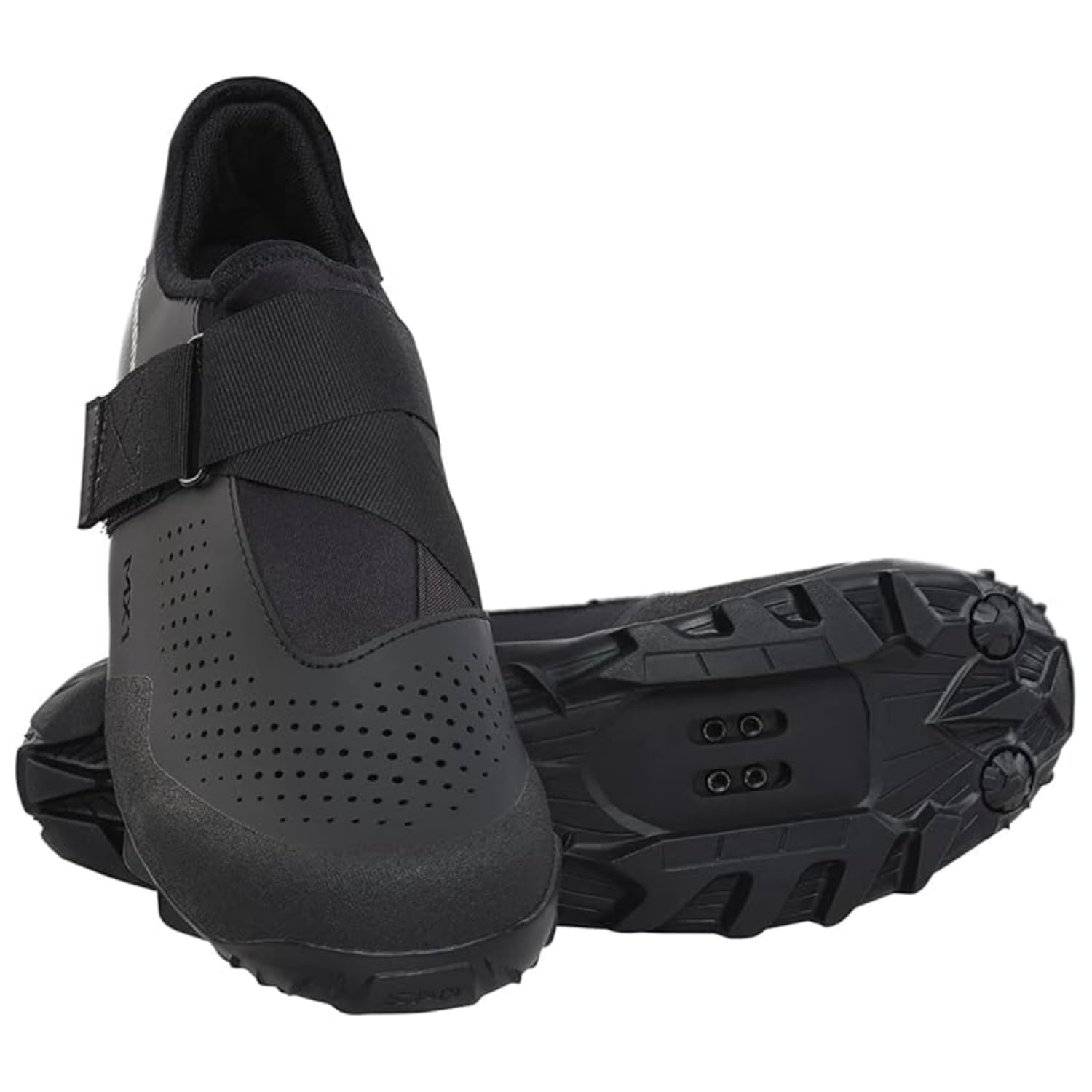
Shimano SH-MX100
Key Features
- Fit: Runs small
- Closure: Velcro straps
- Pedal type: Clipless
- Price: Budget
If your riding includes a commute, a fire-road climb and a walk into town for lunch, the MX100 is the shoe that stops you changing footwear. This is a multi-use off-road shoe rather than a race shoe: soft enough to walk in, with a sole that lets the cleat sit below the tread so you are not skating on tarmac, and plain enough that it does not look like equipment. It is the pair we recommend when the bike is transport as well as a toy.
The walking is what we keep coming back to. The shape suits riders who spend time off the bike, and a cooldown stroll or a push up a muddy section does not turn into a complaint. Mud is handled well for a shoe of this kind: the tread clears instead of packing solid, and the upper sheds water rather than turning into a sponge.
What you give up is precision. The fit runs small and narrow, so wide-footed riders should go up or go elsewhere, and the Velcro straps are shorter and softer than the Ranger’s, which shows when you are cranking them down over a high instep. For commuting, touring and light trail use none of that matters much; for race pace it does.
Pros
- Walks like a normal shoe, cleats and all
- Handles mud and wet weather
- Simple closure, easy on and off
Cons
- Runs small and narrow
- Straps are short and soft
The one for riders who pedal to work as well as the trail: it walks properly, shrugs off mud, and takes a cleat.
Best for Budget Clipless Entry
FOTGOAT MTB Shoe

Key Features
- Fit: Inconsistent sizing
- Sole: Stiff platform
- Pedal type: SPD-compatible
- Price: Budget
The surprise here is the sole. Budget clipless shoes usually feel like cardboard with a cleat hole, but the FOTGOAT has a genuinely stiff platform that puts power down without your foot curling around the pedal, the kind of firmness we did not expect at the entry level. It is easy to get on and off too, which matters more than it sounds when you are clipping in and out at every gate on a greenway.
The fit is the gamble. Sizing is inconsistent: some pairs come up loose around the ankle and heel, others short and narrow at the toe, so order from somewhere with an easy return and treat the first fit as a test rather than a verdict. Walking is clunky as well, because the stiff platform does not flex, and a long push or a shop stop becomes a stomp. For a first clipless pair, or a spare set for filthy weather, that trade is easy to take.
Pros
- Stiff sole puts power down
- Easy to get on and off
- SPD cleats fit without fuss
Cons
- Sizing is inconsistent between pairs
- Stiff sole is clunky to walk in
The budget way into clipless: a stiff sole that punches above its class, if you can get a pair that fits.
How We Picked and Tested 12 Pairs of MTB Shoes
We started with a list of roughly 40 models and whittled it down by reading specs closely: closure systems (laces, straps, dials), stated sole stiffness, whether half sizes and wide options existed, and price. That left 12 pairs, spanning flat-pedal and clip-in designs, from budget picks to spendier ones. For each, we logged the size our tester normally wears and the size that actually fit, because sizing was all over the map.
Testing ran seven months, on rocky local trails, flowy dirt, a gravel commute, and one genuinely wet spring. Every pair did our regular loop, which includes a three-minute hike-a-bike and a stretch of wet roots, and each tester wore one pair for a full week straight, including the walk to the trailhead and the standing around afterward. We also walked up a wet rock slab to see how the tread held, and clipped in and out at a stoplight with gloves on to judge the closures one-handed.
Along the way we pressed each midfoot over a stair edge to feel how much the sole gave, then noted whether that flex turned into arch ache after an hour. We watched for heel lift when standing to pedal, toe box rub on descents, and whether a shoe had scuffed through at the tread or stitching by month seven. Cheaper pairs rode the same loop as expensive ones so we could see what the extra money actually bought, and we gave looks a fair shake — some of these pass as sneakers, some look like race day.
How to Choose Mtb Shoes
Start with your pedals, not your budget: flat and clipless shoes do different jobs, and no single pair does both well.
Flat or clipless comes first
A flat-pedal shoe has a sticky rubber sole shaped to sit on pins and no cleat channel; a clipless shoe has a stiff plate and a two-bolt mount for a cleat that engages a spring mechanism. Buying the wrong one is the most expensive mistake in this category, because the shoe simply cannot do the other job. If you are new to mountain biking, flat pedals and a flat shoe teach you to move your weight properly. If you already ride clipped in on the road, a two-bolt shoe like the Giro Ranger makes the move to dirt an easy, forgiving one.
Grip is the flat-pedal spec that matters
On flat pedals, the rubber and the shape of the sole matter more than anything printed on the box. A soft, tacky sole with a flat profile puts more rubber on more pins, which is exactly why the Five Ten Freerider feels so planted. The trap is that the rubber gripping that well also wears faster, and a very stiff flat sole drives every pin into your arch on a long descent. Neither is a reason to avoid the category, just a reason to buy for the riding you actually do.
Stiffness is a trade, not a ranking
A stiff sole transfers power and stops your foot wrapping around the pedal; a flexible one lets you walk. Race-oriented shoes sit at the stiff end and are miserable to spend a day in off the bike, while multi-use shoes like the Shimano MX100 flex more and give up some pedaling snap. The cleat recess is the other half of this: a recessed cleat lets you walk normally, an exposed one turns every cafe floor into an ice rink. Decide how much walking your rides include before you decide how stiff you want the sole.
Fit and sizing: assume nothing
Sizing is the biggest single source of returns in mountain bike shoes, and the numbers do not line up with your running shoes. Measure your foot in the socks you ride in, leave a thumb’s width at the toe, and if you are between sizes go up rather than down, because a shoe that pinches on a climb will not break in enough to fix it. Width matters as much as length: several pairs here run narrow, so wide feet need a roomier toe box or a strap closure with slack to give.
Closures: what you get for the money
Laces are light, cheap to replace and awkward to adjust one-handed. Velcro straps like the Ranger’s are the easiest thing to live with on a muddy trail, since you can change tension with gloves on. A dial such as the BOA on the Rincon gives finer adjustment and works one-handed, at the cost of more to go wrong. None of this changes how the shoe pedals, so pick the closure you will actually adjust mid-ride, because a shoe you never touch is a shoe set wrong.
Frequently Asked Questions
Do I really need mountain bike shoes, or can I ride in sneakers?
Running shoes have soft rubber that pedal pins chew through, and a flexible sole that folds over the pedal edge when you push hard. A mountain bike shoe adds a stiff plate and a rubber that holds pins without tearing. On flat pedals that is the upgrade you feel immediately; on clipless pedals you need a shoe with a two-bolt mount before the mechanism does anything at all.
Why do my cleat bolts keep coming loose?
A cleat takes a lot of shear load through two small bolts. Clean the threads, use a thread-locker if the shoe maker allows it, tighten to the stated torque, and check them again after the first few rides. A cleat that rotates under a hard pedal stroke can lock you in or twist your knee, so carry a spare bolt on long rides.
Can one pair of shoes cover commuting and trail riding?
Yes, if you pick a walkable two-bolt shoe with a rubber outsole rather than a race shoe. The Shimano MX100 and Giro Ranger are both built for that double life: recessed cleats, tread you can walk on, uppers that cope with weather. What you give up is the last bit of pedaling stiffness, which matters in a race and barely at all on a commute.
Final Verdict
A flat-pedal rider who wants one pair to do everything should buy the Five Ten Freerider: the grip is the best in this group, it walks like a shoe, and it will take the abuse.
If your pedals have a clip-in mechanism, start with the Giro Ranger. Three straps, a rubber tread for pushing and fewer things to go wrong than a dial make it the forgiving first clipless shoe. Step up to the Rincon once micro-adjustment on long rides starts to matter more than simplicity.