This post contains affiliate links. We may earn a small commission when you buy through our links — at no extra cost to you.
An inflatable paddleboard is a drop-stitched fabric shell that only becomes a board once you pump it to full pressure — get it right and you’re standing on something that feels rigid as fiberglass; undershoot it and you’re paddling a pool toy. That gap is what separates a board you keep for years from one that ends up flattened in the garage. The right one packs into a backpack you can carry to the water alone, stays stiff through a full afternoon, and doesn’t leave you bobbing mid-lake wondering where the air went.
I’ve paddled flatwater and easy bays for years, and I’ve watched plenty of budget boards go soft within an hour. My team and I spent six months with 10 boards, pumping them up in gravel parking lots, strapping them to roof racks, and handing them to friends who’d never stood on one. The gaps in stiffness, packed weight, and air retention showed up fast. One thing new buyers miss: the pump matters nearly as much as the board, since reaching full pressure is the difference between paddling and quitting. Here’s what held up.



Best for All-Around Use
Roc 10’6 Inflatable SUP
Key Features
- Deck: Non-slip comfort deck
- Capacity: 350 lb
- Warranty: 3 years
- Dimensions: 126 x 33 x 6 in
- Price: Midrange
The Roc 10’6 is the board we point most adults toward, and the reason is not one headline feature. It has a 33-inch deck, a 350-pound capacity, and a three-year warranty, which is a sensible combination for lakes, slow rivers, and easy coastal bays. That width is the useful middle ground here: stable enough for a first-timer, but not so wide that every stroke feels like pushing a raft.
On the water, we found the Roc tracks predictably and feels planted when you shift your weight. The non-slip deck gives you room to move your feet, and the 6-inch thickness holds its shape at the listed pressure. It is not a fast touring board, and we do not treat it as one; it is the board you grab for a relaxed afternoon, a yoga session, or a first paddle with friends.
The kit is complete enough to start, including the pump, paddle, leash, fins, and carry bag. The 350-pound ceiling is realistic for a solo paddler with a dry bag, and the deck has enough room to shift your stance. What tipped it for us is how little the board asks of a new paddler: inflate it, clip the leash, and go.
Pros
- Balanced 33-inch width for stability and paddling ease
- 350-pound capacity suits most solo paddlers and gear
- Three-year warranty adds long-term cover
- Complete kit gets you on the water
Cons
- 33-inch deck is less forgiving than 35-inch boards
For most adults, the Roc is the inflatable paddle board to buy: stable, complete, and backed by a three-year warranty.
Best for Families and Pairs
Skatinger 11’6 Wide SUP
Key Features
- Weight: 19.8 lb
- Capacity: 450 lb
- Included: 1680D backpack and 10-inch fin
- Dimensions: 138 x 35 x 6 in
- Price: Premium
The 35-inch deck is the reason to choose the Skatinger. That extra width, paired with a 450-pound capacity, turns a stand-up paddle board into a family platform: two adults can sit and paddle, a child can ride up front, or a dog can claim the bow without turning every stroke into a balance drill. We like that it does this without feeling like a barge underfoot.
At 19.8 pounds, the Skatinger is not the lightest board here, but the trade is deliberate. We carried it in the 1680D backpack and appreciated the shoulder strap and the three handles when moving it from car to water. The 10-inch fin and dual bungee system also make it easy to load a dry bag and keep the deck useful.
The kit is one of the more complete ones in this group, with a pump, paddle, leash, dry bag, phone case, and a backpack that feels sturdier than the typical included bag. If your outings regularly include another person or a dog, the Skatinger’s width earns its keep. It is the family board we reach for first.
Pros
- 35-inch deck supports two riders or a dog
- 450-pound capacity is tied for the highest here
- 1680D backpack and shoulder strap ease carrying
- Dual bungee and 10-inch fin add utility
Cons
- Premium price compared with the rest of this set
If your paddle sessions regularly include a partner, child, or dog, the Skatinger’s 35-inch deck and 450-pound capacity are worth the premium.
Best for Bigger Solo Paddlers
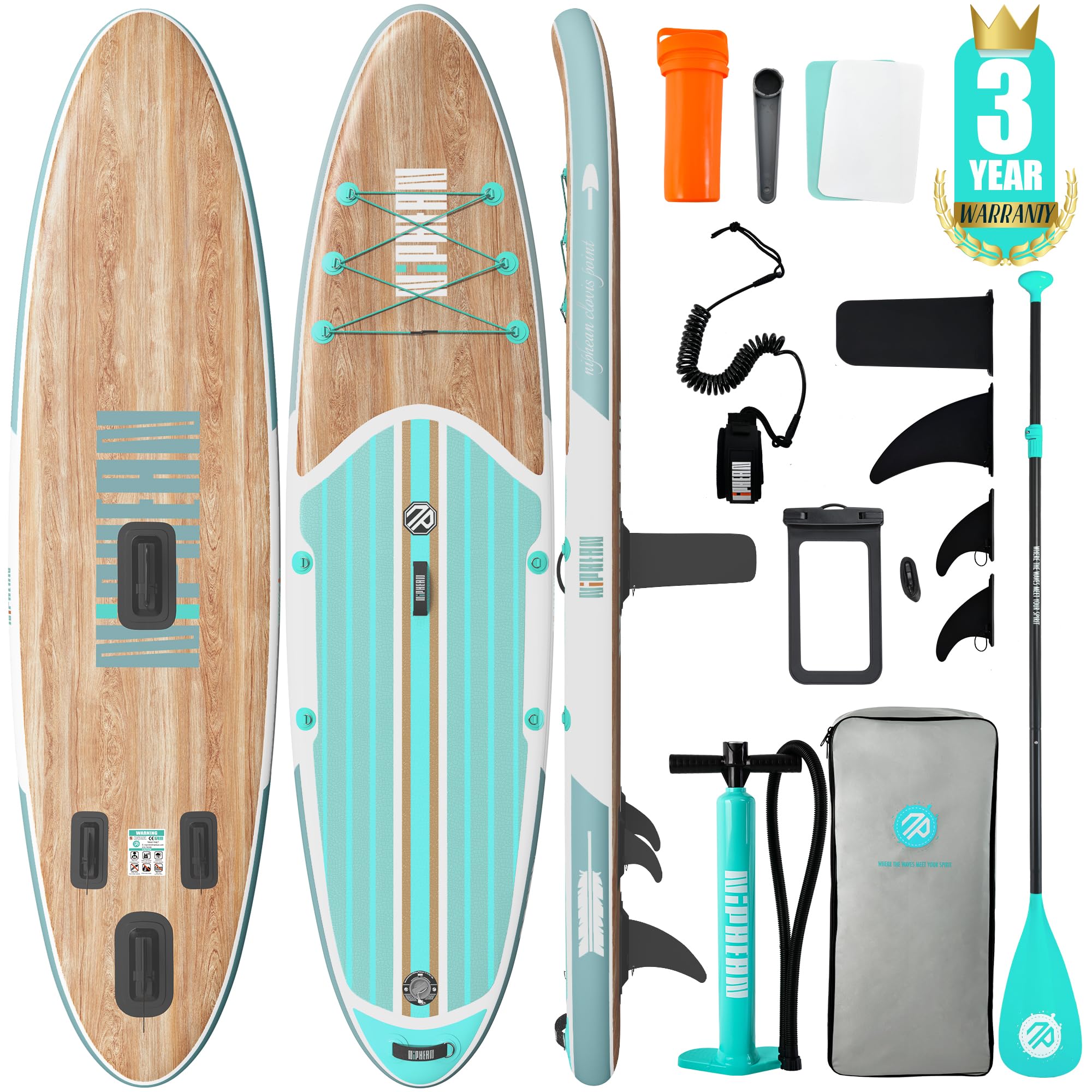
Niphean 10’6 Inflatable SUP
Key Features
- Weight: 19 lb
- Capacity: 450 lb
- Dimensions: 126 x 33 x 6 in
- Max pressure: 20 psi
- Price: Midrange
Niphean puts a 450-pound capacity on a 10’6-by-33-inch board and keeps the package around 19 pounds. That combination is the reason it stands out: it can carry a heavier paddler or a solo paddler plus gear without asking you to step up to a 35-inch family platform.
The board inflates to 20 psi, which is higher than several boards here, and the higher pressure gives the deck a firm, rigid feel underfoot. We found the 33-inch width predictable for flat water and easy to re-board after a swim. The three fins and adjustable paddle are standard, but the included waterproof phone bag is a small convenience we actually used.
What sells the Niphean is the capacity-to-weight ratio. It is not as forgiving as the widest boards here, and it does not have the same premium backpack as the Skatinger, but it covers the middle ground well: enough capacity for bigger adults, enough portability for a solo launch, and a complete kit at a midrange price.
The deck pad is comfortable for longer sessions, and the cargo area holds a dry bag without crowding your stance. We also like the two handles for carrying it inflated. It is a board that makes a heavier paddler feel less like they are pushing a toy.
Pros
- 450-pound capacity in a 19-pound package
- 20 psi maximum gives a firm deck
- Complete kit includes a waterproof phone bag
- 33-inch width balances stability and paddling ease
Cons
- Pump gauge and hose are the weak links
The Niphean is the capacity value here: a 450-pound board that still packs down to 19 pounds and includes a complete kit.
Best for Budget Solo Paddlers
SereneLife 10′ Inflatable SUP
Key Features
- Capacity: 275 lb
- Warranty: 1 year
- Dimensions: 120 x 32 x 6 in
- Max pressure: 15 psi
- Price: Budget
The SereneLife is the budget board in this group, and it makes the case with a simple recipe: a 10-by-32-inch deck, a 275-pound capacity, and a complete kit that has been around long enough to be familiar. For a lighter solo paddler who wants to try the sport without committing to a premium board, that is an easy entry point.
We found the 32-inch width quick to turn and less tiring to paddle than the wide family boards, especially on calm water. The 15-psi inflation is lower than some here, but the board still feels solid when pumped to its stated pressure. The EVA deck is comfortable underfoot, and the three fins track well enough for lake laps.
The backpack and paddle are basic, but they get you to the water. As a solo board for calm conditions, it is hard to argue with the value. It is the one we hand to a friend who wants to try paddleboarding without turning the afternoon into a gear project.
Pros
- Low-cost entry into paddleboarding
- 32-inch width turns quickly on calm water
- Complete kit with backpack and pump
Cons
- 275-pound capacity is the lowest here
The SereneLife is the budget board for a lighter solo paddler who wants a complete kit without paying for extra width or capacity.
Best for Big Riders
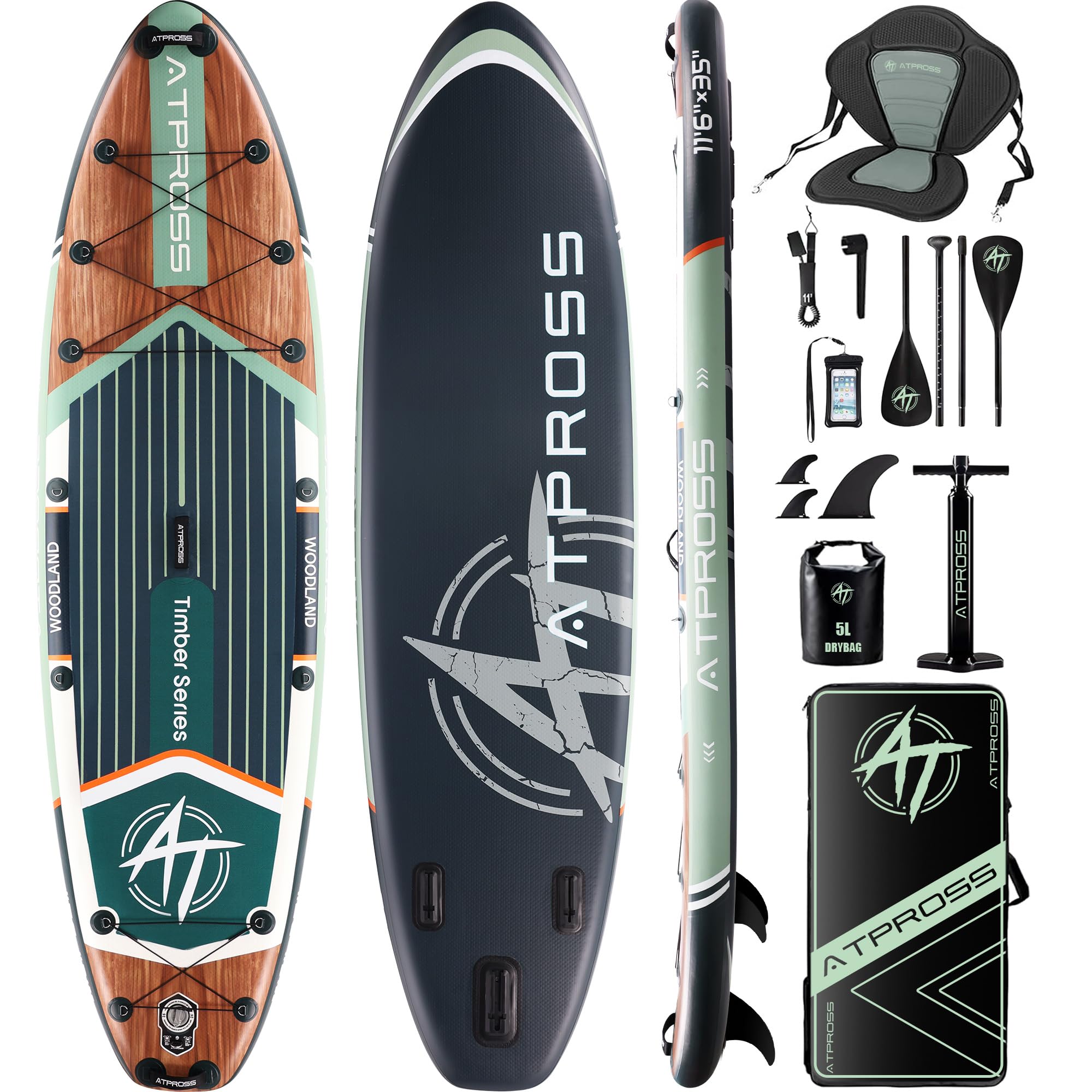
ATPROSS 11’6 Wide SUP
Key Features
- Seat: Inflatable kayak seat
- Capacity: 450 lb
- Warranty: 1 year
- Dimensions: 11’6 x 35 in
- Price: Premium
The ATPROSS is built around a 35-inch deck and a 450-pound capacity, so it starts from the same wide, stable place as the Skatinger. What sets it apart is the included inflatable seat: this is a board that wants to be a kayak for part of the day, not just a stand-up platform.
The extra width makes it extremely steady for bigger paddlers, and the double-layer PVC and reinforced sidewall give it a substantial feel. We appreciated the 600D Oxford backpack and the multiple D-rings for tying down a dry bag. The deck is roomy enough for a tall adult to move around without feeling pinned to one stance.
The seat is not a gimmick. It adds back support for long, slow afternoons and makes the board more usable for fishing or for a paddler who wants to sit when the wind picks up. The trade is bulk: this is a big board, and the accessory package takes up space in a car.
We rank it below the Roc for a simple solo paddler because the extra width and seat are not free. But for a heavier rider, a tall paddler, or someone who wants one board for standing and sitting, the ATPROSS is the more comfortable choice. It is a lot of board for the money, as long as you have the space to store it.
Pros
- 35-inch deck is stable for bigger paddlers
- Inflatable seat adds kayak-style comfort
- 600D backpack and D-rings add practical storage
- 450-pound capacity handles a solo rider and gear
Cons
- Hand pump can make full inflation a workout
The ATPROSS is the wide board to choose if you want a seat, a 450-pound capacity, and a stable deck for long, relaxed days.
Best for Travel and Storage
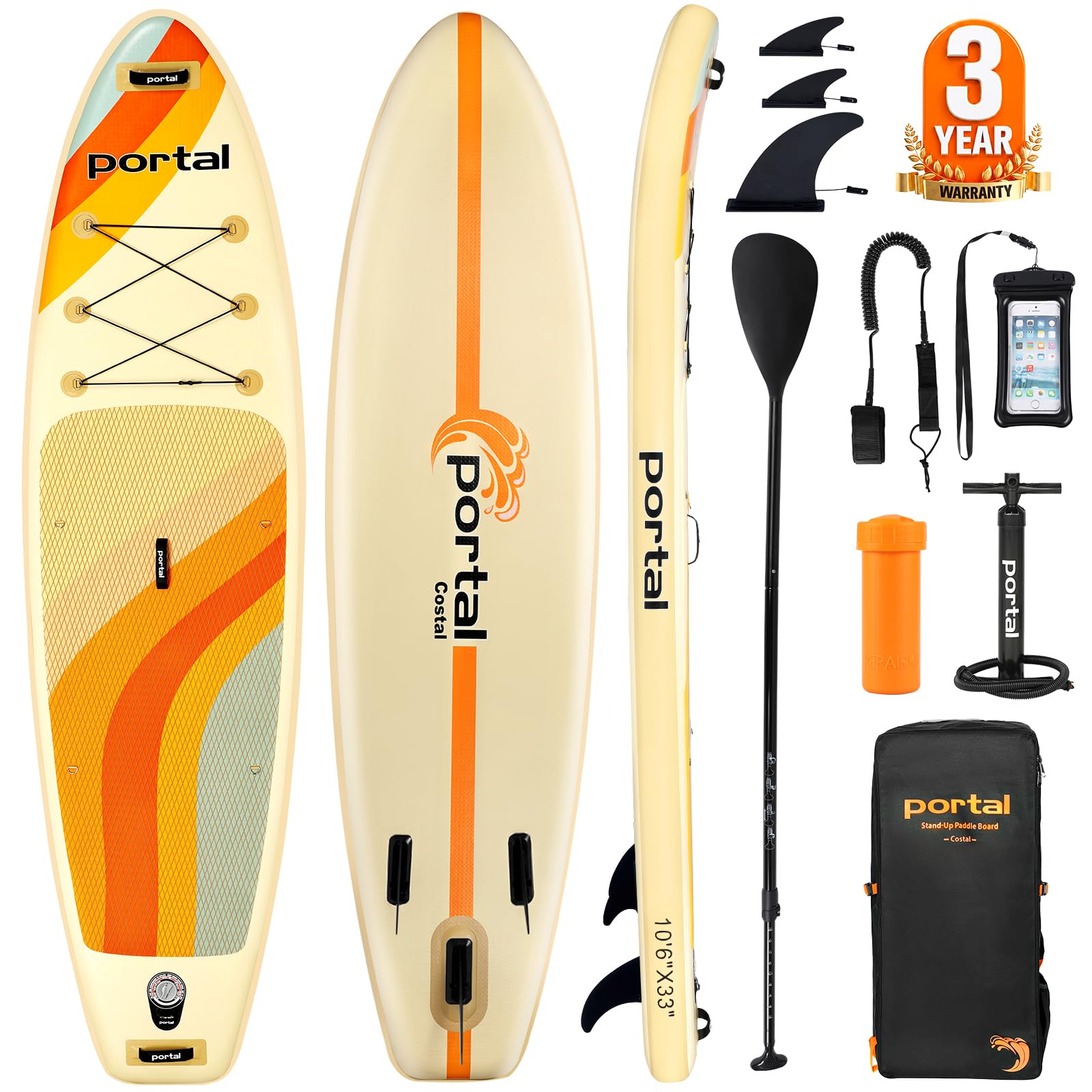
Portal 10’6 Inflatable SUP
Key Features
- Weight: 17.8 lb
- Capacity: 300 lb
- Warranty: 1 year
- Dimensions: 126 x 33 x 6 in
- Price: Midrange
At 17.8 pounds, the Portal is the board we reach for when the walk to the water is part of the trip. It is a 10’6-by-33-inch all-around shape with a 300-pound capacity, and it is noticeably easier to carry in its backpack and to store in a small apartment.
The 6-inch thickness and 300-pound ceiling make it best for a solo adult or a lighter paddler with a small dry bag. On flat water, the 33-inch width feels stable, and the three-fin setup tracks predictably. The included pump, paddle, leash, and bag cover the basics, and the carry bag has enough structure to make the trip manageable.
We like the Portal as a travel board because it does not punish you for owning a small car. For a solo paddler who values portability, it is the easier board to live with. It is the one we leave in the trunk for spontaneous afternoons.
Pros
- 17.8-pound package is easy to carry and store
- 33-inch width is stable for a solo adult
- Complete kit with backpack, pump, and paddle
Cons
- 300-pound capacity rules out heavier paddlers
The Portal is the lightweight pick for a solo adult who carries the board to the water and stores it in a small space.
Best for Kayak Conversion
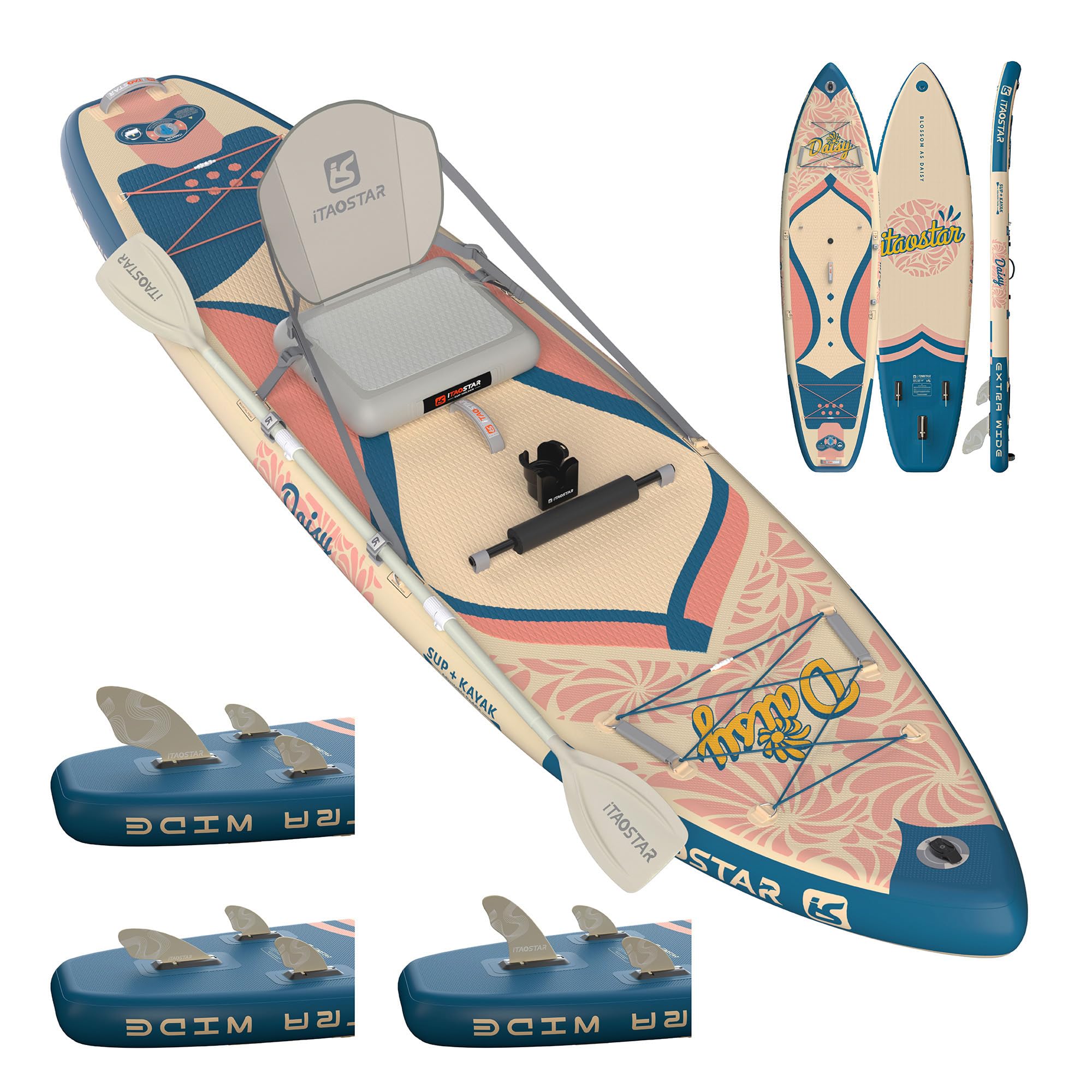
Daisy-Blossom 11’6 SUP
Key Features
- Weight: 20.5 lb
- Capacity: 450 lb
- Kayak kit: Seat, footrest, paddle conversion
- Dimensions: 138 x 35 x 6 in
- Price: Premium
The Daisy-Blossom is the most feature-heavy board in this group. It has five removable fins, a kayak conversion kit with a seat and footrest, a 10L dry bag, a cup holder, and a 450-pound capacity on an 11’6-by-35-inch deck. If you want one board that can stand, sit, and carry a camera, this is the one to look at.
The 35-inch width gives it the same stable, family-friendly footprint as the Skatinger, and the five-fin setup lets you tune tracking for flat water or shallower, rockier launches. We appreciate the thoughtful extras: the cushioned handles, the D-rings for a shoulder strap, and the dry bag that actually fits a phone and keys. It feels like a board designed by someone who packs for a day out.
The kayak seat is comfortable enough for slow paddling, but it is not a replacement for a dedicated kayak. What sells it is the flexibility: one board for standing, sitting, and carrying a camera. For a family that wants versatility, the extra features buy a lot of use.
We put the Daisy below the Skatinger for pure family paddling because it costs more and carries more gear. But if the sitting option matters, the Daisy is the more complete package. It is also the board here with the most accessory hooks and mounts, which makes it fun to customize.
Pros
- Five-fin setup tunes tracking for different water
- Kayak conversion adds seated paddling
- 35-inch deck and 450-pound capacity are family-ready
- Dry bag, cup holder, and mounts add day-trip utility
Cons
- Packed kit is heavy at 20.5 lb
The Daisy-Blossom is the feature-rich choice for a paddler who wants a kayak seat, five fins, and a full day-trip kit in one board.
Best for Budget 11-Footer
DAMA 11′ Inflatable SUP

Key Features
- Mount: Action-camera mount
- Weight: 22 lb
- Capacity: 352 lb
- Dimensions: 132 x 33 x 6 in
- Price: Budget
The DAMA is an 11-foot, 33-inch board with a 352-pound capacity and a built-in action-camera mount. That longer shape gives it a bit more glide than the 10-foot budget boards, while the 33-inch width keeps it from feeling like a specialty touring board.
We found the deck roomy enough for a solo paddler and a dry bag, and the camera mount is a genuinely useful touch for anyone who likes to record a paddle. The three-fin setup and EVA deck are familiar, and the included pump, paddle, leash, and bag make it a complete starter kit.
The longer waterline gives it a relaxed glide, and the deck is comfortable for flat water and slow rivers. The camera mount makes it easy to bring a phone or action camera along. This is not a performance board, and it does not pretend to be.
The reason it is not higher on this list is long-term durability. Seams and the valve are the areas to inspect before a hard season. If you want an inexpensive 11-foot board for flat water, the DAMA is a fun, roomy option. If you want the easiest ownership experience, the Roc or Skatinger is the safer call.
Pros
- 11-foot length adds glide for a budget board
- Action-camera mount is a useful extra
- 352-pound capacity suits a solo adult and gear
Cons
- 22-pound packed weight is a heavy carry
- 352-pound capacity limits two riders
The DAMA is a roomy budget 11-footer for a solo paddler who wants a camera mount and does not need a family-width deck.
How We Tested 10 Inflatable Paddleboards
We started by pulling every board with a stated pressure rating of at least 15 PSI, a drop-stitched core, and a packed weight one person could reasonably carry, then cut the list by comparing hull shape, thickness, fin setup, and what actually came in the box. Ten made it to the water, and each stayed in rotation for six months.
Inflation came first, because it shapes everything that follows. We timed each board from bag to full pressure using its own pump, noted how brutal the last five PSI were, and cross-checked the built-in gauge against a separate pressure reader. Then we carried each packed board a quarter mile to the launch and weighed it on a luggage scale — a bag that digs into your shoulders on the walk is a board you stop taking out.
On the water, we paddled the same stretch of flatwater and light chop, rotating riders between roughly 110 and 220 pounds to see how each deck flexed. We watched how much a board bowed at the midpoint, how it felt stepping on from a dock, and whether it stayed planted through turns and a few deliberate stumbles. After every session we rinsed, dried, and repacked, tracking seams, valves, and fin boxes for wear over the months. Boards were stored inflated in a hot garage between outings and checked with a gauge before each paddle, so we knew which ones held air and which quietly bled it. And we rated each on the least scientific measure of all: whether we wanted to take it out again the following weekend.
How to Choose an Inflatable Paddle Board
The best inflatable paddle board for you is the one you can inflate, carry, and stand on with confidence, not the one with the longest feature list.
Start With Width, Then Length
Width is what you feel first. A 32-inch board is quicker edge to edge and fine for a lighter paddler on calm water, but it asks more of your balance. A 33-inch deck is the all-around middle ground, and a 35-inch deck is the family and big-paddler choice. Length is secondary: 10 to 10 feet 6 inches turns easily; 11 feet 6 inches tracks better but adds bulk.
For most adults, start at 33 inches and move to 35 only if you need the extra stability for a dog, a child, or a heavier rider. The Roc’s 33-inch deck is the reference point; the Skatinger’s 35-inch deck shows what the extra width buys.
Match Capacity to You and Your Gear
Stated capacity is not a suggestion. Add your weight, the weight of a dry bag, and any passenger, then leave a margin. A 275-pound board can be fine for a lighter solo paddler, while a 450-pound board gives a bigger adult room to move and still carry gear.
Board weight matters just as much as capacity because you carry it before you paddle. A 17-to-20-pound board is manageable for most adults; a 22-pound package starts to feel like a two-hand haul. If the launch is a short walk, capacity should win. If you park far away, prioritize the lighter board.
Inflation Pressure and Pump Effort
Higher pressure makes an inflatable board feel more like a hard board, but it also makes the last few strokes of pumping harder. Boards here run from 15 to 20 psi. A 15-psi board can feel solid enough for recreational paddling; a 20-psi board is firmer underfoot but demands more from the pump and the paddler.
We treat the included hand pump as a backup, not the main plan. Test the gauge at home before you rely on it, and consider an electric pump if you inflate more than once a week. A pump that reads wrong can leave you under-inflated and unstable.
The Kit Is Part of the Board
A complete kit saves you from buying a paddle, leash, fins, and bag separately, but the quality varies. The paddle should adjust without wobbling, the fins should click in securely, and the bag should have real shoulder padding if you plan to walk.
We pay close attention to the bag and the pump because those are the parts that fail first on a budget board. A sturdier backpack and a dependable valve are worth more than a decorative deck print. Check the fin box and the leash attachment before your first trip.
When a Kayak Seat Makes Sense
A seat and extra fins turn a paddle board into a sit-on-top hybrid for fishing, birding, or long slow afternoons. That versatility is real, but it adds weight and bulk. If you mostly stand and paddle, a simpler board is lighter and easier to carry.
Choose the kayak option only if you will actually sit for part of the trip. The Daisy-Blossom and ATPROSS are the boards here that make the most of that layout. Otherwise, put the money into a wider deck or a better paddle.
Frequently Asked Questions
Can I use an inflatable paddle board in the ocean?
Yes, on a calm day with light wind. Launch through a gap in the shore break, keep the nose pointed into incoming waves, and use a leash in the surf. A 35-inch-wide board is more forgiving in chop; a 32-inch board is for flat water. Check the wind forecast before you go.
How should I store it between trips?
Rinse with fresh water, dry it completely, deflate, and roll it loosely. Keep it out of direct sun and away from a hot garage floor; heat and UV are harder on PVC and seams than normal use. For short periods, a lightly inflated board is fine if it is shaded and nothing is stacked on it.
Do I need a life jacket?
A properly fitted PFD is the baseline for beginners and anyone who is not a strong swimmer, and local rules may require one. Check the rules for your lake or coast before launch. A leash is the other basic piece of gear, though moving-water paddlers need to think through snag risk.
Final Verdict
We recommend the Roc for most paddlers. Its 33-inch deck is stable without feeling sluggish, the 350-pound capacity covers a solo adult and gear, and the three-year warranty makes the first season less of a gamble.
If your outings regularly include a dog, a child, or a second adult, choose the Skatinger for its 35-inch deck and 450-pound capacity. The Roc remains the easier all-around board for everyone else.