This post contains affiliate links. We may earn a small commission when you buy through our links — at no extra cost to you.
Clean-tasting water shouldn’t come with a tradeoff, but most filtration systems ask for one: better taste in exchange for weaker faucet pressure, a Saturday under the sink, or a pump that hums through dinner. A filter that leaks is one you’ll stop using. What a good system fixes is simpler than the spec sheet suggests—it makes the water you already pay for taste neutral and smell like nothing, at a flow rate that doesn’t make you impatient. Over eight months, we installed and lived with a dozen under-sink and countertop systems, timing installs and tasting the results every morning.
The first thing I’d tell a first-time buyer is that certification matters more than the number of stages on the box—a system should list what it’s actually tested to remove. Installation is where most returns happen: some need a dedicated faucet hole, others clamp onto the tap, and a few require a plumber. Value isn’t just the sticker price; a cheap unit with frequent filter changes can cost more over a year. The picks below are sorted around those realities—taste, fit, flow, and long-term cost.




Best for Family Drinking Water
iSpring RCC7AK-BN
Key Features
- Capacity: 75 GPD
- Filtration: 6-stage RO with mineral stage
- Filter life: 6 months
- Certification: NSF/ANSI 58
- Price: Midrange
Reverse osmosis has a reputation problem: it strips nearly everything out of the water, including the minerals that give it any body, and the result can taste thin and slightly dead. iSpring’s answer is a sixth stage — a mineral cartridge that adds essential minerals back and balances the pH — and it’s the reason this is the system we point most people to. Underneath, it’s a five-stage RO: sediment, carbon, a 75-gallon-per-day membrane, and a post-filter, with the mineral bed on the end.
What settles it for us is the certification. The RCC7AK-BN is certified to NSF/ANSI 58 as a complete system, not as a membrane with a claim printed on the box, and iSpring’s published figures put TDS reduction at 93 to 98 percent with PFAS and chlorine in a similar range. In a category where ‘NSF certified’ appears on systems that only certified one component, a whole-system listing is the most useful thing you can read before buying.
Living with it is straightforward. The first-stage housing is clear, so you can watch sediment build before it starts costing you flow; the filters run on a six-month cycle; and the faucet fastener mounts from above the counter, which saves you from lying on your back with a basin wrench. Plan the cabinet before you order — the system and tank want roughly 15.5 by 16 by 18 inches of floor space, plus a drain saddle on the trap.
Two things to know. The brushed-nickel faucet is the weak link: drips and pinhole leaks can develop, and the fix is a replacement faucet from iSpring support rather than a new system, so register the warranty when it arrives. And at 75 GPD the tank recovers slowly next to the tankless unit here; a family drawing several gallons at dinner will hear it refilling afterward. Neither changes the recommendation for a household that wants certified, mineral-balanced RO without paying premium money.
Pros
- Whole-system NSF/ANSI 58 certification
- Mineral stage fixes flat RO taste
- Faucet mounts from above the counter
- Clear first-stage housing shows sediment
Cons
- Needs a drain line and about 16 by 18 inches of cabinet
- Refills at 75 GPD, slower than tankless
We recommend it as the default for a drinking-water household: whole-system NSF 58 certification, a mineral stage that fixes flat RO taste, and an install you can do from above the counter.
Best for Whole-House Treatment
iSpring WGB32B
Key Features
- Flow rate: 15 gpm
- Filtration: 3-stage, 20 x 4.5 in
- Filter life: 1 year
- Inlet/outlet: 1 in NPT
- Price: Premium
A kitchen filter can’t do anything about the chlorine you breathe in the shower, and that’s the gap a whole-house system fills. The WGB32B treats everything coming in: a 5-micron sediment cartridge catches rust and grit, then two 20-inch carbon block filters pull chlorine, taste, and odor out of every tap, shower, and washing machine. It’s the pick here for anyone whose complaint is the water itself rather than just the glass they drink from.
The plumbing is the real decision. It cuts into the main line with 1-inch NPT fittings, so it needs a spot downstream of the meter or pressure tank where you can actually work — the unit is 24.5 by 8 by 28 inches and around 45 pounds with filters in, and changing cartridges once a year means having room to swing the included wrench. At 15 gpm it’s rated well beyond what a single-family house draws, and that’s the figure that decides whether showers and laundry notice anything at all.
What it won’t do is lower TDS or touch fluoride. iSpring is explicit that you want one of their RO systems for that, and the carbon stages deliberately leave minerals in the water. Plan the location for leaks: pinhole leaks in the middle manifold and slow drips at the canister threads can develop, so mount it where a drip would be visible and drain somewhere harmless rather than above a finished ceiling. Do that and it’s the most consequential upgrade here — one install, and the chlorine smell is gone from the whole house.
Pros
- Chlorine out of every tap and appliance
- 15 gpm rating won’t choke showers or laundry
- Standard 1-inch NPT fittings, wrench included
Cons
- Requires cutting into the main water line
- No TDS, fluoride, or nitrate reduction
Buy this if the problem is the whole house — chlorine in showers, laundry, and every tap — and you have a spot on the main line where a filter can live.
Best for Set-And-Forget
CuZn UC-200
Key Features
- Footprint: 5.5 x 14 x 5.5 in
- Filtration: 3-stage KDF-55 and carbon
- Filter life: 5 years
- Certification: NSF/ANSI 42 and 372
- Price: Midrange
Five years. That’s the pitch on the UC-200, and it’s not marketing math: this is a single inline cartridge packing micro-sediment membranes, KDF-55, and coconut-shell carbon, rated to run five years before you swap it. Compare that with the six-month and annual cycles most of this list runs on and the maintenance story changes completely — no schedule to remember, no cartridges stacked in the garage, no filter housing to open.
It’s also the easiest install here. The cartridge is 5.5 by 14 by 5.5 inches and hangs off the cold-water line under the sink on the included stainless braided hose, with no drain, no tank, no electricity, and no wastewater. Flow is generous enough that you won’t notice it at the tap, and because there’s no membrane stripping everything out, the water keeps its minerals.
Where it stops is dissolved solids. The UC-200 doesn’t lower TDS, soften hard water, or remove fluoride — its certification is NSF/ANSI 42 and 372, which cover taste, chlorine, and lead-free materials, and the lead and PFAS reduction CuZn claims rests on independent testing rather than a health-claims certification. If you’re on decent municipal water and the complaint is chlorine, a metallic aftertaste, or the chore of changing filters, this is the low-effort answer, and over five years it’s the least expensive system here to keep running.
Pros
- Five-year cartridge life
- Inline install with no drain, tank, or power
- Keeps minerals and doesn’t restrict flow
Cons
- No TDS, hardness, or fluoride reduction
- NSF 42 covers taste, not health claims
Five years between cartridges, no drain line, no tank, and no drop in flow: ours is the low-effort pick for decent municipal water that just tastes wrong.
Best for Rentals and Small Sinks
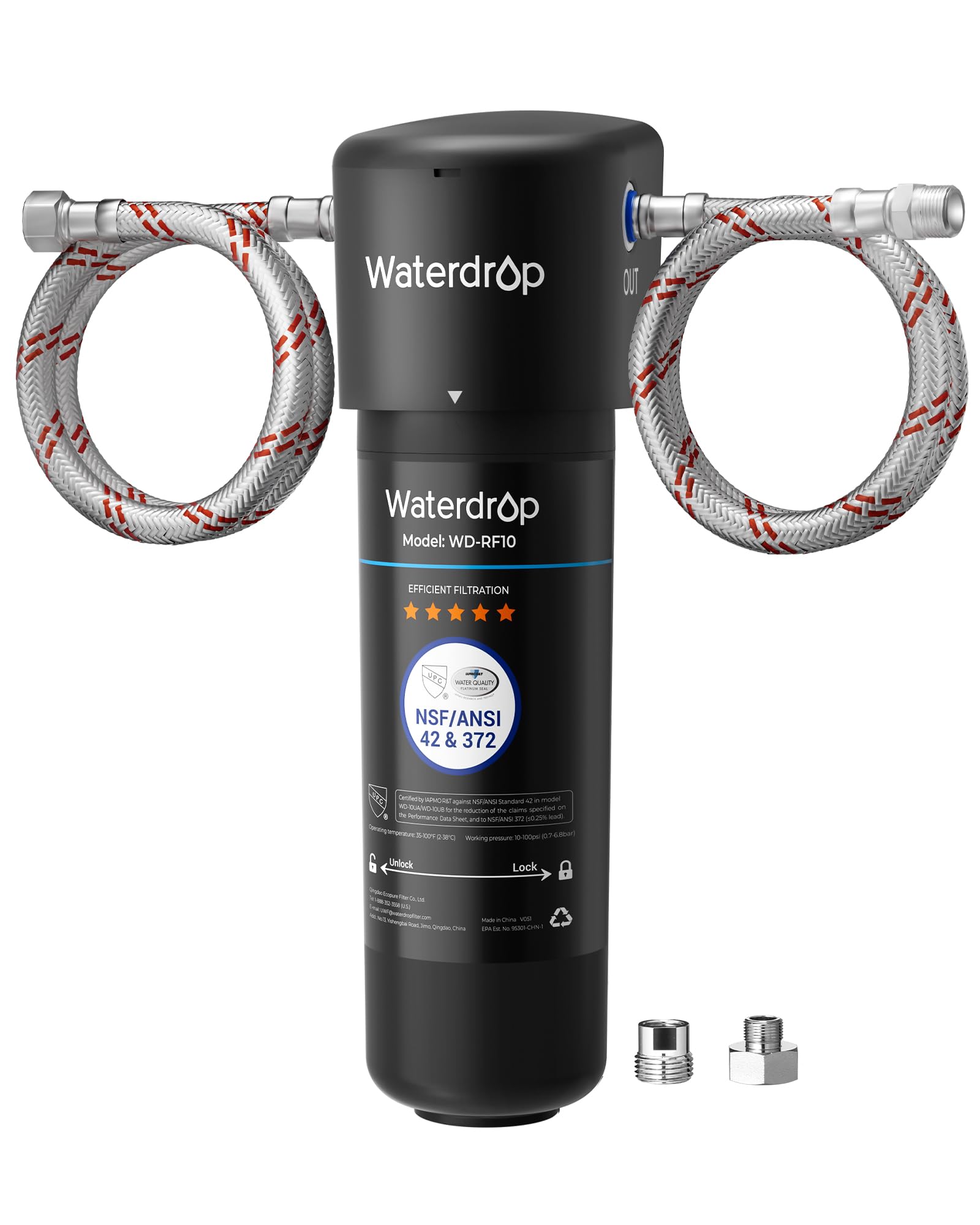
Waterdrop 10UA
Key Features
- Flow rate: 2.5 gpm
- Footprint: 3.9 x 3.6 x 12.3 in
- Filtration: Activated carbon block
- Filter life: 1 year
- Price: Budget
This is the cheapest way into under-sink filtration on this list, and the smallness of the thing is the point: the cartridge is 3.9 by 3.6 by 12.3 inches, it hangs off the cold line with push-to-connect fittings, and it feeds your existing faucet rather than adding a second one. Twist-and-lock changes, no drain, no tank, no outlet. For a rental kitchen or a sink with no spare faucet hole, that combination is hard to argue with, and it’s the unit we suggest to anyone who wants better water without losing a Saturday under the sink.
Know what you’re buying. It’s an activated carbon block certified to NSF/ANSI 42 and 372 — chlorine, taste, odor, and the sediment that comes with them, with the manufacturer also claiming PFOA/PFOS and lead reduction, but no TDS or fluoride removal. Flow is the trade-off: at 2.5 gpm it’s fine for filling a pot, and plenty of households find the tap noticeably slower with the filter in line. It’s cold water only and the cartridge is a yearly change. Two things we appreciated: every fitting comes in the box, and the replacement cartridge costs a fraction of the unit, so year two is cheap.
Pros
- Smallest footprint and easiest install here
- Feeds your existing faucet, no extra hole
- Cheap replacement cartridges
Cons
- Noticeably slower flow at the tap
- No TDS or fluoride reduction
This is the under-sink filter we hand to renters and anyone with a full cabinet: small, cheap to run, and installed in three minutes flat.
Best for Tight Cabinets
Waterdrop G3P600
Key Features
- Capacity: 600 GPD
- Filtration: 8-stage tankless RO
- Drain ratio: 2:1 Pure to Drain
- Certification: NSF/ANSI 58 and 372
- Price: Premium
The faucet is the part you notice first. Waterdrop puts a display in it that reads TDS continuously and shows filter life, which turns the vague ‘is it still working?’ question into a number you can glance at while you fill a glass. Under the counter there’s no tank at all — just a slim box 18.12 by 5.67 by 17.72 inches, with three filters already installed and a twist-out change that takes seconds.
Tankless is the reason to pay for this one. At 600 gallons per day it produces water far faster than a tank system recovers, so the third, fourth, and fifth glass pour at the same rate as the first, and the 2:1 pure to drain ratio means it isn’t running reject water continuously the way a refilling tank does. If your cabinet is already full or your household drinks a lot, that’s worth the premium; if neither is true, the tank-based RO here does the same job for a lot less.
The catch is that it’s a corded unit, so an outlet inside the cabinet is non-negotiable, and it makes noise while it works — the pump cycles after draws, and how much that bothers you depends on whether the kitchen is also the living room. Flow at the faucet is rated at 0.42 gpm, a steady stream rather than a torrent. The display and the reclaimed cabinet floor are real advantages; the pump is the price of admission.
Pros
- 600 GPD tankless, no waiting between glasses
- Faucet shows live TDS and filter life
- Saves most of the cabinet floor
Cons
- Needs a power outlet in the cabinet
- Pump noise after each draw
Worth the premium if cabinet space or back-to-back glasses are your constraint; the display is a genuine bonus, the pump noise is the tax.
Best for No Plumbing
Big Berkey
Key Features
- Power: None, gravity-fed
- Capacity: 2.25 gallons
- Footprint: 8.5 x 8.5 x 19.25 in
- Filtration: 2 Black Berkey elements
- Price: Premium
Two polished stainless cylinders stacked on the counter, 8.5 inches across and 19.25 inches tall, holding 2.25 gallons. The Big Berkey doesn’t look like an appliance, which is half of why it stays out on the counter instead of getting hidden in a cupboard, and the AISI 304 steel will outlast every plastic housing in this guide.
Inside the top chamber sit two Black Berkey elements. You prime them under the tap, drop them in, fill the upper chamber, and gravity does the rest, pulling water through the media and into the lower chamber where the spigot is. No plumbing, no electricity, no drain, no permanent installation — it’s the only system here you can put in a rental, a cabin, or a kitchen with no under-sink space at all, and the only one that keeps working when the power is out.
It’s a hands-on system, though. You fill it by hand, you wait, and you learn to top it up before bed rather than when you want a glass. The spigot is the usual trouble spot: drips can develop, and the lower chamber overflows if you refill the top before it’s been drawn down. Set it somewhere level and it behaves.
We keep coming back to it for the situations the plumbed systems can’t serve. The filter elements, not the steel, are the ongoing cost, so budget for those rather than the box. One practical check: the listing carries a shipping restriction for California and Iowa, so confirm before you order if you’re in either state.
Pros
- No plumbing, power, or installation at all
- Stainless build and 2.25-gallon capacity
- Keeps working during an outage
Cons
- Hand-filled, and gravity flow is slow
- Spigot can drip; refills need watching
Our pick when there’s no plumbing to tap — a rental, a cabin, or a power outage — and you don’t mind filling it by hand.
Best for Shallow Cabinets
APEC ROES-50

Key Features
- Capacity: 50 GPD
- Filtration: 5-stage RO
- Filter life: 6 months
- Certification: NSF/ANSI 58 and 372
- Price: Midrange
If you want reverse osmosis for less than the top pick, the ROES-50 is the obvious second look: five stages, a 50 GPD membrane, NSF/ANSI 58 and 372 certification, quick-connect fittings, and color-coded tubing that makes a DIY install manageable for someone who has never cut into a supply line.
The 50 GPD membrane is the number to weigh. It’s two-thirds the recovery rate of the iSpring’s 75, so the storage tank works harder and refills take longer — fine for a couple, tight for a family that cooks and drinks from the tap all day. What you get in exchange is a genuinely narrow footprint at 15.5 by 5.25 by 17 inches, which matters in a shallow cabinet where a bulkier system simply won’t sit.
Two caution flags. Filter housings and caps have cracked on these units, and when a housing lets go under pressure it makes a mess, so site it where a leak spreads visibly and check the housings each time you change filters. Connection leaks are the other thing to watch, and the usual fix is reseating the tubing in the quick-connect rather than replacing a part.
Where it earns its place is as the straightforward certified RO: compact, simple to fit, and cheaper than the top pick. It has no mineral stage, so the water tastes the flat, stripped way RO water does — if that flatness is what put you off RO in the first place, spend the extra on the iSpring instead.
Pros
- NSF/ANSI 58 and 372 certified RO
- Compact 5.25-inch-deep footprint
- Color-coded tubing and quick connects
Cons
- 50 GPD recovery is slow for big households
- Filter housings have cracked under pressure
A certified, compact RO system that does the job; we rank it behind the iSpring on recovery rate and on the durability of its filter housings.
Best for No-Install Kitchens
PUR Plus Faucet Mount

Key Features
- Capacity: 100 gallons per filter
- Mounting: Faucet mount
- Filtration: 3-in-1 ion exchange
- Filter life: 3 months
- Price: Budget
No tools, no cabinet space, no plumber: the PUR Plus screws onto the threaded end of an aerator-style faucet, and the lever on the side switches between filtered and unfiltered water so you aren’t burning cartridge life rinsing dishes. For a rental, a dorm, or a kitchen where you’re not allowed to modify anything, nothing else here comes close on commitment.
It’s certified to reduce lead along with chlorine, taste, and odor, and the change light on top takes the guesswork out of when it’s spent — 100 gallons or about three months, whichever comes first. On a municipal supply where the complaint is chlorine and a metallic edge, that’s most of what a kitchen filter needs to do.
The honest caveat is longevity. These units can stop filtering or start leaking at the housing within a few months, and the cost per gallon runs high next to an under-sink cartridge because you’re buying a small filter often. Treat it as a stopgap with a purpose rather than a long-term system: it’s the right answer when you can’t modify the plumbing and the alternative is nothing, and the wrong one when an under-sink cartridge would fit, because over a couple of years that money buys a lot more water.
Pros
- Installs in seconds, no tools
- Rated for lead, chlorine, taste, and odor
- Change light takes out the guesswork
Cons
- Short 100-gallon, three-month cartridge life
- Units have quit filtering or leaked within months
The right filter when you can’t touch the plumbing and want better water today, as long as you accept three-month cartridges and a short service life.
How We Tested These Water Filtration Systems
We started by researching more than 30 under-sink and countertop systems, narrowing the field to 12 based on published contaminant-reduction claims, replacement-filter availability and cost, footprint, and whether the setup suited a standard kitchen cabinet. Each system then went into a real kitchen for eight months, where it handled morning coffee, pasta pots, kids’ water bottles, and the occasional midnight glass.
Installation was timed solo with a stopwatch, and we noted every tool needed and whether the setup demanded a plumber. After each install, we ran the tap at full pressure for five minutes and pressed a dry paper towel against every connection, then repeated the check a week later. We measured flow by timing how long it took to fill a quart before and after filtration, and stood three feet away while the system ran to listen for humming, gurgling, or pump noise.
Taste and effectiveness were judged at one week, one month, and three months, comparing each system’s water against unfiltered tap and a national bottled brand; we noted smell, aftertaste, and any cloudiness. Durability got checked along the way—cracked housings, stiff O-rings, cartridges that were hard to seat—and we tracked filter costs to calculate a real per-gallon price.
How to Choose a Water Filtration System
The single decision that shapes everything else is what you want taken out of the water — plumbing, price, and upkeep all follow from it.
Decide what you want taken out
Carbon and KDF cartridges — the CuZn, the Waterdrop 10UA, the whole-house iSpring — pull out chlorine, taste, odor, sediment, and some lead, and they leave the minerals that make water taste like something. Reverse osmosis goes further, cutting dissolved solids, fluoride, arsenic, and nitrate, but it needs a drain line, sends reject water down the drain, and strips the water flat unless a mineral stage puts something back.
Read your utility’s water report before you spend anything. If the complaint is chlorine and a metallic edge, carbon does the job for less money and less plumbing. If you’re on a private well with high nitrates, or you specifically want TDS down, plan on RO.
Read the certification, not the stage count
The standard number is the only part of the label worth memorizing. NSF/ANSI 42 covers aesthetics — chlorine, taste, odor, sediment. 53 covers health effects such as lead and cysts. 58 is for reverse-osmosis systems as a whole. 372 means the wetted materials are lead-free, which says nothing about what the filter removes.
The trap is a box that says ‘NSF certified’ with no standard attached, or one where only a single component was tested rather than the system. Six stages is a stage count, not a performance figure. Check which standard, and whether the whole system carries it.
Match the format to your kitchen
Under-sink RO is the most demanding install: floor space for the unit and its tank, a drain saddle on the trap, and usually a hole for a dedicated faucet. Tankless versions lose the tank but gain a power outlet requirement. Inline carbon cartridges hang off the cold line and need almost nothing. Gravity systems need no plumbing at all but claim counter space and get filled by hand.
Measure the cabinet floor and look for an outlet before you decide. A system that doesn’t fit is a system you’ll be returning.
Budget for the cartridges, not the box
The purchase price is the smaller number over five years. Filter rhythms in this group run from three months on a faucet mount to five years on the CuZn, and RO adds a membrane and post-filters to the annual set. A cheap unit on a six-month cycle can cost more to run than a midrange one you service once a year.
Before you buy, find the replacement part number and its interval, then picture five years of it. That total, not the sticker, is what you’re actually choosing between.
Whole-house is a separate purchase
A whole-house system treats everything entering the house, so it goes on the main line — usually 1-inch NPT, with a flow rating sized to the house rather than to a glass. It removes sediment, chlorine, taste, and odor; it does not lower TDS or fluoride, and anyone who needs that is looking at a point-of-use RO on top.
Two practical checks: confirm your main pipe size, and mount the unit where a drip would be visible and drain somewhere harmless.
Frequently Asked Questions
Will a faucet-mount filter fit my sink?
Only if your faucet ends in a standard threaded aerator — the small round screen you can unscrew at the tip. Pull-out sprayers, pull-down heads, and one-piece faucets without a removable aerator usually can’t take one, and no adapter fixes a spout that has nothing to thread onto.
Unscrew the aerator and look at the threads before you order. If there aren’t any, an under-sink cartridge is the next step up in effort and the next step down in cost per gallon.
Can I use a filtration system on well water?
Yes for sediment and carbon — a whole-house unit is the usual first stage on a well, catching the grit and iron that would otherwise clog everything downstream. RO is fussier about what it’s fed.
The iSpring systems here are rated for supply up to 750 ppm TDS and 40 to 100 °F, and the APEC wants 40 to 85 psi. Test your TDS and pressure first; if TDS runs well above that, plan on a sediment prefilter ahead of the RO rather than a bigger membrane.
How much water does reverse osmosis waste?
Tank-based RO sends reject water to the drain while it refills the storage tank, and the ratio varies by unit. The tankless Waterdrop here is rated at 2:1 pure to drain, so three gallons of tap water yields two gallons of drinking water and one of drain flow.
If that matters on a metered supply or in a drought, choose a unit with a published ratio rather than assuming — the number belongs in the listing, and the tankless designs are the ones that usually state it.
Final Verdict
For most households the iSpring RCC7AK-BN is the system to buy: certified as a complete unit, designed to be installed from above the counter, and finished with a mineral stage that makes reverse-osmosis water taste like water again.
Two situations change that. If there’s no drain line to tap or no cabinet floor to give up, the CuZn UC-200 handles chlorine and lead on a five-year cartridge with nothing to plumb. If there’s no plumbing at all, the Big Berkey earns its counter space.