This post contains affiliate links. We may earn a small commission when you buy through our links — at no extra cost to you.
Many walking pads boast speeds of 7 mph or more, but once you actually use one under a desk, 4 mph is the realistic limit for safe hands-free walking. Higher speeds require holding the handlebar, which defeats the purpose of walking while typing. This guide focuses on models that deliver reliable performance within that real-world range.
Beyond speed, the biggest decision is whether you need incline. Manual incline adds variety but requires a pause to adjust; auto incline is convenient but costs more. Weight capacity and deck length also determine if a pad fits your stride and build. Taller users should aim for at least a 40-inch deck to avoid overstriding.
Prioritize quiet motors and solid construction over flashy features – a noisy or wobbly pad quickly becomes unusable in a home office.

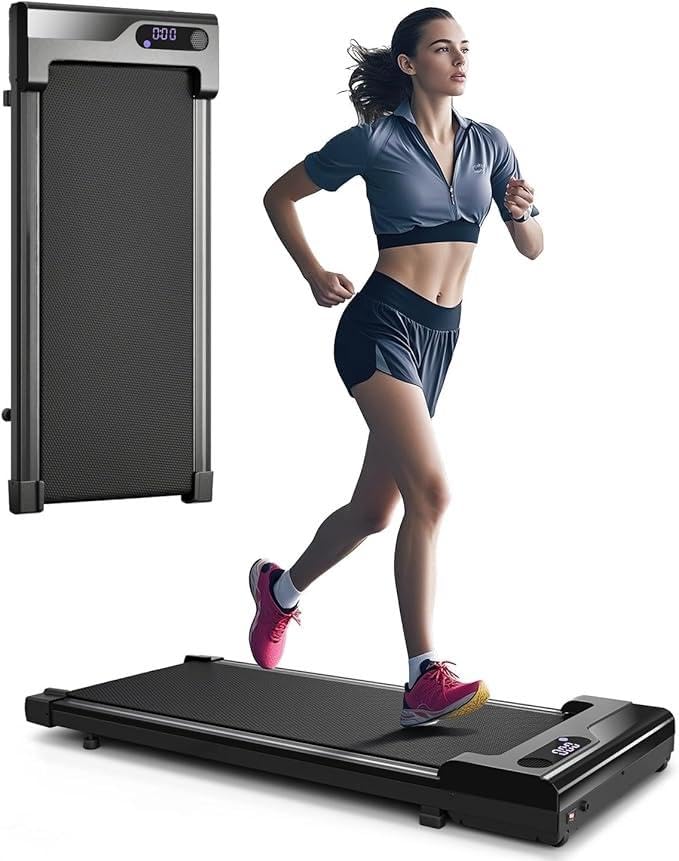
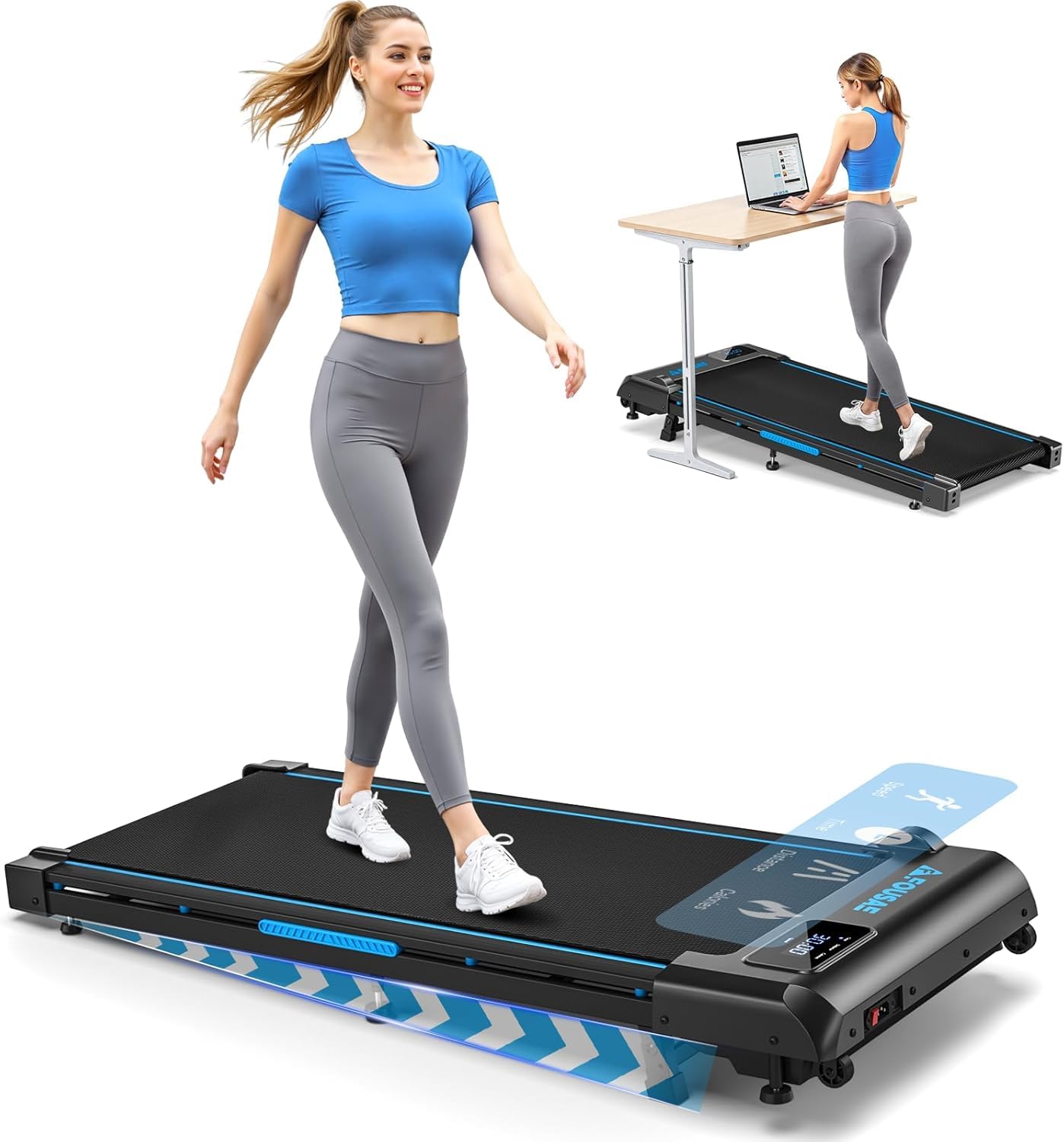

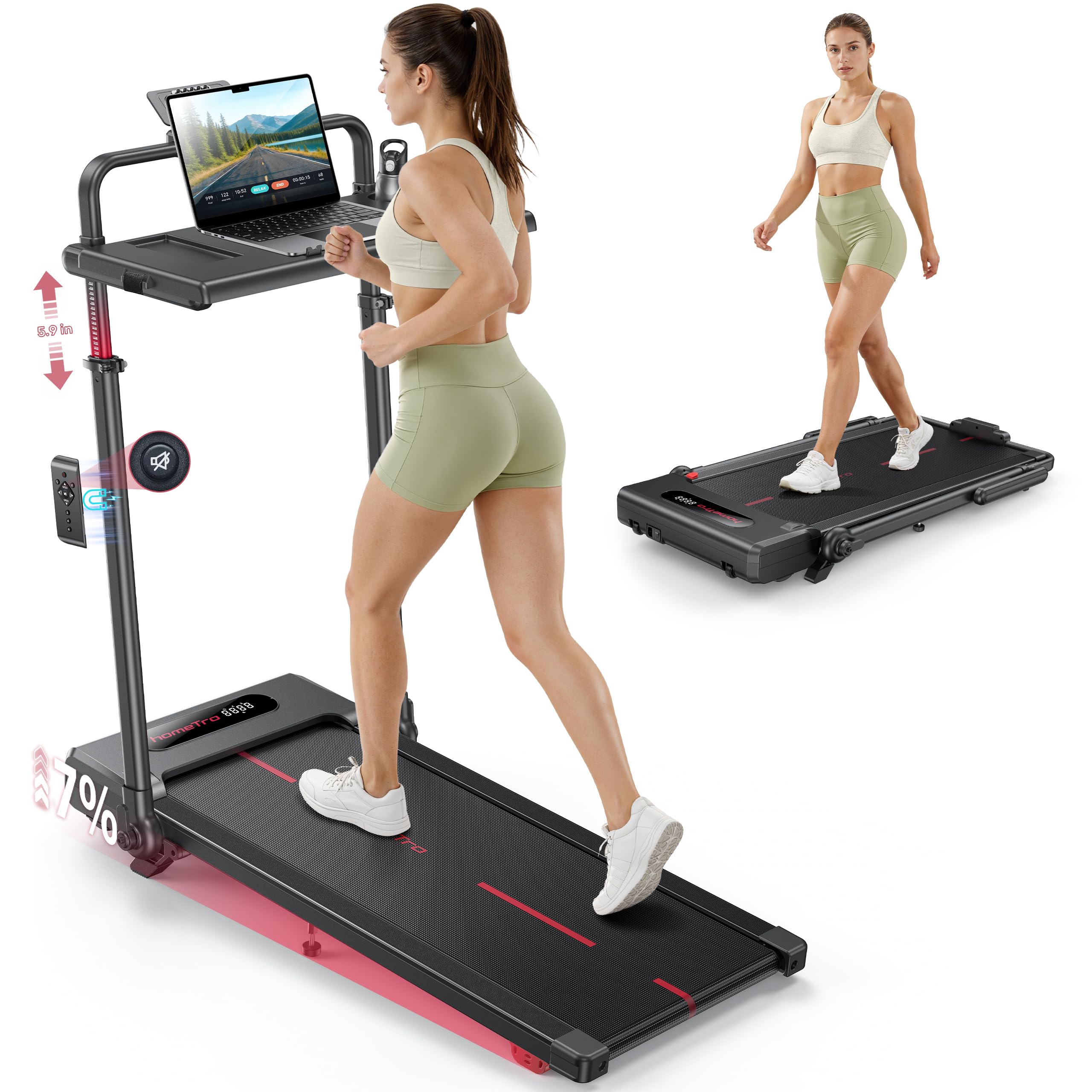
Best for Auto Incline, Heavy
TRAILVIBER Walking Pad
Key Features
- Max Speed: 4 mph
- Incline: 12% auto (9 levels)
- Motor: 2.5 HP
- Weight Capacity: 450 lbs
- Deck Size: 41 x 16.5 in
- Storage: Compact
- Price: $$
The TRAILVIBER Walking Pad brings a 12% auto incline and 450 lb weight capacity together in a compact, quiet design. The motorized incline adjusts across nine levels, adding genuine resistance that mimics outdoor hills. Build quality is solid: the deck and frame feel substantial, and the unit stays planted at any incline setting.
No assembly is required — unbox and plug in. The running deck measures 41 by 16.5 inches, which accommodates a natural walking stride for most users. Noise levels stay low enough for use during phone calls or television, and the RGB LED screen shows time, distance, and incline without being distracting.
This model is best for heavier users (up to 450 lbs) who want incline variety while walking under a desk or in a home office. The maximum speed of 4 mph confines it to walking only — anyone needing jogging or running speeds should look elsewhere. The unit is compact enough to slide under most desks and beds, though its 44-pound weight means rolling it requires some effort.
The Bluetooth speaker adds minimal utility, but the core experience — steady, quiet incline walking — is well executed. The mid-range price reflects the feature set: auto incline, high capacity, and durable construction that competing walking pads at this price often lack.
Pros
- Solid heavy-duty construction handles repeated use at high incline
- 12% auto incline with nine levels adds real hill simulation
- Quiet motor and belt suited for shared office or living spaces
- Compact enough to slide under standard desks and beds
- No assembly required — operational immediately out of the box
Cons
- Maximum speed of 4 mph limits use to walking only — not suitable for jogging
For walkers who want incline training and a high weight limit, this is the most feature-complete walking pad at a reasonable price.
Best for Budget Flat Walking
Vhorilix XM-A1
Key Features
- Max Speed: 4 mph
- Motor: 2.5 HP
- Weight Capacity: 264 lbs
- Deck Size: 15.2 x 37 in
- Storage: Compact
- Price: $
The Vhorilix XM-A1 offers a quiet, compact build at a budget-friendly price, focusing on flat walking up to 4 mph – no incline features or high cost.
Setup takes seconds – no tools needed. The belt is ready to use out of the box, and the remote makes speed adjustments easy. At under 37 pounds, it slides under a desk or stands upright for storage. Owners report consistent performance for daily walking sessions, with the motor holding up well over time.
This walking pad suits budget-minded buyers who need a simple under-desk solution without incline. The deck is narrow, so users above average height may find the stride length limiting. If you plan to use it for low-intensity walking while working or watching TV, the Vhorilix delivers steady motion at a low cost.
Pros
- Quiet motor supports office use without distracting others
- Ready to use straight from the box – no assembly required
- Compact and light enough to move between rooms
- Solid build quality for the price
Cons
- No incline option – flat walking only
- Maximum speed of 4 mph prevents jogging or brisk power walking
For straightforward under-desk walking at a budget price, the Vhorilix does exactly what it promises – no bells, no surprises.
Best for Incline, Hiit Programs
FOUSAE ZX390
Key Features
- Max Speed: 6.2 mph
- Incline: 10% manual
- Motor: 2.75 HP brushless
- Weight Capacity: 350 lbs
- Deck Size: 40 x 16 in
- Storage: Compact
- Price: $$
The FOUSAE ZX390 stands out with its 10% manual incline and 12 HIIT programs at a mid-range price – a combination rare in compact walking pads. Manual incline requires pausing to adjust, but for home users this is a minor inconvenience compared to paying a premium for auto incline. The sturdy double frame supports up to 350 pounds without flex.
This walking pad suits home users who want incline variety and pre-set programs without auto-adjust costs. The 350-pound capacity and quiet motor work well in shared spaces – the noise level is low enough for TV or calls. Setup requires no assembly. Note that incline is manual only, and the speed display may show slight variance from actual pace; for regular walking routines under 4 mph, this is rarely noticeable.
The 12 HIIT programs add structure for interval walkers without needing an app. The 6.2 mph top speed provides headroom beyond practical walking limits, so the belt never feels maxed out during brisk sessions. Overall, the ZX390 delivers consistent daily walking performance with the added benefit of incline and guided programs.
Pros
- Quiet operation that won’t disturb a home office or living room
- Sturdy double-frame construction feels solid underfoot
- Daily walking performance is consistent and dependable
- Straightforward no-assembly setup
Cons
- Adjusting incline requires stopping the belt – less convenient for interval training
- Speed readout may differ slightly from actual pace – minor variance for most walkers
For home users who want incline and structured programs without paying for auto-adjust, the FOUSAE ZX390 is a strong mid-range value – ideal if you’re comfortable with manual incline adjustments and don’t need handlebar support.
Best for Families, Handlebar
TOPUTURE TP6
Key Features
- Max Speed: 7.5 mph
- Incline: 1%-6%-12% manual
- Motor: 2.5 HP
- Weight Capacity: 300 lbs
- Deck Size: 40 x 16 in
- Storage: Foldable
- Handlebar/Desk: Adjustable handlebar
- Price: $$
The TOPUTURE TP6 stands out with its height-adjustable handlebar and three manual incline settings (1%, 6%, 12%), making it one of the few walking pads that adapts to different users without requiring a separate model. The folding design and 56-pound frame feel solid underfoot — no wobble at walking or jogging speeds up to 7.5 mph.
For families sharing a single treadmill, the adjustable handlebar removes the usual one-size-fits-all compromise: taller members can raise it, shorter users lower it. The incline settings add workout variety without an expensive motorized mechanism. That said, at 56 lbs it’s heavier than most walking pads, so moving it between rooms takes more effort. And the incline is manual — you’ll need to stop and adjust the lever, not change it mid-stride.
Setup is about as simple as it gets: unfold, plug in, walk. The motor runs quietly enough for office use, and the 40 x 16 inch deck accommodates average strides without feeling cramped. The LED display shows speed, time, distance, and calories — nothing fancy, but everything needed for a steady walking session.
Pros
- Virtually no assembly — ready to walk within minutes of opening the box.
- Height-adjustable handlebar suits different family members comfortably.
- Multiple manual incline levels add walking intensity without a complex motor.
- Quiet motor operation that doesn’t disturb others in the same room.
Cons
- At 56 pounds, moving it to another room takes some muscle compared to lighter pads.
- Incline requires stopping to adjust manually — no on-the-fly changes.
If you need a walking pad that different users can actually adjust to their height and walking feel, the TOPUTURE TP6 delivers that flexibility without the complexity — just be prepared to lift it and stop for incline changes.
Best for Walk While Work
HomeTro HM6
Key Features
- Max Speed: 7.5/4 mph
- Incline: 7% manual
- Motor: 3.0 HP
- Deck Size: 15.8 x 39.4 in
- Storage: Foldable
- Handlebar/Desk: Removable desk
- Price: $$
The HomeTro HM6 combines a walking pad with a removable desk, letting you stay productive while walking at speeds up to 4 mph in hands-free mode. An adjustable handlebar provides support when not at the desk, and the 7% manual incline adds gentle resistance. This design sets it apart from handlebar-only models that lack a dedicated work surface.
This setup suits remote workers who spend hours at a desk and want to add low-intensity movement. The walking pad operates quietly enough for office use, and the removable desk allows you to switch to handlebar walking when needed. It works best with lightweight laptops – users who carry heavier machines may find the desk less stable.
Pros
- Removable desk creates a dedicated walk-and-work station
- Adjustable handlebar accommodates different user heights
- Quiet motor allows use during calls or in shared spaces
Cons
- Desk height adjustment can slip under the weight of heavier laptops
For remote workers with lightweight laptops, the HM6 offers a unique walk-and-work solution that no other compact walking pad provides.
Best for High Incline Budget
CURSOR X5F
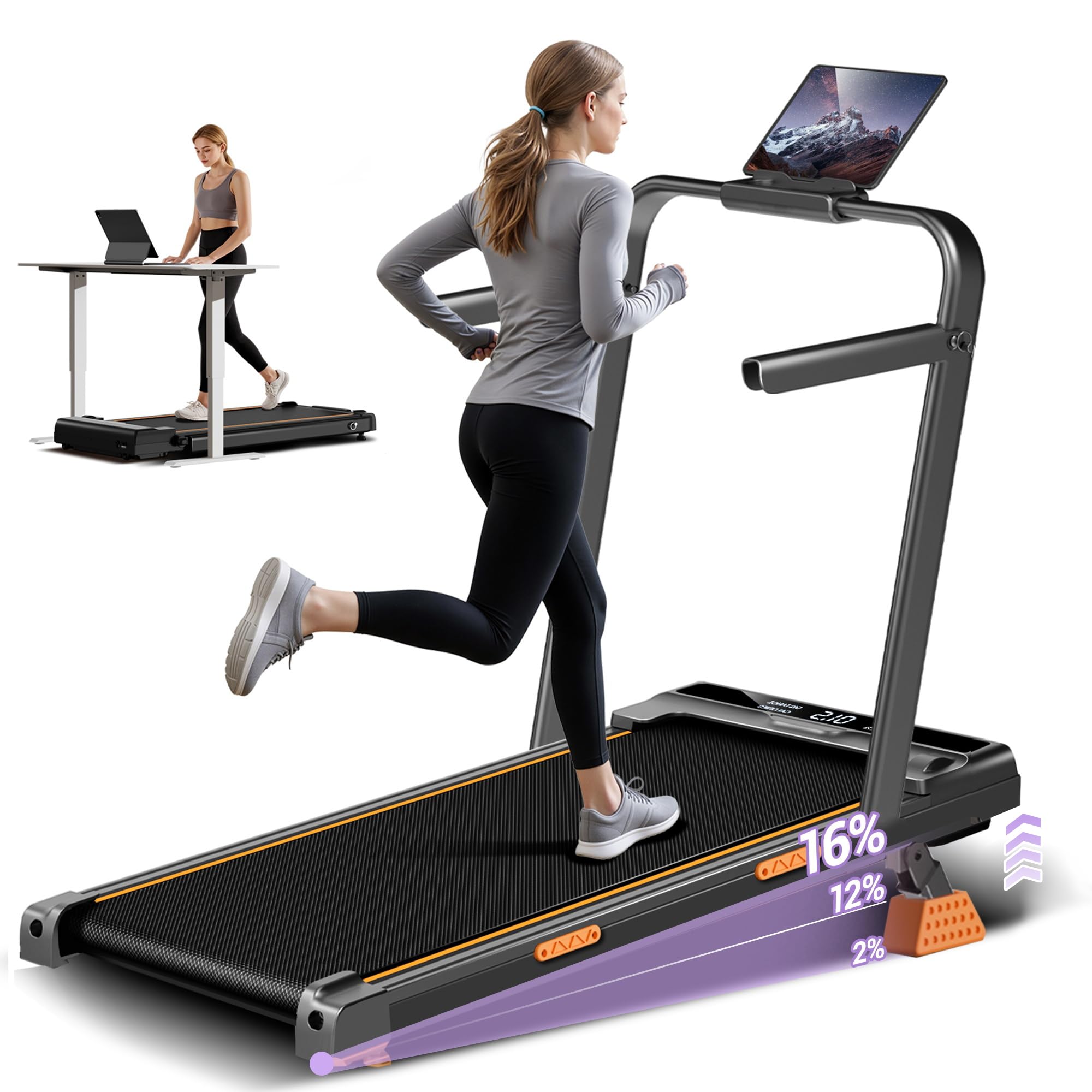
Key Features
- Max Speed: 6.3 mph
- Incline: 16% manual
- Motor: 2.5 HP
- Weight Capacity: 396 lbs
- Deck Size: 35.8 x 15.2 in
- Storage: Compact
- Handlebar/Desk: Handlebar
- Price: $
This walking pad brings a 16% manual incline at a budget-friendly price, making it one of the most affordable ways to add gradient training at home. The 35.8-inch deck suits shorter strides but will feel restrictive for anyone over 5’10”. The handlebar provides minimal support and may wobble during use. For buyers who can walk without relying on the handlebar and need a compact, incline-capable pad without spending much, this is a practical option.
Pros
- 16% manual incline for walking challenge at a low price.
- Quiet motor noise makes it suitable for home or office.
- Easy assembly with minimal setup required.
Cons
- Deck length may restrict stride for users over 5’10”.
- Handlebar assembly can wobble, offering limited support.
For short to average-height buyers on a tight budget who want incline and can do without a sturdy handlebar, this is a reasonable choice.
Best for Budget with Handlebar
Viamotion Incline Pad

Key Features
- Max Speed: 3.8 mph
- Incline: 4° manual
- Motor: 2.5 HP
- Weight Capacity: 265 lbs
- Deck Size: 45.5 x 21.2 in (with handle)
- Storage: Compact
- Handlebar/Desk: Handlebar (non-adjustable)
- Price: $
Assembly takes minutes and controls are intuitive, making this a low-friction addition to a home or office. The 2.5 HP motor handles walking speeds up to 3.8 mph quietly, and the 4-degree manual incline adds some variety without complicating the design. At this price point, the build quality meets expectations for light daily use, and the 39.7-pound weight lets you slide it under a desk or into a closet when not needed.
The handlebar is fixed at a single height — short users (under 5’8′) will find it comfortable, but taller walkers will have to hunch. The narrow deck (21.2 inches) also restricts stride length, and the 3.8 mph cap prevents any jogging. These limitations are acceptable for casual walking on a budget, but buyers who need adjustability or room to move should consider the adjustable-handlebar option in this lineup instead.
Pros
- Easy assembly and straightforward controls
- Solid build quality for the price
- Compact enough to store under a desk or in a closet
Cons
- Handlebar is not height-adjustable and may be too low for users over 5’8”
- Maximum speed of 3.8 mph limits use to walking only
Ideal for budget-conscious users under 5’8′ who need a handlebar for balance and plan to walk at a steady pace. Skip this if you want an adjustable handlebar, a wider deck, or room to jog.
Best for Simple under Desk
Buztrio LF-X2D
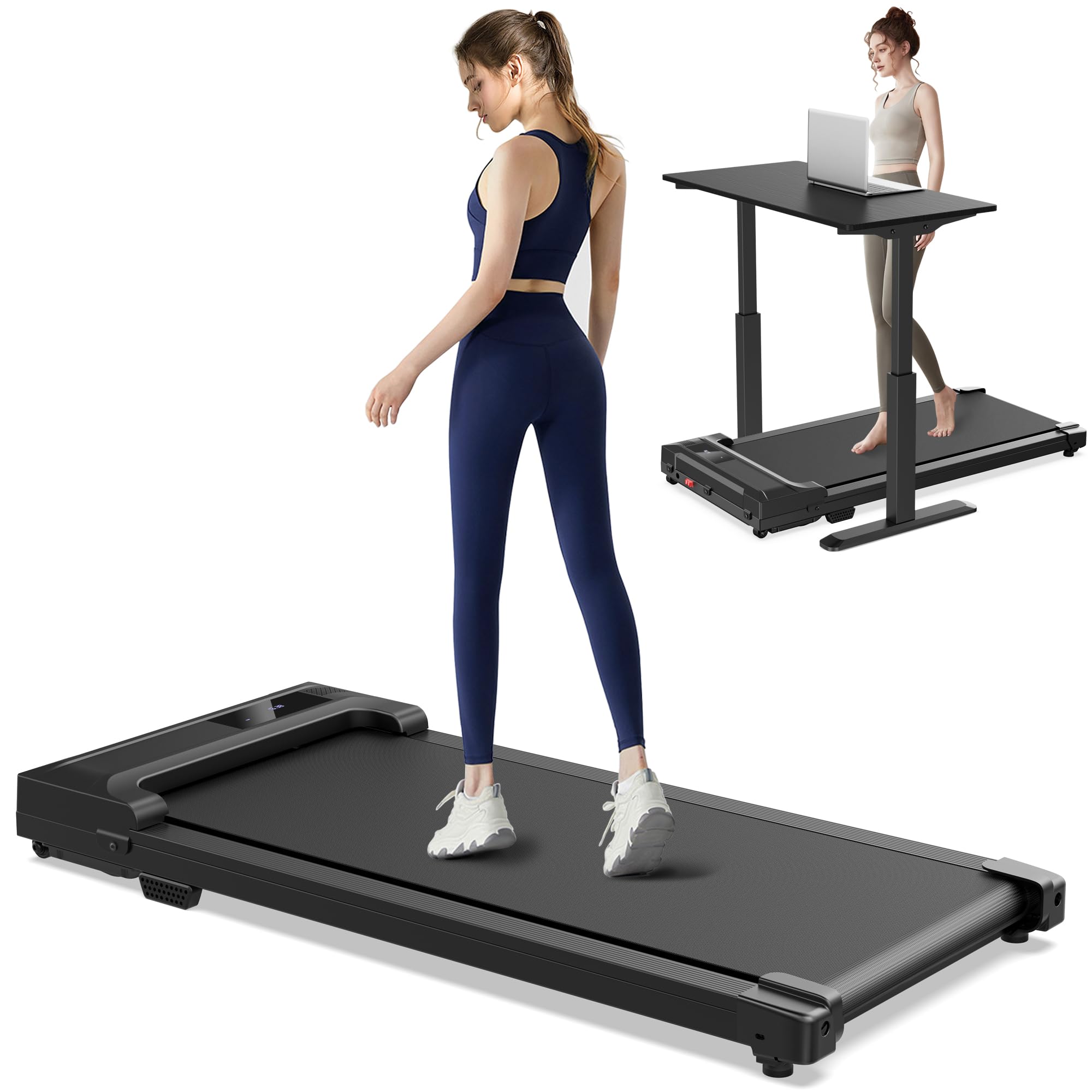
Key Features
- Max Speed: 4 mph
- Motor: 2.5 HP
- Weight Capacity: 265 lbs
- Deck Size: 41 x 19.2 in
- Storage: Compact
- Price: $
The Buztrio LF-X2D comes fully assembled and ready to walk – just unbox and place on the floor. Its sturdy frame and compact dimensions let it slide under a standing desk or into a closet without fuss. The motor runs quietly, making it suitable for shared workspaces. This pad is designed for flat walking only, with no incline option, which keeps it affordable and straightforward. For those who prioritize simplicity and quietness over workout variety, it fits the bill.
Pros
- Sturdy construction with no assembly required – ready to use immediately.
- Compact footprint slides easily under furniture for storage.
- Quiet motor allows use in offices or shared spaces without disturbance.
Cons
- Maximum speed of 4 mph limits use to walking only – not suitable for jogging.
Best for buyers who want a simple, quiet walking pad for flat under-desk use and don’t need incline or higher speed.
Best for Budget Handlebar
Veiharne X2GCF

Key Features
- Max Speed: 6.2 mph
- Motor: 2 HP
- Weight Capacity: 264 lbs
- Deck Size: 15 x 39.4 in
- Storage: Foldable
- Handlebar/Desk: Handlebar
- Price: $
This foldable walking pad with handlebar delivers on its promise of a compact, under-desk solution at a budget-friendly price. Assembly is minimal — essentially pre-assembled out of the box. However, because the product is relatively new to the market, long-term durability under regular use is not yet established, making it a fit for early adopters or those with lighter walking needs who prioritize low cost over proven longevity.
Pros
- Virtually pre-assembled out of the box — just attach four knobs.
- Compact size fits under beds and in small spaces when folded.
Cons
- No incline option, limiting workout intensity for those seeking more than flat walking.
Best for budget-conscious buyers who want a handlebar and folding design for occasional walking, and are comfortable accepting an unproven track record.
Best for Auto Incline Premium
Vitalwalk Apollo 11
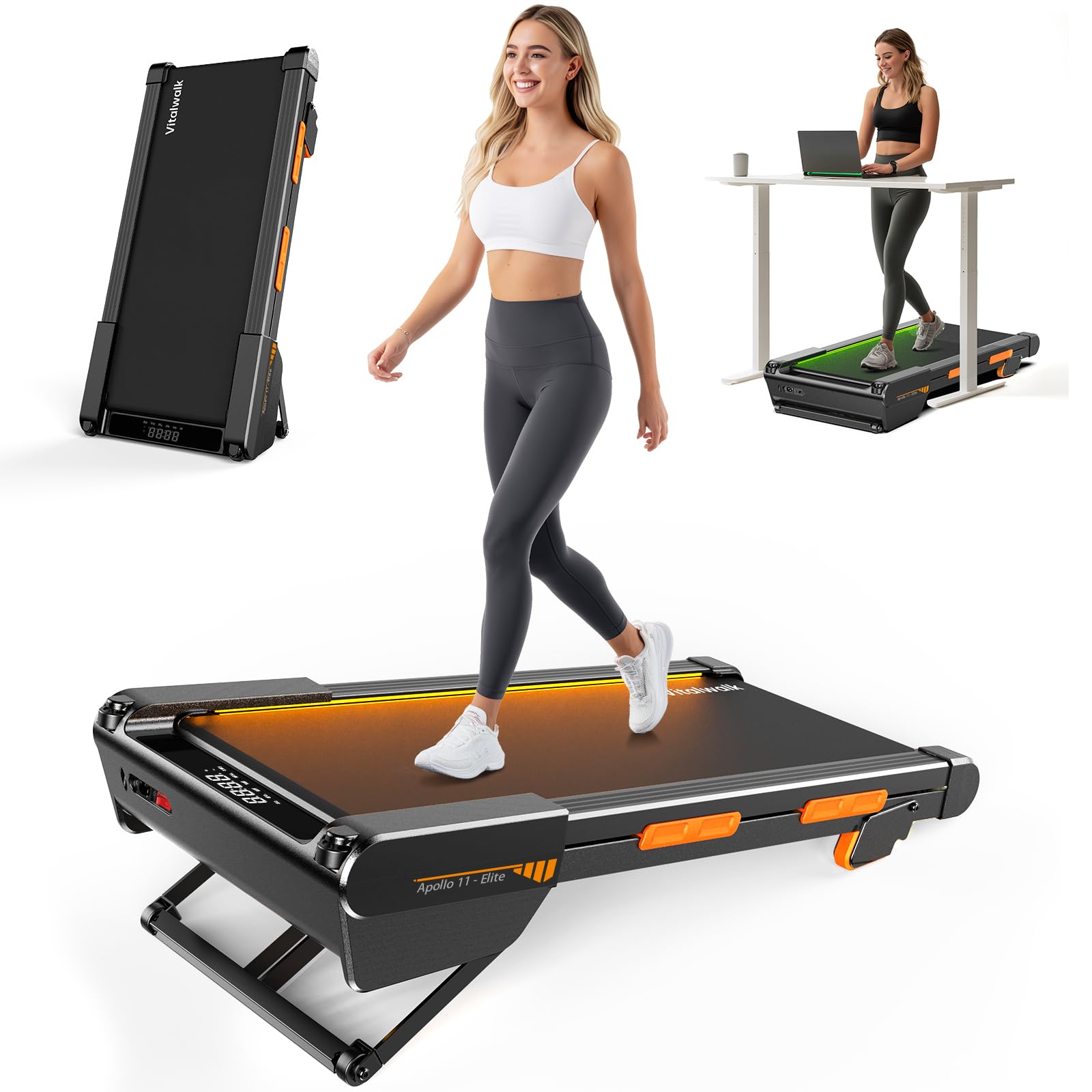
Key Features
- Max Speed: 4 mph
- Incline: 15% auto (6 levels)
- Motor: 3.0 HP
- Weight Capacity: 350 lbs
- Deck Size: 40 x 16 in
- Storage: Compact
- Price: $$$
The Vitalwalk Apollo 11 brings 15% auto incline and a full 40-inch deck to a 50-pound frame that stores vertically. The motor stays quiet enough for calls or TV, and the wider belt gives a roomier stride than most under-desk treadmills. Speed consistency, however, can be uneven: some units may surge or lag during steady walking. With only a modest number of user reports available, long-term behavior is hard to predict — the incline and deck are the real draw here, not the control system.
Pros
- Full-deck design offers a roomier walking surface than typical compact pads
- 15% auto incline adds meaningful intensity without manual adjustment
- Quiet motor operation suits home office or shared spaces
Cons
- Speed may surge or lag during use, which can disrupt steady walking
Best for incline-focused walkers who want a compact unit and accept possible speed variability — the full deck and quiet motor outweigh the control hiccups for short-to-moderate walking sessions.
How to Choose
The most critical insight when buying a walking pad is that safe under-desk walking rarely exceeds 4 mph, so ignore inflated speed numbers and focus on build quality and incline options.
Max Speed
Higher speed ratings look impressive on paper, but walking hands-free above 4 mph becomes risky — you lose balance or drift off the belt. Manufacturers often list peak speeds that require gripping the handlebar, which defeats the purpose of under-desk use. For dedicated walking, a 4 mph cap is sufficient and safer.
If you plan to jog occasionally, look for a model with a sturdy handlebar and a deck long enough to accommodate a running stride. Otherwise, ignore speeds above 4 mph entirely.
Incline Type and Range
Incline adds variety and increases calorie burn without raising speed, but the type matters. Manual incline requires you to stop, step off, and adjust a pin or lever — inconvenient mid-workout. Auto incline lets you change grade on the fly via remote or panel, making interval training seamless.
A 10% to 12% incline is enough to simulate a moderate hill, useful for building leg strength even when walking slowly. For hikers, auto incline is a clear advantage for mimicking outdoor terrain.
Motor Horsepower
A 2.5 HP motor is the sweet spot for walking — enough to drive the belt smoothly at low speeds without overheating. Brushless motors are quieter and more efficient than brushed ones, a key consideration for home office use.
Motors under 2.0 HP may struggle under continuous use or with heavier users. If you expect daily walking sessions, stick with at least 2.5 HP and prefer brushless designs.
Weight Capacity
Weight capacity is directly tied to frame thickness and belt durability. A 300 lb limit works for most, but heavier users (above 300 lbs) need models like the TRAILVIBER with 450 lb capacity, which uses reinforced steel and a wider belt.
Higher capacity also usually means a heavier machine — a trade-off for stability versus portability. If you plan to move the pad frequently, consider a lighter model with a still-adequate capacity for your weight.
Deck Length and Width
Deck length determines stride comfort. For users under 5’8”, a 40-inch deck is fine. Taller users need at least 41 to 47 inches to avoid overstriding, which can cause hip strain or stepping off the back. Width matters less but 16 inches minimum prevents feet from slipping off.
Narrow or short decks are the top complaint among taller buyers — always check the actual belt dimensions, not just the overall unit size.
Storage and Portability
Under-desk walking pads need to be slim enough to slide under a desk or sofa — look for a height under 7 inches. Foldable models save floor space but add weight and hinges that can wear over time.
Weight is a key factor: models under 45 lbs are easy to move, while heavier ones (55 lbs+) often need dedicated placement. If you plan to store it upright, check that the pad has a locking mechanism.
Handlebar and Desk Options
A handlebar provides stability for jogging or for users with balance concerns, but it prevents under-desk use — you can’t slide the pad under a standard desk height with the handlebar attached. Removable or folding handlebars offer flexibility.
Desk attachments let you walk while typing, but they add wobble and reduce stride space. For serious walk-while-work setups, a dedicated desk treadmill like the HomeTro may be worth the compromise. Otherwise, a simple pad with a standing desk works better.
FAQ
Can I walk at 4 mph hands-free on an under-desk treadmill?
Yes, 4 mph is the safe upper limit for hands-free walking on most under-desk treadmills. At this pace, most people can walk naturally without holding the handlebar. Speeds above 4 mph increase the risk of losing balance and should only be used with the handlebar engaged.
Why does my walking pad speed feel slower than the display shows?
Speed calibration varies between brands — some displays show a higher number than the actual belt speed. This is a common issue with budget models. To test, use a stopwatch and mark a known distance on the belt; the true speed is often 0.5 to 1 mph lower than shown. Stick with models that have consistent calibration reports.
Is a manual incline walking pad still effective for burning calories?
Yes, a manual incline is just as effective as auto incline for burning calories — the grade is the same. The only downside is you have to pause and physically adjust the deck, which can break your rhythm. For interval training where you change incline frequently, auto incline is more convenient.
How long should a walking pad motor last with daily use?
With daily walking (1-2 hours), a 2.5 HP brushless motor typically lasts 3 to 5 years before needing repair or replacement. Brushed motors wear out faster — often within 2 years. Regularly lubricating the belt and keeping the motor free of dust can extend lifespan significantly.