This post contains affiliate links. We may earn a small commission when you buy through our links — at no extra cost to you.
Most camping sleeping pads force you to choose between a good night’s sleep and a pack you can actually carry. Foam pads are heavy and bulky. Air pads are light but often leak or leave you cold.
Self-inflating hybrids bridge that gap, offering decent comfort and insulation without the need for a separate pump. But not all hybrids are equal — some sacrifice warmth for weight, others are too heavy for anything beyond car camping.
The best pad for you depends on how you camp. This guide matches specific pads to specific trip styles, so you know exactly what you’re getting into.


Best for All-Around Camping
Gear Doctors Oxylus
Key Features
- Thickness: 1.5 in
- Weight: 2.2 lbs
- Construction: Self-inflating (foam+air)
- Inflation: Self-inflating
- Price: Mid-Range
The Gear Doctors Oxylus combines a thick foam core with an air chamber, so it inflates itself to 1.5 inches of cushioned support within a few minutes of opening the valve. That insulation layer carries an R-value of 4.3, which keeps the ground cold at bay through three-season conditions — into the low 30s without issue. For anyone who wants insulation without the hassle of blowing up a mattress, the self-inflating mechanism is a genuine time-saver.
In a tent or under open sky, the 72-by-22-inch surface gives most sleepers enough room to shift positions without rolling off. The foam interior dampens motion transfer, so tossing and turning doesn’t ripple across the pad. Setup is straightforward: unroll, open the valve, wait a few minutes, then close and make small adjustments by mouth. Deflation rolls up firmly enough to fit into a standard backpack, though the 2.2-pound weight is noticeable on longer carries.
This pad suits car campers who want a quick setup with no pump needed, and short-distance backpackers who can accept the weight in exchange for reliable foam insulation. Long-distance backpackers counting ounces will find lighter inflatable options elsewhere. The same goes for winter campers who need an R-value above 5 — the Oxylus is a three-season tool, not a four-season one.
Pros
- Supportive feel from foam-and-air hybrid reduces pressure points on hips and shoulders.
- R-4.3 rating provides genuine warmth for chilly spring and fall nights.
- Opens and rolls up quickly with no pump — good for campers who value speed.
Cons
- At 2.2 pounds, the weight is manageable for short trips but becomes a burden on multi-day treks.
If you drive to camp or hike a few miles in, the Oxylus delivers warmth and comfort without the risk of deflation that comes with fully inflatable pads. It earns its place as the go-to for three-season ground sleepers.
Best for Ultralight Backpacking
Gear Doctors ApolloAir
Key Features
- Thickness: 3.25 in
- Weight: 17 oz
- Construction: Inflatable (insulated)
- Inflation: Pump sack
- Price: Premium
The Gear Doctors ApolloAir delivers true 4-season warmth (R-5.2) at just 17 ounces, packing down to water-bottle size. Unlike the self-inflating Oxylus top pick, this pad requires a pump sack or breath inflation, but the weight savings and insulation make it the better choice for long-distance trips below freezing.
Thru-hikers and ultralight backpackers who sleep on their back or side will find the 3.25-inch thickness comfortable. However, the tapered shape narrows to 17 inches at the feet, which can feel cramped for broad-shouldered or restless sleepers. Occasional air retention issues have been noted between units, so checking the pad before a critical trip is wise.
Pros
- Exceptional warmth-to-weight ratio for cold-weather backpacking
- Very lightweight and packs down to a water-bottle size
- Comfortable for both side and back sleeping positions
Cons
- Tapered foot section (17 wide) may feel restrictive for broad-shouldered or active sleepers
- Some units may develop slow air leaks over time; careful pre-trip inspection is recommended
If you prioritize pack weight and cold-weather insulation over self-inflating ease and don’t mind a narrower sleeping surface, the ApolloAir is a capable companion for serious backcountry trips.
Best for Car Camping Cot
Teton Outfitter XXL Camp Pad
Key Features
- Thickness: 2.5 in
- Weight: 9 lbs
- Construction: Open-cell foam
- Price: Premium
The Teton Outfitter XXL Camp Pad uses 2.5 inches of thick open-cell foam to deliver a mattress-like feel that needs no inflation. Its canvas cover adds durability and resists punctures better than inflatable alternatives. This design prioritizes comfort and durability over portability, making it a direct contrast to the packing-friendly self-inflating top pick. The result is hotel-like comfort that lets you wake up rested after a night on the ground.
Weighing 9 pounds and rolling up to the size of a small suitcase, this pad is only practical for car camping and cot use. It fits XXL cots securely and provides plush support for side sleepers who find thin pads uncomfortable. Anyone hiking to a campsite or packing a small car should consider a lighter option.
Pros
- Thick 2.5-inch foam provides a bed-like sleeping surface that needs no pumping or inflation.
- Durable canvas cover withstands repeated use and resists punctures.
- Designed to fit XXL cots securely without slipping or bunching.
Cons
- Weighs 9 pounds and rolls up to the size of a small suitcase — only practical for car camping.
- Actual dimensions may be shorter than advertised, potentially too short for taller users.
This pad is ideal for car campers and cot users who prioritize comfort above packability — no inflation needed, just unroll and sleep.
Best for Couples Camping
Hikenture Double Pad
Key Features
- Thickness: 4 in
- Weight: 3.64 lbs
- Construction: Inflatable (air only)
- Inflation: Built-in foot pump
- Price: Mid-Range
The Hikenture Double Pad delivers a 4-inch thick, 79 by 47.5-inch sleeping surface that fits two adults comfortably without the middle gap common in separate pads. The cushioning feels closer to a home mattress than most camping pads, and the packed size is manageable for a double.
This pad suits couples car camping, families with two kids, or anyone wanting a double bed in a tent. Air retention and seam durability vary between units — some pads may develop leaks after a few nights, making this a better fit for trips where bringing a repair kit or backup pad is easy.
Pros
- Very comfortable for two people – feels like a real mattress
- Generous size fits two adults comfortably
- Packs down relatively small for a double pad
Cons
- Some units may lose air overnight – a risk on sleep-dependent trips
- Seam splitting has been noted after a few uses, especially on uneven ground
For couples car camping who can pack a patch kit and don’t mind some uncertainty, the Hikenture offers mattress-like comfort at a manageable packed size.
Best for Ultralight Backpacking
Therm-a-Rest Z Lite
Key Features
- Thickness: 0.75 in
- Weight: 14 oz
- Construction: Closed-cell foam
- Price: Mid-Range
The Z Lite’s closed-cell foam construction removes any risk of punctures or leaks — a clear advantage over inflatable pads for weight-conscious hikers. Its R-value of 1.7 provides enough insulation to keep most users comfortable in summer conditions, and the material withstands years of abuse without losing shape or performance.
This pad targets backpackers and mountaineers who prioritize reliability and low weight over plush comfort. The 0.75-inch thickness offers minimal ground isolation, so side sleepers may feel hard surfaces through the pad — back and stomach sleepers will find it adequate. It also doubles as a sit pad or yoga mat, adding value for multi-use trips.
Pros
- Weighs only 14 ounces and folds compactly for easy packing
- Closed-cell foam is puncture-proof and survives rough terrain
- Provides a reliable barrier against cold ground with R-value 1.7
Cons
- At 0.75 inches thick, the pad offers minimal cushioning — side sleepers may feel the ground
The Z Lite is the right choice for hikers who need an indestructible, ultralight sleeping pad — just not for those wanting thick cushioning.
Best for Car Camping Side
CYMULA Memory Foam Pad
Key Features
- Thickness: 3 in
- Weight: 7.5 lbs
- Construction: Memory foam
- Price: Mid-Range
The CYMULA Memory Foam Pad uses 3 inches of CertiPUR-US memory foam with a removable, washable cover, giving it a genuine mattress feel that inflatables struggle to match. Unlike the self-inflating top pick, this pad packs down to a 7.5-pound roll that takes up a serious chunk of your trunk.
This pad suits car campers who value a plush night’s sleep and side sleepers who need pressure relief at the hip and shoulder. It also works well as a guest bed at home. The weight and packed size rule out any backpacking use — it stays in the vehicle.
Pros
- Sleeps like a real mattress with substantial cushioning
- Softness relieves pressure points for side sleepers
- Rolls up with integrated straps and includes a carry bag
Cons
- May consume significant trunk space and weighs 7.5 pounds
- Some pads arrive thinner than advertised until foam fully expands
If you drive to the campsite and want a bed-like sleep without inflating anything, this pad delivers comfort that air pads can’t match — just bring a big trunk.
Best for Casual Car Camping
Coleman Self-Inflating Pad

Key Features
- Thickness: 2.5 in
- Weight: 6.4 lbs
- Construction: Self-inflating
- Inflation: Self-inflating
- Price: Mid-Range
The Coleman Self-Inflating Sleeping Pad delivers the convenience of self-inflation and a built-in pillow, making setup simple for car camping trips. The Coleman name brings familiarity, but the pad’s strap durability and air retention are less consistent. Occasional air loss and strap wear mean it’s best suited for families who prioritize ease of use over long-term reliability and are willing to monitor these points.
Pros
- Built-in pillow adds comfort for car camping
- Self-inflates without needing a pump
Cons
- Strap and buckle durability may be limited after repeated use
- Air retention can be inconsistent, with some pads losing air overnight
This pad fits casual car campers who value brand recognition and quick setup, as long as they can accept the possibility of strap wear and air loss over time.
Best for Budget Car Camping
FUN PAC Inflatable Pad
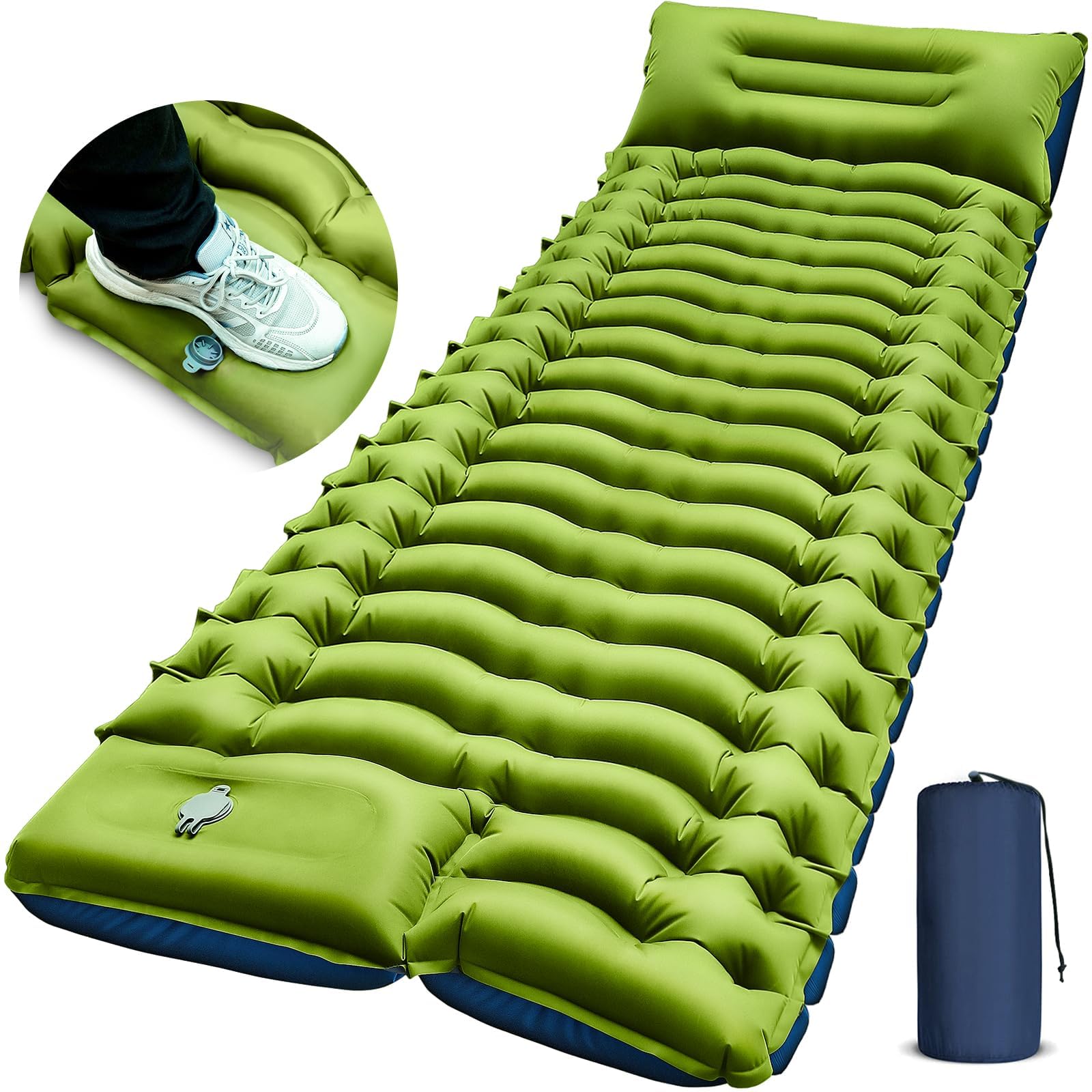
Key Features
- Thickness: 3 in
- Weight: 1.5 lbs
- Construction: Inflatable (air only)
- Inflation: Built-in foot pump
- Price: Budget
The FUN PAC Inflatable Pad delivers impressive comfort for the price — the 3-inch air mattress feel and built-in foot pump make setup quick. At 1.5 pounds and compact when deflated, it’s easy to toss in a car or pack for casual trips. However, air retention can be inconsistent between units; some pads may lose pressure overnight. This works best for car camping, kids’ sleepovers, or festival use where a flat pad is an inconvenience rather than a safety risk.
Pros
- Thick 3-inch construction provides comfortable ground separation for the price.
- Built-in foot pump inflates the pad in under a minute without extra gear.
Cons
- Some units may develop leaks or fail to hold air overnight — best for casual trips where failure is manageable.
A value pick for occasional car camping or festival use, provided you’re prepared to check for leaks before heading out.
Best for Cot Use
CYMULA Cot Pad 3"
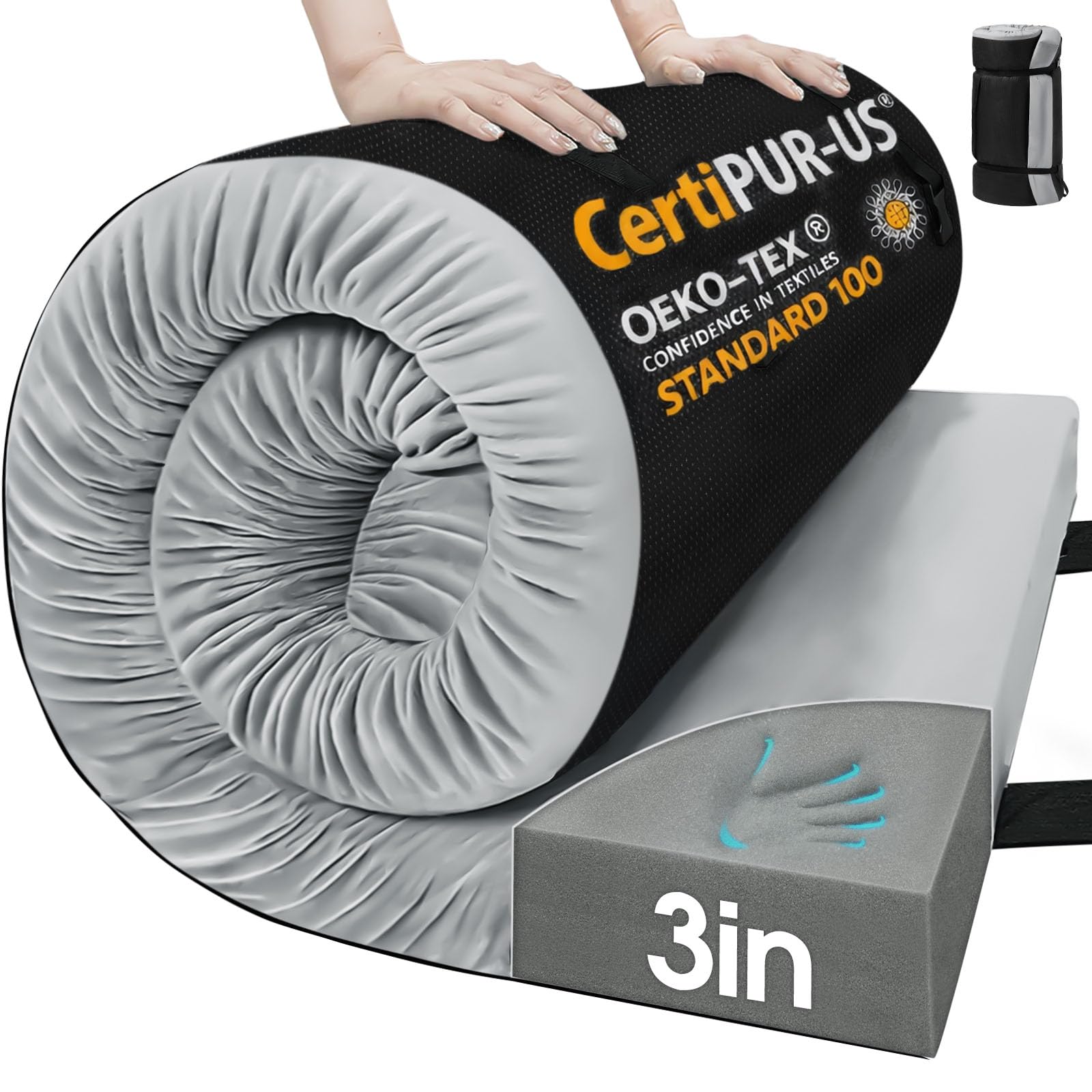
Key Features
- Thickness: 3 in
- Weight: 6.4 lbs
- Construction: Memory foam
- Price: Mid-Range
This pad uses CertiPUR-US memory foam for solid comfort and support when placed on a cot. The non-slip bottom keeps it in place, and the removable cover is easy to clean. However, at just 24 inches wide, it is too narrow for sleeping on the ground or for use on wide cots, limiting its application to narrow cot or truck bed setups.
Pros
- Comfortable and supportive memory foam for cot sleeping
- Non-slip bottom keeps pad from shifting during use
Cons
- Firm foam may feel too hard for some and rebounds slowly
- Only 24 inches wide – too narrow for ground sleeping or wide cots
Best suited as a firm topper for narrow camping cots or truck beds, where its comfortable foam and non-slip base are practical advantages.
Best for Budget Car Camping
HiiPeak Inflatable Pad

Key Features
- Thickness: 3 in
- Weight: 2.05 lbs
- Construction: Inflatable (air only)
- Inflation: Built-in foot pump
- Price: Budget
The HiiPeak pad offers decent comfort on a budget with its quick built-in foot pump and 3-inch thickness. However, the crinkly fabric creates noise when shifting, and some units lose air overnight — making it a gamble for restful sleep. It is a passable choice for short car camping trips where convenience matters more than silence or reliability.
Pros
- Built-in foot pump inflates the pad in under a minute
- 3-inch thickness provides good ground isolation for the price
Cons
- Crinkly fabric noise when moving may be noticeable in quiet tents
- Some pads deflate overnight – a risk for critical trips
Best for campers on a tight budget who want a built-in pump and accept the possibility of noisy nights or early morning re-inflation.
Best for Couples Car Camping
Yuzonc Double Pad

Key Features
- Thickness: 4 in
- Weight: 3 lbs
- Construction: Inflatable (air only)
- Inflation: Built-in foot pump
- Price: Mid-Range
Built-in pillows and a foot pump make setup easy, and the 4-inch thickness provides comfortable support for two people on level ground. However, like other budget double pads, air retention can be inconsistent — some units may lose pressure overnight or develop seam leaks after repeated use, making this a better fit for casual car camping than for trips where gear failure is hard to manage.
Pros
- Comfortable shared sleeping surface with integrated pillows for each side.
- Built-in foot pump inflates the pad quickly without extra gear.
Cons
- Some pads may lose air overnight, requiring a top-up before sleep.
- Seam integrity can vary; occasional leaking after several uses has been noted.
This pad works well for couples who car camp in warm weather and accept the possibility of checking for leaks before each trip — not the pick for remote outings where a failed pad means a sleepless night.
Best for Max Loft Budget
FNARMW 5" Pad

Key Features
- Thickness: 5 in
- Weight: 1.98 lbs
- Construction: Inflatable (air only)
- Inflation: Built-in foot pump
- Price: Budget
The FNARMW pad delivers 5 inches of thickness that provides effective ground isolation for a comfortable night’s sleep. The built-in foot pump inflates the pad in under a minute without extra gear. However, some pads may develop air retention problems after several uses, making this a gamble for extended trips. Combined with its weight (nearly 2 pounds) and bulk, it suits car campers and kids’ sleepovers rather than backpackers. The value is strong if you can accept the risk of a possible leak down the road.
Pros
- 5 inches of loft provides effective ground isolation from cold and uneven ground.
- Built-in foot pump allows fast inflation without needing a separate pump or power.
Cons
- Air retention can be inconsistent; some pads may lose air after repeated use.
Best for car campers or occasional sleepovers where the risk of air loss is acceptable for the comfort and low price.
How to Choose
The sleeping pad market splits between foam comfort (heavy and bulky) and inflatable packability (prone to leaks), but self-inflating hybrids strike the best balance for most campers.
Thickness and Ground Isolation
Thickness determines how much you feel rocks and roots beneath you. Side sleepers need at least 3 inches of air or 1.5 inches of firm foam to avoid hip pressure points.
But thicker pads hold more air, which cools down faster if uninsulated. A 5-inch budget inflatable can feel cold below 50°F because the air inside loses ground heat quickly. Foam pads retain temperature better ounce for ounce.
Insulation (R-Value)
R-value measures resistance to heat loss. A pad with R-1.7 (like closed-cell foam) is adequate for summer, while R-4.3 or higher handles fall and early spring. Many budget inflatables have no stated R-value — they provide zero insulation, making a 3-inch air pad colder than a 0.75-inch foam pad.
If you camp in temperatures below 40°F, look for an R-value of 4 or above. The warmth comes from internal insulation layers (foam, mylar, synthetic fibers) that trap air and reflect body heat back at you.
Weight and Packed Size
Weight and packed volume directly affect how far you can carry your gear. Foam pads weigh 6-12 pounds and roll up to the size of a small suitcase — fine for car camping, impossible for backpacking. Inflatable pads can weigh under 1 pound and pack smaller than a water bottle.
The trade-off is durability. Ultralight inflatables use thin fabrics that risk punctures, while foam pads survive abuse. For short hikes (under 2 miles), a 2-pound self-inflating pad offers a good compromise.
Construction Type
Three main constructions exist: open-cell foam (heavy, uncrushable comfort), closed-cell foam (light, bombproof, but thin), and inflatable (light, packable, but puncture-prone). Self-inflating pads combine foam with air — they open valves to draw in air and suck out foam expansion, providing moderate comfort and insulation without a pump.
Self-inflating pads are the most forgiving for first-time buyers but are heavier than pure air pads. Pure foam pads never leak but offer the least cushioning. Choose based on your priority: durability (foam), weight (air), or balanced convenience (self-inflating).
Inflation Method
Self-inflating pads require no pump — just open the valve and let the foam do the work. Air pads need either a built-in foot pump, a separate pump sack, or mouth inflation (not recommended due to moisture). Built-in foot pumps are convenient but add weight and can fail after a few trips.
Pump sacks (included with many premium pads) double as dry bags and are more reliable. If you car camp, any method works; for backpacking, a lightweight pump sack or self-inflating design saves time and breath.
FAQ
Why does my sleeping pad deflate during the night even though the valve is closed?
Temperature drops cause air inside the pad to contract, reducing internal pressure and making the pad feel soft. This is normal and can be fixed by adding a few breaths before bed. If the pad fully flattens, check for a pinhole leak — submerge the inflated pad in water and look for bubbles. For budget inflatables, valve failure is also common.
Is a self-inflating sleeping pad better than an air pad for cold weather camping?
Self-inflating pads have a foam core that adds insulation, giving them a higher R-value than most uninsulated air pads. However, many premium air pads now include internal insulation (like the ApolloAir’s R-5.2). The deciding factor is R-value, not construction type. For freezing conditions, look for R≥4 regardless of whether it’s self-inflating or air.
Can I use a foam camping pad on a cot for extra comfort?
Yes. A foam pad placed on a cot prevents you from feeling the cot’s frame straps and adds cushioning. The Teton Outfitter XXL and CYMULA cot pads are designed specifically for this. Make sure the pad’s width matches the cot — oversize pads may sag, and undersize pads leave gaps.
How thick does a sleeping pad need to be for side sleepers to avoid hitting the ground?
Side sleepers typically need at least 3 inches of air pad loft or 1.5 inches of firm foam. The exact thickness depends on your hip pressure point — heavier sleepers may need more. A 0.75-inch closed-cell pad will transfer ground feel. The Gear Doctors Oxylus (1.5-inch foam) or CYMULA memory foam (3-inch) both work well for side sleepers.