This post contains affiliate links. We may earn a small commission when you buy through our links — at no extra cost to you.
Finding a dropper post that stays up, doesn’t wobble, and lasts longer than a few rides is harder than it should be. Many budget options cut corners with cheaper internals, leading to sag or side-to-side play after short use. The frustration is real, but the right post for your bike and riding style exists.
This guide focuses on proven models that balance reliability and cost, whether your frame uses external routing or internal. The choice often comes down to how much you ride and how aggressively you push the post. A post that works for casual gravel may fail on technical trail laps.
The best picks here are backed by hundreds of rider experiences, not just marketing claims. You’ll also learn the trade-offs between cable-actuated and cable-less designs, and why a higher price doesn’t always guarantee fewer problems.

Best for Trail & Enduro
TranzX Kitsuma
The TranzX Kitsuma delivers smooth, consistent drop action that holds up across temperature swings. Installation is straightforward with externally routed cable, and the build quality feels solid for a mid-range post. It operates without fuss in both cold and warm conditions.
This dropper suits trail and enduro riders upgrading from a rigid post who prefer external routing and a budget-friendly price. The primary tradeoff: some units may develop lateral play or fail to stay fully raised over time, reflecting minor quality control variation. Riders needing internal routing should look elsewhere.
Pros
- Smooth operation across weather conditions
- Great value for money
- Easy installation and high build quality
Cons
- Side-to-side play can develop after extended use
- Some units may fail after several months of riding
Strong performance and value, with minor QC variability — ideal for external-routing builds where budget matters.
Best for Weight-Conscious Racers
OneUp V3
The OneUp V3 stands out for its featherweight build and exceptionally smooth travel, backed by IGUS bushings and SKF seals that reduce friction. It offers a 20mm travel adjustment range and a 350-hour service interval you can handle at home with basic tools. Unlike the top pick in this category, the V3 requires you to supply your own lever and cable — an additional expense to factor in. This post suits weight-conscious racers and riders who value low-maintenance performance over upfront savings.
Pros
- Weighs significantly less than comparable dropper posts.
- Smooth, low-friction operation with easy at-home service.
Cons
- Lever and cable must be purchased separately, adding to total cost.
For riders chasing weight savings and buttery-smooth dropper action, the OneUp V3 delivers. Just budget for the missing lever and cable.
Best for Casual Riding
TranzX Jump Seat
Key Features
- Travel: 100mm
- Routing Type: Cable-less
- Weight & Length: 1.3 lbs
- Actuation Type: Cable-less hydraulic
- Price: Budget
The TranzX Jump Seat installs like a standard seatpost, skipping cable routing entirely — a clear advantage for gravel bikes and commuters who want drop-on-the-fly adjustability without the hassle. The under-seat lever is intuitive, and the 100mm of travel works well for seated climbs or quick descents on smooth terrain. Some units may slowly sink under heavier riders, and long-term durability for frequent trail use remains uncertain; this post is best suited for low-stress riding where occasional adjustment is the goal, not aggressive mountain biking.
Pros
- No-cable installation works like a regular seatpost
- Good function for short rides or commuting
- Lowest price point for a dropper post
Cons
- Seatpost may slowly sink under rider weight in some cases
- Some units may develop noise or stop working over time
For gravel and commuter riders who want a dropper without cable routing, this is a sensible budget option; trail riders should look to a cable-actuated model with better long-term hold.
Best for Trail Riding
Crankbrothers Highline
The Crankbrothers Highline delivers high build quality, clear instructions, and a five-year warranty on its self-contained hydraulic cartridge – a setup that simplifies installation compared to cable-actuated posts. However, some units may exhibit creeping or lateral play, so consistency varies between individual posts. This post suits trail riders who prioritize easy installation and warranty protection over the lower cost of alternatives like the TranzX Kitsuma.
Pros
- High build quality with consistent operation over time.
- Easy installation with clear instructions.
Cons
- Post may creep up or down in some cases.
- Side-to-side play can be noticeable on some units.
A well-built dropper with easy setup and a strong warranty, provided you can accept unit-to-unit variations in play and position hold.
Best for External Frame Builds
PNW Cascade
The Cascade uses a sealed air cartridge for consistent actuation and offers three travel options (125, 150, 170mm) to match different bike setups. External routing simplifies installation on frames with exposed cables. The lever and cable are not included, so budget an extra $40 or more for those components. This dropper suits trail riders who want travel flexibility and external cable routing, and are willing to buy the lever separately.
Pros
- Sealed air cartridge delivers smooth, consistent performance with minimal maintenance.
- Three travel lengths (125/150/170mm) allow matching to bike geometry and rider preference.
- External routing works with older frames lacking internal cable guides.
Cons
- Lever and cable must be purchased separately, increasing total cost by roughly $40 or more.
The Cascade delivers on travel options and a sealed cartridge – just add the cost of a lever when comparing to all-in-one posts.
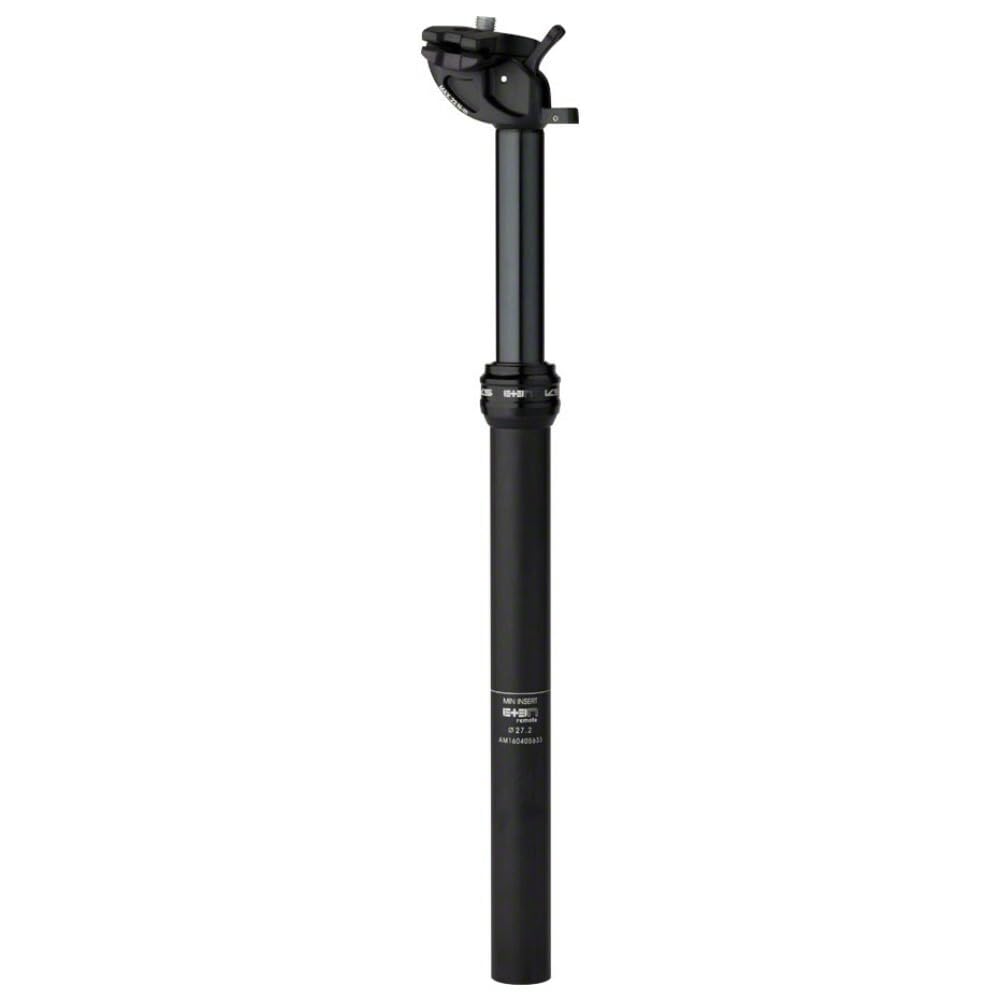
Best for 27.2Mm Frames
KS eTen 27.2
Key Features
- Travel: 100mm
- Diameter: 27.2mm
- Routing Type: External
- Weight & Length: 2 lbs
- Actuation Type: Cable-actuated
- Price: Budget
For riders with 27.2mm seat tubes, this dropper provides a rare, cost-effective option that installs quickly with external cable routing. Its 100mm travel and 20mm offset suit casual XC riding rather than aggressive trail use. Quality control is inconsistent — some units develop hydraulic leaks or fail to lock, so checking the post promptly after purchase is wise.
Pros
- Cost-effective solution for 27.2mm frames
- Simple installation with external routing
- Holds position during regular riding
Cons
- Hydraulic leaks can occur, reducing lockout reliability
- Some posts develop vertical play after a few months
Best suited for casual XC riders on 27.2mm frames who want a dropper without spending top dollar, but be prepared to inspect and possibly return if issues arise.
Best for Budget Internal Routing
EXA Form 900i
The EXA Form 900i offers a lightweight and affordable route to internal routing dropper posts, with multiple travel options. However, some units may have side-to-side play or arrive missing components, so it’s best suited for casual XC or gravel riding rather than aggressive trail use.
Pros
- Competitive pricing for an internal routing dropper post.
- Lightweight construction helps keep overall bike weight down.
Cons
- Side-to-side play may develop even when properly tightened.
Best for low-impact builds like cross-country or gravel riding where weight and budget take priority over long-term durability.
Best for First-Time Buyers
Bibike 125mm External

Key Features
- Travel: 125mm
- Diameter: 30.9mm
- Routing Type: External
- Weight & Length: 828g
- Actuation Type: Cable-actuated
- Price: Budget
This post delivers consistent height adjustment and cold-weather performance for the price, with easy installation. Some units may develop keyway cracking or creaking under load. For a few dollars more, the TranzX Kitsuma offers better consistency, so this fits only if budget is the primary concern.
Pros
- Reliable functionality for the price
- Easy installation
Cons
- Some units may develop keyway cracking or creaking under load
If your budget is very tight and you ride casually, this post works — but be prepared for possible reliability issues that a slightly more expensive option avoids.
Best for E-Bike Commuters
EXA Speed Up
The EXA Speed Up is a cable-less hydraulic dropper that swaps in without routing cables, making it ideal for e-bike commuting or kids’ bikes. However, some units can develop instability – the post may sag or wobble – and long-term durability is uncertain. For serious trail riding, look to a more robust option.
Pros
- Tool-free installation in minutes – no cable routing needed.
- Works reliably for commuting and light recreational use.
Cons
- Post can lose its hold position or develop lateral play.
Best suited for low-stress applications like e-bike commuting or occasional paved paths where no-cable convenience matters more than trail performance.
Best for Suspension + Dropper
PNW Coast
The PNW Coast uniquely integrates 40mm of tunable air suspension into a dropper post, providing added compliance on hardtails and rough roads. However, the design is unproven in the long term, with no consumer review data available to confirm real-world performance under load.
Pros
- Adds rear-end compliance without requiring a separate suspension seatpost.
- Available in multiple diameters and travel options to fit hardtail and gravel frames.
Cons
- The suspension-dropper combination is a new approach, so its long-term durability under heavy use remains unconfirmed.
Best suited for hardtail riders who prioritize comfort over proven longevity and are willing to accept some uncertainty.
Best for 27.2Mm External Builds
PNW Pine 27.2
The PNW Pine 27.2mm dropper fills a gap for bikes with slim seat tubes, such as vintage MTBs and gravel builds. Its external routing and 480g weight suit riders who need a dropper in this uncommon diameter. However, no consumer review data exists in this analysis to confirm real-world performance, so PNW’s generally solid reputation is assumed rather than verified.
Pros
- Fits 27.2mm seat tubes where few droppers exist – a necessary solution for older or slim-frame bikes.
- Lightweight at 480g with simple external cable routing for easy installation.
Cons
- Durability under repeated trail use has not been documented in available rider experiences.
Best suited for riders with a 27.2mm frame who need a dropper and are comfortable relying on PNW’s brand track record without verified user feedback.
Best for Extreme Budget Builds
DJC 100mm
This works reliably for the price, adjusting like an office chair. However, the lever sits high under the saddle, making it awkward to operate while riding, and some units may lose pressure over time. That limits it to build projects where cost is the primary concern or cable routing isn’t possible.
Pros
- Smooth height adjustment akin to an office chair.
- Inexpensive way to add dropper function to a bike.
Cons
- Lever is mounted too high under the saddle, hard to reach mid-ride.
Suitable for extreme budget builds or bikes where cable routing is impossible — not for frequent trail use.
Funn Updown Lever
Funn UpDown Lever

This lever kit offers highly adjustable mounting positions and a smooth, low-friction feel for those already running a cable-actuated dropper. However, it is not a complete dropper post — buyers seeking a full seatpost with remote should look elsewhere.
Pros
- Four mounting positions allow left/right and above/below bar placement.
- Low-friction bearing delivers smooth actuation.
Cons
- For riders needing a new dropper post, this lever alone leaves the seatpost missing.
Best suited for riders upgrading their existing dropper remote with a quality lever, not for those building a new setup from scratch.
How to Choose
The single most important decision is matching the dropper post’s diameter and travel to your frame and riding style — buying the wrong size means wasted money and frustration.
Travel: How Much Drop Do You Need
Travel is the distance the saddle drops when you actuate the lever. For cross-country, 100-125mm is enough to get the saddle out of the way on descents. Trail and enduro riders benefit from 150-170mm for maximum clearance on steep terrain.
Longer travel requires a longer overall post length, which may not fit short seat tubes. Measure your insertion depth before choosing. A post that extends too far can bottom out or damage the frame.
Diameter: Measure Twice, Buy Once
Seat tube diameters are not universal — common sizes are 27.2mm, 30.9mm, and 31.6mm. Using a shim is possible but can introduce play. Measure the inner diameter of your seat tube with calipers, not a tape measure.
Older frames and steel bikes often use 27.2mm, while modern mountain bikes use 30.9mm or 31.6mm. Ordering the wrong size means the post either won’t fit or will require a shim that compromises stability.
Routing Type: External vs Internal
External routing uses a cable that runs outside the frame, making installation easier and compatible with nearly any frame. Internal routing hides the cable inside the frame for a cleaner look but requires frame ports and a bit more effort to install.
Internal routing posts often cost more and are harder to service on the trail. External posts are simpler to swap between bikes. If your frame doesn’t have internal routing guides, go external or consider a cable-less model.
Weight and Overall Length
Weight matters for racers, but a heavier post with better internals will outlast a lightweight one. Overall length (from saddle rail to insertion mark) determines if the post fits your frame. A post that’s too long may not insert deep enough, limiting maximum drop.
Check your current post’s insertion depth and compare. Lightweight posts often use thinner materials or shorter stanchions, which can feel less stable under aggressive riding. Balance weight savings with durability.
Actuation: Cable vs Cable-Less Hydraulic
Cable-actuated posts use a standard brake-style cable to release a cartridge spring. They are reliable, easy to adjust, and parts are widely available. Cable-less hydraulic posts use a lever under the saddle that pushes fluid internally; no cables means zero routing hassle.
The trade-off is that cable-less posts often have more play in the stanchion and can lose pressure over time. They’re best for casual riding where simple installation is more important than perfect stiffness. For aggressive trail riding, a cable-actuated post is usually the safer bet.
FAQ
Why does my mountain bike dropper post have side-to-side play?
Side-to-side play usually comes from worn bushings or a loose internal cartridge. Budget posts often use cheaper bushings that wear out quickly. If your post has excessive play, check if the manufacturer offers a bushing replacement kit. For persistent wobble, it’s often more cost-effective to replace the post than rebuild it.
Is a cable-less dropper post reliable for trail riding?
Cable-less droppers are simpler to install but generally less reliable for aggressive trail use. They rely on a sealed hydraulic cartridge under the saddle, which can develop air bubbles or lose pressure, causing the post to sag. For casual gravel or commuting, they work fine. For enduro or heavy trail riding, stick with a cable-actuated post.
How long should a dropper post last before needing service?
A well-maintained cable-actuated dropper can last 200-400 hours before needing a rebuild, depending on conditions. Premium models like the OneUp V3 advertise 350-hour service intervals. Budget posts may fail much sooner — some units develop problems within weeks. Regular cleaning of the stanchion and keeping the cable properly tensioned extends life.
Can I install a dropper post on a bike without internal routing?
Yes, if your frame has no internal routing guides, choose an external routing dropper post. These run the cable along the outside of the frame and are easy to install. Cable-less droppers also bypass routing entirely. Avoid buying an internal-routing post for a frame without ports — you would have to drill or zip-tie the cable, which looks messy and can damage the frame.