This post contains affiliate links. We may earn a small commission when you buy through our links — at no extra cost to you.
Many cyclists buy a bike computer expecting it to guide them on unfamiliar trails, only to find it tracks speed and distance but can’t show a map. That gap between what’s advertised and what’s delivered is especially common in budget models.
This guide cuts through the confusion to find the computers that actually have turn-by-turn navigation and trail maps. The key trade-off isn’t just price – it’s screen size for reading maps versus battery life for all-day rides.
We focus on models that balance these factors for mountain biking, so you can ride confidently without pulling out your phone every mile.


Best for Reliable Trail Navigation
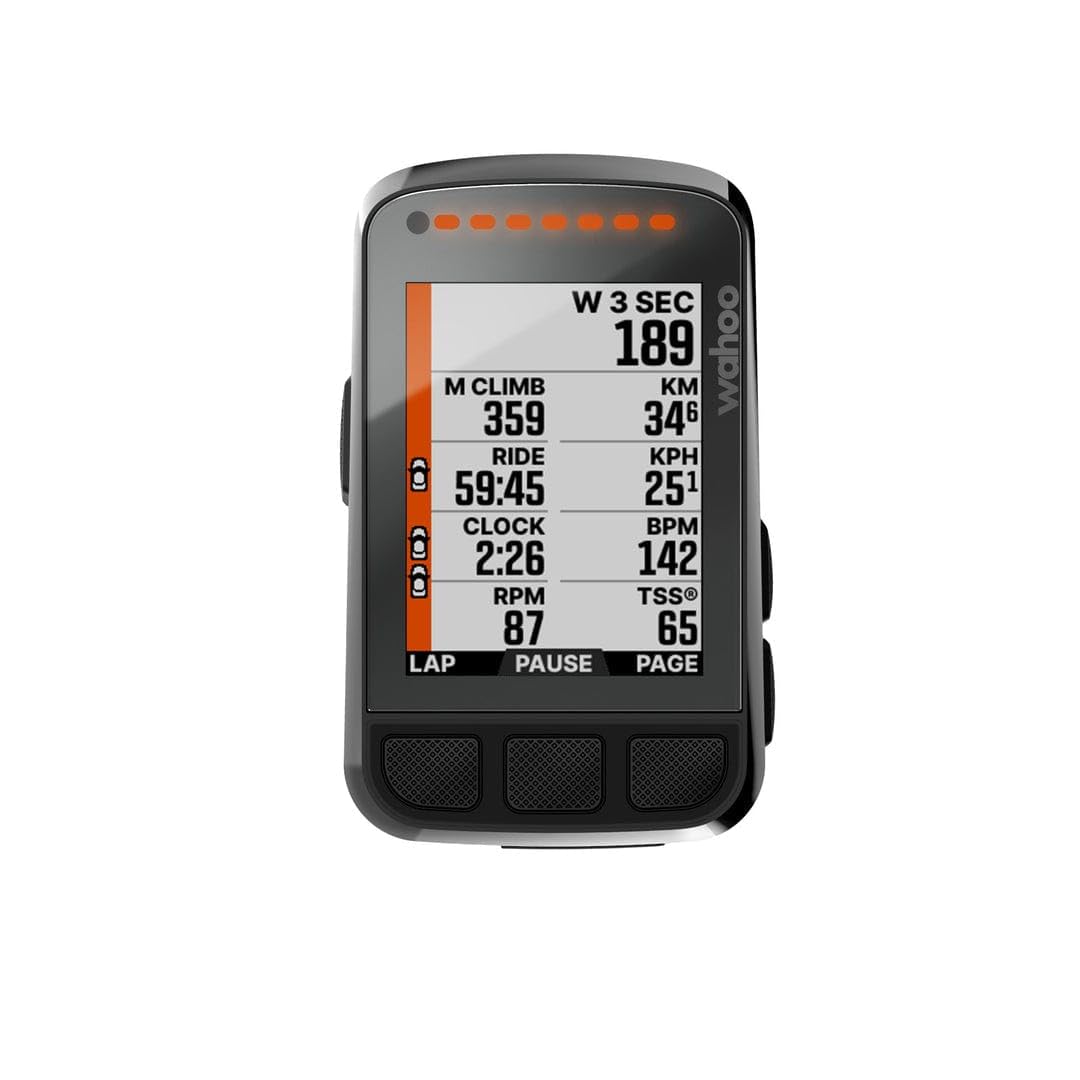
Wahoo Bolt V2
Key Features
- Battery Life: 15 hours
- Waterproof: IPX7
- Screen: 2.2" color, ambient light
- Price: $$
The Bolt V2 sets up in minutes and its physical buttons are easy to operate with gloved hands, a clear advantage for mountain bikers who can’t fumble with a touchscreen on rough trails. Multi-band GPS provides accurate tracking even under tree cover, and the 15-hour battery covers most all-day rides without needing a midday charge.
The 2.2-inch screen keeps the unit compact and lightweight, but trail map details are hard to read at a glance, especially on unfamiliar routes. The display can also show glare in certain lighting, though the ambient light sensor auto-adjusts brightness. This computer is best for riders who want dependable navigation and performance metrics without the heft or cost of a premium Garmin, and who are willing to accept a smaller screen for the sake of simplicity.
Pros
- Physical buttons are easy to use with gloved hands, simplifying navigation on the trail.
- Multi-band GPS provides consistent speed, distance, and routing accuracy.
- Battery life covers a full day of riding and charges quickly with pass-through support.
Cons
- The 2.2-inch screen can make trail map details hard to read at speed.
- Display visibility may be reduced by glare in certain sunlight conditions.
The Bolt V2 delivers accurate trail navigation and straightforward controls at a fair price — a solid fit for mountain bikers who prioritize ease of use over a larger map display.
Best for Long Battery Life
Garmin Edge 540
The Edge 540 offers superior battery life and the same full Garmin navigation suite as more expensive models, making it a strong alternative to the simpler Wahoo Bolt V2. The button-only interface works well with gloves on the trail, though the controls can feel stiff and unintuitive during initial setup. This computer suits mountain bikers who want dependable routing, ClimbPro, and performance metrics without paying extra for a touchscreen they may not need on bumpy terrain.
Pros
- Long battery life supports all-day rides (26 hours, 42 in battery saver).
- Multi-band GPS locks quickly and maintains accuracy under tree cover.
- Full Garmin navigation (ClimbPro, trail maps) at a competitive price.
Cons
- Button controls can feel stiff and unintuitive, especially before the learning curve.
The Edge 540 delivers the navigation and battery a mountain biker needs, as long as you’re comfortable with button-only operation.
Best for Mtb Dynamics Screen
Garmin Edge 1030+
The Garmin Edge 1030 Plus stands out with its 3.5-inch color touchscreen and mountain bike-specific metrics like jump count, Grit, and Flow — data that serious trail riders actually use to improve their technique. ClimbPro pacing guidance and preloaded trail maps make it easy to navigate unfamiliar singletrack without pulling out your phone. The battery holds up for all-day epics, and the display stays readable in bright sun.
This is the computer for riders who want every possible performance metric on a large, easy-to-read screen and don’t mind a touchscreen that needs a dry finger. But the reliability picture is mixed: some units develop issues after a year of regular use, and Bluetooth dropout with radar or sensors can interrupt a ride. If you prioritize consistent connectivity and long-term dependability over screen size, the Wahoo Bolt V2 is a more straightforward choice.
Pros
- Large 3.5-inch color touchscreen makes trail maps easy to read at a glance.
- MTB-specific metrics (jump count, Grit, Flow) offer actionable trail performance data.
- Battery lasts 24 hours, enough for multi-day rides without recharging.
Cons
- Long-term durability can be a concern; some units may develop issues after a year of heavy use.
- Bluetooth connectivity with radar and sensors can drop out occasionally, interrupting data flow.
The Edge 1030 Plus delivers the most trail-focused data on the biggest screen, but it’s best for riders who accept some connectivity quirks and want depth over simplicity.
Best for Premium Display Tech
Garmin Edge 1050
Key Features
- Battery Life: 20 hours
- Screen: 3.5" vivid color touch
- Price: $$$$
The Edge 1050’s vibrant 3.5-inch touchscreen is the most readable trail map display available, and the built-in speaker provides clear route alerts even with wind noise. Group-ride messaging and road hazard alerts add social and safety layers. However, the high price and occasional software freezes during rides mean this computer suits riders who prioritize screen quality and feature depth over budget and absolute reliability.
Pros
- High-contrast 3.5-inch touchscreen makes trail maps easy to read in bright sunlight
- Built-in speaker and group-ride messaging keep you connected on group mountain bike rides
Cons
- Premium pricing places it well above other MTB computers with similar navigation capabilities
- Occasional software freezes may occur during rides, interrupting navigation mid-trail
For mountain bikers who want the sharpest trail display and are willing to pay a premium, the Edge 1050 delivers excellent navigation with the caveat of possible software hiccups.
Best for Beginner Navigation
Garmin Edge Explore 2
The 3-inch color touchscreen and preloaded maps make route planning and rerouting intuitive for recreational mountain bikers. But the 16-hour battery life is less than many competitors at this price, making it better for shorter rides than full-day epics. Safety features like incident detection and LiveTrack add peace of mind for solo riders. Setting up a route from the Garmin Connect app is simple, and eBike data integration works well. For riders focused on exploring new trails rather than tracking splits, this is a capable companion.
Pros
- Large 3-inch touchscreen simplifies trail map viewing.
- Preloaded maps and automatic rerouting keep you on track.
- Incident detection and LiveTrack enhance safety on remote rides.
Cons
- Menu navigation can be confusing for some users, requiring a learning period.
- No advanced training metrics for riders who want performance data.
The Garmin Edge Explore 2 provides clear navigation for recreational mountain bikers, but limited battery life and missing performance metrics make it a better fit for casual explorers than data-driven riders.
Best for Touch and Buttons
Garmin Edge 840
Responsive touchscreen plus physical buttons for glove-friendly use and quick navigation. Unlike the button-only Edge 540, this adds a touch interface without losing physical controls – useful for gloved hands on rough trails. The 2.6-inch screen and premium pricing make it less suitable for riders who prioritize large map views or budget savings, but for those who want both input methods in a compact package, the tradeoff is manageable.
Pros
- Touchscreen and physical buttons work together – use the screen for quick data views and buttons for gloved inputs.
- Multi-band GNSS locks position fast and maintains accuracy under tree cover.
- Adaptive coaching adjusts training plans based on performance – useful for structured mountain bike workouts.
Cons
Best for mountain bikers who want touchscreen flexibility but value button backup for gloved hands, as long as the 2.6-inch screen and premium pricing are acceptable.
Best for Gps Data Logging
Bryton Rider 320E

Key Features
- Battery Life: 35 hours
- Screen: 2.3" B&W optically bonded
- Price: $$
The Rider 320E delivers 35-hour battery life and a display that stays readable under direct sun, handling GPS data logging and ANT+/BLE sensor pairing effectively. The catch is the absence of turn-by-turn navigation and maps, which rules it out for mountain bikers needing trail guidance. It suits road cyclists who prioritize battery life over routing capabilities.
Pros
- 35-hour battery life supports multi-day rides without charging.
- Optically bonded display remains clear in bright sunlight.
Cons
- No turn-by-turn navigation or maps, limiting use to data logging only.
Best for road cyclists and endurance riders who need long battery life and sensor support, not for mountain biking where trail navigation is essential.
Best for Budget Speed/distance
CYCPLUS G1

Key Features
- Battery Life: 50 hours
- Waterproof: IPX6
- Screen: 2.0" LED
- Price: $
The CYCPLUS G1 delivers exceptional battery life for under $40, with a large, sunlight-readable display that makes basic speed and distance easy to track. However, it lacks any routing or map features, meaning it is not suited for trail navigation.
Pros
- Exceptional battery life for long rides
- Very good value at budget price
Cons
- GPS lock can be slow and accuracy may drop under tree cover, limiting usefulness on wooded trails
Fits budget-conscious road riders or commuters who track basic metrics and don’t need trail routing.
Best for Budget Gps Tracking
iGPSPORT BSC100S
Key Features
- Battery Life: 40 hours
- Waterproof: IPX7
- Screen: 2.6" anti-glare LCD
- Price: $
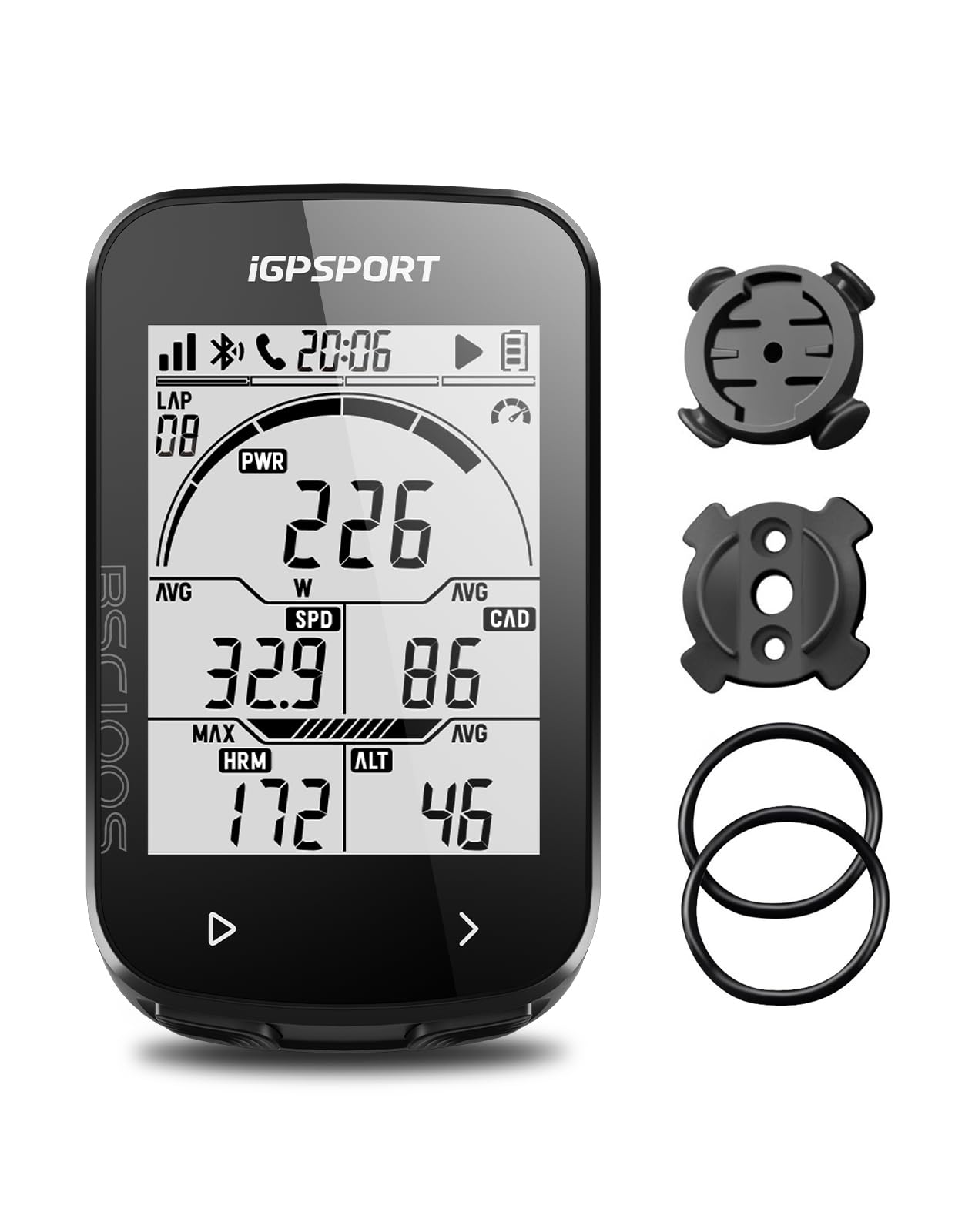
The iGPSPORT BSC100S offers a 40-hour battery and IPX7 waterproofing at a budget price. It pairs easily via app and logs many data fields. But it lacks maps and turn-by-turn navigation, making it unsuitable for mountain bike trail riding. Instructions are sparse and app sync can be buggy. For road riders or commuters needing basic GPS tracking, it is a practical choice.
Pros
- 40-hour battery life covers multi-day rides without recharging.
- Provides a wide range of data fields at an entry-level price.
Cons
- No maps or turn-by-turn navigation — cannot provide trail routing for mountain biking.
A capable budget GPS for road riders or commuters who only need basic tracking and don’t require navigation.
Best for Sensor-Ready Budget
CooSpo BC107

Key Features
- Battery Life: 80 hours
- Waterproof: IP67
- Screen: 2.4" FSTN glass
- Price: $
The CooSpo BC107 delivers impressive 80-hour battery life and works with both ANT+ and BLE sensors, making it a strong value for riders focused on speed, distance, and cadence data. However, it lacks any trail navigation or mapping, so mountain bikers relying on turn-by-turn route guidance will need to look elsewhere. Some units have shown occasional reliability quirks after extended use.
Pros
- Extremely long battery life – up to 80 hours
- Full sensor support via ANT+ and Bluetooth
Cons
- No trail navigation or maps – requires a separate device for MTB route guidance
For road cyclists who prioritize battery life and sensor data over navigation, the CooSpo BC107 is a cost-effective GPS tracker. Mountain bikers needing trail maps should pass.
Best for Cheapest Gps Speed
Bikevee GPS Computer
Key Features
- Battery Life: 28 hours
- Waterproof: IPX7
- Screen: 2.4" LCD auto backlight
- Price: $
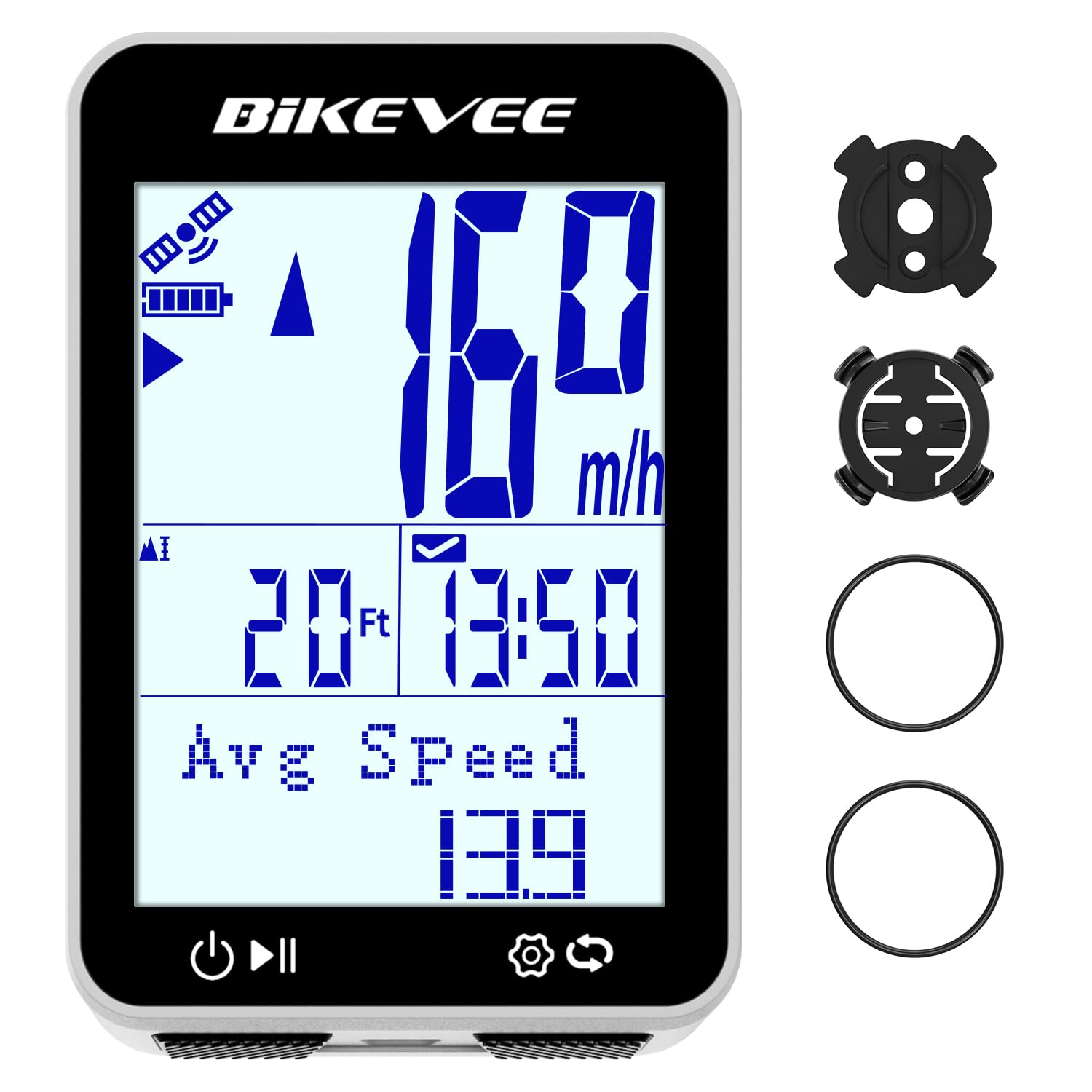
The cheapest GPS speedometer with auto backlight and 28-hour battery – tracks speed, distance, and time in 9 languages. No navigation or maps, and the mount may not fit all handlebar sizes. This is for budget-conscious road cyclists needing basic metrics, not for mountain bikers.
Pros
- Very affordable GPS speedometer with auto backlight and decent battery life.
- Easy to set up and operate with simple controls.
Cons
- Mount may not fit all handlebar sizes – check compatibility before purchase.
This is only worth considering if you need a no-frills GPS speedometer for road riding and can accept limited mounting fit and zero navigation.
Best for Basic Wireless Speed
Cateye Velo Wireless

Key Features
- Battery Life: 1 year
- Waterproof: IPX8
- Screen: LCD no backlight
- Price: $
Delivers consistent speed and odometer tracking with a straightforward zip-tie mount and long battery life. However, it lacks GPS, navigation, and backlight – making it unsuitable for mountain biking on trails that require maps and routing.
Pros
- Long-lasting battery – one year of typical use from a coin cell.
- Simple installation with zip-tie mount and intuitive operation.
Cons
- No GPS or navigation – offers only basic speed and distance.
Works well for casual road riding or children’s bikes where only speed and odometer are needed – not for mountain bike trail navigation.
Best for Urban Commuting
Cateye Urban Wireless
Key Features
- Battery Life: 1 year
- Waterproof: IPX8
- Screen: LCD, backlight
- Price: $
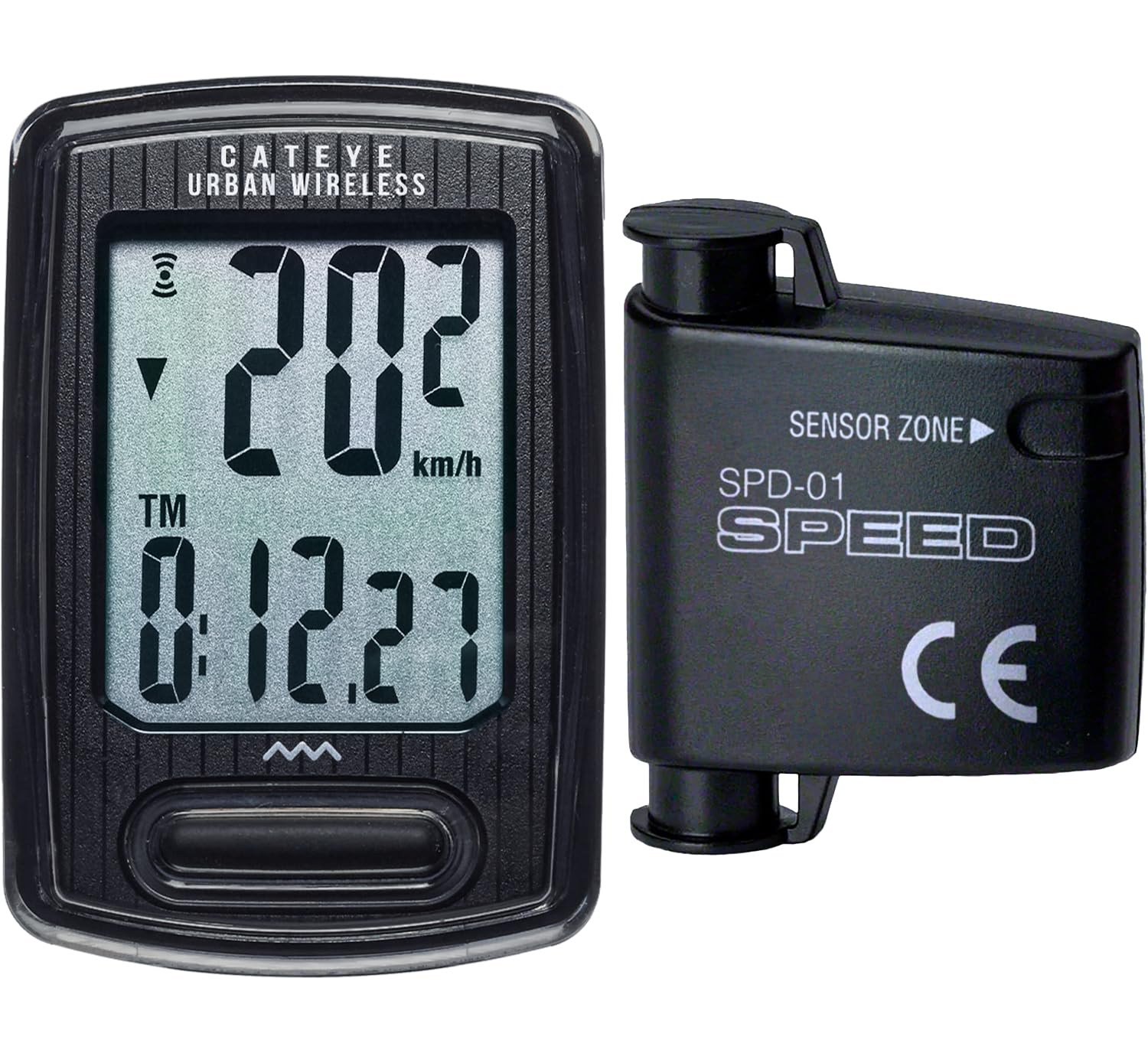
This wireless computer delivers easy-to-read speed and odometer data with a backlit display and a tool-free mount. But it has no GPS, maps, or trail routing – critical for mountain bike navigation. Bright headlights may also interfere with the signal.
Pros
- Wireless setup with simple, tool-free installation
- Large backlit numbers readable in various light
Cons
- No GPS or navigation – only basic speed and distance data
A capable urban speedometer, but leave it on the pavement – not for off-road trail riding.
Best for Oversized Display
Cateye Padrone

The 5.5 cm display offers exceptional readability for riders who prioritize a clear speed and distance readout. However, the FlexTight mount can release on bumpy trails, and there’s no GPS for trail navigation or elevation data. This makes it a poor fit for mountain biking where durability and mapping matter. It serves best as a simple road or commuter speedometer.
Pros
- Oversized 5.5 cm LCD for effortless reading at a glance.
- Intuitive button interface toggles functions without menus.
Cons
- Mount can detach on rough trails, risking loss of the unit.
Best for road cyclists or urban commuters who want a large, simple speedometer without navigation — not for mountain biking.
Best for Wired Reliability
Cateye Wired

Key Features
- Battery Life: 3 years
- Waterproof: IP54
- Screen: LCD no backlight
- Price: $
This Cateye delivers consistent speed and distance tracking with a three-year battery that truly lasts. However, the wired sensor requires careful installation and provides no trail maps, elevation data, or routing — it is built for pavement, not mountain singletrack. For a commuter or road bike where wiring is simple and navigation isn’t needed, it works well; for mountain biking, it misses the essential features.
Pros
- Three-year battery life – set and forget.
- Simple wired sensor gives steady speed and distance readings.
Cons
- No navigation support – unsuited for exploring unfamiliar trails.
Best for budget road or commuter cyclists who want basic metrics without battery worries, but skip it if you need trail navigation.
How to Choose
The single most important buying insight: trail navigation requires a device with built-in maps and routing, not just GPS tracking of speed and distance.
Navigation and Maps
A bike computer that only logs GPS data won’t show you where to turn on a trail. For mountain biking, you need a unit with preloaded topographic maps and turn-by-turn routing.
Cheaper models often market themselves as ‘GPS cycling computers’ but omit maps entirely. After a few wrong turns on unfamiliar singletrack, the extra cost for navigation becomes a worthwhile investment.
Battery Life
Claimed battery life is usually measured in ideal conditions – screen dimmed, GPS on but no backlight. Expect 70-80% of that number in real-world use, especially with the display constantly lit on sunny rides.
For a full day on the trail, aim for at least 15 hours of real-world runtime. Cold weather can further reduce capacity by 20-30%, so a unit with 20+ claimed hours gives you a safer buffer.
Water Resistance
Mountain biking means mud, rain, and stream crossings. An IPX7 rating means the unit can survive submersion in 1 meter of water for 30 minutes – enough for a dropped bike in a creek.
Lower ratings like IPX4 or none at all risk failure after a wet ride. Check the spec carefully; many Garmin models don’t list an official rating, but typically match IPX7 in practice.
Screen Readability
A screen that washes out in direct sunlight makes map reading frustrating. Optically bonded displays (like Bryton’s) or color touchscreens with ambient light sensors (like Wahoo’s) stay visible in bright conditions.
Larger screens (3 inches and up) are easier to read trail maps at a glance, but they add bulk and reduce battery life. For technical riding where you can’t stare at the screen, a crisp 2.6-inch display with high contrast may be enough.
MTB-Specific Features
Advanced metrics like jump count, hang time, Grit (trail difficulty), and Flow (descent smoothness) are exclusive to Garmin’s Edge 1030+ and 1050. These are useful for riders who want to quantify their performance on descents.
For most mountain bikers, reliable trail routing and climb ascent planning (ClimbPro) matter more than trick metrics. The trade-off is between a standard navigation unit and a full-featured training computer that costs hundreds more.
FAQ
Why does my bike computer lose GPS signal under tree cover?
Tree canopy can block or weaken satellite signals, especially on older single-band GPS units. Multi-band receivers (like those in the Wahoo Bolt V2 and Garmin Edge 540) use multiple satellite constellations and frequencies to maintain a lock in dense woods. If you ride heavily forested trails, a multi-band unit is worth the extra cost.
Can I use a road bike computer for mountain biking?
Yes, but only if it has offline trail maps and turn-by-turn routing. Many road-oriented computers lack MTB-specific features like ClimbPro or impact dynamics, but they still handle navigation. The main caveat is screen durability and mount security – a road computer’s mount may not survive rough descents. Look for reinforced mounts and a waterproof rating of IPX7.
How long does a Garmin Edge 540 battery last in cold weather?
In freezing temperatures, the Edge 540’s claimed 26-hour battery drops to roughly 18-20 hours with the screen backlight on. Using battery saver mode (which dims the display and reduces GPS polling) can extend that to 30+ hours even in cold. Plan for a recharge stop if your ride exceeds 15 hours in winter.
Is the Wahoo Bolt V2 screen too small for navigation?
The 2.2-inch screen is adequate for turn-by-turn prompts and basic map overviews, but reading detailed trail maps at speed requires good eyesight. Users with older eyes or those who rely heavily on map detail may find the Edge 540’s 2.6-inch screen or the Explore 2’s 3-inch touchscreen easier to use. For quick glance directions, the Bolt works fine.