This post contains affiliate links. We may earn a small commission when you buy through our links — at no extra cost to you.
Most first aid kits marketed for hiking stuff hundreds of tiny bandages into a pouch, but when you actually need a decent gauze pad or a tourniquet, they’re missing. The weight adds up fast.
The trick is to ignore the big number on the box and focus on what’s inside: a few well-chosen items that cover the injuries you’ll actually encounter on the trail. That means reliable bandages, a space blanket, and something for bleeding control.
This guide picks kits that balance weight, cost, and real-world usefulness — so you’re not carrying a pound of cotton balls when you could have a compact kit that handles cuts, scrapes, and minor emergencies.


Best for Day Hikers
Protect Life Mini 100pc
A doctor-curated selection that includes a tourniquet and space blanket at under 8 ounces — exactly what a day hiker needs without the weight penalty of larger kits. The 100-piece contents cover cuts, scrapes, and blisters while adding trauma items most comparable kits skip.
The tight packing keeps everything secure during movement, though returning items after use takes a bit of patience. This is a minor tradeoff for the slim profile that slips into a backpack or large pocket.
Best suited for solo day hikers, trail runners, or parents wanting a doctor-recommended kit for short outings. Not ideal for extended expeditions needing large quantities of supplies or those who prefer a soft-sided case over hard shell.
Pros
- Doctor-curated contents that cover essential emergencies
- Lightweight and slim profile for easy packing
- Includes critical survival items rarely found in similar-priced kits
Cons
- Tightly packed case makes re-folding items after use slightly fiddly
For day hikers who want real trauma capability without adding bulk, this kit earns its place in a pack.
Best for Ultralight Hikers
Vriexsd Mini 150pc
Key Features
- Weight & Size: 0.73 lbs
- Case Durability: Hard EVA shell
- Price: Budget
At 0.73 pounds with 150 items, this kit packs professional-grade supplies into a waterproof hard shell that resists crushing — a rare combination for ultralight hikers. The tradeoff: the rigid case won’t squeeze into curved pack pockets, so it suits flat compartments or glove boxes over backpanel stowage.
Pros
- Compact 0.73-pound case holds 150 supplies for ultralight hiking.
- Waterproof hard shell protects contents from crush damage and moisture.
- Cost-effective alternative to assembling a custom kit.
Cons
- Rigid case doesn’t conform to curved pack pockets, limiting placement options.
For ultralight hikers who prioritize weight and durability over pack flexibility, this is the most efficient 150-piece kit available.
Best for Serious Hikers
Surviveware Premium 98pc
Key Features
- Weight & Size: 1 lb
- Case Durability: 600D polyester
- Price: Mid-Range
The Surviveware kit stands out for its permanent labels and MOLLE-compatible pouch, letting you grab what you need without rummaging. While other mid-range kits pack more pieces, this one uses higher-quality materials — the bag and contents feel built to last on the trail. The tradeoff is clear: you pay more per item for superior organization and durability, which makes sense for hikers who want a reliable base they can customize over time.
This kit suits serious backpackers who prefer a well-organized system over raw number of bandages. It’s also a strong choice for vehicle emergency kits where quick access matters. However, if raw piece count at a given price is your priority, you’ll find cheaper options with more components — this one asks you to invest in build quality instead.
Pros
- Permanent labels on each compartment let you find supplies in seconds without opening pouches.
- Compact 1-lb design fits easily into a daypack without sacrificing essential wound care items.
- Rip-resistant 600D polyester shell and MOLLE webbing add durability for rugged outdoor use.
Cons
- At $35.99, you get fewer pieces than similarly priced kits, which may feel expensive for those counting components.
If you value organization and build quality over sheer volume, this kit delivers — just know you’re paying a premium for the structure.
Best for Day Hikes
Band-Aid Travel Ready 80pc
Key Features
- Weight & Size: 6.88 oz
- Case Durability: Soft pouch
- Price: Budget
This kit packs BAND-AID, NEOSPORIN, and TYLENOL into a 6.88-ounce pouch that slips into a hydration vest or daypack. While the Protect Life kit includes a tourniquet and emergency blanket, the BAND-AID Travel Ready focuses on minor cuts and scrapes with supplies you already recognize.
It suits day hikers, parents, and travelers who value compactness over comprehensive trauma coverage. The 80 pieces cover small cuts and headaches, but the supply may run thin for trips longer than a few hours or groups larger than two.
Pros
- Includes name-brand pain relievers and antibiotic ointment
- Slips easily into purses, glove boxes, or running vests
- Affordable entry price for a ready-to-use kit
Cons
- May not have enough bandages and gauze for trips beyond a single day
For quick outings where basic wound care from familiar brands is enough, this kit delivers. If your hikes run longer or you carry for more than one person, step up to a larger kit.
Best for Backpackers
EVERLIT Survival 250pc
Key Features
- Weight & Size: 2 lbs
- Case Durability: 1000D nylon
- Price: Mid-Range
The EVERLIT 250-piece kit includes a knife, fire starter, and emergency blanket alongside standard first aid supplies in a MOLLE-compatible pouch — a practical choice for backcountry trips where survival tools matter. While the Surviveware kit offers better organization with labeled compartments, EVERLIT’s rugged 1000D nylon construction and multi-functional focus appeal to preppers and hikers who attach their kit to a pack or vest. The weight (2 lbs) and tight packing mean adding personal items requires careful repacking, making it less suited for ultralight hikers.
Pros
- Comprehensive survival and first aid gear in one pouch
- Rugged, military-grade construction
- MOLLE-compatible design allows secure attachment to packs and vests
Cons
- Packaged very tightly; limited room for adding personal items
Best for backcountry users who want survival tools integrated with first aid and don’t mind the added weight and tight pack — a capable companion for bug-out bags and MOLLE gear.
Best for Cars/rvs
Swiss Safe 348pc 2-in-1
Key Features
- Weight & Size: 3 lbs
- Case Durability: Soft zippered
- Price: Mid-Range
Swiss Safe packs 348 pieces into a 3-pound case with a dual-access design that keeps supplies organized, plus a separate 32-piece mini kit for quick grab-and-go use. The size makes it impractical for backpacking, but for car trunks, RV cabinets, or home storage it offers the most variety at this price point.
Pros
- Most comprehensive kit in its price range with 348 pieces covering multiple wound care scenarios.
- Dual-access case lets you see and grab supplies without dumping everything out.
- Includes a separate 32-piece mini kit for quick grab-and-go use on short trips.
Cons
- At 3 lbs and 13×10.8 inches, the case is too bulky to fit in a hiking backpack.
Perfect for families or drivers who want one kit to cover car, home, and base camp, but not for hikers who need to carry supplies on their back.
Best for Car/home
First Aid Only 298pc Kit
Key Features
- Weight & Size: 1 lb
- Case Durability: Soft zippered
- Price: Budget
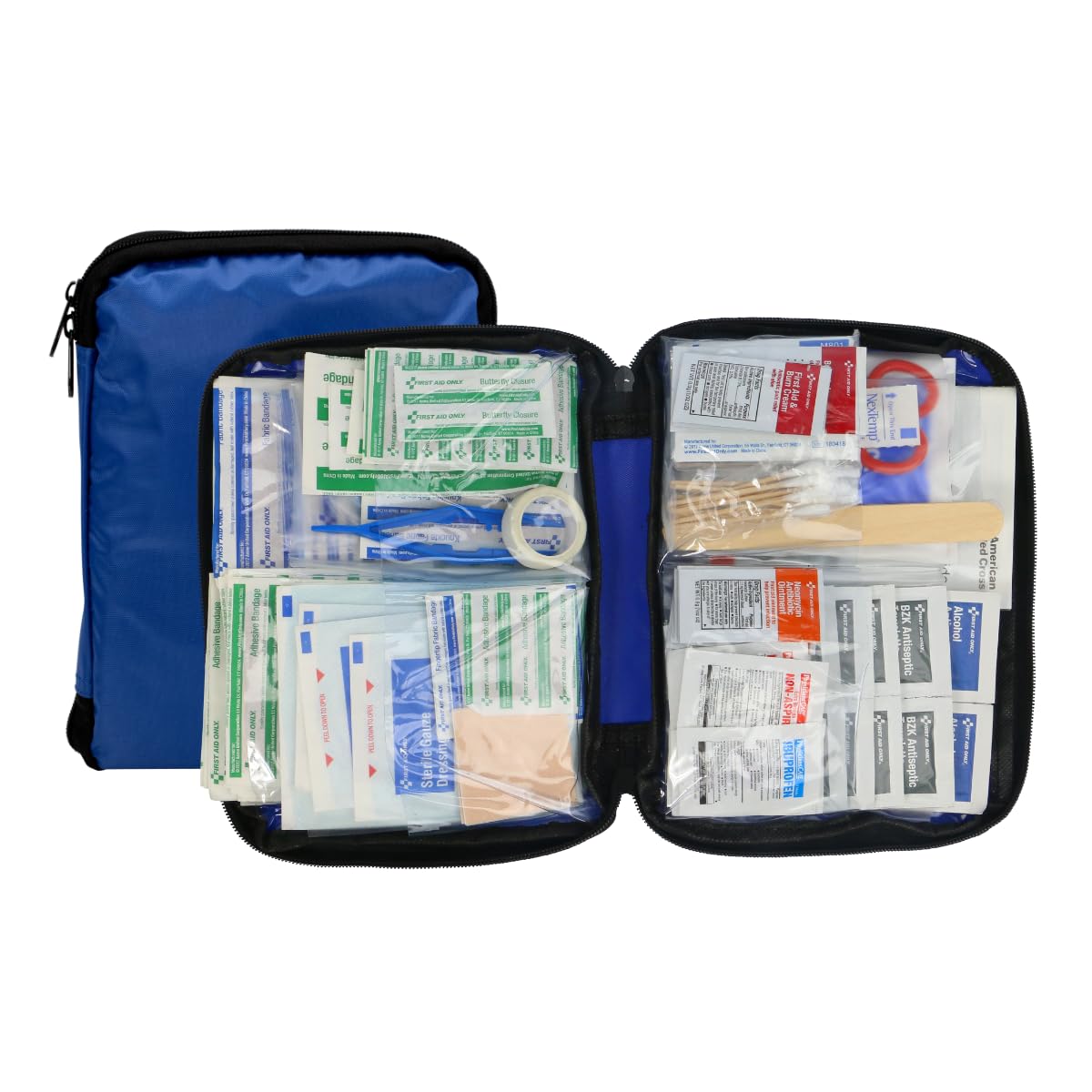
This kit packs 298 pieces into a soft pouch at just one pound — impressive for the price. It covers cuts, scrapes, and burns thoroughly. However, the 1 lb weight is heavier than hiking-focused alternatives, and some units arrive missing small items. Best reserved for car or home backup rather than day hikes.
Pros
- Covers a wide range of minor injuries with 298 pieces in a compact pouch.
- Soft-sided pouch fits easily in car compartments or daypacks.
Cons
- Occasional missing items, like antibiotic cream, may require a quick check upon arrival.
For a budget-friendly home or car emergency kit that covers minor injuries, this is a solid value — just verify contents after purchase.
Best for Budget Hikers
General Medi 2-in-1 215pc

Key Features
- Weight & Size: 1.5 lbs
- Case Durability: Soft zippered
- Price: Budget
Two kits in one package for under $20: the main 215-piece soft-sided bag and a separate 43-piece mini kit. The compartments help keep supplies sorted. Bandage adhesion can be inconsistent, and occasional missing items may occur — a consideration when packing for a hike where every piece needs to be dependable.
Pros
- Good value for a dual-kit system with a useful mini kit included.
- Organization is aided by separate compartments that keep items sorted.
Cons
- Some bandages may have low adhesion, and missing items can occur in some kits.
Works well for home and car storage where you can double-check contents, but hikers who need guaranteed item presence and secure bandages should consider other options.
Best for Minimalists
THRIAID Mini 100pc

Key Features
- Weight & Size: 0.53 lbs
- Case Durability: Hard EVA shell
- Price: Budget
Weighing just 0.53 lbs with a waterproof EVA hard shell, this kit is among the lightest options for hikers who want bare-minimum wound care in a crush-resistant package. However, its 100-piece selection is heavy on bandages and wipes, with no tourniquet, emergency blanket, or large gauze pads — so it fits solo day hikers treating minor cuts and blisters, not backcountry trips requiring trauma preparedness.
Pros
- Weighs only 0.53 lbs — one of the lightest portable kits available.
- Waterproof EVA hard shell protects contents from crushing and moisture.
Cons
- Contents skew heavily toward bandages and wipes, with limited gauze or trauma items.
Best for solo day hikers who carry separate trauma gear and want a tiny backup for blisters and scrapes.
Best for Budget Families
AMORNING 276pc Compact

Key Features
- Weight & Size: 1 lb
- Case Durability: EVA water-resistant
- Price: Budget
The AMORNING kit delivers 276 pieces in a hiking-pack-friendly size at a budget-friendly price. However, bandage adhesion can be inconsistent — especially in humid conditions — making it best for short trips where backup supplies are available and the reliability of a primary kit is not critical.
Pros
- Large number of pieces for a low price
- Compact enough to fit in a hiking pack
Cons
- Some bandages may lack adhesion in humid or sweaty conditions
Best for budget-conscious families on short hikes who can tolerate occasional adhesive issues and have backup supplies.
Best for Home Stash
Vriexsd Large 400pc

Key Features
- Weight & Size: 2.64 lbs
- Case Durability: 1680D polyester
- Price: Mid-Range
This 400-piece kit packs a wide range of supplies in a water-resistant case with clearly labeled compartments, useful for a home emergency stash or car kit. However, at 2.64 lbs it is too heavy for backpacking, and some tourniquets have arrived non-functional, making it unsuitable for situations where that component must be dependable.
Pros
- Covers a wide range of injuries with 400 pieces.
- Labeled compartments allow quick item retrieval.
Cons
- Tourniquet may arrive non-functional in some cases, making it unreliable for critical use.
Best for a home or car emergency stash where weight is not a concern and the tourniquet is not the primary trauma tool – not suitable for hiking where a dependable tourniquet is needed.
Best for Large Set
SHBC Compact 228pc

Key Features
- Weight & Size: 1.5 lbs
- Case Durability: EVA mold
- Price: Mid-Range
This 228-piece kit in a waterproof EVA case offers a mid-range price point and a large assortment of supplies. However, without the backing of customer reviews, its real-world quality remains unverified — making it a gamble for hikers who need dependable gear.
Pros
- Large 228-piece assortment covers minor wound care needs at a reasonable price
- Waterproof EVA case protects contents from moisture during outdoor use
Cons
- Quality is unconfirmed by customer experience; the kit’s real-world durability is untested
A reasonable option for buyers willing to take a chance on an unverified kit, but for critical outdoor use a more reviewed alternative is safer.
Best for Large Kit
Poygik Premium 420pc

This 420-piece kit packs a vast assortment of supplies in a durable 1680D polyester case with MOLLE webbing. Its large size makes it impractical for hiking, and the lack of pricing or customer reviews prevents a firm recommendation. Proceed with caution and verify contents before buying.
Pros
- 420-piece count covers a wide range of supplies for home or base camp use.
- MOLLE-compatible and reflective piping allow attachment to packs or bags.
Cons
- Without pricing or verified customer feedback, real-world value and reliability are uncertain.
Suitable as a bulk home or car kit if you can verify contents and price independently, but too large and unverified for hiking use.
Best for Car Glove Box
Be Smart Travel 125pc

Key Features
- Weight & Size: 9.95 oz
- Case Durability: Hard shell
- Price: Budget
This 125-piece kit is affordable and compact, fitting easily in a glove box. However, its contents lean heavily toward bathroom items (toilet seat covers, toilet paper) rather than wound care essentials, and the hard case may arrive cracked. For urban everyday carry or car emergencies, it offers decent value at the price, but it is not a suitable choice for hiking or outdoor trips where medical supplies matter.
Pros
- Budget-friendly price for a pre-packed kit
- Compact size fits in glove boxes and small bags
Cons
- Includes toiletries like toilet seat covers rather than standard first aid supplies
Best for car glove box or urban daily carry, not for hiking where medical supplies are needed.
Best for Backup Only
Monoki Portable Mini

Key Features
- Weight & Size: 0.48 lbs
- Case Durability: PU waterproof
- Price: Budget
At under half a pound and $10, the Monoki kit is one of the lightest and cheapest options you can toss in a glove box or daypack. The waterproof PU case keeps contents dry, and the slim profile slides into tight spots. However, the included flashlight, compass, and tweezers may arrive broken or non-functional, so this kit cannot be trusted for any situation where you need tools to work on the first try. It works as a backup stash for non-critical boo-boos — just don’t rely on the extras.
Pros
- Very light and slim profile fits easily in a vehicle glove box or pack pocket.
- Budget-friendly price point makes it a low-risk secondary addition.
Cons
- Flashlight, compass, and tweezers can be non-functional out of the box, limiting utility beyond basic bandages.
Useful as a throw-in backup for casual day trips where you already carry a reliable primary kit — not a standalone solution for hiking or emergencies.
How to Choose
The single most important factor is weight: a lightweight kit that you’ll actually carry on every hike beats a heavier one with more supplies that gets left behind.
Weight and Packed Size
A kit that feels light in the store can become a burden after five miles. Every ounce adds up, especially when you’re also carrying water, food, and layers.
Look for kits under 12 ounces for day hikes; multi-day trips can tolerate a pound or two if the contents justify it. A soft pouch conforms to pack shape better than a hard case, but hard cases protect items from crushing.
Bandage Variety
High piece counts often come from counting each tiny bandage and alcohol wipe individually. A 300-piece kit may have only a few large gauze pads and no trauma supplies.
Focus on the variety of sizes and types: a mix of adhesive bandages, sterile gauze, medical tape, and antibiotic ointment is more useful than 100 identical bandages.
Trauma Items
Most budget kits skip tourniquets and hemostatic dressings because they’re bulky and expensive. If you hike in remote areas where help is an hour away, these items are critical.
A tourniquet can stop life-threatening bleeding, and an emergency blanket prevents hypothermia. Check that these are included and functional before heading out.
Case Durability
Soft pouches are lightweight and flexible, but they offer little protection against moisture or crushing. Hard shells keep items dry and intact, but add weight and rigidity.
Water-resistant coatings on soft cases can fail after repeated rain exposure. For wet climates, a hard EVA shell or a waterproof dry bag is a safer bet.
Organization
In an emergency, seconds matter. Kits with labeled compartments or color-coded sections let you grab what you need without dumping everything out.
Without organization, you’ll waste time digging through a jumble of supplies, possibly dropping items in the dirt. Look for clear, permanent labels or separate pouches.
FAQ
Can I use a car first aid kit for hiking if it’s light enough?
Yes, if it weighs under a pound and contains hiking-relevant supplies like blister care, gauze, and tape. But car kits often include items you won’t need on the trail (e.g., burn cream, large bottles) and lack tourniquets or emergency blankets. It’s better to buy a hiking-specific kit.
What size first aid kit should I bring on a day hike vs. a multi-day trek?
For a day hike, a kit under 10 ounces with 50-100 pieces is sufficient for cuts, scrapes, and blisters. For multi-day treks, you need more wound care supplies, a tourniquet, an emergency blanket, and pain relievers — aim for a 1-2 pound kit with at least 150 pieces.
How do I add a tourniquet to a compact first aid kit without making it too bulky?
Choose a tourniquet that folds flat, like the CAT Gen7 or a mini version. Slide it into an external pocket or attach it to the outside of the kit with a small carabiner. This keeps it accessible and doesn’t compress the main kit’s contents.
Are the flashlights and compasses in survival first aid kits actually reliable?
Usually not. Budget survival kits include cheap, single-use flashlights that may not work out of the box, and compasses that are often inaccurate. Ignore these extras and rely on your own headlamp and GPS if needed.