This post contains affiliate links. We may earn a small commission when you buy through our links — at no extra cost to you.
Many camping first aid kits promise a lot but let you down where it matters: bandages that peel off, cases that let in moisture, and medications you would not trust. It is easy to get distracted by high piece counts and low prices, but those numbers rarely reflect what actually keeps a cut clean or a blister protected.
The real difference between a useful kit and a frustrating one comes down to three things: case construction that survives your pack, bandage adhesive that holds on sweaty skin, and whether the included extras are worth carrying. A day hiker needs a different setup than a family car-camper, and this guide will help you match the kit to your specific trip.
No single design works for every campsite. Soft pouches keep weight down but offer little crush protection; hard cases add bulk but keep supplies dry and organized. The trade-off between portability and durability is the first decision you need to make.


Best for Budget Families
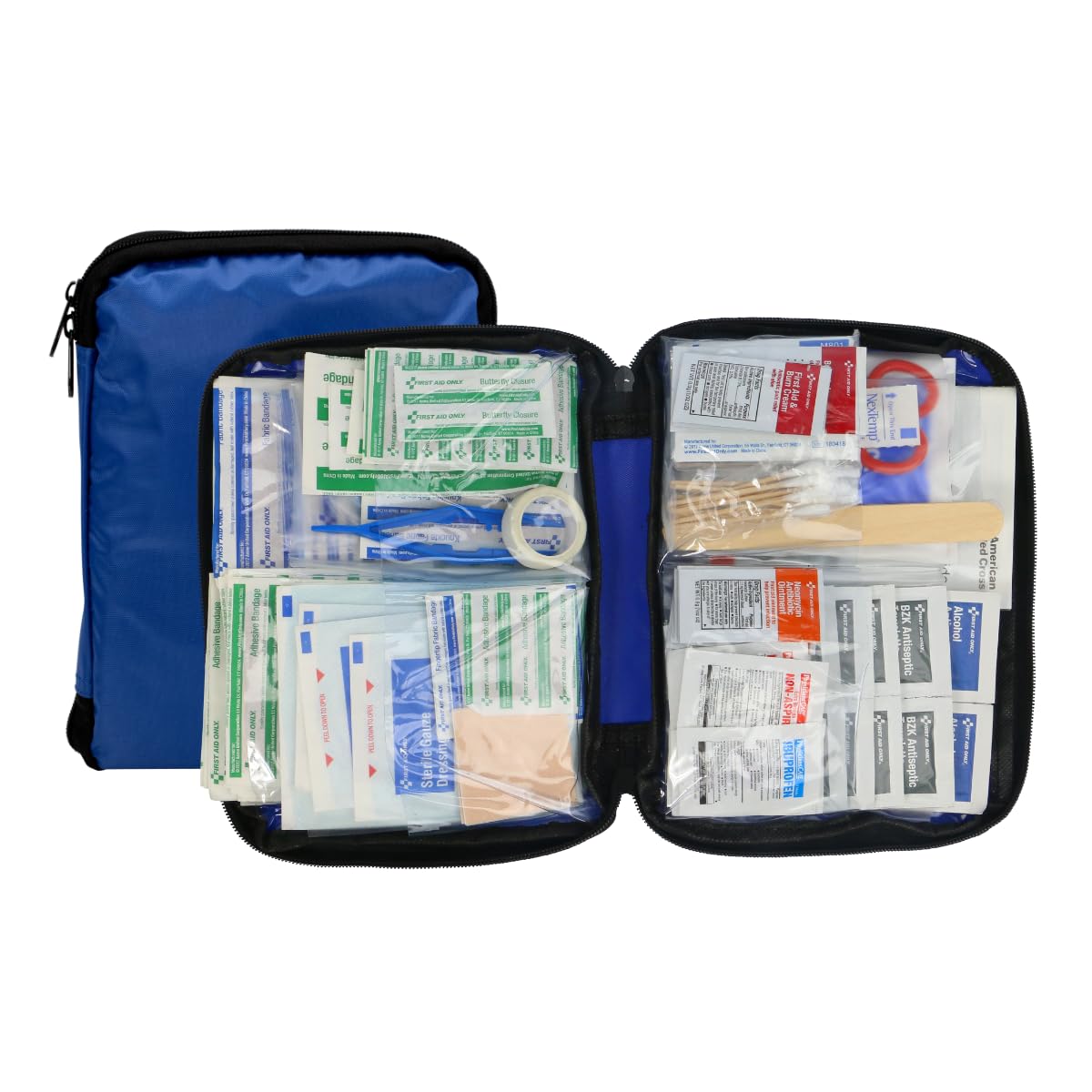
First Aid Only 298pc Kit
Key Features
- Piece Count: 298 pieces
- Case & Waterproof: Soft pouch, not waterproof
- Portability & Weight: 1 lb, compact
- Organization: Unlabeled pockets
- Price: $
The 298-piece count covers cuts, scrapes, burns, and minor injuries without inflating numbers with filler items. The soft pouch weighs only one pound, making it easy to tuck into a car glovebox or backpack side pocket during camping trips. The zippered design keeps supplies organized enough to find what you need quickly. Despite the low price, the included scissors, tweezers, and antiseptic wipes match the quality of higher-priced kits. User feedback consistently highlights the strong value — a comprehensive set at a fraction of what smaller kits cost.
This kit is best for budget-conscious campers and families who store their first aid supplies in a car, dry bag, or home drawer. The soft case is not waterproof, so it requires protection from rain or splashes. Bandage adhesion can be inconsistent across batches — worth testing a few bandages before a long trip to avoid surprises. Ideal for car emergency kits or home first aid drawers, it also works for day hikes if stored in a dry bag.
Pros
- Massive 298-piece count for a low price — covers most minor first aid needs.
- Lightweight soft pouch fits easily in cars, backpacks, and drawers.
- Comprehensive selection of bandages, gauze, and antiseptics for everyday use.
Cons
- Cold pack may arrive with cracks from shipping, reducing its usefulness.
- Bandage adhesion can be inconsistent; some batches have poor sticking power.
For casual campers and families on a budget, this kit delivers impressive value — just verify the bandage quality and keep the pouch dry.
Best for Minimalist Hikers
Vriexsd Mini 150pc Hard Shell
Key Features
- Piece Count: 150 pieces
- Case & Waterproof: EVA hard shell, waterproof
- Portability & Weight: 0.73 lb, small
- Organization: Unlabeled
- Price: $
With a waterproof EVA hard shell that withstands moisture and crush damage, this 150-piece kit weighs under 0.8 lb and costs less than ten dollars – a rare combination for ultralight hikers. Tradeoff: the internal space is tight, so adding personal medications or extra bandages requires repurposing or carrying a separate pouch. Best suited for solo day-trippers, car glove boxes, or as a gift for new campers who want basic supplies without bulk.
Pros
- Waterproof hard shell protects contents from moisture and damage.
- Extremely compact and lightweight for backpack carry.
- Great value for a hard-case kit at a budget price.
Cons
- Internal space is limited; adding personal items is difficult.
For solo hikers needing a crush-proof, waterproof backup that won’t weigh them down, this kit delivers the essentials – just don’t plan on customizing it.
Best for Day Hikers
BAND-AID Travel Ready 80pc
Key Features
- Piece Count: 80 pieces
- Case & Waterproof: Soft pouch, not waterproof
- Portability & Weight: Very compact, light
- Meds & Extras: Tylenol, Neosporin
- Organization: Unlabeled
- Price: $
Includes Tylenol and Neosporin in a compact travel pouch, setting this kit apart from others that rely on generic medications. The 80-piece count leans heavily on small bandages, so it works best as a day-use or backup kit rather than a primary camping supply. An easy grab for a car glovebox, dorm drawer, or as a light supplement to a larger outdoor kit.
Pros
- Includes name-brand Tylenol and Neosporin, not generic substitutes.
- Compact and lightweight pouch fits easily in a bag or glovebox.
- Good value for the quality of components included.
Cons
- 80-piece capacity limits use to short outings – not enough for multi-day trips or groups.
If you want real Tylenol and Neosporin in a portable pouch for day hikes or as a car backup, this is the kit to grab.
Best for Hikers/preppers
EVERLIT 250pc Survival
Key Features
- Piece Count: 250 pieces
- Case & Waterproof: 1000D nylon Molle, water-resistant
- Portability & Weight: 2 lb, mountable
- Meds & Extras: Knife, flashlight, fire starter
- Organization: Compartments
- Price: $$
This kit combines 250 pieces of first aid supplies with real survival tools — a fixed-blade knife, flashlight, compass, and fire starter — all packed into a rugged 1000D nylon pouch that mounts to any Molle webbing. Unlike the top pick’s soft pouch, this one stays attached to your pack or vest, making it ideal for off-grid adventures where you need both medical and bushcraft gear in one grab.
The trade-off is that the pouch is packed extremely tight. After you use an item, getting everything back in its original order takes patience. This suits hikers, preppers, and overlanders who carry a dedicated kit and don’t need to restock often. Not for ultralight backpackers — the 2 lb weight, plus the bulk from the included tools, adds up.
Pros
- Combines first aid and survival tools in one compact, mountable pouch
- Rugged 1000D nylon with Molle loops — stays secure on bags and vests
- High-quality components across the kit, from the pouch to the tools
Cons
- Pouch is very tightly packed — repacking items after use is slow
- Occasional manufacturing residue found on the flashlight in some units
Best for anyone who needs a do-it-all kit that stays put on a pack — just know you’ll spend extra time reorganizing after every use.
Best for Family Car Camping
Swiss Safe 2-in-1 348pc
Key Features
- Piece Count: 348+32 pieces
- Case & Waterproof: Hard case, not waterproof
- Portability & Weight: 3 lb, bulky
- Meds & Extras: Bonus mini kit
- Organization: Organized hard case
- Price: $$
The Swiss Safe 2-in-1 packs 348 pieces into a dual-access hard case — plus a separate 32-piece mini kit for quick grab-and-go use. The case keeps supplies organized and protected, and the value is strong for groups that won’t need to carry it far. At 3 pounds and roughly the size of a small laptop bag, this is best parked in the trunk, at a campsite base, or in a home closet. Ice packs may not fit in the main compartment, so plan to store those separately.
Pros
- Highest piece count in this comparison, with a bonus mini kit for smaller trips
- Hard case with dual-access keeps items organized and survives drops in vehicles
- More supplies and better case quality than most kits at this price
Cons
- Too heavy and bulky for backpacking or day hikes — best for car-based travel
- Ice packs may not fit in the main compartment, and fasteners can be fragile
For family camping by car or as a home emergency station, this hard case delivers generous supplies and solid organization — just don’t plan to carry it on trail.
Best for Organized Hikers
Surviveware 98pc Premium
Key Features
- Piece Count: 98 pieces
- Case & Waterproof: 600D polyester, water-resistant
- Portability & Weight: Compact, MOLLE
- Organization: Labeled compartments
- Price: $$
The Surviveware kit stands out for its organization: every compartment is clearly labeled, so you grab exactly what you need without digging. The MOLLE-compatible pouch attaches to a backpack or belt, keeping supplies within reach on the trail. This design shines for solo hikers or parents who want fast access, but the 98-piece count is modest — better for day trips than extended group outings.
Pros
- Labeled compartments eliminate rummaging during an emergency.
- MOLLE-compatible pouch attaches securely to bags or belts.
- 600D rip-resistant polyester case holds up to trail conditions.
Cons
- Cost per item is higher than bulkier kits — a tradeoff for the detailed organization.
- Tightly packed interior leaves little room to add personal items.
The go-to kit for solo or duo trekkers who prioritize quick access over piece count; skip it if you need to cover a whole campsite.
Best for Day Hikers
Protect Life Mini 100pc

Key Features
- Piece Count: 100 pieces
- Case & Waterproof: Hard case, waterproof
- Portability & Weight: Compact, light
- Meds & Extras: Blanket, tourniquet, CPR mask
- Organization: Compartments
- Price: $
This 100-piece hard-shell kit includes trauma extras like a tourniquet and CPR mask, rare in this size. The waterproof case fits easily in a day pack. However, contents are tightly packed, making quick access and repacking less convenient than some similar mini kits that also cost slightly less.
Pros
- Doctor-designed contents include emergency blanket, tourniquet, CPR mask
- Compact and portable – fits easily in backpack or glove box
Cons
- Very tightly packed – finding specific items quickly can be a challenge
Best for day hikers who want trauma extras in a small package, but the tight packing may slow access in a hurry.
Best for Budget Families
General Medi 2-in-1 258pc

Key Features
- Piece Count: 215+43 pieces
- Case & Waterproof: Soft bag, not waterproof
- Portability & Weight: 1.5 lb, portable
- Meds & Extras: Ice pack, blanket, moleskin
- Organization: Compartments
- Price: $
The General Medi 2-in-1 provides two kits in one purchase: a main 215-piece set and a mini pouch. The soft case stores easily in a car or backpack. However, the bandages may be hard to open and can have poor adhesion, and occasional missing items occur. This kit is better for home or car use than for camping where consistent bandage adhesion matters.
Pros
- Two kits in one: main kit plus a mini pouch for on-the-go use.
- Good value for combined piece count and extras like ice pack and emergency blanket.
Cons
- Bandages can be difficult to open and may have poor adhesion in some cases.
Best for budget-conscious households needing a spare kit for car or home; not recommended for camping trips where consistent bandage adhesion is necessary.
Best for Ultralight Backpackers
THRIAID Mini 100pc Hard Shell

Key Features
- Piece Count: 100 pieces
- Case & Waterproof: EVA hard shell, water-resistant
- Portability & Weight: 0.53 lb, ultra-light
- Organization: Unlabeled
- Price: $
Weighing just 0.53 lb and small enough for a jacket pocket, this hard-shell kit offers solid build and a carabiner clip for quick attachment. The 100-piece supply covers minor cuts and scrapes but lacks medications and trauma gear, making it a spare for ultralight backpackers rather than a primary camping kit.
Pros
- Ultra-lightweight and compact – fits easily in a pocket or small bag
- Sturdy hard shell with reliable zipper and carabiner clip for carrying
Cons
- Limited piece count and no medications – not enough for larger wounds or multiple incidents
Pick this as a backup or gym-bag spare when weight matters most, but keep a larger kit for actual camping trips.
Best for Home Prep
VRIEXSD Large 400pc

Key Features
- Piece Count: 400 pieces
- Case & Waterproof: 1680D polyester, water-resistant
- Portability & Weight: 2.5 lb, large
- Organization: Labeled compartments
- Price: $$
This 400-piece kit delivers an unmatched quantity of supplies in a water-resistant bag with clearly labeled compartments, making it easy to find bandages, ointments, and tools. The value is hard to beat for home or car storage. However, the included tourniquet may separate under tension, and the tight packing slows access when every second counts — issues that keep it from top-tier status.
Pros
- Massive 400-piece count covers nearly any minor injury scenario.
- Labeled compartments keep supplies easy to find in an emergency.
Cons
- Tourniquet may separate under tension, a safety concern if relied upon for severe bleeding.
Best suited for home or vehicle preparedness where weight isn’t an issue and you have time to repack — skip it if you need a dependable tourniquet.
Best for Budget Car
AMORNING 276pc EVA

Key Features
- Piece Count: 276 pieces
- Case & Waterproof: EVA bag, water-resistant
- Portability & Weight: 1 lb, compact
- Meds & Extras: Flashlight
- Organization: Unlabeled
- Price: $
Its EVA case is compact and water-resistant, and the included self-rechargeable flashlight adds real value for day hikes or car storage. Where it falls short is bandage adhesion — some strips may not stay put on active skin, which makes it a better fit for minor incidents near home than for extended outdoor trips.
Pros
- Good price-to-piece ratio: 276 items at a budget-friendly cost.
- Compact and easy to pack for camping or car storage.
Cons
- Bandage adhesion may be inconsistent during active movement.
Best for budget-minded buyers who need a backup kit for the car or occasional day hikes, not for multi-day camping trips where reliable bandages matter.
Best for Night Use
General Medi 210pc Reflective

Key Features
- Piece Count: 210 pieces
- Case & Waterproof: Soft bag with reflective tape
- Portability & Weight: Moderate weight
- Meds & Extras: Ice pack, blanket, splint
- Organization: Unlabeled
- Price: $$
This kit’s reflective bag stands out in low light, making it a smart choice for car or roadside use. It packs 210 pieces including an ice pack and emergency blanket. But the soft bag’s seams may tear when tossed around — better kept stationary at home or in the office than carried on camping trips.
Pros
- Reflective bag makes the kit visible in dark conditions.
- Includes a wide range of supplies like ice pack and emergency blanket.
Cons
- Bag seams may tear under normal use.
Best suited as a stationary kit for home or office where visibility in the dark is valued, not for outdoor adventures.
Best for Indoor Use
SHBC 228pc Hard Shell

Key Features
- Piece Count: 228 pieces
- Case & Waterproof: EVA hard shell, not waterproof
- Portability & Weight: 0.96 lb, compact
- Meds & Extras: Survival card, whistle
- Organization: Unlabeled
- Price: $$
Sleek EVA case with 228 pieces and a survival card make this a well-stocked hard-shell kit. However, the waterproof claim is misleading – water can enter through the zipper, so it’s best suited for dry environments like indoor or vehicle use.
Pros
- Hard shell case offers solid protection and a sleek look.
- Includes a survival card and whistle alongside 228 pieces.
Cons
- Water can enter through the zipper, making the waterproof claim unreliable.
Ideal for indoor or dry vehicle storage where waterproofing isn’t needed, but not for wet camping trips.
Best for Budget Car
YIDERBO 275pc EVA

Key Features
- Piece Count: 275 pieces
- Case & Waterproof: EVA case, water-resistant
- Portability & Weight: 10 oz, lightweight
- Organization: Unlabeled
- Price: $
This kit delivers a high piece count and lightweight packaging at a low price, making it easy to toss in a car or daypack. However, because the kit’s long-term performance is not yet confirmed through widespread use, it suits casual outings rather than trips where you need a known track record.
Pros
- Affordable price for 275 pieces
- Lightweight and compact for its piece count
Cons
- Quality consistency has not been documented through prolonged use, so it’s best for light-duty scenarios.
Best as a budget spare or starter kit for short, low-stakes outings where verified durability is not a top priority.
How to Choose
The single most important thing to know: piece counts are inflated by counting tiny individual bandages and wipes, so focus on case build, bandage adhesive quality, and whether you actually need the extras.
Piece Count and Variety
A 300-piece kit sounds impressive but often means dozens of small adhesive bandages that barely cover a fingertip. The real value is in having a mix of sizes, antiseptic wipes, and a few trauma items like gauze and tape. Look for kits that list specific quantities of each item type rather than just a total number.
In practice, a well-chosen 100-piece kit with proper bandage sizes will serve you better than a 400-piece kit filled with tiny butterfly strips you will never use. Prioritize variety over raw count: you need a few larger pads for scrapes and a roll of medical tape more than you need 50 identical band-aids.
Case Type and Water Protection
Hard shells protect supplies from being crushed in a packed backpack or car trunk, but they add weight and bulk. Soft pouches are lighter and easier to stuff into tight spaces, but offer little protection against a dropped water bottle or a sharp object pressing against the kit.
Waterproof cases matter only if you expect rain or stream crossings. Many soft pouches and even some hard cases have zippers that let water seep in. A tested waterproof seal (like an EVA clamshell with a gasket) is rare at budget prices. If you need guaranteed dry storage, choose a kit explicitly built for marine use or add a dry bag.
Portability and Weight
For day hikes and ultralight backpacking, every ounce counts. A 3-pound hard case might be overkill for a quick afternoon walk, while a 0.5-pound soft pouch leaves you underprepared for a multi-day trip. The trade-off is straightforward: the more you carry, the more weight you accept. Match the kit size to the duration and remoteness of your outing.
Medications and Extras
Name-brand pain relievers and antibiotic creams are a genuine plus because generics are often smaller or missing entirely. However, many kits include only a few pills or tiny packets. Survival extras like knives, fire starters, and tourniquets add weight and take up space. Ask yourself: will I actually use a compass or a whistle, or is it just adding clutter? Choose a kit that fits your planned activities, not one that tries to cover every what-if.
Organization and Quick Access
In an emergency, fumbling through a jumble of items wastes precious seconds. Labeled compartments or see-through windows let you grab a bandage without dumping everything out. Some kits are packed so tightly that repacking after use is frustrating. Look for a case with separate sections for wound care, medications, and tools. If you plan to add personal items (like allergy meds or a splint), ensure there is spare room.
FAQ
Why do some first aid kit bandages not stick?
Bandages in budget kits often use low-tack adhesive to reduce cost. This can fail on sweaty skin or after brief exposure to moisture. Even name-brand bandages can lose grip if stored in a hot car or humid tent. If adhesion is critical, look for kits that specifically mention medical-grade adhesive or purchase separate bandages from a trusted brand.
Is a hard shell first aid kit worth the extra weight for camping?
It depends on how you use it. For car camping or base camp, the added weight is negligible and the protection from crushing is valuable. For backpacking where every ounce counts, a soft pouch with a water-resistant lining is usually a better trade-off. If you expect heavy rain or stream crossings, a hard shell with a true waterproof seal is worth the weight.
What should I look for in a camping first aid kit to treat bee stings and allergic reactions?
Ensure the kit includes an antihistamine (like diphenhydramine) and a sterile pad for cleaning. Many budget kits omit these. If you have a known allergy, you must carry your own epinephrine auto-injector; no standard kit will include one. Check that the case has a separate compartment for personal medications so you can add your own without rummaging.
Can I repack a tightly packed first aid kit without damaging the case?
Yes, but it takes patience. Remove all items, organize them by type, and fold or roll bandages flat before placing them back. Avoid overstuffing, which can stress zippers and seams. If the case has internal dividers, use them to keep categories separate. Some users buy a small dry bag to store extra items rather than forcing everything into the original case.