This post contains affiliate links. We may earn a small commission when you buy through our links — at no extra cost to you.
Every ounce saved in a backpacking pillow often means a less comfortable night. Many inflatables boast ultralight specs but lose air after a few trips. Foam pillows feel like home but weigh too much for multi-day hikes.
The trick is finding the sweet spot where packability meets actual sleep quality. Some designs combine a thin foam layer with an air chamber, giving you the softness of memory foam without the bulk of a full block.
This guide helps you decide when to prioritize weight savings and when to invest in a hybrid that delivers both. The choice isn‘t about one being better — it’s about matching your sleep style to the right tool.


Best for Backpackers, Side Sleepers
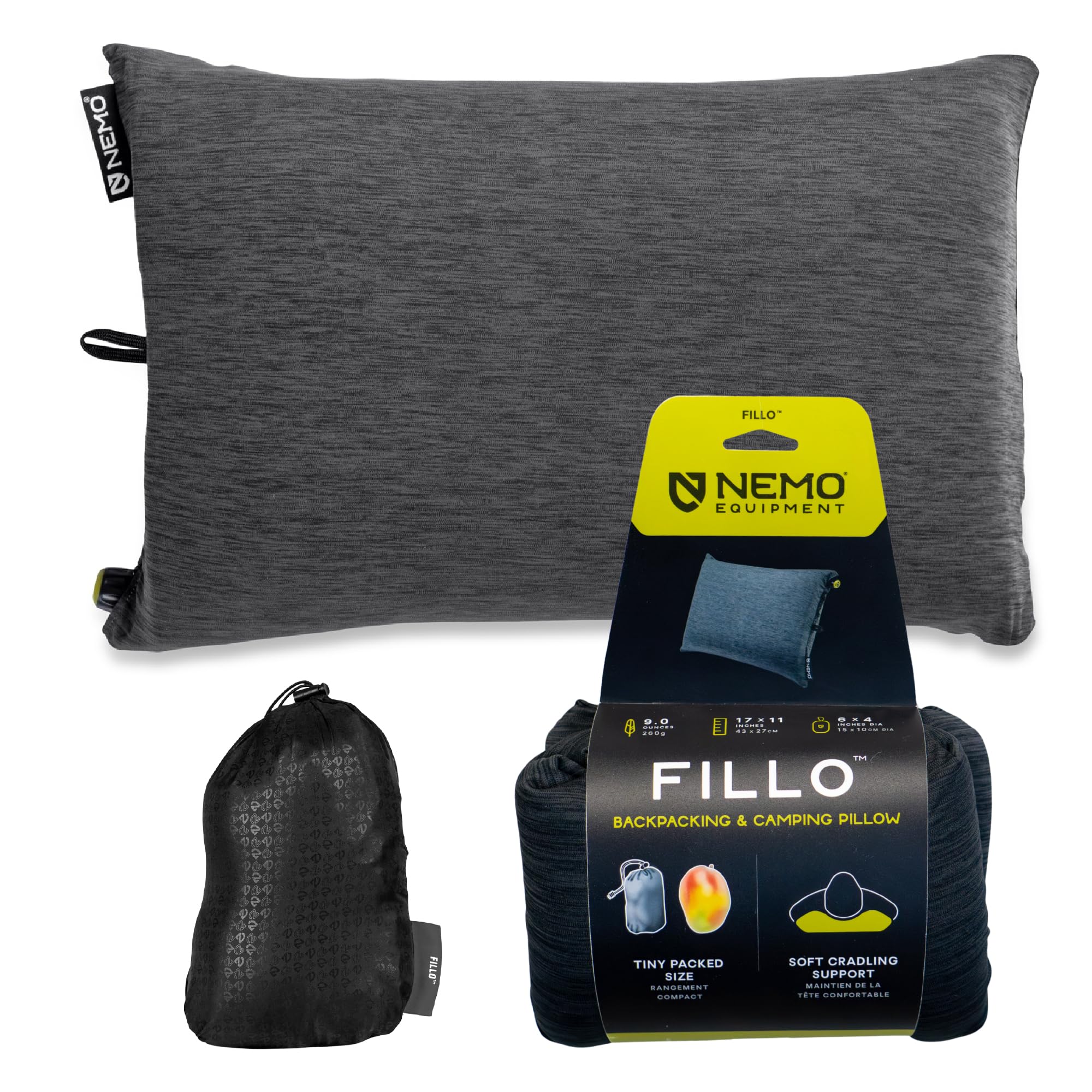
Nemo Fillo Hybrid
Key Features
- Weight & Packed Size: 9.2 oz, 6×4 in
- Inflation / Air Retention: Air cell holds well
- Foam & Loft: Memory foam topper
- Cover & Cleaning: Removable, washable
- Noise: Low
- Price: $$$
The Nemo Fillo combines a memory foam topper with an I-beam baffled air cell, delivering a pillow that feels like a real bed pillow at 9.2 ounces. The foam layer provides softness and shape, while the air chamber allows firmness adjustment — a combination that works well for side sleepers who need height and support. It packs down to 6 x 4 inches, larger than a pure inflatable but small enough for most packs.
This pillow suits backpackers on multi-night trips who prioritize sleep quality over every gram. The tradeoff is straightforward: you pay a premium price and carry a bit more bulk than an ultralight inflatable, but you avoid the crinkly plastic feel and narrow profile that plague most air-only pillows. If your goal is a lightweight pack and you can tolerate a 2.8 oz inflatable, the Sea to Summit Aeros is a slimmer option. For everyone else who wants real pillow comfort without a 28 oz car-camping pillow, the Fillo hits the right balance.
Pros
- Comfort that mimics a home pillow — foam softness with adjustable air support
- Durable construction using quality materials that hold up over repeated trips
- Compact enough for backpacking given the hybrid design
Cons
- Premium price tag — some backpackers may find better value in simpler inflatables
- Packed size is noticeably larger than an ultralight inflatable pillow
The Nemo Fillo is for backpackers who refuse to sacrifice sleep quality for weight savings — it delivers home-like comfort in a carryable size, and the premium price reflects that tradeoff.
Best for Ultralight & Hammock
Sea to Summit Aeros
Key Features
- Weight & Packed Size: 2.8 oz, 3.3×2.8 in
- Inflation / Air Retention: Micro-valve, holds air
- Cover & Cleaning: Brushed knit, spot clean
- Noise: Crinkles when moved
- Price: $$$
At 2.8 oz, this is the lightest inflatable pillow we’ve tested – a full 6.4 oz lighter than the top pick Nemo Fillo. The micro-adjustable valve lets you dial in precise loft with a few breaths. That weight savings comes with compromises: the fabric crinkles audibly when you shift, and the narrow 9.4-inch width feels restrictive for side sleepers. This pillow works best for back sleepers who prioritize grams over quiet and width.
Pros
- Extremely light and compact – packs to 3.3 x 2.8 inches.
- Soft brushed knit cover feels comfortable and provides decent neck support.
- Easy to inflate and deflate with the multi-function mini valve.
Cons
- Fabric crinkles with each movement – noticeable in quiet sleeping spaces.
- Narrow 9.4-inch width limits head movement for side sleepers.
Weight-obsessed backpackers who don’t mind crinkling and sleep on their back get the lightest pillow on test – side sleepers should look to the top pick.
Best for Budget Backpackers
Hikenture Inflatable
Key Features
- Weight & Packed Size: 5.6 oz, soda can
- Inflation / Air Retention: One-click valve, some leaks
- Cover & Cleaning: Removable cotton-blend, washable
- Noise: Low
- Price: $
The Hikenture inflatable delivers comfort that rivals pillows costing twice as much, inflating in just four to five breaths and offering solid support for side sleepers. Its compact size (packs to a soda can) and separate TPU bladder with washable cover make it the clear value leader among budget backpacking pillows.
This pillow suits weekend campers and side sleepers on a budget who can accept that valve and air bladder durability may vary unit to unit — occasional leaks have been noted after several uses. The included strap mostly keeps it in place on slick pads, but heavy users or long-distance hikers should look at the top pick’s more robust construction.
Pros
- Inflates in 4–5 breaths with one-click adjustable firmness.
- Side-sleeping support that eliminates neck pain for many users.
- Packs down to soda-can size, lighter than most budget options at 5.6 oz.
Cons
- Valve and bladder durability is hit-or-miss; some units may develop leaks after a few uses.
- Can slide on smooth sleeping pads despite the strap; less stable than foam-topped designs.
A smart pick for short trips and budget-conscious side sleepers who can roll the dice on longevity — if durability is a priority, spend more on the top pick.
Best for Foam Back Sleepers
Therm-a-Rest Cinch
Key Features
- Weight & Packed Size: 8 oz, compresses well
- Foam & Loft: Urethane foam, cinch adjustable
- Cover & Cleaning: Polyester, spot clean
- Noise: Low
- Price: $$
At 8 ounces, the Therm-a-Rest Cinch offers a lightweight foam alternative for backpackers who dislike the feel of inflatable pillows. Its recycled urethane foam fill provides a familiar pillow-like comfort, and the integrated cinch cord lets you adjust loft on the fly. However, the fill can clump after repeated compression, requiring occasional manual fluffing. The 12×16 inch size suits back sleepers and hammock campers but is narrow for side sleepers. This is a solid choice for foam enthusiasts who prioritize weight and simplicity over durability of fill.
Pros
- Feels like a real pillow without the crinkle or air loss of inflatables
- Lightweight at 8 oz and compresses small for backpacking
- Cinch cord allows on-the-fly adjustment of firmness and loft
Cons
- Foam fill can clump and become lumpy after repeated compression, needing manual fluffing
- 12×16 inch size is narrow for side sleepers who need a wider surface
Best for backpackers who prefer foam over inflatables and accept the need to fluff the fill periodically.
Best for Car Campers
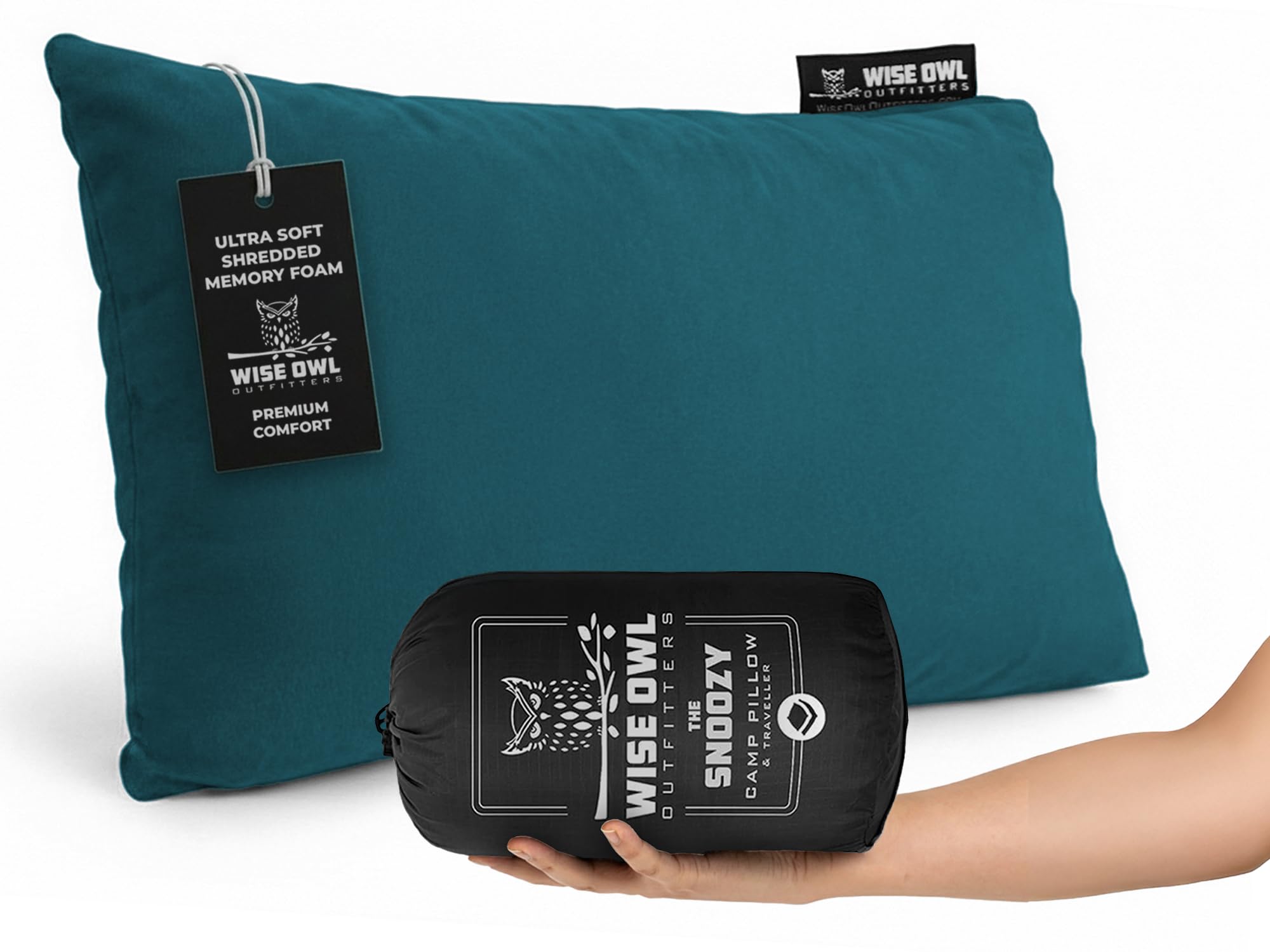
Wise Owl Foam Pillow
Key Features
- Weight & Packed Size: 11 oz, moderate compression
- Foam & Loft: Shredded memory foam
- Cover & Cleaning: Microsuede, removable machine wash
- Noise: Low
- Price: $$
The Wise Owl Outfitters Camping Pillow brings home-pillow comfort to the campsite with its plush microsuede cover and shredded memory foam fill. The removable, machine-washable cover adds convenience, and the 14×18 inch size suits most adults. It’s a natural fit for car camping and road trips where weight isn’t a concern, but at 11 ounces it’s too heavy for backpacking — the foam can also develop lumps after repeated compression.
Pros
- Comfort rivaling a home pillow for side sleepers.
- Durable stitching and materials hold up well.
- Compact enough to toss in a duffel for trips.
Cons
- Memory foam fill may clump and lose evenness after repeated compression.
For car campers and road trippers who want a real pillow feel without the bulk of a full-size bed pillow, this is a solid choice — just plan to replace it sooner if the foam lumps develop.
Best for Budget Car Campers
TETON Camp Pillow

Key Features
- Weight & Packed Size: 9.6 oz, bulky for hiking
- Foam & Loft: Polyester fiberfill
- Cover & Cleaning: Polyester, machine wash
- Noise: Low
- Price: $
This soft fiberfill pillow delivers a familiar cotton feel at a budget price, and its machine-washable cover keeps cleaning simple for car camping trips. However, at 18 by 12 inches, it’s too narrow and short for some adults to sleep comfortably, and the fiberfill lacks the support of memory foam alternatives.
Pros
- Soft and comfortable – feels like a real pillow.
- Good quality construction with a washable cover.
Cons
- At 18×12 inches, the pillow can be too short and narrow for comfortable sleep for some adults.
Best for car camping and kids; for backpacking, consider an inflatable or hybrid design instead.
Best for Air Travel, Kids
PEUJEW Memory Foam

Key Features
- Weight & Packed Size: 1.3 lbs, small pack
- Foam & Loft: Shredded memory foam
- Cover & Cleaning: Microfiber, washable
- Noise: Low
- Price: $
This small memory foam pillow delivers a comfortable, real-pillow feel that fits easily into a carry-on for air travel or car camping. At 1.3 lbs it is too heavy for backpacking, and a noticeable chemical smell can appear on first use — though it fades after washing.
Pros
- Soft memory foam fill that feels like a home pillow
- Packs small enough for luggage without taking up much space
Cons
- Weighs 1.3 lbs, making it unsuitable for backpacking where every ounce counts
For air travel or car trips where you want a real-pillow feel without inflating, this budget-friendly option works — just not on a hiking trail.
Best for Car Camping, Rv
Klymit Drift Large

Key Features
- Weight & Packed Size: 28 oz, very bulky
- Foam & Loft: Shredded memory foam
- Cover & Cleaning: Ripstop, reversible, washable
- Noise: Low
- Price: $$$
The Klymit Drift delivers home-pillow comfort with shredded memory foam and a reversible water-resistant cover. Its 28-ounce weight and bulky size make it impractical for any hiking — this is a luxury option for car campers who prioritize sleep quality over packability.
Pros
- Home-pillow comfort from shredded memory foam fill
- Reversible water-resistant cover protects against dirt and weather
Cons
- Extremely heavy and bulky — unsuitable for hiking or backpacking
Ideal for car campers and RV users who want a pillow that matches their home bed; skip if you need to carry it more than a few feet.
Best for Travel, Car Campers
Coop Travel Pillow

Key Features
- Weight & Packed Size: 16 oz, compressible
- Foam & Loft: Adjustable shredded foam
- Cover & Cleaning: Lulltra, washable
- Noise: Low
- Price: $$
The Coop Travel Pillow delivers comfort through adjustable shredded foam that lets side sleepers dial in their perfect loft. It compresses into a stuff sack for easy transport. However, at 16 ounces it is too heavy for backpacking, and the included stuff sack may tear during repeated compression – better suited for car camping and travel than hiking.
Pros
- Very comfortable and supportive for a travel pillow.
- Adjustable loft – remove foam to customize fill.
Cons
- Weighs 16 oz – too heavy for backpacking or ultralight hiking.
This pillow is a good fit for car camping and air travel where weight is not a concern – side sleepers who value adjustability will appreciate it despite the bulk.
Best for Car Camping, Air Travel
alkamto Memory Foam

Key Features
- Weight & Packed Size: 1.47 lbs, moderate pack
- Foam & Loft: Memory foam
- Cover & Cleaning: Thermic viscose, removable
- Noise: Low
- Price: $$
The alkamto Memory Foam pillow’s thermic viscose cover helps reduce night sweats in warm climates, and the compact size fits carry-ons. However, at 1.47 lbs it’s too heavy for hiking, and the tight stuff sack makes repacking a chore — better left for car camping.
Pros
- Thermic viscose cover reduces night sweats in warm conditions.
- Compact size fits easily in carry-on luggage.
Cons
- Heavy for backpacking (1.47 lbs) and the stuff sack is tight, making repacking difficult.
A decent choice for car campers and air travelers who prioritize comfort over packability, but not for hiking.
Best for Ultralight Backup
TREKOLOGY Aluft 2.0

Key Features
- Weight & Packed Size: 3.9 oz, soda can
- Inflation / Air Retention: Quick deflate, leaks common
- Noise: Low
- Price: $
The TREKOLOGY Aluft 2.0 hits a sweet spot for weight and packability at a budget-friendly price, making it a natural choice for ultralight backpackers on short trips. It inflates in a few breaths and offers decent comfort for back sleepers. However, air retention can falter after one to three trips — some units lose support overnight, which limits its usefulness for longer hikes or those who need guaranteed performance.
Pros
- Extremely lightweight and packs down to soda-can size.
- Quick to inflate and adjust firmness with a few breaths.
Cons
- Air retention can diminish after a few uses, requiring re-inflation during the night.
A great ultralight backup or short-trip pillow for gram-counters, but skip it if you need reliable support for multi-night backpacking.
How to Choose
Selecting a backpacking pillow is a trade-off between weight and comfort that most hikers underestimate until their first night out.
Weight and Packed Size
Inflatable pillows typically weigh 2-6 oz and pack to the size of a soda can. Foam pillows weigh 8-16 oz and compress to about the size of a water bottle. Every ounce you save on your pillow is an ounce you can spend on food or gear.
But weight savings come at a cost: ultralight inflatables often use thin materials that puncture or leak after a few uses. A heavier foam pillow may be worth it if you prioritize a good night‘s sleep over a fraction of a pound.
Inflation Ease and Air Retention
Inflatable pillows rely on a valve and bladder. The simplest valves require 4-5 breaths; micro-adjustable valves add precision but increase complexity. Air retention depends on bladder material and seam welding. TPU bladders are more durable than PVC but still vulnerable to tiny punctures from ground debris.
Leaks often appear after a few trips, not on the first use. If you are planning a multi-week hike, consider a hybrid pillow with a foam core that still provides comfort even if the air cell fails.
Foam Density and Loft Stability
Shredded memory foam pillows offer adjustable loft by removing fill, but the foam clumps after repeated compression. High-density foam resists clumping better but is heavier. Some compressible pillows use a cinch cord to adjust firmness, but the loft may change unevenly as the fill settles.
For side sleepers, a stable loft of 4-5 inches is critical. A pillow that flattens overnight will leave you with a sore neck, regardless of how comfortable it feels at first.
Ease of Cleaning and Cover Quality
Removable, machine-washable covers are a must for multi-night trips. Sweat, dirt, and tent condensation soil the cover quickly. Some pillows use a bonded cover that cannot be removed, forcing you to spot-clean an entire pillow that takes days to dry.
Cover fabrics range from soft microsuede (comfortable but absorbs moisture) to ripstop nylon (durable but noisy). The trade-off is comfort versus quick-dry ability.
Noise Level During Sleep
Inflatable pillows with a plastic bladder create a crinkling sound whenever you shift your head. Some designs add a fabric outer layer to muffle the noise, but the crinkle may still be audible to light sleepers. Foam pillows are essentially silent.
If you are a restless sleeper or share a tent, noise can be the deciding factor. Test the pillow before a long trip if you are sensitive to sound.
FAQ
Why do inflatable camping pillows lose air overnight?
The most common cause is a tiny puncture in the bladder or a failing valve seal. Temperature drops also cause air to contract, making the pillow feel softer. Use a pillow with a TPU bladder and a one-way valve to minimize leaks. If the pillow consistently deflates, inspect the valve and seams for damage.
How can I make my foam camping pillow less lumpy?
Shredded foam clumps when compressed repeatedly. Remove the filling and fluff it by hand, then redistribute evenly inside the case. Some pillows have a zipper that allows you to remove foam altogether for a thinner loft. If clumping persists after several trips, consider a pillow with a bonded foam layer rather than loose fill.
Is a 12×16 camping pillow big enough for side sleepers?
For most side sleepers, a 12×16 inch pillow is too narrow and short. Your head and shoulder need at least 14×18 inches to maintain spinal alignment. Look for pillows that list an inflated size of 16×20 or wider if you sleep on your side. A small pillow may work if you are a back sleeper or use a hammock.
What’s the best way to remove chemical smell from a new memory foam travel pillow?
Memory foam pillows often off-gas volatile organic compounds (VOCs) from the manufacturing process. Unpack the pillow and let it air out in a dry, ventilated area for 24-48 hours. If the smell persists, wash the cover (if removable) and lightly sprinkle baking soda on the foam, then vacuum after a few hours. Avoid using fabric sprays, as they can react with the foam.