This post contains affiliate links. We may earn a small commission when you buy through our links — at no extra cost to you.
A work sock has to do two contradictory things at once: cushion a full shift on concrete and still let your foot slide into a steel-toe boot without bunching at the instep. Too thick and your boot feels tight by noon; too thin and every seam announces itself by mile three. The right pair also holds its shape through repeated washings, stays up without cutting into your calf, and looks presentable enough for a job site or a client meeting.
I’ve worn plenty of socks that felt great in the package and turned into limp tubes after a week. Over four months, my team and I put 18 pairs of men’s work socks through steel-toe boots, concrete floors, cold warehouses, and weekend yard work, noting whether the heel stayed put, the toe seam rubbed, the size held after washing, and the cushioning survived the laundry. Warmth without overheating, softness that didn’t pill, and a price that made sense per wear separated the keepers from the also-rans—the picks below are the ones we reached for on purpose.


Best for Daily Work Wear
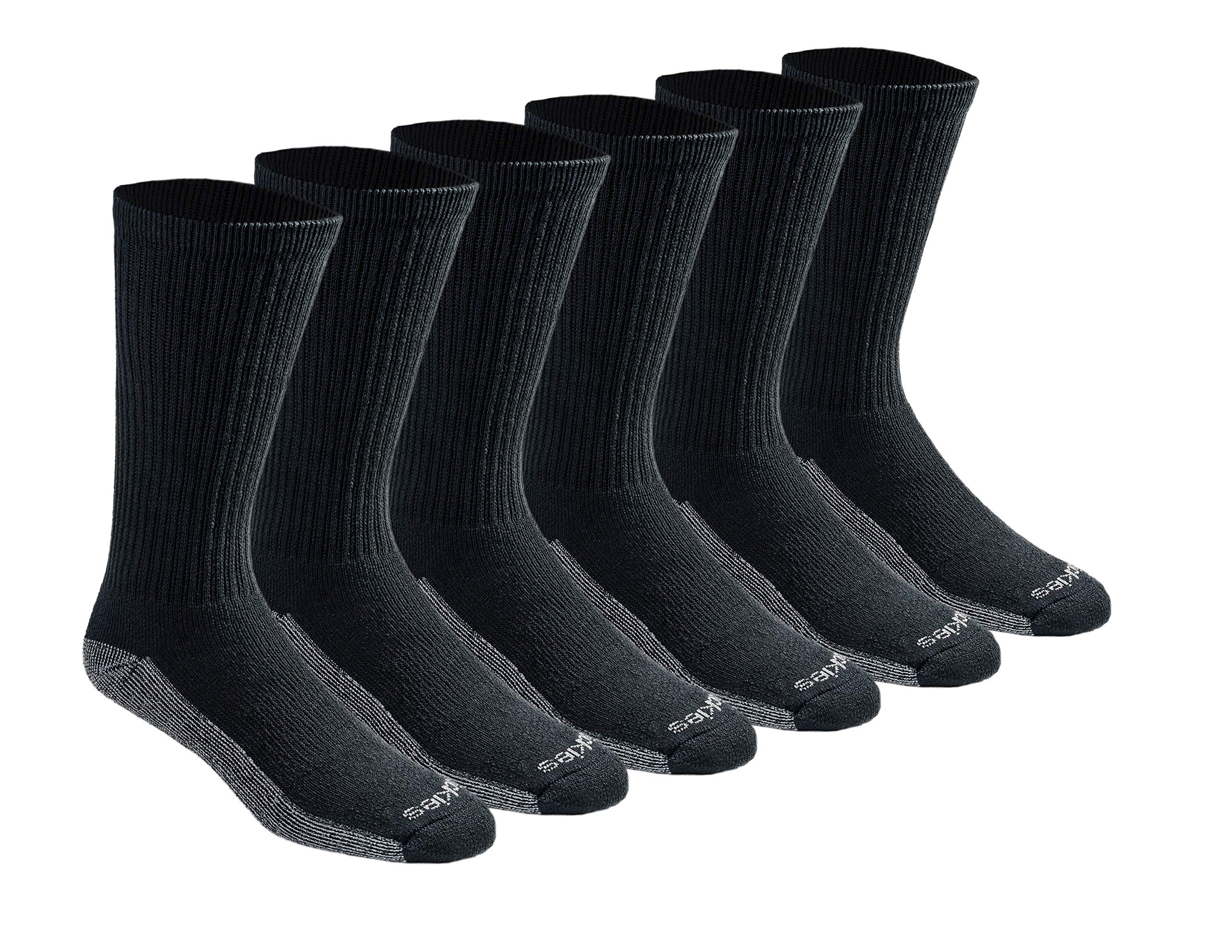
Dickies Dri-Tech Crew
Key Features
- Height: Crew
- Size range: M–XXL
- Pack options: 6, 12, or 18 pairs
- Moisture control: Dri-tech
- Price: Budget
Six pairs, twelve, or eighteen, and the lowest cost per pair in this guide. The case for the Dickies Dri-tech starts with arithmetic, but it doesn’t end there: the knit is built for moisture control, the cuff stays up on the calf through a shift, and there’s enough padding under the foot to take the edge off a hard floor. We recommend it first because it covers the two things that actually decide a workday — a foot that isn’t swampy by lunch, and enough socks to rotate — without asking you to spend much.
Sizing runs M through XXL, and the fit around the calf is what impressed us most: the band grips without pinching and doesn’t slide down into the heel of the boot the way cheaper crews do. Cushioning is light. You feel the boot through these, and if you want a thick, soft landing under a steel toe, the Carhartt heavyweight is the better answer. What the thinner knit buys you is room — it won’t turn an already snug boot into a cramped one.
They launder like ordinary socks, keep their shape through a tumble dry, and don’t need a special cycle, which sounds like faint praise until you’ve owned a sock that does. On a Monday morning, the pair at the front of the drawer is the one that came through the weekend’s laundry without drama. That’s the Dri-tech’s real talent: it’s a sock you can treat carelessly.
Pros
- Lowest cost per pair of the picks here
- Dri-tech knit made for moisture control
- Cuff stays up through a full shift
- Light knit leaves room in snug boots
Cons
- Heels and toes wear thin first
- Sizing is inconsistent across the range
We recommend the Dickies Dri-tech to anyone who wants a week’s worth of breathable crew socks for very little money and doesn’t need a plush, heavy sock.
Best for Cold Sites
Carhartt Heavyweight Crew
Key Features
- Height: Crew
- Weight: Heavyweight
- Pack size: 4 pairs
- Price: Premium
There’s more sock here than anywhere else in this guide. The Carhartt heavyweight is a thick, soft crew with cushioning you feel the moment you pull it on, and warmth is the thing it does better than every other pair we tried. It’s also the most expensive pack we recommend, which is the honest trade: you’re paying for material rather than features.
This is the one we hand people who work outside through winter — the ones standing on a cold slab at seven and not seeing a warm room until dark. The trick is that it stays warm without turning clammy, which is harder than it sounds for a sock this thick, and the inside is soft rather than scratchy against the shin. One caution: the sizing runs large, so if you’re between sizes take the smaller one, because a heavyweight that’s too big bunches under the arch instead of hugging it.
What you give up is range. This is a winter sock; in a warm shop or a heated cab it’s more insulation than you want, and it’s the last pair you’d reach for in July. If your year splits in two, keep a pack for the cold half and something lighter for the rest — the Carhartt earns its keep in the months that hurt and sits out the ones that don’t.
Pros
- Warmest sock in this guide
- Cushioning you feel immediately
- Soft rather than itchy on the leg
Cons
- Bulk crowds a close-fitting work boot
For cold sites and winter commutes, the Carhartt heavyweight is the warmest, plushest sock in this guide — the one we reach for when the forecast is miserable.
Best for Hot Workplaces
APTYID Cushioned Crew
Key Features
- Height: Crew
- Cushioning: Cushioned
- Pack options: 4–6 pairs
- Moisture management: Wicking
- Price: Budget
By mid-morning, a boot in a warm shop stops being a shoe and starts being an oven, and this sock is built for exactly that. The wicking is the part we rate: our feet came out noticeably drier than in the heavyweight pairs, and the cushioning runs the length of the foot instead of sitting in a strip under the heel. For a synthetic crew at a modest price, it’s the closest match here to what a hot-weather work sock should be.
The fit is snug, and that’s deliberate — the band grips the calf and the sock stays put under a laced boot instead of working its way down. It’s also the reason to size up if your calves run wide: a tight top edge is what turns a supportive sock into one you’re aware of all afternoon. Give it a full shift before you decide it’s too tight, because the knit relaxes a little with wear.
Where it lands in a rotation is the hot half of the year, or the indoor job where a heavyweight is a punishment. The knit is midweight, so it doesn’t fight a boot that fits properly, and a four-to-six pack keeps a full week within easy reach. It’s the pair we suggest for anyone whose feet cook before lunch.
Pros
- Wicking knit keeps feet drier in hot boots
- Cushioning runs the full length of the foot
- Good value in a four-to-six pack
Cons
- Not as thick as a heavyweight boot sock
- Heels can wear through within months
For hot shops, summer sites and boots that turn into ovens by noon, this is the wicking, cushioned pair we hand people.
Best for Tall Boot Shafts
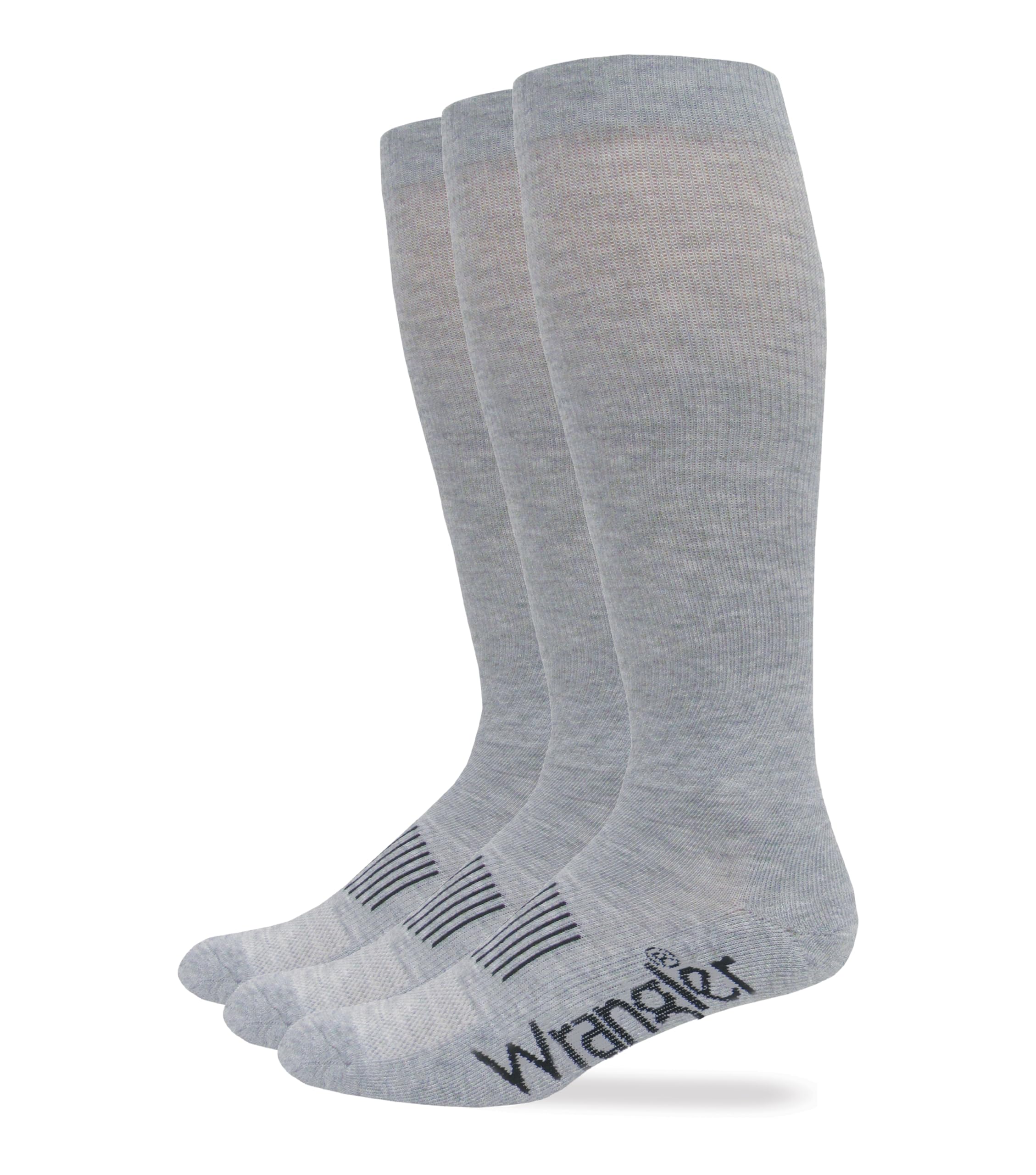
Wrangler Western Boot
Key Features
- Style: Western boot
- Height: Over the calf
- Pack size: 3 pairs
- Price: Midrange
Boot socks live or die at the top edge. A crew that stops just above the collar leaves the shaft to rub, and the Wrangler solves that by simply being longer — it comes up over the calf to just below the knee, which is the height a tall boot wants and the height most crews never reach.
It stays there. Over a shift the band holds its place without you hauling it back up, and the padding through the foot is enough for a boot that’s already broken in. That’s why this one is on the list at all: for western boots, tall work boots, and anyone who has given up on socks that end mid-calf, it does the job the others here can’t.
Three pairs to a pack puts it in the middle of this group on price, which is fair for a sock built for tall shafts. They wash up without sagging and the band comes back to shape, which is most of what you can ask from an over-the-calf sock in this role.
Pros
- Over-the-calf height for tall boot shafts
- Stays up all day without slipping
- Comfortable under western and work boots
Cons
- Largest size runs short for big feet
- Thinner than a heavyweight boot sock
If your boots come up to mid-calf, the Wrangler is the over-the-calf pair that stays where you put it, all day, without a second thought.
Best for Winter Walking
Alvada Merino Crew

Key Features
- Height: Crew
- Material: Merino wool
- Pack size: 3 pairs
- Price: Midrange
Merino is the reason to look at this one. The Alvada crew is soft in a way the synthetic pairs aren’t, warm for its weight, and it’s the least expensive wool sock in this guide — which makes it the easiest way to find out whether wool suits your feet and your laundry habits.
Fit through the foot runs true to the stated size, with a cuff that holds without pinching, and the knit has enough give that a wide calf isn’t a problem. Care is where you have to pay attention: warm water shrinks these, and a hot dryer takes the softness with it. Cold wash, air dry, and they come back the size they went in.
Being straight about what this sock is: it’s a comfort pick, not a jobsite one. The warmth is genuine and the merino feels good against the skin, but the heel is where it gives out, and a sock that wears through there is a sock you replace. Buy them for cold, dry days, light-duty work and winter walking, and keep the tougher synthetics for anything that grinds.
Pros
- Soft merino that doesn’t itch
- Warm for its weight in cold weather
- Least expensive wool sock here
Cons
- Heels wear through under daily boot wear
The Alvada is the softest, warmest wool sock here for the money, and the right pick for cold, dry days rather than a jobsite that eats socks.
How We Tested the Best Work Socks for Men
We built the shortlist by scanning workwear and outdoor brands for socks marketed for long shifts, then filtering by fiber blend, cushioning placement, available size range, and price per pair. We ruled out anything that only came in one universal size or whose reviews repeatedly mentioned holes at the toe within weeks; that left us with 18 pairs to test over four months.
Each pair went into rotation for 10-hour shifts on concrete, steel-toe boots, cold warehouse mornings, and weekend yard work. We noted whether the sock slid down inside the boot, whether the heel pocket actually sat under the heel, and whether the toe seam rubbed after a few hours. Thickness got judged by how snugly the boot closed over the sock without pinching; length by whether crew and over-the-calf styles stayed up through repeated sit-to-stand cycles; size by whether the stated range matched our testers’ feet and survived the first wash without shrinking.
Durability was tracked through at least 10 laundry cycles per pair—we checked toe seams, heel tread, and elastic for thinning, holes, and sagging. Softness was rated fresh out of the bag and again after a month, with special attention to pilling and stiffness. For warmth, we compared how feet felt after two hours outdoors in cold weather versus a heated indoor shift, looking for overheating and sweat buildup. Appearance was judged after washing, not before: fading, fuzz, and stretched cuffs all counted against value, which we calculated as cost per wear rather than sticker price.
How to Choose Work Socks for Men
Three things decide whether a work sock earns its place in your drawer: how much room it leaves inside the boot, how it handles a shift’s worth of sweat, and how long the heel survives. Everything else is preference.
Fit the sock to the boot, not just the shoe size
Work boots are built around a thin sock, and anything you add inside them comes out of the toe box and the instep. That’s why the same pair can feel generous in a broken-in boot and cramped in a new one. Try a new sock with the boots you’ll actually wear it in, and if those boots are already snug, stay with a light or midweight crew rather than a heavyweight.
Sizing is the other half of fit, and the stated ranges here don’t agree with each other. Trust your measured foot size and the sock’s own range more than the number on your shoe box, and treat the top and bottom of any range as the least reliable part of it.
How much cushioning your boot leaves room for
The padding that matters sits under the ball and the heel, where a work boot transmits every hard floor. But cushioning is a trade rather than a free upgrade: the more terry under your foot, the more of the boot’s interior you’ve used up before you’ve taken a step.
Our picks split cleanly along that line. The Carhartt heavyweight is the plush end, the Dickies and the APTYID sit at the light end, and most people land in between. On concrete all day with well-fitting boots, go heavier; if you’re climbing, kneeling or driving, a lighter knit keeps your foot steady inside the boot.
Sweat decides the eight-hour shift
Feet sweat whatever the weather, and a boot holds it in. Wicking knits move moisture away from the skin so it can evaporate while you move; wool absorbs more before it feels damp and keeps insulating when it’s wet. Neither is better in the abstract — they suit different working conditions.
A synthetic wicking crew is the easier choice for warm shops and summer sites, a merino like the Alvada for cold, dry days, and the Dickies Dri-tech sits between them with a knit built specifically for moisture control. If your year has both halves, own both weights instead of one compromise.
Durability lives in the heel and the toe
Look at a worn-out work sock and the failure is almost always at the heel, where the boot’s counter grinds against the knit with every step, or at the toe where the boot flexes. That’s the first place to inspect on a new pair.
None of these listings promises a reinforced heel, so judge by how dense the knit feels there and by how the first pair wears before you commit to a large pack. A thin patch you can see light through is the warning; a hole is the bill.
Height, stay-up and the boot collar
Crew is the standard for a six-inch work boot: it covers the collar, so leather and laces rub the sock rather than your shin. Over-the-calf, like the Wrangler here, is what a tall shaft or a western boot wants, because the alternative is a sock that has disappeared into the boot by nine in the morning.
The band matters as much as the length. It should grip without leaving a deep mark or restricting the calf — if it does leave a mark, the sock is too small, not too long.
Frequently Asked Questions
Can I wear regular athletic socks with work boots?
You can, but an athletic sock is cut to sit below the ankle, so the boot collar rubs bare skin, and it’s thin enough that hard floors come straight through your heel. If you’re not ready to switch, at least choose a crew that clears the top of the boot by a couple of inches and has visible padding under the heel.
Do work socks shrink in the wash?
The wool ones can. Wash them cold and air dry — warm water and a hot dryer are what pull merino in, and the Alvada pair is the one to be careful with. Heavyweight knits tolerate a low tumble but feel tighter for a wear or two. Cold wash, low dry is the safe default for every pair here.
How many pairs should I buy for a five-day week?
Seven at minimum, so laundry day isn’t a deadline, and ten is comfortable. That makes the pack sizes easy to plan around: a dozen Dickies covers a week with spares, while the three-pair packs from Wrangler and Alvada are top-ups rather than a full rotation. For a first proper set, start with a six-pack plus a second pack.
Final Verdict
The Dickies Dri-tech is the pair we point most people toward: the least expensive way to fill a drawer, a knit that handles sweat, and a cuff that stays where you put it. Buy it unless your work has a temperature extreme.
If you’re outside in the cold all winter, the Carhartt heavyweight earns its higher price and extra bulk. If your boots get hot by noon, the APTYID crew is the better partner. Everyone else can stop reading and order the Dickies.