This post contains affiliate links. We may earn a small commission when you buy through our links — at no extra cost to you.
A climbing shoe is supposed to be tight — that’s the whole point. The rubber has to press into a dime-thin foothold and your toes need to feel the shape of the wall. The trouble is that the line between snug and unbearable is narrow, and sizing is a mess: one brand’s 38 is another brand’s 40, and a leather upper will stretch in ways a synthetic one won’t. Get it right and the wall gets easier — you edge on small chips, smear on slab, and trust your feet on the move before the anchor.
I’ve bought the wrong pair more than once, and I’ve learned the hard way that the shoe you keep reaching for is the one that matches your foot shape, not the one with the best numbers on paper. My team and I just spent seven months in 12 pairs — gym sessions three nights a week, plus weekend trips to real rock — and that held true every time. Below are the ones that earned a permanent spot in my bag.


Best for All-Around Climbing
La Sportiva Tarantulace
Key Features
- Fit: Snug; size up if between
- Level: Beginner to intermediate
- Closure: Lace-up
- Break-in: Short
- Price: Midrange
Almost every first pair goes wrong in the same place: people buy their street size. The Tarantulace is the shoe that taught us how much the next half size matters. Worn snug, it holds the foot steady on a small foothold and keeps the heel locked down; bought loose, it slides around and you end up blaming the rubber. We climbed in ours for full gym sessions without the break-in misery that puts people off the sport.
That balance, snug but wearable for an hour, is why it’s our top pick here. It does the beginner job with fewer compromises than either strap shoe in this group: comfortable enough for a long session, grippy on plastic and rock, and precise enough that you’re not fighting the shoe while you learn footwork. Laces are part of that argument. You can crank the midfoot down for an outdoor day and loosen everything for the walk-off, which a strap shoe can’t do.
Sizing is the thing to get right. Half a size up from your street shoe gives a snug, comfortable fit, while your usual size tends to press the heel and cramp the toes. Go up if you’re between sizes or want a roomier toe box. The other variable is stiffness: they feel board-like on the first session, and ours gave noticeably by the third.
Pros
- Comfortable through full-length gym sessions
- Grip holds on gym walls and boulders
- Laces dial the fit for outdoor days
Cons
- Stiff for the first session or two
Our pick for a first or second pair: comfortable enough to keep on for a full session, with the grip and the lacing to follow you outdoors — just size up if you’re between sizes.
Best for First Gym Season
Black Diamond Momentum Strap
Key Features
- Fit: Narrow; size up half
- Level: Beginner
- Closure: Hook-and-loop straps
- Price: Budget
Two seconds is the whole pitch. At the gym you’re in and out of your shoes between attempts, and a pair you can kick off and pull on without touching a lace is the difference between warming up properly and skipping it. The Momentum Strap is built around that, and it’s the shoe we reach for when the session is about volume rather than projecting.
It’s also the least expensive shoe in this group, which matters when you’re not certain climbing will stick. What you’re buying is a beginner shoe a clear step above the rental fleet: a friendly shape, a strap that gets you in and out fast, and nothing you can’t use yet. For a first season of gym climbing, that’s a sensible place to put your money.
The fit asks something of you, though. It runs narrow and short, so take a half size up from your street shoe, and if your forefoot is wide this may not be your shoe at all; the lace-up La Sportiva is the better bet there. The upper is also firmer than our top pick’s, and you feel it at the end of a long session. Buy it for the convenience and the price, not for precision on tiny edges.
Pros
- Straps on and off in seconds
- Least expensive shoe in this group
- Beginner-friendly, above rental quality
Cons
- Too narrow for wide forefeet
- Firm upper aches on long sessions
We point gym-first beginners here: it goes on in seconds, costs the least of the three, and suits narrow feet — size up half, and look elsewhere if your forefoot is wide.
Best for Bouldering Sessions
La Sportiva Tarantula
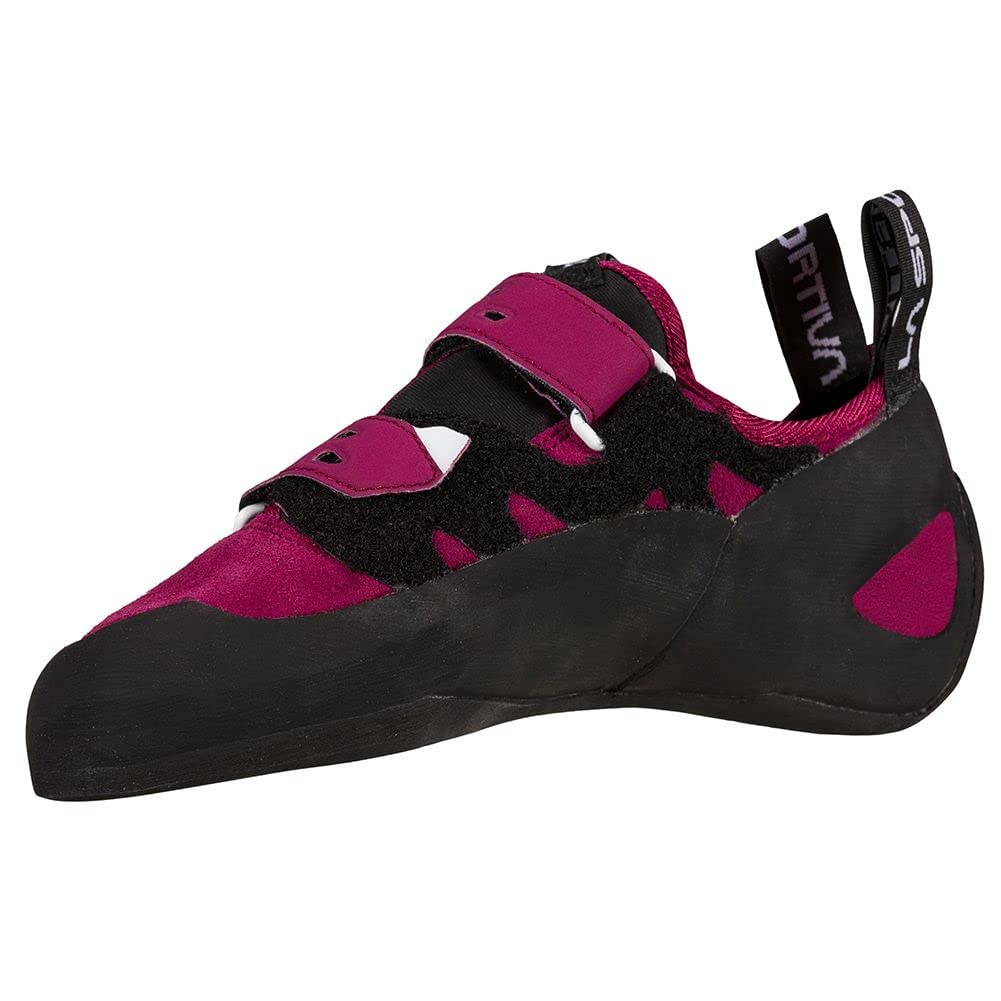
Key Features
- Fit: Runs small; size up half
- Heel: Higher-cut back
- Level: Beginner
- Closure: Hook-and-loop straps
- Price: Premium
The back of the Tarantula comes up higher than you expect. On a shoe this snug, that edge sits right on the Achilles for the first few sessions, and a heel that rubs is the fastest way to ruin a session you paid for. Order half a size up from your street shoe, since this one runs small even by climbing-shoe standards, and wear them around the house for an evening before you take them to the wall.
Past the first week, it earns its place. It’s essentially the strap version of our top pick, with the same La Sportiva shape and the same snug hold minus the laces, which makes it the one to choose if you want to pull shoes on between boulder problems instead of tying up. It’s comfortable for a few hours at the gym, and the build feels like the same shoe at the same standard.
What it costs to own is why it isn’t our top pick. It’s the priciest of the three, and the extra money buys straps rather than performance: the same fit as the lace-up, without the lacing. Buy it because that trade appeals to you. If it doesn’t, the lace-up is cheaper and the pair we recommend first.
Pros
- Straps make quick work of gym changes
- Same snug La Sportiva fit as the lace-up
- Comfortable for a few hours at the gym
Cons
- High-cut heel can rub the Achilles
- Priciest shoe in this group
We think of it as our top pick with straps: the same snug La Sportiva fit and quick on-off, worth buying if the higher heel clears your Achilles.
How We Tested the Best Women’s Climbing Shoes
We started with a long list of roughly 35 models and cut it down on specs first: women’s-specific lasts and low-volume fits, rubber thick enough to resole, and nothing priced above the mid-range tier. We also wanted a spread that covered people buying a first pair alongside climbers chasing their first 5.12. That left 12 pairs, which we climbed in for seven months.
Every pair went to the gym on Tuesday and Thursday nights for bouldering and top-rope laps, and most came along on weekend trips to granite and sandstone. We noted how long each took to get on and off, whether the heel lifted when we hooked it on a hold, and how much the sole flexed when we stood on a three-quarter-inch edge. Traction we judged by feel on polished plastic versus rough granite, paying attention to smears and heel hooks.
Fit got the most attention. We measured feet before the first session and again after two months to see how far each upper had stretched, and two newer climbers on the team wore each pair for a full three-hour session to judge whether the pressure faded or turned into hot spots. Durability came down to the toe rand: we checked for worn rubber, separating rands, and crushed liners every few weeks, and weighed each shoe new and again at the end to see how much rubber had gone. The pairs that kept their shape and stayed comfortable past the break-in were the ones that made the list.
How to Choose Women’s Climbing Shoes
Fit decides more than any specification here: a modest pair that matches your foot will outclimb an expensive pair that doesn’t.
Fit Comes Before Everything Else
Climbing shoes should be snug, not punishing. In a beginner-friendly flat shoe, your toes should touch the front without curling hard, your heel should stay down when you stand on a small edge, and there should be no single pressure point you notice after two minutes. Go half a size up from your street shoe if you’re between sizes. A shoe you can’t keep on for a full session won’t teach you anything about footwork, because you’ll spend the session thinking about your feet instead of the wall.
Laces or Hook-and-Loop?
The closure decides how much you can change the fit through a session. Laces give you range: crank the midfoot down for an outdoor day, loosen the whole shoe for the walk-off, and the adjustment holds once you’ve made it. Hook-and-loop straps are faster and more consistent, which is why they suit gym climbing and bouldering, where you’re changing shoes between attempts.
Two of our picks are the same La Sportiva shoe with different closures, so treat this as a real either-or rather than a step up in performance. Pick the one that matches how often you take your shoes off.
Gym Plastic and Real Rock Ask Different Things
Gym holds are rounded, often polished, and you spend a lot of time smearing. Outdoor edges are sharper and reward precision. A flat, comfortable beginner shoe handles a first year of both. A downturned, aggressive shoe helps on steep overhangs but is miserable to wear for a two-hour session, and it won’t make you better while your footwork is still forming. If you climb indoors twice a week and outside a few times a year, buy for the gym and accept that outdoor days will be a little less precise.
Give Them a Few Sessions Before You Judge
New climbing shoes feel stiff and slightly absurd. Wear them at home for an evening, keep the first sessions short, and don’t walk on pavement in them, which grinds the rubber flat. Most of the give happens early; ours softened noticeably by the third session. If a pressure point on the heel or the little toe is still there after that, the shoe is the wrong shape for your foot rather than merely new, and no amount of break-in fixes it.
Frequently Asked Questions
Do women’s climbing shoes fit differently from men’s?
Usually, yes. Women’s models are built on a lower-volume last with a narrower heel and a shorter forefoot, and they’re sized on that last rather than simply recolored. If your forefoot is wide, a men’s version of the same shoe in a smaller size can fit better.
Try the women’s model in your street size first, and go up half a size if your toes press the front.
Can you wear socks with climbing shoes?
Thin socks are fine, and they’re the difference between a snug shoe and an unbearable one if you’re between sizes or using rental pairs. They cost you a little feel on small holds.
Size for whatever you’ll actually wear: a shoe that is comfortably snug barefoot becomes tight with a sock, so bring the sock you plan to climb in when you try shoes on.
When do climbing shoes need resoling?
Watch the toe. When the rubber over the toe thins enough that the rand underneath starts to show, stop climbing in them and get them resoled; once the rand is worn through, the shoe usually can’t be saved.
Gym climbing wears the toe from repeated dragging more than from hard edging, so check the toe every few weeks.
Final Verdict
Buy the La Sportiva Tarantulace. It’s the shoe we recommend to anyone buying a first or second pair: snug enough to trust on small holds, comfortable enough to leave on for a whole session, and laced so it works as well outside as it does on plastic.
If your climbing is mostly bouldering and you want to skip the laces, the Black Diamond Momentum Strap is the quicker, less expensive alternative, provided your foot isn’t wide. Want the strap version of our top pick in the same snug La Sportiva fit? That’s the Tarantula, as long as a high-cut heel doesn’t sit on your Achilles.