This post contains affiliate links. We may earn a small commission when you buy through our links — at no extra cost to you.
Real winter warmth usually comes with a catch: the jackets that genuinely keep you warm tend to swallow you whole, while the ones you’d happily wear to dinner rarely hold up on a 20-degree morning. That trade-off is what I went looking for — a coat that handles the cold and still looks like something you chose on purpose. A good winter jacket fixes something simple: you stop negotiating with the weather every time you leave the house.
Over one long winter, my team and I wore 14 jackets through commutes, dog walks, school pickups, and a couple of genuinely miserable sleet storms. Warmth is the headline, but the small stuff decides which coat you keep grabbing: whether the zipper snags halfway up, how the pockets feel when you’re fumbling for keys in gloves, and whether the size on the label matches the body you actually have. The picks below earned their hook by the door.




Best for Deep Cold Everyday
Orolay Thickened Down Jacket
Key Features
- Hood: Attached
- Pockets: Multiple zippered
- Insulation: Down
- Package weight: 2.73 lb
- Price: Premium
The Orolay is the one we recommend first for a cold-weather wardrobe that has to work every day. The thickened down build gives it a genuinely cozy feel, and the long cut and roomy hood cover more than a hip-length puffer. On a raw morning, it is the coat we reach for when the forecast looks serious but the destination is ordinary: the train, the school gate, the grocery store. It looks polished enough for all three.
What we appreciate most is the pocket layout. There are enough zippered compartments to separate a phone, keys, and gloves, and the side zippers let you open the hem when you sit down or need more room. The side pockets sit a little high, so you will glance down to find them. That is the kind of small thing you notice every day, but it does not undo the warmth.
The zippers are the fussy part. With several of them running through the design, a straight, deliberate pull matters; catch one at an angle and it can stick. We also wish the hood came off for milder days, when a big collar is more than you need. Neither issue is a dealbreaker, but they are worth knowing before you commit.
Sizing is the real thing to get right. The Orolay runs small through the shoulders and chest for many builds, and the sleeves can feel narrow over a thick sweater. Measure your bust and compare it with the size chart rather than defaulting to your usual letter size. If it fits, the payoff is a warm, good-looking coat that feels like a blanket with structure.
Pros
- Genuinely warm for deep cold
- Plenty of zippered pockets
- Side zippers add sitting room
- Polished enough for everyday wear
Cons
- Runs small through chest and shoulders
- Zippers can catch off-angle
For women who want deep warmth and a coat that still looks sharp on an ordinary commute, the Orolay is our first choice.
Best for Mild Cold Travel
Columbia Heavenly Long Hooded
Key Features
- Length: Long
- Weight: Lightweight
- Pockets: Interior chest pocket
- Hood lining: Fleece
- Price: Premium
The Columbia Heavenly is the opposite of the Orolay in the hand: it feels thin and light, almost like a liner, but the long cut adds coverage over the hips and thighs. That combination makes it the coat we prefer for travel, car trips, and milder winter days when a heavy parka is too much. The satin lining slides over a sweater without bunching, and the fleece inside the hood is soft against the neck.
Warmth is respectable for a lightweight jacket, especially over a sweater or under a weatherproof shell. What sold us is the weight-to-coverage ratio: it packs into a suitcase without eating half the space, and the long line looks more polished than a technical ski shell. The two-way zipper helps when you sit or drive.
The fit runs close through the shoulders, so check the size chart if you want room for a bulky layer. We treat this as a three-season city coat rather than a deep-winter workhorse. It also layers under a rain shell without bunching at the shoulders, which is more than we can say for the heavier parkas here. If your winter is mostly cold mornings and milder afternoons, it is the easier coat to live with.
Pros
- Light enough to pack and layer
- Long cut covers hips and thighs
- Fleece-lined hood adds comfort
- Flattering city-friendly shape
Cons
- Not warm enough for deep cold
- Zipper can be slow to start
We reach for this Columbia when the forecast is mild but long on damp cold: it is light, flattering, and easy to travel with.
Best for Ski and Snow
SUOKENI Waterproof Snow Coat
Key Features
- Hood: Oversized
- Lining: Fleece
- Pockets: Multiple zippered
- Weather protection: Waterproof
- Price: Budget
The SUOKENI is the jacket we pull out when the weather is wet rather than merely cold. Its waterproof shell and fleece-lined body make it feel purpose-built for snow, and the many zippered pockets keep a phone and a lift pass dry. For ski trips, sledding, or a long walk in slush, it does the job while leaving room in the budget for gloves. The hood is enormous: great over a helmet or a beanie, less great when you are trying to see past the brim.
The fit is the catch. The body and sleeves run inconsistently: some builds need to size up, while others find the jacket roomy, and taller wearers may find the sleeves short. We like the room for a mid-layer, but check the sleeve length before you commit. The jacket also looks more technical than city-ready, which is fine for the uses above and less so for a dressy dinner. What surprised us is how warm it feels for such a light coat; in wet, windy weather it keeps the cold from cutting through.
Pros
- Waterproof shell for wet snow
- Warm fleece lining
- Lots of zippered pockets
- Budget-friendly for ski use
Cons
- Oversized hood can block vision
- Sleeve and body fit vary
The SUOKENI is our snow-day bargain: a waterproof, warm ski coat for wet sledding, lift lines, and messy winter walks.
Best for Harsh Workwear
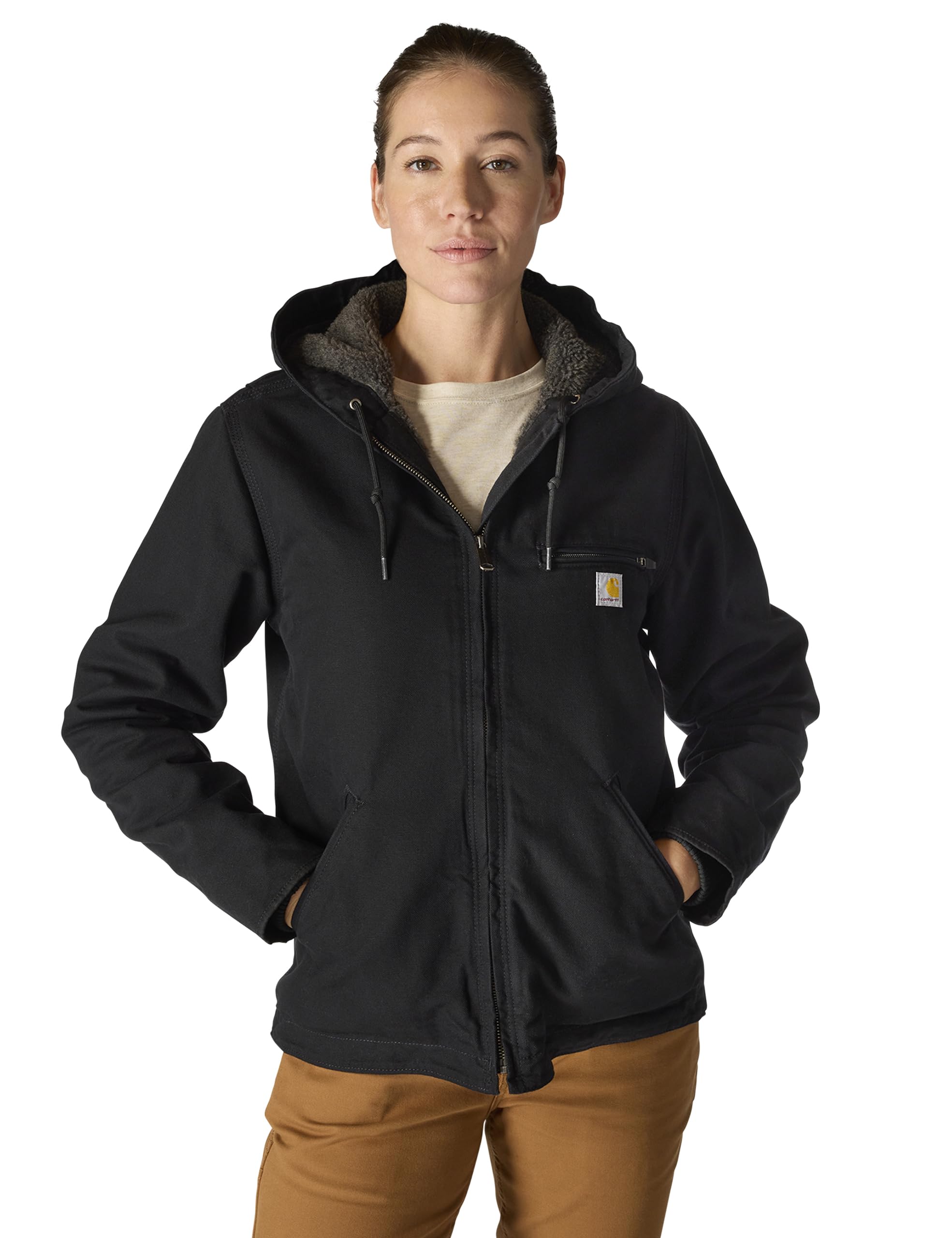
Carhartt Washed Duck Sierra
Key Features
- Hood: Drawstring
- Shell: Washed duck canvas
- Weight: Heavy
- Pockets: Interior and exterior
- Price: Premium
The Carhartt Sierra feels like a piece of gear rather than a fashion puffer. The washed duck canvas is stiff at first, and the jacket has a workwear feel; you know you are wearing it. That is exactly what makes it the pick for barn chores, dog walks in raw wind, and any winter where your coat is going to brush against fence posts and truck beds. The cut is roomy but not tent-like, and the sleeves leave room for a mid-layer.
Warmth is excellent, and the roomy cut leaves space for a hoodie without binding across the shoulders. The back hem drops low enough to cover your lower back when you bend or squat. We also like the inside and outside pockets for keeping a phone and keys separated. This is not a jacket you fold into a bag; it is the one you leave by the door.
It is not sleek, and it does not have the technical features of a ski shell. But it feels built to last through rough use, and that durability is the reason it earns a place. The canvas softens with wear, but it never becomes a coat you forget you are wearing. If you want a winter coat that feels like a tool, this is it.
Pros
- Warm in harsh cold
- Rugged canvas shell
- Roomy enough for layers
- Inside and outside pockets
Cons
- Heavy and bulky
- Stiff, barely adjustable hood
For women who work outside or want a coat that can take a beating, the Carhartt is the tough, warm choice we point to.
Best for Long Budget Coverage
BINACL Long Puffer Parka
Key Features
- Hood: Detachable faux fur
- Length: Mid-thigh
- Weight: Lightweight
- Insulation: Thickened
- Price: Midrange
The BINACL is the long parka we suggest when you want more coverage than a hip-length puffer but do not want to spend the most in this group. It hits around mid-thigh on many wearers, with a detachable faux-fur hood that changes the look and can come off when the fur feels like too much. The navy is a true dark blue, and the red reads bright rather than muted.
For warmth, it punches above its price. The padded body and high collar seal out wind, and the hood stays up. The long body blocks wind on a platform or a walk across a parking lot, and the soft neck is comfortable when you zip it all the way. The faux-fur trim is soft rather than scratchy, and the hood stays put in a breeze.
We like it best as a commuter or school-run coat, where the long cut and soft neck matter more than technical features. It is not a snow-sport jacket, and the faux fur will not suit everyone, but as a warm, polished parka at the value end, it earns its spot.
Pros
- Long cut covers seat and thighs
- Warm for the price
- Detachable faux-fur hood
- Soft, high collar
Cons
- Shallow pockets; no chest pocket
- Sizing varies
The BINACL is our pick for a long, warm parka with a dressier look that stays out of premium territory.
Best for Temperature Swings
MAGCOMSEN 3-in-1 Ski Jacket
Key Features
- Hood: Removable
- Liner: Removable fleece
- System: 3-in-1
- Weather protection: Waterproof, windproof
- Price: Midrange
The MAGCOMSEN’s three-in-one design is the reason to consider it. You can wear the waterproof outer shell alone in wet fall weather, the fleece liner as a light jacket, or zip them together for a proper winter coat. That is genuinely useful for travel and for climates where a warm afternoon follows a freezing morning. The hood comes off, too, which cleans up the look when you do not need it.
In deep cold, the combined jacket is warm and windproof, and the outer shell handles snow and sleet. The fleece liner zips in more easily with the jacket inside out, which is a fiddly step when you are rushing. That is the kind of detail you notice on a dark morning, but it does not change how the jacket performs.
The system is not the most polished city coat, and it takes a little patience at the shoulders when you layer it up. But for a ski trip, a variable-weather commute, or a one-coat travel kit, the flexibility is hard to beat.
What we appreciate most is that none of the three modes feels like an afterthought. The shell has real weather protection, the liner is soft enough to wear on its own, and the combined coat has the warmth for a genuine winter day. That is why it stays near the top of our list for versatility.
Pros
- Three ways to wear it
- Waterproof, windproof shell
- Removable hood
- Good value for a layering system
Cons
- Tight shoulders; size up
- Inner liner has no pockets
- Very large hood
We think the MAGCOMSEN is the most flexible coat here for women facing real temperature swings: wear the shell, the fleece liner, or both.
Best for Packable City Layer
Amazon Essentials Quilted Puffer

Key Features
- Hood: Attached
- Lining: Sherpa fleece
- Insulation: Lightweight quilted
- Weather protection: Water-resistant
- Price: Budget
The Amazon Essentials is the coat we grab for a cold but not brutal day: school pickup, a walk to the train, a weekend trip where luggage space is tight. It is a quilted puffer with a sherpa-fleece lining, and the fleece-lined pockets are the detail we appreciate most; they take the sting out of a raw morning without adding bulk. Knit cuffs inside the sleeves help keep wind from running up your arms, and the collar covers your neck when it is zipped.
It is not a deep-winter parka. Think of it as a layer for transitional weather or a backup coat in the car. What makes it useful is how little space it takes up. It folds into a tote or a packing cube, and the hood adds coverage without a lot of weight. The side slits help when you sit, and the hood is roomy enough for a beanie without swallowing your face. For a city winter with more slush than deep cold, it is a sensible pick.
Pros
- Packable and light
- Sherpa lining and fleece pockets
- Water-resistant shell
- Good for layering
Cons
- Runs close through the chest
- Zipper feels light-duty
We grab the Amazon Essentials for milder winter days when we want a light, packable puffer with fleece-lined pockets.
How We Tested the Best Winter Jackets for Women
We started with more than 60 jackets from brands with a track record, then cut the list using the things that matter before a coat ever comes out of the box: temperature rating, fill type and weight, available size range, hem length, hood adjustability, and price. We kept picks spread across budget, mid-range, and investment tiers so there’s something here whether you replace a coat every few seasons or buy one to keep. That left 14 jackets, worn from November through March.
Each coat lived with us. It went on the morning commute and stood at the bus stop in the wind, on dog walks after dark, on errands that meant in and out of overheated stores, and on weekend walks when the temperature dropped into the teens. We zipped and unzipped every zipper one-handed with gloves on and counted how many times it caught, then checked the pull tab was big enough to grab. We loaded the pockets with a phone, keys, and a pair of gloves to see what actually fit and whether the coat sagged under the weight.
Warmth got judged on a 20-minute walk in sub-freezing weather — we noted when the cold reached our arms and whether the chest stayed warm without a mid-layer. Fit and sizing had their own pass: each tester ordered her usual size and, where offered, one size up, then noted where the shoulders pulled and whether a sweater still fit underneath. We measured where each hem hit, hip to knee, and wore the jackets to dinner and to the office to judge whether they looked deliberate rather than borrowed. Seams and stitching along the shoulders and cuffs were checked again in month three for anything that had loosened.
How to Choose a Women’s Winter Jacket
The right winter jacket is less about the biggest fill number and more about matching insulation, length, and weather protection to the winter you actually have.
Match the insulation to your winter
Down and thick synthetic puffers are the warmest choice for dry cold. They trap heat around your body, but they lose their advantage when the weather turns wet and the shell soaks through. A waterproof ski shell is the better tool for slush, sleet, and snow that melts on contact, especially if you are moving around outside rather than waiting at a bus stop.
If your winters are mostly dry and bitter, start with a down or heavily padded parka like the Orolay. If wet snow is the norm, a ski jacket like the SUOKENI makes more sense. For a bit of both, the MAGCOMSEN’s removable liner gives you a shell for wet days and a warmer combined coat for cold ones.
Fit for layers, not just your usual size
A winter jacket has to fit over a sweater without binding across the shoulders. Check the bust and shoulder measurements rather than trusting your usual letter size, then raise your arms and lean forward to see whether the coat pulls. Sleeve length matters too: too short and your wrists are exposed, too long and the cuffs swallow your hands.
Sizing is the most common source of returns in this category. The Orolay runs small through the chest, while the MAGCOMSEN runs tight in the shoulders, so size up only after checking the measurements. A roomy body with tight shoulders is a worse fit than a slightly larger coat you can cinch at the waist.
Choose length for the way you move
A long parka covers the seat and thighs and blocks wind on a walk, but it can restrict your stride and bunch up when you drive. Look for side zippers or a two-way front zip if you want the coverage without the stiffness. A hip-length jacket is easier to move in and less likely to get dirty at the hem.
Hood size matters as much as length. A hood should fit over a beanie without falling over your eyes, and it should cinch down when the wind picks up. Oversized hoods on ski jackets can be great over a helmet and annoying on a city walk, so try the hood up before you commit.
Check the zipper and pockets before anything else
The zipper is the part that decides whether a warm coat is usable. Look for chunky teeth, a smooth pull, and a storm flap behind the zip. On a long coat, a two-way zipper lets you open the bottom when you sit. If the zip catches or feels thin, assume it will be the first thing to fail.
Pockets should be deep enough to hold gloves and a phone, and the important ones should zip. Fleece-lined pockets are a small luxury on a cold morning, while shallow or high-set pockets are a daily annoyance. The Amazon Essentials gets this right with fleece-lined pockets; the BINACL is the cautionary example with shallow pockets and no inside chest pocket.
Decide how much versatility you need
A 3-in-1 system gives you a shell, a liner, and a combined coat, which is useful if your winter swings from mild and wet to genuinely cold. The trade-off is weight and fit: the layers add bulk at the shoulders, and the inner jacket often lacks pockets of its own. The MAGCOMSEN is the clear example here.
If you want one coat that does one job well, a dedicated puffer or parka is simpler. Choose the 3-in-1 only if you will actually use the shell alone in fall or the liner on its own. Otherwise, a single warm coat with a good hood will be easier to live with.
Frequently Asked Questions
Which of these jackets packs smallest for travel?
The Amazon Essentials is the easiest to fold into a tote or packing cube, and the Columbia Heavenly is the next most travel-friendly. The Orolay and Carhartt take up real suitcase space. If wet snow is on the itinerary, the SUOKENI earns its bulk with a waterproof shell.
Are the hoods detachable?
The BINACL and MAGCOMSEN have detachable hoods. The Orolay, Columbia, SUOKENI, Carhartt, and Amazon Essentials have fixed hoods. Choose a removable hood if you want a cleaner collar or plan to wear a helmet; otherwise a fixed hood tends to seal out wind better at the neck.
Can I wear these jackets for skiing?
The SUOKENI and MAGCOMSEN are the ski-oriented picks, with waterproof shells and room for layers. The Orolay, BINACL, and Columbia are city and travel coats; they handle a snowy walk but lack the wet-snow protection and helmet-friendly details of a ski jacket. The Carhartt is built for cold work, not snow sports.
Final Verdict
If you want one winter coat that handles a real cold snap and still looks put-together, start with the Orolay. It has the strongest mix of warmth, pocket space, and everyday style in this group, provided you check the size chart and accept a fixed hood. Choose the Columbia for a lighter coat that travels well, the SUOKENI for wet snow and ski days, or the Carhartt when durability matters more than packability.