This post contains affiliate links. We may earn a small commission when you buy through our links — at no extra cost to you.
A hiking jacket has one job in bad weather—keep the rain out—and several quieter jobs the rest of the time: let sweat escape on a climb, pack down small, and look normal enough for the drive home. That balance is where most shopping decisions get stuck. A jacket that shrugs off a downpour can feel like a plastic bag on a steep mile, and the lightest shell won’t help if the fit is so trim you can’t layer a fleece under it. The right shell solves that trade-off without making you choose one virtue over the others.
I’ve had shells that fit beautifully and soaked through at the shoulders, and others that kept me dry while rustling like a tarp. Over eight months, my team and I wore 14 waterproof hiking jackets on wet morning walks, windy ridge climbs, and drizzly weekend errands, watching seams, hoods, cuffs, and packed size. The best share solid construction, room for layers, and weather protection that doesn’t quit halfway up the trail.
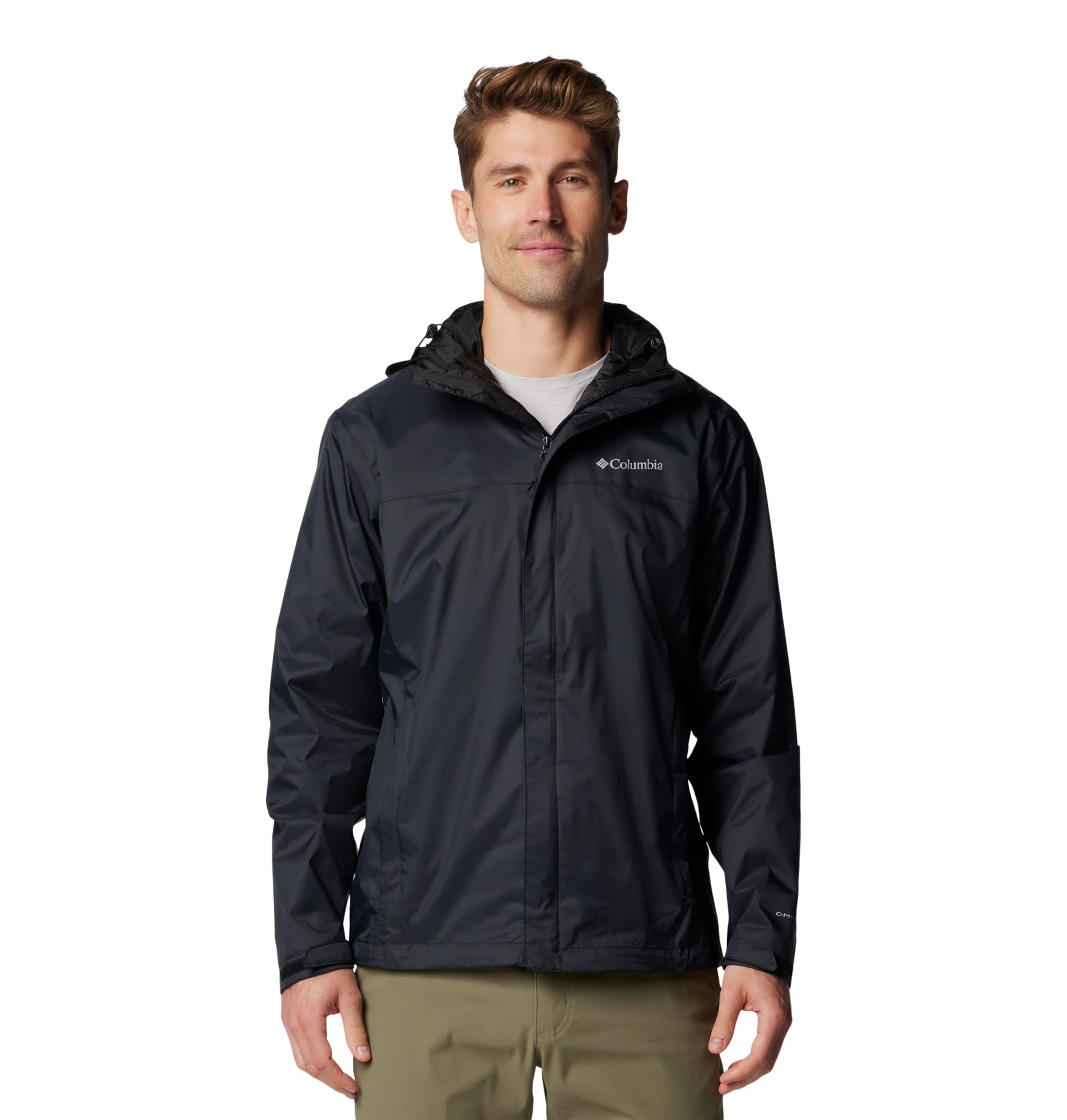


Best for Three-Season Hiking
Columbia Watertight II
Key Features
- Hood: Attached
- Type: Men’s rain shell
- Packability: Folds small into a pack
The Watertight II is the jacket we kept pulling out of the pack, and that’s the recommendation in one line: it does the two jobs a hiking shell has to do without asking anything of you. Rain stays out on a long, wet day, and when the sky clears it rolls into a bundle small enough to forget about.
What we noticed in steady rain is how little there is to fiddle with. The hood sits close and stays forward when you look up, the cuffs close down over gloves, and the front zip keeps the weather out without a fight. It blocks wind well too, which matters more than people expect on open ground, because a wet wind is what turns a mild day miserable.
It’s genuinely light, light enough that you stop noticing it on the climb, and it doesn’t trap heat the way a lined jacket does. That’s the point of an unlined shell: add a fleece at the summit, strip it on the way up, and let the jacket handle the weather. Fit is the one thing to get right. It runs big and the sleeves run long, which is generous over a midlayer and sloppy over a baselayer, so if you hike in a thin layer and you’re between sizes, take the smaller one.
Worth saying plainly: this is a men’s cut, and the women’s jacket in this guide is a different shape rather than a scaled-down version, so start there instead of sizing down in this one. For everyone else hiking three seasons in a wet climate, it’s the default.
Pros
- Keeps steady rain out
- Rolls into a small bundle
- Light enough to wear on the climb
- Cuts wind as well as rain
Cons
- Runs big with long sleeves
We recommend this to almost every hiker: it keeps steady rain out, packs to nothing, and layers well enough to cover three seasons of walking.
Best for Sustained Rain
The North Face Antora
Key Features
- Fit: Roomy for layering
- Type: Men’s waterproof jacket
- Sizing: Standard and big sizes
- Price: Premium
Some shells are built for a shower and some for the day the forecast gives up. The Antora is the second kind, a substantial, roomy jacket that we were glad to have when rain settled in for hours instead of blowing through.
What the extra money buys is a jacket that feels like kit rather than a plastic bag. The fabric has some body to it, water beads and runs instead of soaking into the surface, and it shrugs off wind on open ground. Against the Watertight II it’s the more reassuring jacket in genuinely grim weather, and whether that’s worth the step up depends on how often you hike wet. If rain is a regular feature of your weekends rather than an occasional inconvenience, it is.
The cut is generous, roomy enough for a fleece plus a grid midlayer without feeling like a tent, and the standard-and-big sizing is a real advantage for anyone who finds shells tight across the shoulders. Two things to know before you buy: it’s a shell, so it won’t warm you on its own, and we found it ran hot on fast climbs. On a cool, wet day that’s fine. On a humid summer ascent you’ll want something thinner.
Pros
- Sheds water through long wet days
- Roomy enough for a midlayer
- Holds wind off on open ground
- Comes in standard and big sizes
Cons
- Runs hot on fast climbs
If your hikes regularly meet hours of rain, this is the shell we point you to: roomier, sturdier, and more windproof than the lighter picks here.
Best for Warm-Weather Hikes
Columbia Arcadia II
Key Features
- Hood: Attached
- Type: Women’s rain jacket
- Pockets: Deep hand pockets
Start with the sizing, because it decides whether you like this jacket: the Arcadia II runs small, and it runs small through the chest and hips rather than just the shoulders. Order a size up, especially if you plan to wear a fleece underneath.
Get that right and it’s one of the easiest jackets here to live with. It’s thin and light, the fabric doesn’t crackle like a cheap shell, and the hood is cut to sit forward over your face instead of sliding back the moment you look up at the weather. The hand pockets are properly deep, and the Velcro cuffs close down over gloves to stop drips running up your sleeves.
In rain it does what a light shell should: water beads and runs, and the whole thing weighs so little that we stopped thinking about it on the climb. It’s at its best in warm, wet weather, where anything heavier turns into a sauna, and it won’t keep you warm on its own. There’s no inside pocket either, which is the one shortcut we noticed. For women hiking three seasons in a wet climate, it’s the sensible place to start.
Pros
- Thin, light, quiet fabric
- Hood sits forward over your face
- Deep hand pockets
- Beads water in steady rain
Cons
- Runs small, so order up
- No inside pocket
Size up and this becomes the women’s shell we reach for in warm, wet weather: light, quiet, and covered where it counts.
Best for Cool-Weather Hikes
Diamond Candy Rain Jacket
Key Features
- Hood: Removable, zippered
- Type: Women’s hooded rain jacket
- Lining: Warm inner lining
- Price: Midrange
There’s a warm lining in the Diamond Candy, and it changes the character of the jacket. On a raw, drizzly morning you can step out of the tent in a baselayer and be comfortable, without a midlayer, which is not something we can say about the unlined shells here.
Rain performance is good rather than exceptional. Water beads and rolls off in drizzle and light rain, and it cuts wind well enough that a breezy ridge doesn’t go straight through you. What we wouldn’t do is rely on it for hours of heavy rain, which is a job for a technical shell. In exchange you get a jacket that’s far more pleasant around camp or in town than a thin, crinkly one.
It’s thicker than a windbreaker and it packs bigger because of the lining, and that’s the trade you’re making. The hood zips off for mild days, the pockets are zippered and covered, and the cuffs adjust. The fabric has enough structure that it doesn’t cling when you’re moving, which is more than we expected from a lined jacket at this level.
Think of it as a cool-weather hiking jacket rather than a summer one. It’s at its best on slower days, a damp walk, a misty summit, a cold morning, when warmth matters as much as keeping the rain off, and it’s the jacket we hand to someone who feels the cold on every trip.
Pros
- Warm lining for raw mornings
- Sheds drizzle and light rain
- Hood zips off on mild days
- Zippered, covered pockets
Cons
- Runs small through the hips
Our pick for cold, drizzly women’s hikes: the lining does the work of a midlayer, so you carry one jacket instead of two.
Best for Low-Light Hikes
baleaf Men’s Rain Jacket
Key Features
- Type: Men’s hooded rain shell
- Length: Longer at the back
- Visibility: Reflective details
- Price: Midrange
Two details sold us on the baleaf, and neither shows up in a waterproof rating: reflective trim across the shoulders and back, and a hem that drops lower than most shells here. On a dawn start or a dusk finish, that combination is worth more than a slightly better coating.
It’s built for cyclists and runners and it shows. The fit is trim, the hood is big enough to swallow a cap, and it stuffs into a pack pocket or a jersey pocket without a fight. For hiking we take it on a fast, sweaty walk in light-to-moderate rain rather than an all-day soaking; where it stops is the sustained stuff, when you want a shell with more fabric between you and the weather.
The hood is deliberately big, good over a cap and it cinches down when the wind picks up, and the pockets are the nicest surprise: stormproof zips on the hand pockets and a chest pocket that swallows a phone. The longer back is the detail we kept appreciating, because it stays where it is when you’re moving and doesn’t ride up over a hipbelt.
Pros
- Reflective trim for dark starts
- Longer back hem
- Stormproof zippered pockets
- Packs into a jersey pocket
Cons
- Runs small, so order up
- No pit zips, clammy on climbs
For dawn starts and dusk finishes we take this one: reflective, longer in the back, and honest about being a light-rain jacket.
Best for Cold Morning Starts
33,000ft Fleece Lined Shell
Key Features
- Hood: Adjustable
- Type: Men’s hooded rain shell
- Lining: Fleece lined
- Price: Midrange
A cold, drizzly morning at the trailhead is where this jacket earns its place. The 33,000ft has a thin fleece lining that takes the sting out of a raw start, and it does it without the bulk of an insulated coat: you can still swing your arms and wear a pack comfortably.
Rain protection is fine for drizzle, mist, and light showers, and the fabric keeps the wind off. It isn’t the jacket we choose for hours of steady rain, and it isn’t a summer piece at all. This is cold-weather, low-effort kit: a slow walk, a flat trail, a morning that never warms up.
Where it impresses is warmth for the weight. The lining traps heat without turning the jacket into a sleeping bag, and the seams and zips are neat and have held up. The body sits close, which is what makes the lining work, so it’s a poor fit over a thick midlayer. As a warm layer for cold, wet days, nothing else here does the job as simply.
Pros
- Fleece lining traps warmth
- Keeps drizzle and wind out
- Neat seams and working zips
Cons
- Narrow sleeves run tight
- Clammy once you climb hard
The jacket we hand to anyone who hikes cold and slow: fleece-lined warmth for drizzly starts, provided the day isn’t a hard climb.
Best for Cold Wet Walks
Outdoor Ventures Softshell

Key Features
- Type: Women’s softshell rain coat
- Length: Covers to the knees
- Lining: Fleece lined
- Pockets: Multiple zippered pockets
- Price: Midrange
This is a coat rather than a technical shell, and we mean that as a description, not a complaint. The Outdoor Ventures is a long, fleece-lined softshell that falls to the knee, and it earned its place on the parts of a wet hiking trip that aren’t really hiking: the walk into town, the cold morning at camp, the muddy path where being warm beats being fast.
It sheds steady rain, the lining is properly warm, and the knee-length body keeps your thighs dry in a way no hip-length jacket manages. The pockets are numerous and zippered, and the two-way zip lets you open it from the bottom when you sit down or push a bike up a hill. The cut is generous and the inner drawstring pulls it in at the waist, so it doesn’t hang like a sack.
Pros
- Knee-length coverage
- Fleece lining for cold days
- Lots of zippered pockets
- Two-way zip for sitting
Cons
- Too warm and long for summer ascents
We treat it as a wet-weather coat, not a trail shell: warm, knee-length, and happiest at camp or on the walk in.
Best for Light Rain, Travel
OTU Men’s Rain Jacket

Key Features
- Type: Men’s hooded rain shell
- Style: Lightweight and packable
- Pockets: Zip hand and chest pockets
- Price: Budget
A jacket this inexpensive raises two questions: what it does well, and where it stops. The OTU is light, packs into almost nothing, and keeps you dry on a short walk in light rain.
That’s the honest split. Water beads and runs off in drizzle, and the fabric blocks wind, but in sustained or heavy rain it can wet through and leave you feeling it. We treat it as a just-in-case shell, the one that lives at the bottom of a pack or a suitcase for the shower nobody planned for, rather than the jacket to rely on when rain is in the forecast.
Sizing runs large and the hood is genuinely huge: good over a cap, tiresome in wind unless you cinch it down. The pockets are a pleasant surprise, with two zippered hand pockets and a large zippered chest pocket that takes a phone, and the whole thing folds back into its own little bag at the end of a trip.
As a spare, it makes sense. Keep one in the car or at the bottom of a daypack for summer showers, and it earns its keep the first time the sky opens on a walk that was supposed to stay dry.
Pros
- Light and packs tiny
- Fine in drizzle and light showers
- Two zip hand pockets plus a chest pocket
Cons
- Can wet through in sustained rain
- Runs large with an oversized hood
We keep one as a spare: light, packable, and fine in drizzle, though a real downpour will find its way through.
How We Tested These Waterproof Hiking Jackets
To build the shortlist, I started with jackets actually cut for hiking: a hood you can cinch, seams that are taped or welded, and fabrics rated for sustained rain rather than a dash to the car. We cross-checked specs against customer reviews for repeated complaints about sizing, wet-out, and zippers, then narrowed by price and available sizes. That left 14 jackets, which we wore over eight months.
Testing happened where jackets get used. We wore them on wet morning walks, hiked in steady rain and drizzle, climbed windy ridges, brushed through wet brush, and stuffed each jacket into a daypack at the trailhead. After wet hikes we checked shoulders, chest, and hood for damp spots, then noted whether water beaded or soaked in. We wore each over a T-shirt on mild mornings and over a fleece and thin puffer on colder ones, watching for clammy backs, overheating on climbs, and any real warmth.
Fit and sizing got their own scrutiny. Testers tried their usual size and, when possible, one size up, then raised their arms overhead, cinched the hood, and layered a midweight fleece underneath; we noted tight shoulders, short sleeves, and hems that rode up. We checked zippers, seam tape, stitching, and cuff closures for signs of corner-cutting, and wore the jackets on drizzly weekend errands to see whether they looked like trail gear or something I’d keep on. Lightweight models earned points only if they still blocked wind and rain.
How to Choose a Waterproof Jacket for Hiking
The jacket that keeps you dry is the one you actually carry, and on a hike that means weighing rain protection against sweat, weight, and pack space.
Waterproof and breathable: where jackets fail
A shell does two jobs at once: it stops rain getting in and it lets sweat out. The second half is where bad days happen. A fabric that blocks water completely also blocks vapour, so the harder you climb, the more condensation collects inside, which is why a jacket can keep the rain off and still leave you soaked. Vents, a breathable fabric, and a hood that cinches properly are what separate a shell you wear all day from one you resent.
Match the jacket to your rain. Showers and drizzly mornings are handled by any decent light shell; a climate where rain settles in for hours justifies spending more on fabric and hood design. The North Face Antora is the jacket here built for that second case.
Packability: buy the jacket you’ll carry
On a hike, the jacket in your pack beats the better one you left at home. Packed size and weight decide whether a shell goes in the daypack on a sunny forecast or stays in the car, and that decision matters more than a small difference in waterproofing. Unlined shells fold down smallest; fleece-lined jackets take up noticeably more room. If you hike with a small pack or you’re packing for a trip, choose something that stows, as the Watertight II and the baleaf both do, and treat a lined jacket as cold-day kit.
Lined or unlined: match it to the season
An unlined shell plus a midlayer is the more flexible system: add a fleece at the summit, strip it on the climb, and the same jacket works from spring to autumn. A fleece-lined jacket is warmer and simpler, one thing to pack instead of two, but you can’t take the lining off when the trail tilts upward. If most of your hiking is cool, slow, and wet, lining is comfort. If it involves real climbing, stay unlined. The Diamond Candy and the 33,000ft are the lined options here we rate; the Antora and the Watertight II are the layering ones.
Fit: size for the layer you’ll wear
Sizing is the most common mismatch in this category, and it runs both ways: several jackets here fit small, and a couple are roomy enough to swim in. Fit the jacket over the layer you’ll actually wear underneath, then reach forward as if grabbing a handhold, because a shell that fits standing still can leave your wrists bare when you stretch. Between sizes with a baselayer only, size down; layering a fleece, size up. Check the hood the same way: it should cinch over a cap without pulling the whole jacket up.
Frequently Asked Questions
What should I wear under a waterproof jacket on a hike?
A thin synthetic or wool base layer, plus a fleece or light synthetic midlayer when it’s cold. Skip cotton, which holds sweat and chills you the moment you stop. With a lined jacket like the Diamond Candy or the 33,000ft you can usually leave the midlayer at home; with an unlined shell, carry one. Try the combination on before you go, and if the shoulders feel tight with the midlayer on, size up.
How do I keep a jacket waterproof after washing it?
Wash it with a technical cleaner rather than ordinary detergent, skip fabric softener, and tumble it on low, because the heat reactivates the water-repellent finish on the face fabric. If water still soaks into the surface instead of beading, apply a spray-on water-repellent treatment and let it cure. A jacket that wets out on the outside isn’t necessarily leaking; usually the finish is asking for a refresh.
Are packable rain jackets as waterproof as heavier ones?
Not automatically. Packability usually comes from a thinner face fabric, and thinner fabric has less to give when rain keeps coming, so the lightest jackets here are at their best in showers rather than an all-day soaking. The trade-off is still worth it if the alternative is leaving the jacket at home. Carry a packable shell for summer and uncertain forecasts, and a more substantial one for trips where rain is guaranteed.
Final Verdict
For most hikers, the Columbia Watertight II is the jacket to buy. It keeps rain out on a long wet day, packs small enough to live in a daypack, and doesn’t turn into a sauna on the climb. If you hike where rain settles in for hours, the North Face Antora is the more substantial shell and worth the step up. Women shopping for the same lightness should start with the Arcadia II and size up.
If you want warmth built in, the Diamond Candy for women and the 33,000ft for men are the ones we pack for cold, drizzly days. The OTU is a spare, not a shelter.