This post contains affiliate links. We may earn a small commission when you buy through our links — at no extra cost to you.
Thermal underwear has a Goldilocks problem: the pair that keeps you warm on a cold morning is often the pair that bunches under jeans by lunchtime. I’ve worn enough base layers to know that the wrong set makes you choose between shivering at the bus stop and sweating through a meeting. What you want is a pair that disappears under clothes, holds its warmth after a wash, and feels soft enough to forget you have it on. That’s the problem these picks solve.
Over one winter, we tested 14 pairs on commutes, weekend walks, and drafty office days, paying close attention to fit and sizing across different builds. The keepers kept their shape after repeated laundry, showed no thin spots at the knees or seat, and stayed comfortable without extra bulk. Value mattered too, but not in a cheap way: the best pairs earned their place by lasting and layering well. The right pair for you depends on how cold you run and what you wear over it, and there’s a match below for both.




Best for Cold-Weather Hiking
romision Thermal Set
Key Features
- Fit: Snug stretch
- Neckline: High collar
- Set contents: Top and bottoms
- Price: Budget
Skiing, snowboarding under a bib, a full day on a roof in February: the base layer question is always the same. Does it hold heat when you’re out for hours, and does it stop cooking you once you start moving? This set handled both better than anything else we tested. Warmth is the headline, and it arrives without bulk, thin enough to vanish under a shell and warm enough that we stopped thinking about the temperature.
Two details do a lot of the work. The collar sits high enough to close the gap between a jacket and your neck, which is where a surprising amount of heat leaves. The legs run long and the knit stretches with a stride instead of fighting it, so the cuffs stay down inside a boot rather than bunching at the ankle halfway up a hill.
It’s a thin knit, and we count that as a feature rather than a compromise: thin layers slide under anything and let you add a midlayer where you need one. If you want plush fleece against your skin, this isn’t that. The fleece-lined sets below feel softer on contact and trap more heat when you’re standing around, and that’s a real difference on a cold, stationary day.
What settled it for us is that nothing about it needs managing. It doesn’t ride up, it doesn’t need a particular outer layer, and it doesn’t cost enough to make you nervous about washing it. The bottoms are the quieter win: long, stretchy and completely unnoticeable under jeans, which is exactly what a bottom layer should be.
Pros
- Holds heat through long days outdoors without bulk
- High collar closes the neck gap under a shell
- Long, stretchy legs that stay tucked into boots
- Full set at the bottom of the price range here
Cons
- Top runs small against the listed chart
The best all-round set here: warm without bulk, long in the leg, high at the collar, and cheap enough to own two.
Best for Budget Winter Layering
HEROBIKER Fleece-Lined Set
Key Features
- Fit: Snug but not tight
- Lining: Fleece lined
- Set contents: Top and bottoms
- Price: Budget
Buying a thermal set usually means choosing between cheap and warm, and this one refuses the trade. You get two fleece-lined pieces at the bottom of the price range here, and the lining is the part we keep coming back to: brushed and soft against the skin, closer to a light sweatshirt inside than the scratchy waffle a lot of budget long johns use.
Fit is what makes it the value pick rather than just the cheap one. The knit stretches and settles instead of clamping, so it lies flat under jeans and work trousers and doesn’t fight whatever you pull on over it. Nothing about it is trying to be tight, which is the right call for something worn under clothes rather than as the outer layer. It also machine washes with the rest of a normal load, which matters more than it sounds for a garment you’ll wear three days running.
Where it gives ground is serious cold. The fleece is warm but it’s a midweight layer, so it does its best work with something over it and starts asking for a second layer when the temperature drops hard and you stop moving. That’s the honest boundary: for a commute, a dog walk, a day under work clothes, it’s plenty. For a summit, the romision’s thinner, more technical knit layers better, and the Thermajohn traps more heat when you’re idle.
Pros
- Soft brushed fleece lining, not scratchy
- Sits flat under jeans and work trousers
- Full two-piece set at the low end of the price range
- Stretchy knit that settles rather than clamps
Cons
- XL runs small against the rest of the size run
- Not enough on its own in serious cold
The best-value set here: a warm fleece-lined top and bottoms that sit flat under everyday clothes instead of bunching.
Best for All-Day Comfort
Thermajohn Long Johns Set
Key Features
- Feel: Silky smooth
- Lining: Microfleece
- Set contents: Top and bottoms
- Price: Premium
The inside is the whole argument. A smooth microfleece that feels like sleepwear rather than outdoor gear, with no scratch, no chill on first contact and none of the wool-adjacent texture that makes some base layers a chore to put on. We think that’s worth paying for if you’re the sort of person who notices what’s against their skin for eight hours.
It’s built for long, low-effort wear: a shift on your feet, a long walk, a day under jeans and a sweater. The legs don’t ride up and the fabric doesn’t bunch behind the knee, which is the difference between a layer you forget about and one you keep adjusting in public. The fleece is also soft enough that it doubles as loungewear, which is not something we can say about the waffle knits here.
What it isn’t is a technical layer. The fleece is thin, so it warms the way a soft sweater warms rather than the way a lofted synthetic does, and it loses ground fast if you’re standing still in wind. The size run is the bigger catch, and it runs small across the board, the tops especially. Order up, and if you’re tall, expect the legs to land on the short side.
Pros
- Microfleece lining that feels like pajamas
- Stays in place on long days of walking
- Soft enough to wear around the house
Cons
- Thin fleece, so it layers rather than fights deep cold
- The priciest of the fleece-lined sets here
Worth the extra if comfort outranks technical performance: the softest thing against your skin in this group, if you size up.
Best for Working Outdoors
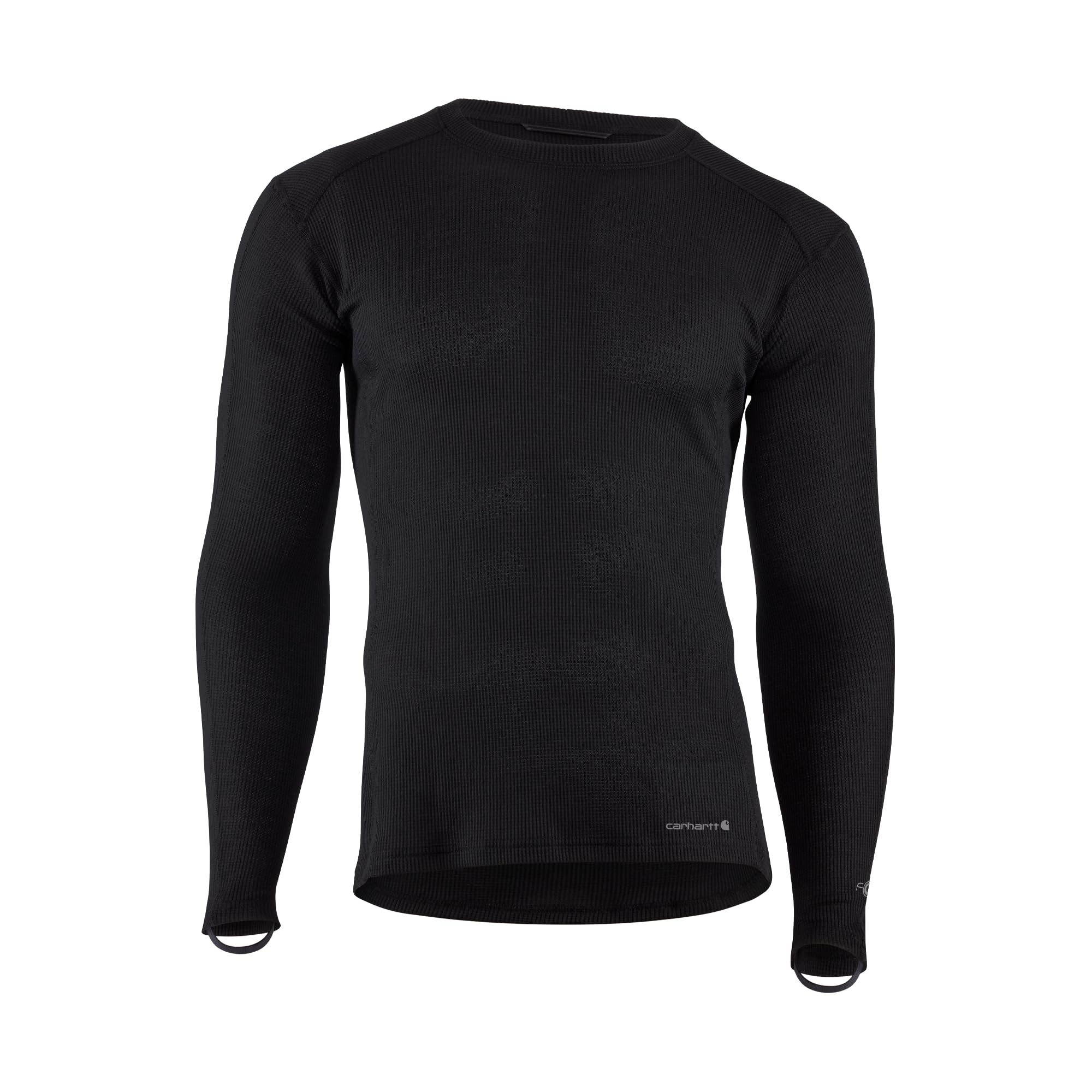
Carhartt Force Waffle Crew
Key Features
- Knit: Waffle
- Cuffs: Thumb holes
- Weight: Midweight
- Pieces included: Top only
- Price: Premium
Most thermal shopping is a set decision, which is a problem when only half of yours wears out. This is the best tops-only option here: buy the piece you actually need instead of a second pair of bottoms that will sit folded in a drawer until spring.
The design is aimed at people who work in it. The body and sleeves run long and slim, so nothing pulls out of a waistband or a glove, and the waffle traps warm air without much loft. It also moves sweat along rather than holding it, which is the difference between a layer you can wear through a shift and one you have to peel off at lunch.
The word midweight oversells the thickness, though, and that’s the judgement you need before ordering. This is a genuinely thin layer, useful under a work shirt or a jacket and forgettable in the good sense, but it is not what you want if the plan is standing around in the cold. Where thin is a feature, it’s an excellent top; where you wanted bulk, it will disappoint, and the price is high for one garment.
Where it earns its keep is the rider, the tradesman and the winter golfer: someone moving, sweating a little, then stopping. The thumb holes are the detail we didn’t expect to care about, right up until a sleeve rides up inside a jacket at exactly the wrong moment.
Pros
- Thumb holes keep the sleeves from riding up
- Long body and sleeves stay tucked
- Wicking knit for active days
- Thin enough to wear under a work shirt
Cons
- Runs close and small through the shoulders
- Premium price for a single layer
Buy it if you only need the top half: thin, long in the body and warm under a work shirt, with cuffs that stay down.
Best for Winter Sport Layers
Under Armour ColdGear Mock
Key Features
- Fit: Fitted, long torso
- Neckline: Mock neck
- Pieces included: Top only
- Price: Premium
The torso is the tell. This mock is cut long so it stays tucked into whatever you wear over it, and the neck comes up high enough to seal a jacket collar without a scarf. If you’ve ever spent a cold morning hitching a base layer back down every few minutes, that’s the specific problem it solves.
For cold-weather exercise it’s the most technical top here: fitted without being restrictive, warm from the knit rather than from loft, and comfortable under a shirt and a hoodie on a freezing night. It’s the one we reach for on a winter run or a cold round of golf, where a fleece-lined set would have you sweating by the second hill.
One expectation to drop: this is a fitted base layer, not a compression garment. It holds close and stays put, but it isn’t squeezing anything, and if support is what you’re after you want an actual compression top instead. Sleeves and hem are the places to check first, because the finish is light and thin seams are the first thing to go on a layer cut this close.
Pros
- Long torso stays tucked under layers
- Mock neck seals a jacket collar
- Warm under a shirt and hoodie below freezing
Cons
- Highest price here, and it’s a top only
- Fitted cut that runs small through the shoulders
The pick for cold-weather exercise: fitted, long in the torso and warm without loft, though it costs more than a set.
Best for Work Week Rotation
TELALEO Compression Tops
Key Features
- Fit: Compression fit
- Lining: Fleece lined
- Pieces included: 4 or 5 tops
- Price: Midrange
The arithmetic is the appeal. Depending on which option you pick, this ships as four or five long-sleeve tops for roughly what one premium base layer costs, which changes the question from which top to how many. That’s a different purchase, and for anyone who works outside it’s the more useful one.
The tops themselves are warmer than the price suggests: a smooth, faintly satin synthetic with a brushed inside that holds heat in proper cold and doesn’t go clammy the moment you start moving. We were surprised by how much warmth comes out of something this thin. The fit is snug without being a wrestling match, and the length holds up on a tall frame.
The practical case is a working week. Four or five tops means Monday to Friday without a mid-week wash, and they come out of the machine looking like they went in rather than pilled and stretched. The one annoyance is small and specific: there’s no tag or print telling front from back on the crew neck, so check before you pull one on in the dark.
As a complete winter system it’s unfinished, since there are no bottoms in the pack, so you’ll be pairing it with something else. As the top half of one, it’s the best value here, and the pick for anyone whose layers wear out on a schedule rather than all at once.
Pros
- Four or five tops for about what one premium layer costs
- Warm for how thin it feels
- Snug fit that doesn’t squeeze
- Comes out of the wash looking new
Cons
- Tops only, with no bottoms in the pack
- No front or back marker on the crew neck
Warm, snug tops in a multi-pack, the sensible buy if you go through layers faster than you do laundry.
Best for Cold-Weather Hunting
CL convallaria Hunting Set

Key Features
- Fit: Snug under layers
- Fabric: Stretch knit
- Set contents: Top and bottoms
- Price: Midrange
The hardest job for a base layer isn’t hiking. It’s sitting: a stand before first light, a dock, a blind where nothing moves for three hours except your toes. This set is built for that kind of cold, and it’s the only one here sold specifically as hunting gear.
It’s snug enough to stay put under a uniform or a set of bibs, and it doesn’t ride up when you’re climbing in and out of a truck or shifting on a seat. The stretch in the knit is what does the work, holding shape and pulling flat instead of bagging at the knee after an hour in one position. Layered up with a couple of pieces over it, it holds heat without much bulk.
We think it’s the best of this group for cold you’re not moving through, and it’s quietly presentable in a way most long johns are not: the top reads as a plain base tee rather than underwear, which is more than the rest of these manage. That’s a small thing that matters on a trip where you’re sharing a cabin with five other people.
The sizing is what keeps it out of the top tier, and it’s worth reading the chart properly rather than reaching for your usual letter. It’s the sort of set that ends up living in the truck from November to March, which is about the strongest recommendation a hunting layer can get.
Pros
- Stays put under uniforms and bibs
- Holds heat when layered for cold, still conditions
- Top passes as a plain base tee
- Stretchy knit that doesn’t bag at the knee
Cons
- Top fits about a size small
- Legs run short in the larger sizes
The set for cold you sit through rather than walk through, warm under bibs and presentable enough to wear indoors.
Best for Extra Leg Layer
Fruit of the Loom Waffle Bottom

Key Features
- Knit: Waffle
- Fabric: Cotton blend
- Pieces included: Bottoms only
- Price: Budget
One pair of waffle-knit bottoms, and the least you can spend here to add a leg layer. No top, no system, no packaging worth mentioning. It’s the piece you buy when the bottoms of your good set have gone thin and the tops are still fine.
Warmth per dollar is the reason it’s on this list. The waffle is light, which matters when you’re wearing it under jeans for ten hours, and it’s warm for how little it weighs. What we appreciate most is the length: the legs run longer than you might expect, enough to tuck into a boot without pulling, which is the detail tall buyers notice first and the one most budget bottoms get wrong.
It’s a cotton blend, and that shapes where it belongs. Soft and breathable next to the skin, but it holds moisture and it can shrink, so it’s a dry-cold layer for a commute, a cold house or a night’s sleep rather than something to sweat into on a wet hill.
What it won’t do is replace a proper set, and the price is only good value if you accept that. Wear it as the extra pair that keeps you out of the laundry on a Thursday, or as the bottom half of a set you already like, and it earns its place.
Pros
- Warm for how light it feels
- Longer in the leg than you might expect
- Cheapest way to add a bottom layer
Cons
- Waist runs big and sits high
- Seams and stitching can give out after a few washes
The cheapest way to add a warm leg layer: longer in the leg than most, and best treated as a spare rather than a set.
How We Tested Men’s Thermal Underwear
We began by reading through product specs and customer reviews for men’s base layers, then narrowed the field to 14 pairs that covered different fabric weights, size ranges, and fits. The goal was not to find the thickest option, but to see which pairs actually worked under real clothes for a full winter.
Testing ran through one winter, with each pair worn on morning commutes, weekend errands, cold-weather walks, and long days at a desk. We layered them under jeans, chinos, and workout pants, noting whether hems rode up, waistbands rolled, seats sagged, or fabric bunched behind the knee. Testers of different heights and builds tried their usual size, and we tracked how each pair fit before and after five laundry cycles.
We also checked the details that separate a good base layer from a frustrating one: whether the fabric felt soft against skin without scratching, whether seams sat flat, and whether thin spots appeared at the heels, knees, or seat after washing. On cold mornings we noted how quickly warmth built up and whether we overheated indoors. At the end, we compared how each pair held up against its cost per wear, because value here comes from seasons of use, not one warm weekend.
How to Choose Men’s Thermal Underwear
The biggest mistake in thermal shopping is buying the warmest layer instead of the right one, because the best base layer is the one that matches whether you’ll be moving or standing still.
Moving or standing still
Thermal layers fail in two opposite ways. A thick fleece-lined set that feels wonderful in a cold room will leave you damp and chilled twenty minutes into a climb, because the heat you’re generating has nowhere to go. A thin wicking layer is the reverse: perfect on the move, unkind the moment you stop for lunch on a ridge.
So decide what your cold looks like before you buy. For hiking, snowshoeing or anything with a pack, start thin and add a shell for the stops. For stands, docks, sidelines and slow shifts outdoors, start thick and accept that you’ll overheat if you break into a run.
Waffle cotton or fleece-lined synthetic
The two families behave differently and it’s worth knowing which you’re buying. Waffle knits, usually cotton or a cotton blend, feel dry and breathe well, which makes them the traditional choice for cold, dry weather and for sleeping in. They also hold moisture, so they’re the wrong layer for a wet climb where you’ll be sweating into them for hours.
Fleece-lined synthetics are warmer for their weight, slide easily under other clothes and dry faster, at the cost of feeling like technical gear rather than a soft old shirt. If you run cold, go fleece. If you sweat, go synthetic. If you can’t decide, one of each covers a winter.
Fit, length and the size chart
Most of these sets go wrong on sizing, and it’s rarely the buyer’s fault. Sizing up is the standard fix: tops usually run tighter than bottoms, and the letter you wear in a t-shirt is not a reliable guide. Use the chart, and if you’re between sizes on a cotton set, take the larger one before it shrinks.
Check length as carefully as width. A leg that finishes above the boot is useless, and a torso that pulls out of a waistband defeats the layer. Aim for contact rather than squeeze: a base layer works by sitting against the skin, and a loose one just adds trapped air that shifts every time you move.
What’s actually in the pack
Thermal underwear is sold four ways: full sets, tops only, bottoms only, and multi-packs of tops. Buy the piece that wears out first in your drawer, which for most people is the top, and don’t pay for a second pair of bottoms you’ll never reach for.
Sets make sense for a first purchase or for starting from nothing. Multi-packs make sense if you work outside and rotate layers through the week. A bottoms-only pair is the cheapest way to extend a set you already own, and it’s the option most shoppers forget exists.
Bulk, boots and layering
A base layer that’s too thick creates its own problems: jeans that won’t close, boots that suddenly fit badly, a shell tight across the shoulders. Thinner layers give you options, because you can add a fleece over them, while a thick layer commits you to one outfit for the day.
If you’re layering under close-fitting trousers or a slim shell, choose one of the thin knits and put the warmth on the outside. Save the heavy fleece for the days when the outer layer is roomy and the plan involves standing around.
Frequently Asked Questions
How many pairs of thermal underwear do I need?
Two sets covers a normal week if you wash one while you wear the other, and three is comfortable. If you’re outside daily through winter, add a thin pair for active days and a thick fleece-lined pair for standing around.
One full set plus one bottoms-only pair is often cheaper than two full sets, and it’s the smarter split if your tops wear out first.
Do thermal long johns shrink in the wash?
Cotton and cotton-blend waffle knits can, and the legs are usually where you notice it first. Wash cold, skip the dryer, and size up if you’re between sizes in a cotton set. Fleece-lined synthetic sets hold their size better but still degrade faster on high heat.
If a pair already fits snug at the ankle, don’t count on it loosening back out.
What’s the difference between thermal underwear and a compression shirt?
Compression is about support: it’s cut to squeeze and is usually thinner. Thermal layers are about trapping heat, and they’re cut close but not tight. For warmth under a jersey or on a run, either works; for standing around, thermal wins, and for recovery or support, compression does.
Check the fit description rather than the product title, because plenty of fitted thermals are sold with compression language attached.
Final Verdict
Buy the romision set. For one of the lowest prices here you get a full top and bottoms that are warm without bulk, cut long in the leg and high at the collar, and stretchy enough to hike in. It covers a cold commute, a day in the woods and a ski trip without asking you to think about it again.
Change the answer if you’ll mostly be standing still: the Thermajohn’s fleece lining is softer and warmer against the skin, and worth the extra for a stand, a dock or a long shift outdoors. If you only ever wear the top half, buy the Carhartt crew and skip the bottoms.