This post contains affiliate links. We may earn a small commission when you buy through our links — at no extra cost to you.
The whole point of a thermal top is to disappear. It goes under a flannel, a work shirt, or a sweater and does its job without adding a lump at the shoulder or a roll at the wrist. The ones that get it wrong fail in one of two directions: either the fabric is so thin you can nearly see the light through it and feel every draft off a cold window, or it’s thick enough that you spend the morning wrestling your jacket sleeve back down. I’ve owned both kinds, sometimes on the same 25-degree morning, and neither is what anyone is shopping for.
Over the past five months I’ve been rotating 12 thermal tops through the same cold-weather routine, and the differences showed up fast. We washed each one over and over, because the real test isn’t the first wear, it’s whether the thing still fits after the fifth. A few shrank a full size in the sleeve, a couple pilled under the arms, and a handful got softer with every wash. The ones that made the list share a few things: warmth without bulk, fabric you don’t mind against bare skin, and sizing you can trust when you’re ordering online and can’t try it on first.



Best for Cold-Weather Layering
Under Armour ColdGear Mock
Key Features
- Fit: Fitted
- Sleeve: Long sleeve
- Neckline: Mock neck
- Department: Men’s
- Price: Premium
A thermal top earns its keep at the collar and the hem, and the ColdGear Mock is built around both. The mock neck sits close without choking, which seals the gap a jacket leaves open at your throat, and the body is cut long enough to stay tucked when you bend, reach, or haul a pack up.
This is the layer we recommend first. Under a shell it effectively disappears: no bunching across the shoulders, no sleeve climbing your forearm when you reach for a hold or a handrail. The fabric feels thick and brushed without carrying the bulk of a knit, and the stretch moves with you rather than against you. It also passes as a top on its own — over a t-shirt at the trailhead, under nothing but a vest on a cool run — which is more than the smooth compression layers here manage.
Fitted is the operative word, so if you’re between sizes or broad through the chest and shoulders, go up; the size that fits your arms can feel tight across the front. The mock collar is a commitment too. If you hate anything against your throat, the crewneck Carhartt is the friendlier shape and nearly as warm.
What we didn’t expect is how often it ends up being the only thermal in the bag: warm under a shell at a cold summit, tidy enough over a t-shirt when you stop for lunch. After a few hours the inside can start to feel a little coarse against bare skin, which is the one place it gives ground to the softer fleece-lined tops here.
Pros
- Long torso stays tucked under a pack
- Mock neck seals the collar gap
- Stretchy enough to move under a shell
- Passes as a top on its own
Cons
- Priciest top in this roundup
- Fitted cut, not true compression
Our default pick: a snug, long-torsoed mock neck that layers under a shell and seals the collar, best for men who want one thermal top that does everything.
Best for Outdoor Work Shifts
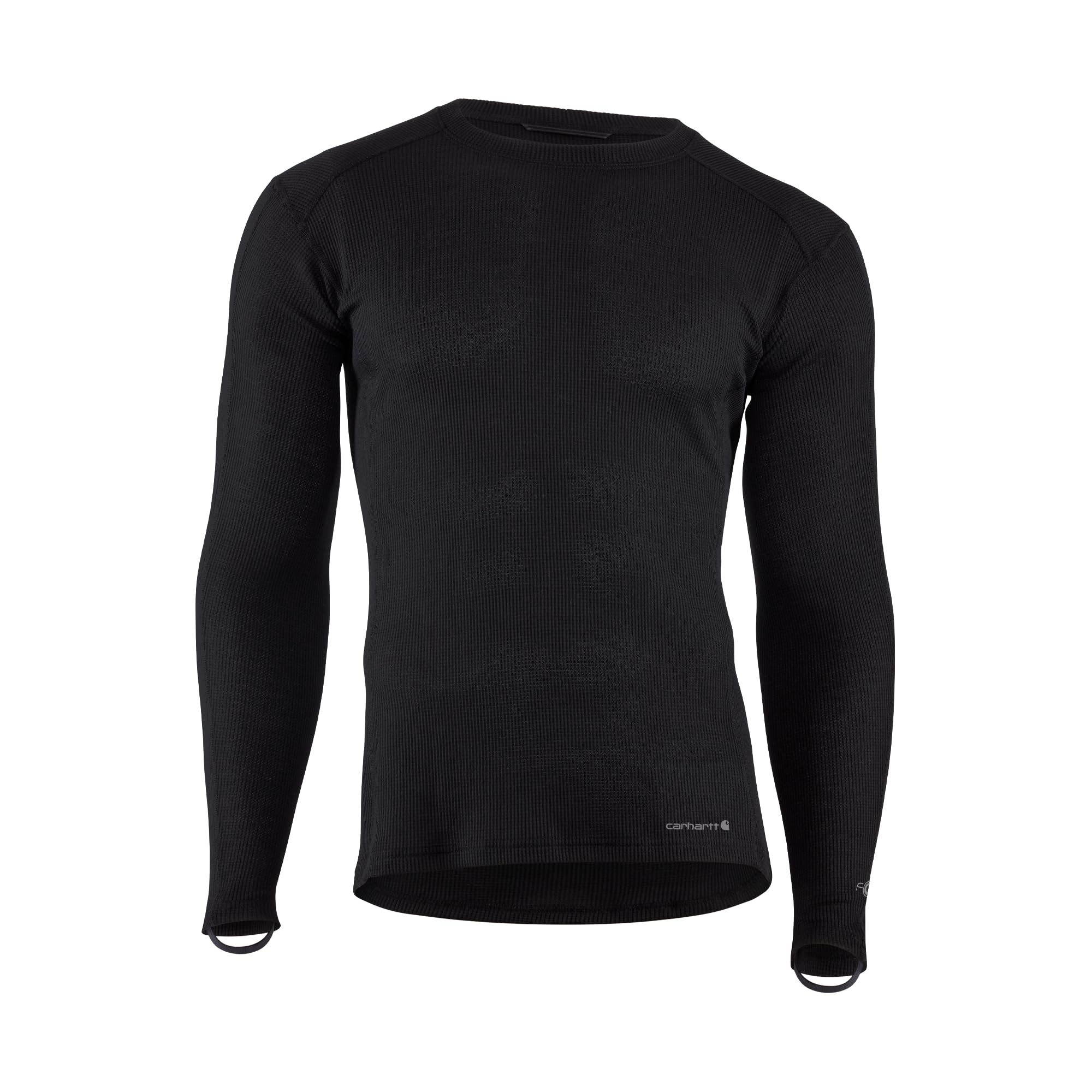
Carhartt Force Waffle Crew
Key Features
- Fabric: Waffle knit
- Sleeve: Long sleeve, thumb holes
- Weight: Midweight
- Neckline: Crew neck
- Price: Premium
If you want texture against your skin rather than a slick synthetic, start here. The waffle grid traps air in a way a flat knit doesn’t, and we noticed the difference within minutes of stepping outside on a cold morning. We were also taken with the thumb holes — a small thing that stops the sleeve creeping up your forearm every time you reach for something.
It’s cut snug to hold warmth without going compression-tight, so it layers under a work shirt without printing every seam through the fabric. The body runs long and slim, which keeps it tucked through a day of bending and lifting, and it comes out of the wash holding its shape.
The catch is that it behaves like a true midweight. Under a jacket on the move it’s the most comfortable top here; standing still in real weather, you want the heavyweight Access instead. Under a work shirt with a fleece over it, this is the one we grab.
Pros
- Waffle knit traps warmth without bulk
- Thumb holes keep sleeves in place
- Snug cut layers under a work shirt
- Holds shape through washing
Cons
- Runs thin for a midweight
- Premium price for a waffle knit
If you want a waffle knit against your skin rather than a slick synthetic, this is the one — snug, warm under a jacket, with thumb holes that keep the sleeves down.
Best for Deep Cold
Access Heavyweight Thermal Crew
Key Features
- Sleeve: Long sleeve
- Weight: Heavyweight
- Neckline: Crew neck
- Department: Men’s
- Price: Budget
Out of the bag, the first thing you notice is weight — this is the only top here that feels like cold-weather equipment rather than underwear. The knit is dense and slightly old-school, the kind of thermal that turns up in a farm supply catalog, and it holds heat the way a thick sweater does.
Standing around in the cold is its job: a job site, a sideline, a slow walk with the dog on a raw morning. It delivers more warmth than anything else in this guide, comes in a wide range of colors, and asks for nothing in the way of technology — no stretch panels, no wicking claims, no fleece lining.
Where it gives ground is against bare skin, where the knit can feel coarse across the shoulders, and in the cut, which runs roomy enough that a size down is usually right. Worn over a t-shirt under a jacket, neither bothers us. For raw, standing-still cold, this is the one we take.
Pros
- Warmest top in this roundup
- Cheap for the warmth it delivers
- Wide colour range
- Generous length through the body
Cons
- Sizing runs large; order a size down
- Needs a tee underneath
For bitter, standing-around cold, this heavyweight knit is the warmest thing here and costs less than the technical layers — order a size down.
Best for Weekday Rotation
TELALEO Men’s 5-Pack Thermal
Key Features
- Fabric: Fleece-lined compression
- Pack size: 5 or 4 pack
- Department: Men’s
- Price: Midrange
The arithmetic is what sells this pack: the whole thing costs less than our top pick does on its own, and you get five fleece-lined compression tops to rotate through a workweek. We like it for exactly that buyer — someone who needs a clean layer every morning and doesn’t want to think about laundry on a Wednesday night.
The fit is genuinely form-fitting without turning restrictive, and the arm length is right, which is where cheap multipacks usually give themselves away. Fleece inside, a smooth face outside, and enough stretch to wear under a work shirt or a jersey without bunching at the elbows.
Small annoyances come with the price. There’s no back label, so you find the front by checking the seam, and the compression cut isn’t the one to pick if you want something loose to sit around in. The fleece lining is warm enough that we save these for genuinely cold days rather than desk wear.
Pros
- Whole pack costs less than one premium layer
- Fleece lining without much bulk
- Good arm length for the money
- Form fit that stays put
Cons
- No back label to tell front from back
- Compression fit, not a relaxed top
A stack of fleece-lined compression tops for less than our top pick alone makes this the value buy, best for men who want a clean layer every workday.
Best for Budget Layering
Amazon Essentials Waffle Thermal
Key Features
- Fit: Slim fit
- Trim: Ribbed
- Fabric: Waffle knit
- Department: Men’s
- Price: Budget
Cheap is the headline, and cheap is what you get: a light waffle thermal with ribbed trim and a slim cut, for less than anything else in this guide. The real question is whether it’s warm enough, and the answer depends entirely on where you wear it.
As a layer, it’s better than the price suggests. It’s light enough to vanish under a flannel or a sweater without adding bulk at the shoulders, the waffle traps a little warmth of its own, and it looks tidy enough to wear on its own around the house. We reach for it in fall and spring, and indoors under something heavier.
Two things to know before ordering. The sleeves run long — noticeably so on shorter frames, and occasionally uneven between left and right — and the fabric is a cotton-poly blend rather than the pure cotton it’s often described as. It also fills the dryer’s lint trap for the first several washes.
Pros
- Least expensive thermal here
- Light enough to layer under anything
- Waffle texture looks good on its own
Cons
- Sleeves run long and can be uneven
- Sheds lint in the dryer
The cheapest way into a waffle thermal, and good enough to buy three of — as long as the cold you’re dressing for is fall and spring, not January.
Best for Winter Running
baleaf Women’s Fleece Thermal
Key Features
- Fabric: Fleece-lined
- Sleeve: Long sleeve, thumb holes
- Department: Women’s
- Price: Midrange
Cold-weather running is where this top makes sense: fleece inside, a smooth face outside, and thumb holes that pull the sleeves over your hands for the coldest first mile. It handles a run and a shift under a uniform shirt with equal ease, which is more range than most fleece layers manage.
Warmth without the clammy feeling is the trick, and the lining gets it right — it holds heat on the walk out and doesn’t turn into a sauna once you’re moving. The cut stays put at the waist instead of riding up, and there’s enough stretch for full range of motion through the arms.
The zippered pocket is the detail we didn’t expect to care about and now do: a car key goes in and stays there, one less thing to think about on a run. Sizing is the real frustration — these run small, so size up — and the sleeves run long, though the thumb holes take up some of that slack.
Pros
- Fleece lining that breathes on a run
- Thumb holes warm your hands
- Zip pocket holds a key
- Stays put at the waist
Cons
- Runs small; size up
- Sleeves run long on shorter arms
Women who run, walk, or work outside in winter should start here — fleece-lined, breathable, with thumb holes and a zip pocket for a key.
Best for Wearing Alone
Trendy Queen Turtleneck Thermal
Key Features
- Fabric: Fleece-lined
- Sleeve: Long sleeve
- Neckline: Turtleneck
- Department: Women’s
- Price: Budget
A turtleneck is the only thermal here that can stand in for a scarf, and this one sits close at the neck without strangling you: high enough to block wind, relaxed enough that you forget it’s there.
It’s thick for the money, with a plush fleece inside that feels good straight out of the bag and a finish that reads as a top rather than hidden underwear. Tuck it into trousers or wear it over leggings — either way it looks like a sweater.
Two warnings. Some colors arrive with a chemical smell that takes a wash or two to clear, so plan on laundering it before you wear it, and the plush inside collects fuzz, which means a lint roller earns its place by the door. Sizing is the bigger issue: these run large, and the neck runs large with them.
The neck is what settles it. Nothing else here covers that much skin, and on a raw day that’s the difference between a slow walk and a short one. Treat the first wash as part of the purchase and it’s a lot of top for the money.
Pros
- Warmth at the neck without a scarf
- Thick and soft enough to wear alone
- Reads as a sweater, not underwear
Cons
- Sizing runs large; size down
- Collects lint and fuzz
A thick, soft turtleneck that works as a top in its own right — the warmest thing here at the neck, provided you size down and wash it first.
Best for Everyday Winter Wear
ANRABESS Fleece-Lined Thermal Tee

Key Features
- Fabric: Fleece-lined
- Sleeve: Long sleeve
- Neckline: Crew neck
- Department: Women’s
- Price: Budget
The surprise here is the fabric. This isn’t a waffle and it isn’t a compression shell — it’s a smooth, thick long-sleeve tee with a brushed inside, and once it’s on it looks like an ordinary shirt. That’s the point if you want warmth without the technical look.
It delivers roughly the warmth of a light sweatshirt at a much lower profile: enough under a coat, not enough on its own when the temperature really drops. The inside is as soft as anything in this guide, the outer face hasn’t pilled through repeated washing, and the sleeves are long, which is rare at this end of the price range.
Sizing catches people out. It runs small and sits close through the body, so order a size up unless you want it snug, and the white is properly opaque rather than the see-through white you often get at this price.
As an everyday winter top it does something the technical layers here don’t: it passes at the office without explanation. We take the baleaf for anything active and this one for everything else, and we’ve stopped treating that as the lesser job.
Pros
- Soft brushed inside, smooth outside
- Looks like a normal long-sleeve tee
- Doesn’t pill through washing
- Long sleeves for the price
Cons
- Runs small; order a size up
- Not enough for real cold on its own
It doesn’t look like a thermal and that’s the appeal — soft, smooth, and warm enough for everyday winter wear, best for women who want warmth without the technical look.
How We Tested the Best Thermal Tops
We started by pulling together a shortlist of tops in a range of fabric blends and price points, then filtered it by what shoppers actually complain about in reviews: sleeves that end above the wrist bone, charts that run a size small, and fabric that looks substantial in photos but arrives paper-thin. Where a brand’s size chart was vague, we ordered the same top in two sizes so we could compare the fit side by side. In total, 12 tops went into the rotation for five months.
Each top got worn the way a thermal top actually gets worn. That meant a 30-degree morning walk with the dog under a flannel, a full day at a desk in a drafty room with nothing over it, and a couple of weekend drives to colder ground where it was layered under a jacket. We noted how quickly we felt cold standing still outside, whether the cuff stayed put or rode up when we pulled a jacket on, and whether the fabric bunched at the shoulder or slid smoothly under a second layer. We also wrote down how each one felt against the neck and forearms after an hour, since softness on the hanger and softness on skin are two different things.
Material got checked the least scientific way and the most useful one: we held each top up to a lamp and looked for thin spots at the elbows and shoulders, weighed them on a kitchen scale to confirm the fabric weight matched the claims, and ran every single one through five wash cycles, measuring body and sleeve length before and after and checking for pilling under the arms. Value came down to cost per wear — whether the seams, hem, and shape held up well enough that we’d buy a second one.
How to Choose a Thermal Top
The biggest decision isn’t the fabric or the brand — it’s matching the weight of the top to what you’ll be doing while you wear it.
Match the weight to the job, not the forecast
Thermal tops come in three broad weights, and the mistake we see most often is buying the heaviest one for a hike. A heavyweight knit is superb when you’re standing still — a sideline, a lift queue, a job site in January — and miserable on a climb, because you sweat through it and then chill the moment you stop.
If you’ll be moving, choose a midweight or a light fleece-lined layer and add a shell for wind. Save the heavyweight for the days when the cold is the whole activity. The Access crew is our heavyweight; the Amazon Essentials waffle sits at the opposite end.
Fit decides whether the warmth works
Every top here is sold as warm; what separates them is whether the fit lets that warmth do anything. A base layer should sit close enough that warm air stays put, with no folds under a pack strap, and long enough in the body that it doesn’t escape your waistband when you bend.
Sizing drifts in both directions across this category: most fleece-lined tops run small, while heavyweight knits and the turtleneck run large. Read the guidance for the specific top rather than assuming your usual size, and when a compression-style top is borderline, go up.
Collars, cuffs, and hems do the quiet work
The parts that meet the outside world matter most. A mock neck or turtleneck seals the gap between coat and skin, a crew slides under a shirt collar with less fuss, and thumb holes stop a sleeve migrating up your forearm every time you reach for something.
Torso length is the other underrated spec — a long body stays tucked, a short one rides up. Layering under a pack hipbelt or a harness, choose the smooth, flat-seamed top rather than the lofted waffle, which bunches where the strap crosses it.
Fleece-lined synthetics or waffle knits
Fleece-lined synthetic tops give the most warmth for the least bulk and feel soft immediately. They also hold heat indoors, so they suit cold mornings better than warm offices. Waffle knits trap air in the texture, breathe better, and look more like clothing when the jacket comes off — but a thin waffle is a cool-weather layer, not a winter one, and cotton blends feel cold once damp.
If you run hot or move a lot, go waffle or light fleece. If you feel the cold, go lined synthetic.
Buy for the laundry cycle, not the closet
You need fewer of these than you think and more than one. Two tops cover a weekend away; three or four cover a working week if you air them between wears, since base layers pick up odor faster than they pick up visible dirt.
That’s why multipacks suit some buyers and not others: a five-pack is excellent value if you’ll wear one daily for work, and overkill for two ski weekends a year. Compare cost per top rather than the pack price.
Frequently Asked Questions
Is a thermal top the same thing as a base layer?
A base layer is the snug first layer that moves sweat away from your skin; a thermal top is any long-sleeve top built to hold warmth, and most of the ones here do both. Choose a close-fitting fleece-lined synthetic if you’ll sweat, and a lofted waffle knit if you’ll mostly stand in dry cold. Wear it against your skin, not over a t-shirt, or you lose the warm air pocket that does the work.
Can I wear a thermal top as a normal shirt?
Often, yes. A waffle knit with a ribbed hem or a turtleneck reads as a regular top once the jacket comes off; a smooth compression layer looks like underwear. If you want to shed layers indoors without embarrassment, pick a finished hem with a crew or turtleneck collar — the Trendy Queen turtleneck and the ANRABESS tee are the two here that pass that test.
How should I wash a fleece-lined thermal top?
Turn it inside out, wash cold, and skip fabric softener, which coats the fleece and flattens the loft that keeps you warm. Tumble dry low or hang it. Waffle knits shed lint in the dryer for the first several washes and shrink if you run them hot, and a chemical smell out of the bag usually clears in one cold wash.
Final Verdict
Buy the Under Armour ColdGear Mock. It covers the most situations — snug enough to layer, long enough to stay tucked, with a mock neck that seals the one gap a jacket leaves open — and it’s the top we pack first when the forecast is uncertain.
If your cold involves standing still, the Access heavyweight is warmer for less. If you want a week’s worth of layers, the TELALEO five-pack costs less than the Under Armour alone. And for women, the baleaf is the one to start with.