This post contains affiliate links. We may earn a small commission when you buy through our links — at no extra cost to you.
Sunglasses have a way of humbling you. A pair can look perfect in the store mirror, then spend the next month pinching behind your ears, sliding down your nose, or collecting scratches in your bag. The right pair should disappear on your face — clear enough for driving, dark enough for the beach, comfortable enough that you forget you’re wearing it. Over the past six months, I’ve worn 14 pairs on commutes, hikes, and yard work, and the differences come down to fit, lens quality, and whether they hold up after being tossed around.
Fit matters more than most people expect: a slightly wide temple or a mismatched nose bridge can turn a stylish pair into a headache. We also paid attention to value for money, how they looked with everyday outfits, and whether they stayed comfortable past the first hour — sunglasses are one of the few accessories you might wear for eight hours straight. The picks below are the ones that earned a permanent spot in the car, the beach bag, or my jacket pocket.



Best for Everyday and Trail
SUNGAIT Ultra Lightweight Rectangular
Key Features
- Lens: Polarized, UV400
- Frame: Rectangular
- Weight: 0.88 oz
- Included: Carry case and mini screwdriver
- Price: Midrange
The number that decides this pair is 0.88 ounces. That’s the lightest frame in this roundup, and lightness is what keeps sunglasses on your face at hour six instead of folded in a pocket. The lens is polarized and rated UV400, and the view through it stays neutral — road markings stay white, trail dirt stays brown, no warm cast and no smearing at the edges.
Light frames often give up grip, and this one doesn’t. The nose pads adjust, which matters more than a spec sheet suggests: it’s the difference between a pair that rides down your nose on a sweaty descent and one that stays where you put it. We like that the frame doesn’t rattle or flex when you pinch it — unusual at this weight.
It ships with a soft case and a small screwdriver for the hinge screws, the kind of detail that tells you the brand expects these to be worn hard rather than saved for occasions. Against the goodr below, you give up a little grip at speed and a lot of the price tag; against our round style pick, you give up character and gain coverage around the eyes.
Pros
- Lightest frame here at 0.88 ounces
- Polarized UV400 lens with a clean, neutral view
- Adjustable nose pads hold on sweaty descents
- Comes with a carry case and mini screwdriver
Cons
- Lens runs smaller than the product photos suggest
Our default pick: at 0.88 ounces it disappears on your face, the polarized lens stays clear, and the nose pads hold. Most people should start here.
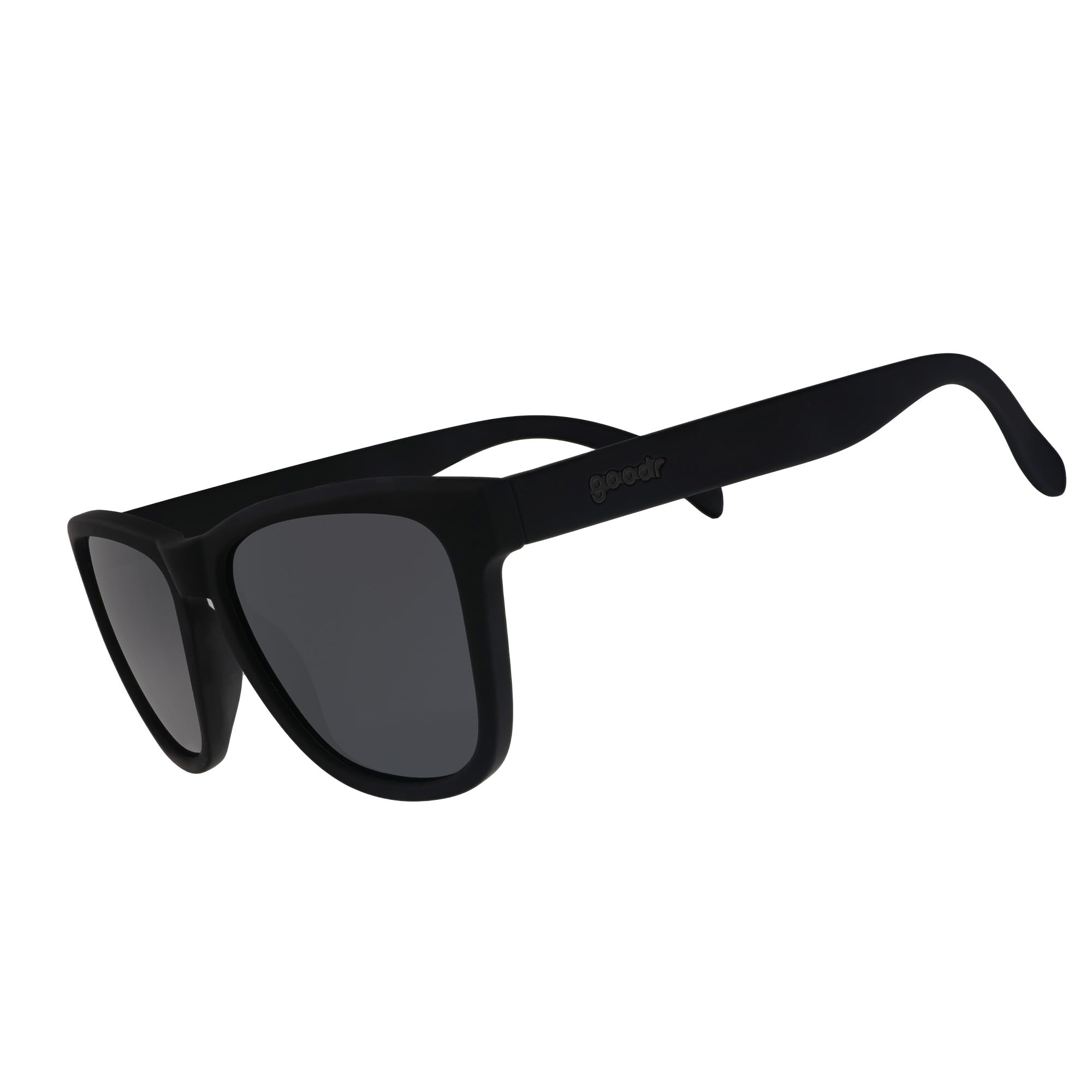
Best for Running and Hiking
goodr OG Polarized
Key Features
- Fit: Unisex
- Lens: Polarized
- Category: Sport sunglasses
- Price: Premium
Running sunglasses live or die on one question: do they stay on your face when you’re sweating and looking down a descent? The goodr OG is the pair here built entirely around that answer. The frame sits close, hugs behind the ears, and needs no hand to push it back up mid-effort.
That grip is worth the premium. This is the priciest pair in the roundup, and the money buys hold and glare control rather than toughness: the polarized lens flattens glare off water and hot pavement, and the whole frame is light enough that a hat or headband doesn’t fight it. On a long climb we stopped thinking about them, which is the highest compliment a running pair can get from us.
The coating is the trade. Lenses scratch, and with enough abuse the coating starts to peel, so these are a pair to keep in the pouch rather than loose in a pack. Do that and they earn their place; treat them like a gas-station pair and the coating will tell you about it.
Pros
- Stays put through runs and sweaty descents
- Polarized lens cuts glare on water and pavement
- Light enough to wear under a hat
Cons
- Highest price in this roundup
We reach for these when the day involves running or a hard climb — they simply don’t move. Worth the premium if staying put matters more than toughness.
Best for Retro Everyday Style
SUNGAIT Vintage Round
Round retro frames are where cheap sunglasses usually fall apart — the shape is easy to copy and hard to make look right. This SUNGAIT pair gets the proportions right, the finish doesn’t read as hollow plastic, and the whole thing is so light that it disappears on your face. It’s the best-looking frame in this set, we think, for anyone who wants sunglasses that look like a considered choice rather than sports equipment.
The fit is gentle: no pinching at the temples, no pressure across the bridge, and it stays put on most faces. What you give up is side coverage. The round lens sits fairly flat against the face, so light comes in around the edges — fine walking around town, less fine staring into a low sun over water, where the rectangular SUNGAIT or the goodr wrap you in more.
Pros
- Best-looking frame in this set
- Barely-there weight with no pressure points
- Polarized lens with strong sun protection
Cons
The pair we point to when someone wants sunglasses that look considered rather than technical. Light, comfortable, and the best-looking frame in this set.
Best for Driving and Water
DUCO 8177 Sports
Key Features
- Lens: Polarized, UV protection
- Weight: 1.59 oz
- Included: Hard case and screwdriver
- Frame dimensions: 5.67 x 2.52 x 1.57 inches
- Price: Midrange
Open the box and you get a hard shell case, a cleaning cloth, and a small double-ended screwdriver. That’s a nice touch, and it says what kind of pair this is: a metal-framed sport frame built to be adjusted and kept rather than replaced.
At 1.59 ounces it’s heavier than the SUNGAIT rectangular, and you feel that difference in the hand more than on the face. What the metal buys you is a wide, stable frame and a lens that does the thing you want on a bright highway — it flattens glare off the road and off oncoming hoods without making the world look dim. We also noticed how little pressure it puts on the ears over a long drive.
Where it earns its place is on long drives and bright water. The frame is wide, which suits bigger faces that make smaller round frames look lost, and the hard case is the kind you can throw in a truck bed without a second thought. On a narrow face this pair will swim — it is unambiguously a big-frame set of sunglasses.
Pros
- Hard case and screwdriver included
- Flattens road glare for driving
- Wide metal frame suits bigger faces
Cons
- Hinge screws work loose over time
Buy this one for long drives and bright water, especially if you have a wider face. The metal frame and included case make it feel like gear you keep.
Best for Spare Pairs
KALIYADI Matte 3-Pack
Key Features
- Lens: Polarized, UV blocking
- Pack: 3 pairs
- Finish: Matte
- Included: Pouch and cloth per pair
- Price: Budget
Three pairs is the whole idea, and it’s a good one: one in the car, one in the daypack, one wherever you keep the things you’re tired of hunting for. The matte finish and the slim frame mean none of them look like a giveaway, and each comes with its own pouch and cloth.
What surprised us is how the frame feels. The satin matte finish is the nicest in this set to touch, and the fit is steady without clamping — good for long drives, where a pair that presses on your temples turns into a headache by hour two.
The lenses are genuinely polarized and dark enough for a bright afternoon, and the shape reads closer to a classic wayfarer than to a promotional freebie. We treat this as the pack you take on a trip where sunglasses historically get lost — losing one costs you a shrug instead of an afternoon.
Pros
- Three polarized pairs, each with a pouch
- Satin matte finish feels better than the price suggests
- Steady fit without temple pressure
Cons
- Hinge and arm joints are the weak point
The pack we recommend to anyone who loses sunglasses: three polarized pairs and three pouches, in a matte finish that punches above its price.
Best for Bright Glare
Joopin Oversized
Key Features
- Lens: Polarized
- Frame: Oversized
- Dimensions: 6.69 x 1.57 x 1.97 inches
- Price: Budget
Glare doesn’t only arrive head-on. If you’re light-sensitive, or you spend the day on water or snow, the light that gets in around the edge of a small frame is what gives you the headache. The Joopin’s oversized lens answers that: it carries coverage out past the cheekbone and up over the brow, and the tint is dark enough to make a bright afternoon feel like a cloudy one.
Comfort is the other half. Big frames usually press somewhere — cheeks, bridge, behind the ears — and we found this one mostly doesn’t. It sits light for its size and doesn’t leave marks behind the ears after a few hours, which is more than most oversized frames manage.
What it gives up is longevity. These are light frames, and the side arm is the part that suffers if they get sat on or crammed into a full pack. Keep them in a case and they handle bright afternoons fine; treat them as a loose pair rolling around the bottom of a bag and the rim will tell you about it.
Pros
- Oversized lens blocks light from the sides
- Dark tint for very bright days
- Comfortable behind the ears for a big frame
Cons
- Oversized frame rests on the cheeks on smaller faces
For bright, glare-heavy days and anyone who wants maximum shade, this oversized frame delivers — as long as your face can carry the size.
Best for Trend Looks
Dollger Rectangle

This is the least expensive pair in the roundup, and it doesn’t pretend otherwise: thin frame, simple hinges, a lens you can see your own reflection in. What it does have is a shape. The squared, slightly narrow rectangle is the Y2K silhouette that’s everywhere right now, and it’s the one here that looks like it came from a store that also sells records.
But we appreciate that it comes with a case, a cloth, and a small screwdriver — more than you can reasonably expect at this position in the market. The frame is light, the hinge is basic, and the whole thing has the feel of something designed to be photographed.
The lens is UV400, and that’s the claim worth checking on a pair this cheap, because plenty at this level don’t state one at all. It isn’t the darkest lens here, so it’s a town and beach pair rather than a high-altitude one; on a glacier you want the Joopin or the goodr.
What it comes down to is how you feel about a trend pair. If you’re going to wear the shape for a season or two and then move on, paying fashion prices for it is silly, and this is the version that lets you have the look without the commitment.
Pros
- Least expensive pair in this roundup
- Distinct squared Y2K shape
- UV400 lens, case, cloth, and screwdriver
Cons
- Narrow cut; tight on wider faces
A trend pair worth buying: the Y2K rectangle, a stated UV400 lens, and a case, near the bottom of the price range.
Best for Narrow Faces
SOJOS Small Round

Key Features
- Lens: Polarized
- Frame: Small round
- Style: Vintage
- Price: Budget
Most sunglasses are built for an average face, and if yours is narrow, the standard frame slides forward until the bridge lands on your nose and the top edge blurs your view. The SOJOS small round is cut for that face: a compact lens, a short temple, and enough grip that it doesn’t creep.
It’s light — noticeably so across the bridge — and it doesn’t press behind the ears, so an afternoon in them doesn’t end in a headache. The lenses are polarized, the tint is dark enough for real sun, and the round shape adds vintage character without going full retro.
Between this and the Dollger, this is the better-made small frame; between this and the round SUNGAIT, you trade size for a fit that doesn’t move.
What settles it for us is that a pair that fits beats a pair that’s better made, every time, because you’ll actually wear the one that doesn’t slide. That’s the case for the SOJOS: it’s the pair that disappears and stays.
Pros
- Compact frame that suits narrow faces
- Light enough to forget on the bridge
- Polarized lens at a modest price
Cons
- Arms and hinge screws are the weak point
The small-face pick: a compact round frame that doesn’t slide, with polarized lenses and a price that makes replacing it painless.
How We Tested 14 Pairs of Sunglasses
We started by pulling together a shortlist from brands we’d heard good things about, filtering for lens material, UV protection, frame shape, and price. We ended up with 14 pairs spanning drugstore basics to designer-adjacent styles, then wore them for six months — not just on sunny days. They came on morning commutes, weekend hikes, beach afternoons, dog walks, and yard work, and we deliberately left them in hot cars, stuffed them into bags with keys, and handed them around to testers with round, narrow, and wide faces.
Fit and comfort were judged on the move: we noted whether the nose pads left marks, whether temples pressed behind the ears after an hour, and whether the frames slipped when we looked down or got sweaty. Size mattered more than we expected — a pair that covered one tester’s cheeks swallowed another’s face. For lens darkness, we drove into low sun, read outside on overcast days, and checked whether colors looked natural rather than muddy.
Quality and durability came down to hinges, frame flex, and lens clarity — we opened and closed each pair dozens of times and dropped them from waist height onto pavement. Scratch resistance got its own rough test: we cleaned lenses with a microfiber cloth and checked for fine marks, then tossed each pair loose in a bag with keys for a week. Throughout, we tracked value for money by asking whether we’d buy the pair again at full price. Appearance and style got a real-world check: we wore each pair in public, with everything from gym clothes to work outfits, and noted which ones drew compliments without feeling like a costume.
How to Choose Sunglasses for Trail, Road, and Town
The pair that works is the one that stays on your face and keeps the glare out, and that comes down to fit and coverage far more than to what the lens costs.
What Polarization and UV Ratings Actually Do
Polarization removes the horizontal glare that bounces off water, snow, and hot asphalt. It’s the difference between seeing the road and squinting at a sheet of white. UV protection is a separate claim, and it’s the one that matters for your eyes: look for a stated rating such as UV400 rather than assuming a dark lens does the job.
The trap is that tint is not protection. A very dark lens with no stated UV rating is a worse buy than a lighter lens that names one, and an over-dark lens makes trail texture and shadows harder to read. We take polarized, UV-rated lenses every time for hiking — it’s the glare, not the brightness, that wears you out by mid-afternoon.
Fit and Weight Decide Whether They Stay On
Three things keep a frame in place: nose pads that grip, temples that hug without pinching, and a width that matches your face. Weight amplifies whatever the fit is already doing wrong. The 0.88-ounce SUNGAIT rectangular stays put largely because there’s so little mass to drag it down; the 1.59-ounce metal DUCO stays put because it is wide and sits on a bigger face.
The trap here is buying online by looks alone. Measure a pair you already own across the hinge and compare it with the listed width. If you’re between sizes, adjustable nose pads buy you margin — they are the cheapest insurance against a pair that slides.
Match Frame Shape to Where You’ll Wear Them
Coverage is the quiet variable. A flat round lens looks great and lets light in around the edges; a wrap or an oversized frame closes that gap. For a day on rock or open water, coverage wins — that’s where an oversized frame like the Joopin earns its place. For town and travel, a smaller shape is easier to live with and easier to pack.
The trap runs the other way too: oversized on a small face doesn’t just look large, it slides forward and rests on your cheeks until you’re pushing it up every few minutes. Big lenses need a face big enough to carry them, and the small round SOJOS exists for the opposite problem.
Spend on the Frame You’ll Keep, or Buy Spares
The parts that fail are predictable: hinge screws, the joint where the arm meets the frame, and the lens coating. None of those get better with price alone, but a case and a small screwdriver make more difference than most shoppers expect — which is why the pairs here that include them are easier to recommend.
So the real question is how you treat sunglasses. If you lose them, three cheap polarized pairs cost less grief than one precious pair. If you keep track of your things, buy the light, comfortable frame and keep it in its case.
Frequently Asked Questions
How do I clean polarized lenses without scratching them?
Rinse first. Grit is what scratches a lens, and a dry wipe drags it across the coating. Hold them under a tap or dip them in clean water, then dry with the cloth that came with the pair.
Skip paper towels and shirttails, and don’t use household glass cleaner on a coated lens. At the beach, rinse before you wipe, every single time.
Can I drive in polarized sunglasses?
Yes, in daylight — polarization is exactly what you want for glare off the road and off other cars. One quirk: at some angles a polarized lens makes dashboard screens, phone displays, and tinted side windows look dark or patchy. Tilt your head at a red light and check before you rely on them.
Take them off at dusk. A dark tint after the sun drops cuts the light you need for the road, whether the lens is polarized or not.
Can I leave a spare pair in the car?
Heat is hard on frames and coatings — a plastic frame can warp and a coated lens degrades when it bakes against a windshield all summer. A spare in the glovebox is fine; one left face-up on the dashboard is not.
If the car is where your sunglasses live, plan for a cheap pair to live there and keep the good one in its case.
Final Verdict
Start with the SUNGAIT rectangular. It’s the lightest pair here, the polarized lens stays clean and neutral, and it holds on your face without fuss — the least complicated way to be done shopping.
If you run or climb hard and want a frame that grips, the goodr OG is the upgrade worth paying for. If you want sunglasses that look like a considered choice rather than kit, the round SUNGAIT earns that spot.