This post contains affiliate links. We may earn a small commission when you buy through our links — at no extra cost to you.
The worst part of a glare-filled morning on the water isn’t the squinting—it’s what you don’t see. Flat light turns a shallow flat into a mirror, and a good pair of polarized fishing sunglasses strips that surface shine away so you can read depth, pick out rocks and weed lines, and spot fish before they spot you. I’ve fished from banks, kayaks, and borrowed boats for years, and the difference between a decent lens and a bad one is obvious by hour three: one leaves your eyes fresh, the other leaves you with a headache and a squint line.
Over the past eight months, our team has worn 12 pairs through early launches and long days on the water. We paid attention to fit under a cap, comfort after a full day, glare reduction at different sun angles, lens tint for bright versus overcast conditions, and how the frames and lenses hold up to boat life. Appearance and value matter too—you want glasses you’ll actually wear. The picks below are the ones we kept reaching for.


Best for All-Round Fishing
KastKing Skidaway
Key Features
- Included: Hard case and soft pouch
- Lens tint: Brown – Chartreuse Mirror
- Lens material: 1.0mm polarized TAC
- Frame material: Grilamid
- Price: Midrange
A coating called PuriVex is why we hand this pair to someone heading out on the water before any other in this group. It sheds water, sunscreen and oil instead of smearing them into a film, and it sits on a 1.0mm polarized TAC lens that’s thicker than most of what it’s up against here. The brown and chartreuse mirror finish isn’t decoration either — it holds contrast in stained water rather than just making everything darker.
The frame is Grilamid, which the maker lists as lightweight, flexible and resistant to heat and UV, and that adds up to a real boat-bag advantage. It bends instead of cracking when it gets crammed into a dry bag, and a hot afternoon on a console doesn’t worry it. We also like getting both a hard case and a soft pouch, because the pouch is the one that actually ends up in a jacket pocket.
Coverage is the one place this pair doesn’t fully deliver. The wrap sits close, but it doesn’t seal on every face: if your temples sit wide, low sun still gets in at the edge. On a bright day with the sun off your shoulder, that’s the difference between sunglasses and a proper fishing lens. For most faces, though, this is a lens that reads structure in the water and stays comfortable through a long shift.
Pros
- Coating sheds water, oil and sunscreen
- Brown-chartreuse mirror holds contrast
- Flexible Grilamid frame shrugs off heat
- Hard case and soft pouch included
Cons
- Temple gap lets low sun in
Our pick for most anglers: a coated 1.0mm lens that reads water, a flexible Grilamid frame and a hard case that comes along.
Best for Wet, Sweaty Days
suoso TR90 Sports Wrap
Key Features
- Grip: Rubber nose pads and temple arms
- Included: Hard case with carabiner
- Lens material: TAC
- Frame material: TR90
- Price: Midrange
A slick nose bridge is the quiet reason a lot of sunglasses spend the afternoon on the deck instead of on your face. suoso’s answer is a pair of rubber nose pads and hydrophilic temple arms — the kind that grip harder the wetter they get instead of skating around.
That detail is what earns this pair its place. On a humid morning, or a boat that keeps taking spray, it stays where you put it, and we stopped adjusting it after the first hour. The TR90 frame flexes well past what a hard plastic frame will take, the TAC lenses carry a scratch-resistant coating, and the lens is rated UV400.
You get a hard shell case with a carabiner, a cleaning cloth and a pouch, which is more kit than most pairs at this level ship with. The lanyard is the weak point: the cord is fiddly to thread and set the first few times, and it’s the piece that can give out, so the case is what actually protects them.
Pros
- Rubber nose pads grip when wet
- Flexible TR90 frame takes knocks
- Hard shell case with carabiner
Cons
- Lanyard is fiddly and can break
The pair to take on a humid morning — rubber pads and hydrophilic arms keep it on your face when sweat or spray would slide anything else down.
Best for Dedicated Fishing
Fishoholic Polarized Fishing
Key Features
- Included: Hard case and lens pouch
- Lens tint: Blue mirror
- UV protection: UV400, 100% UV
- Frame material: FlexTuff composite
- Price: Midrange
Gloss black frame, blue mirror lens, a logo on each arm — the Fishoholic looks like it belongs on a bass boat, and that’s the whole idea. It’s the most single-minded pair here: the mirror exists to knock down the flat white glare that comes off open water.
It’s a rectangular wrap with rubber along the arms, and it hugs the face without pressing anywhere. The mirror earns its keep twice: on bright, flat water where a plain gray lens leaves you squinting, and in the low light at either end of the day, when cutting surface glare is what lets you pick out structure instead of staring at a white sheet.
The listing states UV400 as full UV protection, and the pair ships with a hard case and a cleaning pouch — which matters more than it sounds, because a mirror coating is exactly the surface you don’t want rattling loose in a tackle bag.
What holds it back is toughness. The composite frame is light and it does flex, but a hard knock is where this design is most likely to let you down, so the case isn’t a bonus here, it’s how you keep them. Treat them as gear that rides in the case and you get a lot of fishing-specific lens for the money.
Pros
- Blue mirror flattens open-water glare
- Stated UV400 full UV protection
- Hard case and cleaning pouch included
Cons
- Too close-fitting to wear over glasses
- Lenses can rattle in the frame
If you want a lens tuned for water and nothing else, this is the one: the blue mirror kills flat glare and the hard case keeps it alive.
Best for Driving and Everyday
DUCO 8177 Sports
Key Features
- Weight: 1.59 oz
- Included: Hard case, pouch, cloth, screwdrivers
- Frame material: Metal
- Price: Midrange
Not a wrap, not a mirror, and not really a boat pair at all — the DUCO is the one we leave in the car. The metal frame sits closer to a classic sport aviator than to the wraparound shapes that dominate this group, which means it looks right at a gas station, on a jobsite or in a school pickup line.
At 1.59 ounces it’s light enough that you forget you’re wearing it, and the shape rests on the ears rather than pressing on them. It ships with a hard shell case, a pouch, a cloth and two small screwdrivers — which sounds like a gimmick until the hinge screws start backing out, which they can. The included drivers are the fix, and tightening them is a thirty-second job.
That’s the trade for the look and the low weight: this is a metal frame with screws, not a molded plastic wrap, and it wants the occasional look-over. What it gives you is the best everyday pair here for driving, where the lens kills glare off a wet road and takes the edge off oncoming headlights. Just don’t expect it to seal out side light on open water.
Pros
- Very light metal frame at 1.59 ounces
- Cuts wet-road and headlight glare
- Doesn’t press on the ears
- Screwdrivers included for hinge screws
Cons
- Temple tips feel sharp
Keep a pair in the car: light metal, a lens that handles wet-road glare, and screwdrivers in the case for what works loose.
Best for Boat Bag Spares
KALIYADI 4-Pack Sports
Key Features
- Included: Pouch, cloth and strap per pair
- Pack count: 4 pairs
- Frame style: Half frame, rectangular
- UV protection: UV400
- Price: Budget
Four pairs, each with its own pouch, cleaning cloth and neck strap, plus a gift box — the arithmetic is the argument. One goes in the boat bag, one in the truck, one in a jacket, and one gets handed to whoever forgot theirs.
They’re half-frame rectangles with integrated nose pads and a medium fit, so they sit close without the full wraparound clamp of the KastKing or the Fishoholic. UV400 covers the whole set, and the polycarbonate lenses are clear enough for reading water once you’re actually on it.
Four lens colors is the useful part, not a gimmick: something lighter for an overcast morning, something darker for midday, and a spare that doesn’t matter if it goes overboard. The frames feel light in a way that reads as inexpensive, and that’s an honest description of what you’re buying.
We treat this pack as consumables rather than as a pair you keep for years, and it’s genuinely good at that job. If you fish with family, run a boat, or lose sunglasses the way most people lose lighters, four adequate pairs will serve you better than one good one.
Pros
- Four pairs with pouch, cloth and strap
- UV400 across the whole set
- Four lens colors for different light
Cons
- Lenses can pop out if dropped
Four polarized pairs, four straps and no tears when one goes over the side — the right arithmetic for a boat bag.
Best for Cheap Backups
Foliful 3-Pack Wrap

Key Features
- Included: Hard case, pouch and cleaning cloth
- Pack count: 3 pairs
- Lens material: TAC
- Frame material: Polycarbonate
- Price: Budget
Three wrap-around pairs, a hard case, a pouch, a cloth and neck straps — the whole set costs less than one pair of the KastKing. The frames are polycarbonate, the lenses are TAC with a scratch-resistant coating, and all three are UV-protecting.
Where the set earns its place is tint variety. Three lens colors means you can match the day instead of arguing with it, and it removes the flinch from scratching a lens or leaving a pair on a picnic table. That’s the case for a multi-pack on the water, and this one makes it cheaply.
The compromises are predictable. The frames are stiff enough that they don’t flex much going on, and you get one hard case for three pairs, so the other two travel loose unless you add a pouch of your own.
Pros
- Three wraps for the price of one
- TAC lenses with scratch-resistant coating
- Neck straps included
Cons
- Only one hard case for three pairs
- Rims can crack under a knock
Three wraps for the money of one good pair: the smart buy if you want a different tint for every kind of light.
Best for Snug Low-Light Wear
ATTCL TR90 Wrap
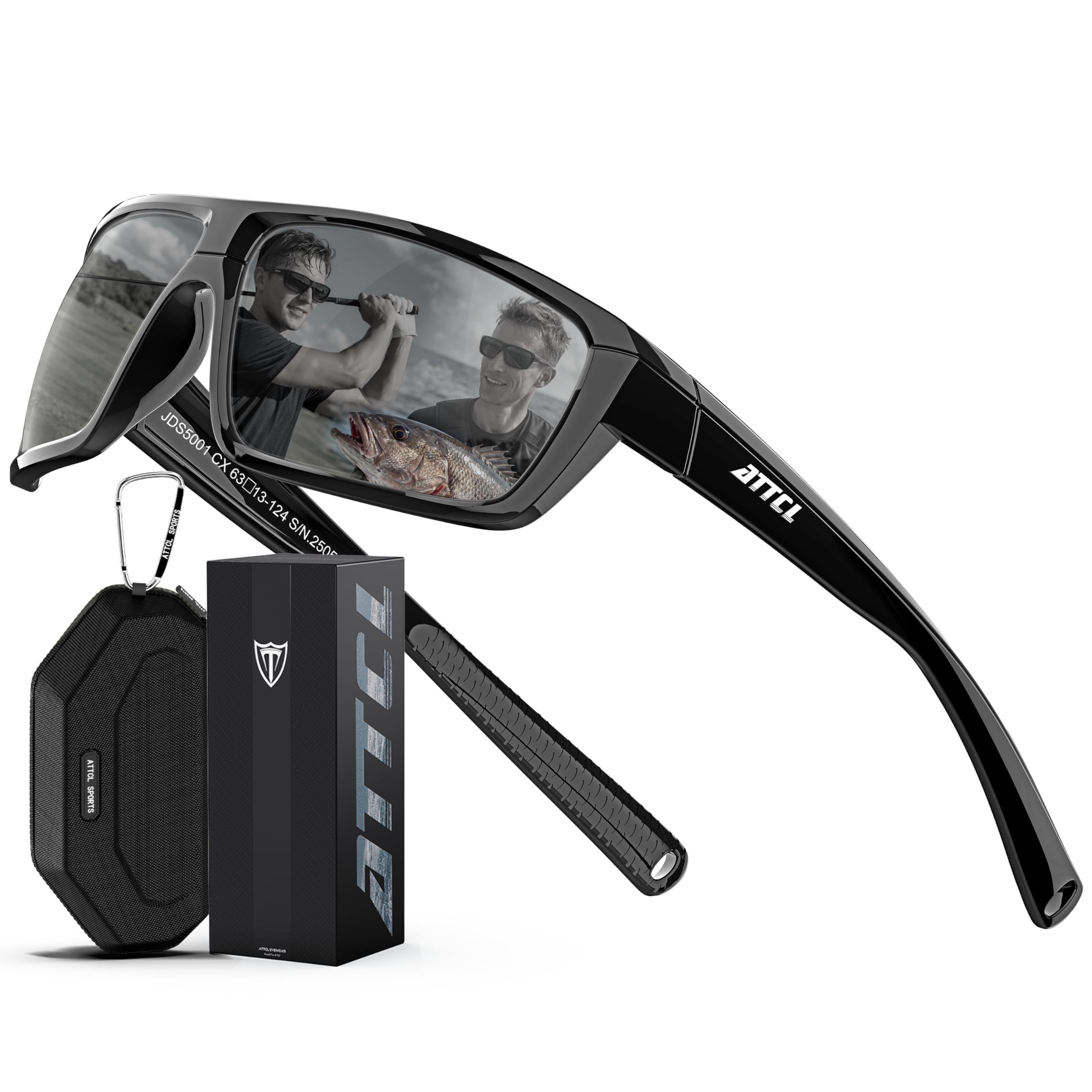
Key Features
- Frame style: Wrap around
- UV protection: UV400
- Frame material: TR90
- Price: Midrange
The tint is the first argument you’ll have with these. ATTCL’s wrap runs lighter than a dedicated bright-sun lens, which is exactly right at dawn and dusk and underwhelming at noon on open water — that split is why it isn’t the pair we hand out first.
The fit is where it wins. The TR90 wrap sits snug and stays there through an afternoon of moving and casting, and the shape covers a wide field without pressing on the temples. UV400 is stated, and the frame flexes rather than fighting you when you put it on.
The hard case, microfiber bag and cleaning cloth are the same kit the better picks ship with. Lens retention is the thing to keep an eye on: a popped lens is the failure that shows up around this kind of frame, so keep them in the case rather than loose in a bucket.
Pros
- Snug wrap that stays in place
- Wide coverage without temple pressure
- Hard case, bag and cloth included
Cons
- Tint runs light for bright sun
A snug, wide wrap that is at its best in flat light; skip it if your days are all noon glare.
Best for First Pair
FAGUMA Polarized Sports

Key Features
- Lens: Polarized
- UV protection: UV400
- Package dimensions: 6.5 x 2.5 x 2.5 inches
- Price: Budget
The first thing we noticed is how little there is to notice — light enough that a long shift on the water doesn’t leave sore spots behind the ears, and grippy enough that they don’t creep down your nose when you look down to tie on a lure.
They’re a sport wrap with UV400 protection and a tint dark enough for midday glare, and the coverage runs past the temples, so side light is less of an issue than it is with a flat frame like the DUCO.
The case for them is simple: this is the least expensive route into a proper wrap here, and they do the two things that matter — cut glare and stay on your face — well enough that you stop thinking about them. For a first pair, a truck pair or a spare that lives in the tackle box, that’s enough.
Pros
- Light enough to forget you’re wearing them
- Holds position without slipping
- Full UV400 protection
Cons
- Frames can crack under a knock
- Lenses scratch easily
The cheapest way into a proper wrap here, and good enough at glare and grip to live in the truck without complaint.
How We Tested the Best Polarized Sunglasses for Fishing
We started by building a shortlist from manufacturer specs, lens tint options, frame sizes, and customer reviews, then filtered out pairs that were hard to adjust, came only in one fit, or felt overpriced for what they offered. That left us with 12 pairs to test over eight months.
We wore each pair from the boat ramp to the trailer, often for six to eight hours at a time, under caps and with a buff pulled up. We noted whether the temples pinched behind the ears, whether nose pads left marks, and whether the frames stayed put when we turned to check a cast. On the water, we looked at the same stretch of shoreline at low sun, high sun, and flat glare, and judged whether we could see structure below the surface or just the surface itself. We also asked fishing partners to weigh in on appearance—not a vanity contest, but whether a pair looked reasonable enough to wear off the water too.
Lens tint got its own check: we swapped pairs between bright bluebird mornings and overcast afternoons to see which tints helped contrast without washing out color. Durability was less polite—we dropped glasses on gravel, tossed them into boat bags, wiped them with a shirt when we shouldn’t have, and rinsed them in saltwater. We checked lenses for scratches and coating wear after each trip. At the end, we compared what each pair delivered against what it cost, because value isn’t the cheapest pair—it’s the one that survives a season and still cuts glare.
How to Choose Polarized Sunglasses for Fishing
Polarization is the entry ticket here; what actually separates one pair from another is how much water you can read through the lens and whether the thing stays on your face while you’re reading it.
Pick the tint for the water you fish
Two lenses with identical polarization can look completely different on the water. Gray keeps colors neutral and handles full midday sun. Brown, amber and chartreuse-mirror tints push contrast, which is what lets you separate a rock from a bass in stained or green water, and what keeps a lens usable in the last hour of light. A mirror coating mostly reduces how much light reaches your eye; it doesn’t add contrast on its own.
If you fish bright, open water and shaded water in the same season, a multi-tint pack is a practical answer rather than a compromise — you can swap lenses to match the day instead of squinting through the wrong one.
Coverage beats lens shape
The difference between a fishing pair and a fashion pair is mostly at the edges. A wrap that sits close to the brow and curves back toward the temple cuts the light coming in from the side, along with wind and spray, which a flat aviator-style frame can’t do however good its lens is.
The trap is that coverage depends on your face as much as on the frame. A wrap that seals on one person leaves a gap on another, so look for a shape that sits close without pressing on your temples, and treat side light as something to check rather than assume.
Grip is a wet-weather feature
Rubber nose pads and hydrophilic temple arms — the kind that get tackier as they dampen — do more for a fishing pair than an extra lens coating does. Metal frames and smooth plastic arms slide the moment sunscreen and sweat get involved, and a pair that keeps sliding ends up pushed up on your head rather than over your eyes.
If a pair you already like is optically fine but won’t stay put, a neck strap is the cheapest fix there is. Flexible TR90 and Grilamid frames also earn their keep here, because they bend instead of cracking when the glasses get crammed into a bag.
Spend on the frame and the case
At this level the lens is rarely the failure point; hinges, lens retention and coatings are. A thick TAC lens with a hydrophobic coating resists sunscreen smears far better than an uncoated one, and it’s the coating that dies first if the glasses ride loose in a tackle box.
So weigh what comes in the box. A hard case isn’t a luxury, it’s the difference between a lens that lasts a season and one that picks up haze from bouncing against a lure. When two pairs look equal on paper, take the one with the better case and the more flexible frame.
Frequently Asked Questions
Do polarized sunglasses actually help you see fish?
Yes, though not like a glass-bottom bucket. Polarization cancels the horizontal glare bouncing off the surface, so instead of a sheet of white you’re looking through, you see into the water. The angle matters more than anything else: looking at the water from a few feet away and at an angle works far better than leaning over the gunwale and staring straight down.
Match the tint to the water too — brown and amber show more contrast in stained water, while gray is easier on bright, clear water.
How can I tell whether a pair is really polarized?
Hold the lenses in front of a phone or laptop screen and rotate them 90 degrees. A properly polarized lens makes the screen go dark or shift color at one point in the rotation; a tinted lens with no polarization just stays uniformly dim the whole way round.
Do the test before you peel the protective film off, and repeat it on each pair in a multi-pack — it takes ten seconds and it’s the only way to know what you actually got.
Can I wear these over my prescription glasses?
Only if the pair is built for it, and most close-fitting wraps aren’t. A frame that sits near your brow pushes a prescription frame into your nose and lets light in at the sides.
Compare the overall width of your everyday glasses with the lens width and bridge figures on the listing; if the numbers are close, expect a fight. The reliable route is a pair sold specifically as fit-overs.
How should I look after them after a day on the water?
Rinse in fresh water and dry with a microfiber cloth. Salt, sunscreen and bait residue etch coatings if they sit, and paper towels or a shirttail are how lenses pick up the fine scratches that show as haze at sunset. Skip the ocean dunk — soapy fresh water is kinder.
Don’t leave them on the dash. Heat is what kills TAC lenses and the coatings on them.
Final Verdict
The KastKing Skidaway is the pair we point most anglers toward. Its coated 1.0mm lens reads water rather than just darkening it, the Grilamid frame survives life in a boat bag, and the hard case gives the coating a chance to last more than a season.
If your hands are wet all day, the suoso’s rubber contact points are the smarter buy. If you want four pairs to scatter across boat, truck and jacket, the KALIYADI four-pack is better arithmetic than one good pair.