This post contains affiliate links. We may earn a small commission when you buy through our links — at no extra cost to you.
The best day of the season usually starts the same way: cold air, a fresh groomer, and a first chair that’s still wet from the snow the lift crew knocked off it. Then you sit down, and within two laps you know exactly what your pants are doing for you. The right pair keeps that seat dry, lets you squat to strap in without a waistband digging into your ribs, and stays put over your boots instead of riding up your shins. We rode in 12 pairs over six months to find the ones worth the money.
Worth knowing before you shop: snowboard pants aren’t cut like ski pants. They’re roomier through the seat and thighs, longer in the leg, and reinforced at the inner cuff, which is exactly where a board edge chews through fabric first. We weighed insulated pairs against shells, wore both the size the chart suggested and the size either side of it, and judged warmth, comfort, durability, and value by how each pair held up from November into April. There’s a pick here for park laps, powder days, and the ten-days-a-year rider alike.


Best for Resort Snowboarding
FREE SOLDIER Snow Ski Pants
Taped seams and inner snow gaiters are the first two things we check on any snowboarding pant, and this is the only pair in the group that lists both. Taping seals the stitch holes that otherwise wick meltwater through the seat and knees when you sit down to strap in, and the gaiters close the gap between cuff and boot so a heel-side slide does not fill your pants with snow.
That construction is why it is our top pick. There is 120 grams of synthetic insulation, a 100% polyester shell with a durable water-repellent finish, articulated knees, and four pockets — two of them waterproof zips. The cut is loose and straight rather than tapered, which is exactly what you want when a base layer and a fleece are going underneath.
Two things to know before ordering. The shell has no stretch, so the loose cut is doing all the work and a size that is too small will feel restrictive when you crouch over your board — plan to go one up from your usual. And while the fabric is sold as waterproof, the label on the garment says water-resistant; treat it as a very water-resistant shell, refresh the finish each season, and it will handle anything short of a soak in a puddle.
Pros
- Fully taped seams seal the stitch lines
- Inner gaiters close the gap at the boot
- 120 g insulation without heavy bulk
- Articulated knees for a riding stance
Cons
- No stretch in the shell fabric
We tell riders who sit on snow to start here: taped seams and gaiters keep water out where softshells quit. Size up for layers and boot clearance.
Best for Trim Everyday Look
Gash Hao Softshell Snow Pants
Key Features
- Cut: Slim, not baggy
- Cuffs: Zippered leg openings
- Shell: Fleece-lined softshell
- Price: Midrange
Where the FREE SOLDIER is a shell, this is a softshell: fleece-backed, stretchy, and closer in feel to a windbreaker than a snow pant. We think that is exactly the appeal. The fleece lining does the warming, the zippers at the leg openings open the cuff wide enough to pull over a boot, and it has the longest track record of anything here — one that reads consistently warm, good-looking, and rarely regretted.
The trade-off is the shape. This cut is deliberately trim — it looks like a normal pant, which is the whole point — and the calf is where that gets tight. If you have wide calves or a bulky boot, the cuff can end up inside the boot rather than over it, so try them on with your boots before you commit, and size up if you plan to layer.
What we kept coming back to is the versatility. Fleece lining plus that slim silhouette means it works from the parking lot to the lift to the bar without looking like you are still in your gear, and it handles a cold bike ride or a winter walk just as happily as a groomer day. For one pant that covers everything short of a storm, this is the one.
Pros
- Fleece lining is warm without bulk
- Zippered leg openings clear a boot
- Trim cut that looks like a normal pant
- Stretchy softshell moves with you
Cons
- Softshell wets through in wet snow
We reach for this one when we want warmth without the puffy snow-pant look; the fleece lining and zippered cuffs do the work, provided the trim calf fits your boots.
Best for Park and Freestyle
GSOU SNOW Baggy Bib
Key Features
- Style: Baggy bib
- Venting: Zip leg vents
- Suspension: Removable suspenders
- Price: Premium
Baggy is a fit, not a flaw, and this is the one pant here built around it. The GSOU is a bib: suspenders over the shoulders, a high front panel, and a wide leg that hangs over a boot instead of tapering into it. That is the silhouette park riders have been buying for years, and the removable suspenders mean you can drop the top and wear it as a plain pant when the weather softens.
The details earn the money. Zippered leg vents let you dump heat on the hike back up, an extra waistband zips on to tighten things over a base layer, and the high front keeps snow from going down your back when you sit. It is the priciest pick in this group, and for a freestyle rider chasing this look we still think it is the right answer.
What gives us pause is water. It handles snow well enough, but a long sit in wet spring snow is where the fabric starts to soak, so it is a cold-snow bib rather than a storm-day one. Sizing is the other wrinkle: it is inconsistent for a cut this roomy, so go by your measurements rather than the letter on the tag.
Pros
- Baggy bib keeps snow off your back
- Removable suspenders and a cinch waist
- Zip leg vents for spring laps
Cons
- Water resistance fades in wet snow
If you want the loose, bib-and-suspenders look for park laps and powder days, this is the one we point you to — measure carefully, because the sizing does not match the cut.
Best for Women’s All-Rounder
MAGCOMSEN Women’s Snow Pants
Key Features
- Fit: Regular through hips
- Lining: Fleece
- Waterproofing: Waterproof softshell
- Price: Midrange
Fit is the dimension that splits women’s snow pants in this group, and this is the pair where it holds together. Hips and thighs get room without the waist going slack, the fleece lining sits flat under a base layer, and the leg has enough give that kneeling to strap in does not pull the seam. We make it our women’s default on that basis alone.
It is a waterproof softshell rather than a sealed shell, so it is happiest in cold snow and works less well in wet, heavy stuff. Length runs a touch long, which is an asset with boots and a nuisance with sneakers, and the size chart reads small against real measurements — order your usual size and ignore the numbers.
Pros
- Fit works through hips and thighs
- Fleece lining adds warmth
- Waterproof softshell for cold snow
Cons
- Length runs long for shorter riders
For women who have given up on guessing sizes, this is the pair we hand over first: the hips and thighs fit like they were measured, and the fleece lining does the rest.
Best for Budget Women’s Pick
Arctix Women’s Snow Pants
Key Features
- Pockets: Zippered hand pockets
- Insulation: Insulated
- Water resistance: Water-resistant shell
- Price: Budget
This is the least expensive women’s pant here, and it is the one we point to when the trip is already expensive enough. The insulation is genuinely warm — this is a pant people take into single digits and stay comfortable in — and the cut is a classic straight ski pant that pulls over a boot without a fight.
As a value proposition we think it is hard to beat for a first pair or a once-a-season trip. What you give up is the long haul: the shell is water-resistant rather than a sealed waterproof, and the cuff seam is where the wear shows first, because tugging a tight hem over a stiff boot is the hardest thing you will ask of it.
One more practical note: the length runs short on taller riders, so check it against your boot height before you buy, and check the cuff stitching each spring. Neither is a reason to skip it at this price, but both are the difference between a two-season pant and a five-season one.
Pros
- Cheapest women’s pick here
- Warm insulation for cold days
- Straight cut goes over boots
- Zippered hand pockets
Cons
- Water-resistant rather than waterproof
We keep it on the list as the budget women’s pick: warm, simple, and easy to say yes to for a first season, as long as you are not long in the leg.
Best for Touring and Hiking
BenBoy Women’s Snow Pants
Key Features
- Cut: Straight leg
- Lengths: Regular and long
- Waterproofing: Waterproof shell
- Price: Midrange
Long and regular inseams on a women’s snow pant are rarer than they should be. This BenBoy pair offers both, which is the reason a tall rider should start here — the usual complaint about women’s snow pants is a cuff that stops above the boot and leaves a gap for snow.
It is also the most walkable pant in the group. It is marketed as a hiking crossover, and the leg is cut straight rather than tapered, so it does not drag or bind when you are snowshoeing, skinning, or hiking a ridge after the lifts close.
Water is where it gets honest. As a softshell it shrugs off mist and dry snow and holds up in light rain, but an afternoon sitting in wet spring snow is beyond it. Pockets are the other thing to watch, since they are the part that gives out first.
We rank it as the touring pick rather than the resort default: it walks better than anything else here, the inseam choice is a real advantage, and it looks good enough that the contrast stitching does not read as gear. Just do not ask it to be a storm-day shell.
Pros
- Long and regular inseams
- Walks well for touring and hiking
- Warm without a bulky feel
- Straight leg does not drag
Cons
- Pockets and seams are the weak points
We put this one forward for tall riders and tourers: the long inseam and straight leg make the difference here, not the insulation.
Best for Travel and Layering
Heathyoga Women’s Ski Pants

Key Features
- Cuffs: Boot gaiters
- Weight: Lightweight
- Waterproofing: Waterproof softshell
- Price: Midrange
The first thing you notice is how little it weighs. This is a softshell you can fold into a daypack, which matters if you are flying to the mountain or packing for a family trip where luggage space is the real constraint.
The boot gaiters are the detail we appreciate most: they cinch over the boot and stop snow riding up the leg on a deep day. The fabric has some stretch, the fleece lining is warm without bulk, and there is enough wind protection that a lift ride does not cut straight through.
Our pick for travel and mild-to-cold resort days rather than for a full season of hard riding. The wrinkle is sizing: it runs small, and the ankle comes up short for taller riders, so go one size up and check the length against your boots before you commit.
Pros
- Light enough to pack
- Boot gaiters keep snow out
- Stretch fabric moves easily
- Wind protection on lifts
Cons
- Short at the ankle for tall riders
This is the pair we pack when luggage space is tight: light, stretchy, and gaitered, as long as you order a size up and you are not long in the leg.
Best for Cold, Dry Days
Moosehill Vented Snow Pants
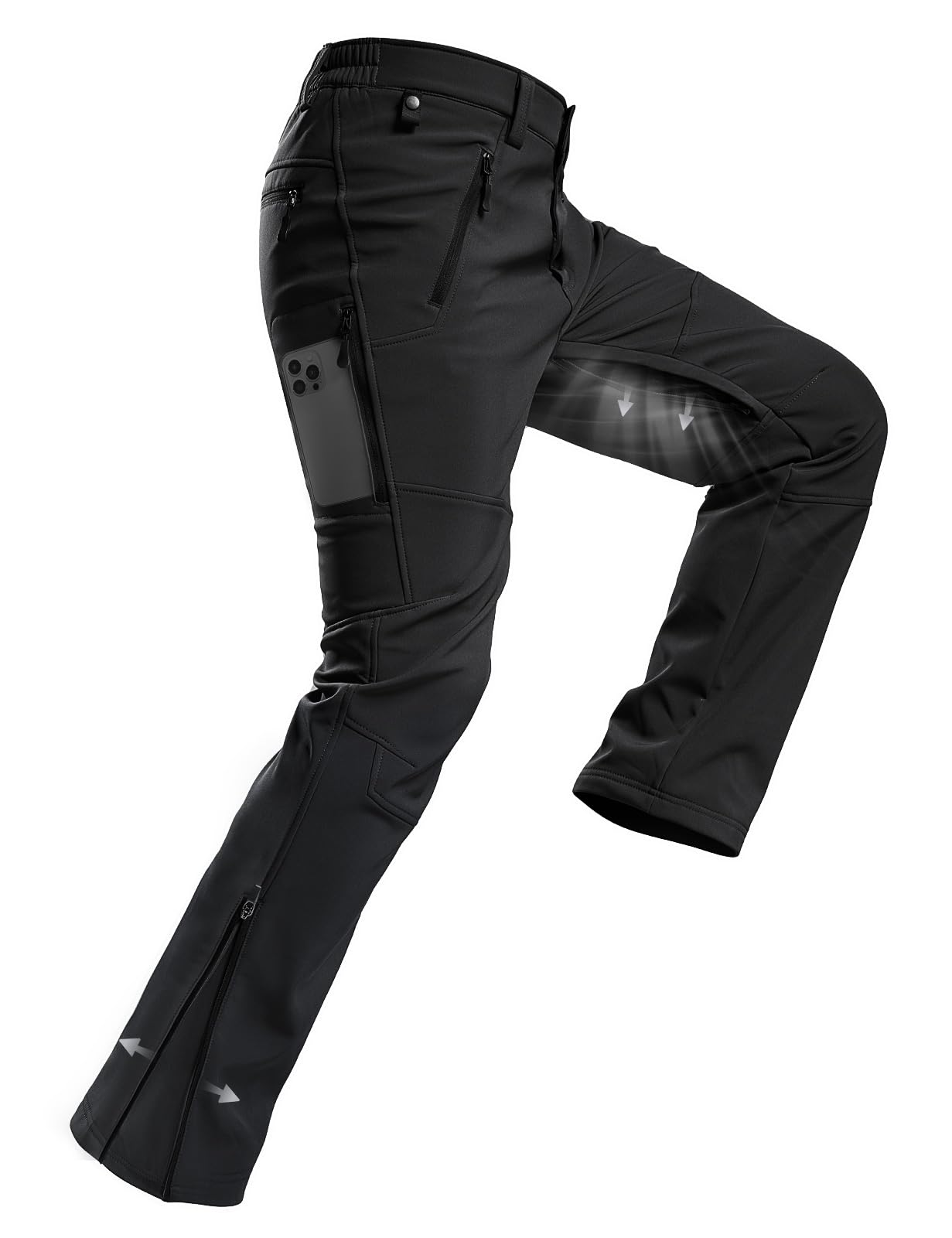
Key Features
- Cut: Not baggy
- Lining: Fleece
- Venting: Zippered inner-thigh vents
- Price: Budget
Zippered inner-thigh vents are the reason to look at this pair. They are the feature that turns a cold-weather pant into something you can wear on a sunny spring day or a long climb above the tree line, and nothing else in this group puts them front and center.
The rest is a sensible cold-weather pant: a fleece lining, a cut that stays close to the leg rather than ballooning, and enough room at the hem to work with a ski or snowboard boot. It is the least expensive men’s option here, which is what makes it interesting as a second pair.
The design is aimed at cold and dry conditions: fleece for warmth close to the skin, vents for the heat you build up moving, and a trim cut that layers easily. There is no sealed shell or taped seam in the construction, so it is a fair-weather friend in the most literal sense.
We keep it in the roundup because vents are the feature people forget to shop for, and buying a vented pant for spring riding costs less than buying a second shell. It is not the pant for a wet climate or a storm day, and we would not…
Pros
- Zippered inner-thigh vents
- Fleece lining for cold days
- Trim cut works with boots
- Lowest-priced men’s pick here
Cons
- Soaks through in wet, heavy snow
We recommend it as a spring and cold-dry-day pant: the thigh vents do what a sealed shell cannot, and the price makes a second pair easy to justify.
How We Tested Snowboarding Pants in Real Conditions
We built the shortlist by pulling every pair our testers could get their hands on from brands we already ride in, then cutting it down by waterproof and breathability ratings, insulation type, available inseams, and whether the size range actually covered real bodies. Price mattered too, so we kept a spread of budget and premium pairs rather than stacking the field with flagships. That left us with 12.
Each pair got the same six months of riding, and we wore the same baselayer underneath every one so the warmth comparisons meant something. Fit, sizing, and length got the most scrutiny: we measured each inseam against where the cuff landed on a boot, kneeled and squatted to strap in, walked the parking lot, and noted whether the waistband stayed put or the hem bunched over the bindings. When a size chart ran small or long, we ordered the next size to confirm it before writing it down.
Water resistance was tested the unglamorous way, by sitting on wet chairlift seats, on a soaked towel in the lodge, and under a sputtering hose for a minute to see whether the fabric beaded or soaked through to the layer underneath. For durability we scuffed the inner cuffs against board edges, hiked a few bootpacks, and checked hems and seat seams for abrasion at the end of the season. Appearance and value got a final pass: how each pair washed up, whether colors faded or pilled, and whether the details justified the price next to everything else in the field.
How to Choose Snowboarding Pants
Buy for the shell and the cuff first; insulation is the part a base layer can fix.
Waterproofing Before Insulation
Snowboarding is a seated sport. You sit to strap in, you kneel to dig a board out, you land on your backside, and the seat and knees take all of it. Taped seams — the tape welded over every stitch line — matter more than a headline fabric rating, because stitching is where meltwater finds a way in. A softshell with a durable water-repellent finish sheds dry snow and light sleet happily but wets through under sustained contact.
If you ride lifts and sit often, put your money into a taped shell, as the FREE SOLDIER pair does. If you are mostly moving, a softshell like the Gash Hao is lighter and more comfortable. Whichever you pick, the water-repellent finish is consumable: wash the pant when it stops beading and re-proof it.
The Cuff, the Boot, and the Layer Underneath
A snowboarding pant has to answer one question at the ankle: does it go over the boot, or seal against it? Zippered or gusseted cuffs open wide enough to pull on over a boot; inner gaiters cinch around the shaft and stop snow riding up. Ski and snowboard boots are bulky, so the size you wear in jeans is not the size you wear over a base layer plus a fleece.
Try them with your boots on, and pay attention to the calf, which is where a trim cut binds first. If you are between sizes, take the larger one: a pant that is slightly loose rides better than one that pulls across the knee when you crouch. The mistake is buying the size that looks right standing in front of a mirror.
Insulation, Vents, and How Warm You Run
Warmth is easy to add and hard to lose. A fleece-lined softshell over a base layer covers most resort days; 120 grams of synthetic insulation adds margin for single digits. Over-insulating is the more common error, because sweat is what makes you cold at four in the afternoon — a damp base layer stops insulating.
Zippered thigh vents are the cheap fix and the reason a vented pant works from December into April. Choose vents if you ride spring conditions, hike for your turns, or simply run warm; skip them if you are static and always cold, since a vent you never open is just another zip.
Length, Hardware, and the Details That Fail
Zips and seams fail long before fabric does. Check that the fly and pocket zippers have a real pull and a storm flap, that suspender clips close with a click, and that pockets shut — snow in a hip pocket makes for a cold, wet afternoon. Inseam matters more than it gets credit for: a cuff that stops above the boot leaves a gap, and one that drags gets shredded in the parking lot.
Tall riders should look for a long inseam and shorter riders for a regular; the BenBoy pair is the one here that offers both. If you ride deep powder, a bib removes the waist gap entirely, which is worth more than any single specification on this page.
Frequently Asked Questions
How do you wash snowboarding pants without killing the waterproofing?
Machine wash cold with a mild detergent, skip the fabric softener, and hang or tumble on low. Heat is what reactivates a durable water-repellent finish, so a few minutes on low once the pant is dry helps. When water stops beading and starts darkening the fabric, wash it and re-proof with a spray-on or wash-in treatment made for technical shells. Once a season is usually enough.
Are bibs better than pants for snowboarding?
In deep snow, yes. A bib puts a high panel and suspenders between your back and the snow, so a fall or a long sit does not send powder down your waistband, and it stays up however much you move. Pants are quicker for bathroom stops and cooler in spring. If you ride powder or hike for your turns, the bib wins; for groomers and park laps, pants are simpler.
Can you snowboard in ski pants?
Mostly, yes. They are the same family of garment, and the differences that matter are the cuff and how much time you spend on the snow. Check that the cuff clears a snowboard boot, since ski pants are often cut for a narrower boot and a forward lean. Beyond that, a ski pant with a taped seat and knees works fine for riding.
Final Verdict
Start with the FREE SOLDIER pair. Fully taped seams, inner gaiters, and 120 grams of insulation make it the most weatherproof option here, and it is the one we trust for a full day of sitting, kneeling, and strapping in. Order a size up; the shell has no stretch.
If you want a softshell that looks like a normal pant, the Gash Hao is the one to wear. For a baggy bib, the GSOU earns its premium. Women tired of guessing sizes should start with the MAGCOMSEN, and the Arctix stays the pair to buy when the budget is tight.