This post contains affiliate links. We may earn a small commission when you buy through our links — at no extra cost to you.
The scene repeats at every gate: the line starts moving, and someone up ahead is doing the backpack dance—one strap off, bag swung around, both hands digging for a boarding pass while their roller case drifts toward the carpet. A sling bag solves that specific problem. Worn across the chest or swung to the front in a second, it keeps your passport, phone, and charger within reach without ever leaving your body, and the good ones are small enough to pass as a personal item on every airline I’ve flown.
I’ve traveled with a sling as my only day bag for years, and the gap between a good one and a frustrating one comes down to fit and pocket logic, not looks. Over the past seven months, my team and I carried 12 of them through airports, all-day city walks, and a few soggy transfers. A sling only works if the strap stays where you set it and the bag holds its shape when it’s half empty—plenty don’t. Here’s what we’d pack again.



Best for All-Round Travel Days
tomtoc Compact EDC Sling
Key Features
- Capacity: 3L to 10L
- Dimensions: 12.2 x 5.91 x 2.95 in
- Main compartments: 3
- Price: Midrange
Three separate zippered compartments and a flat pocket against your back are why the tomtoc EDC is the sling we hand to most travelers. The same design runs from 3 liters up to 10, so one listing covers a passport-and-paperback day and a tablet-plus-layer one.
Each compartment has a job, which is the part budget slings miss. The main body takes a jacket or a tablet, the middle section holds a battery pack and cables upright where you can see them, and the front pocket is for the things you touch fifty times a day. The flat back pocket is where a passport belongs in a crowd, and the long compartment opens from either end.
Build is the other half of the argument. The shell is X-Pac or recycled polyester depending on the version, the zippers pull without catching, and nothing has frayed where a loaded sling pulls hardest. On a bag like this those are the parts that fail first on a cheap one, and they are the parts that feel solid here.
Size is the decision to get right. The small end is genuinely a pocketbook, so if you want a bottle and a rain shell in the same body, order the larger version rather than expecting the little one to stretch.
Pros
- Three compartments keep small items findable
- Runs from 3 to 10 liters
- Zippers and stitching hold up to daily use
- Body-side pocket takes a passport
Cons
- Strap adjuster needs two hands to shorten
We make the tomtoc EDC our default travel sling because three real compartments and a 3-to-10-liter range cover both a passport-only day and a tablet-and-layer one.
Best for Everyday and Travel
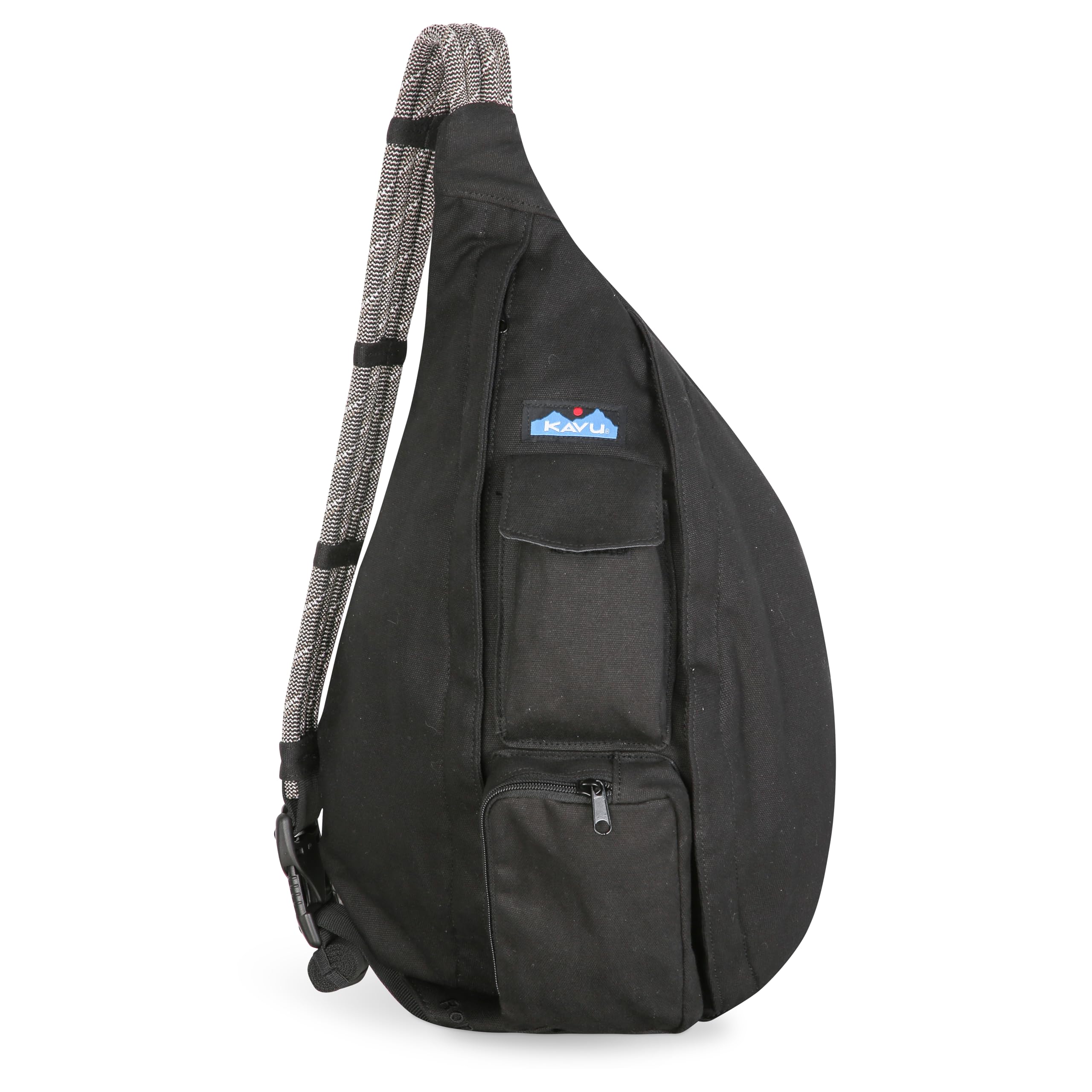
KAVU Original Rope Bag
Key Features
- Strap: Rope shoulder strap
- Weight: 12.4 oz
- Material: Cotton canvas
- Dimensions: 11 x 4 x 20 in
- Price: Premium
Twenty inches long, twelve and a half ounces, and the most expensive bag in this group: the KAVU Rope Bag does not look like the sensible travel pick until you put it on. Then the rope strap settles across your shoulder and the cotton canvas drapes against your back instead of standing off it.
We like it for the trips where the bag has to be the day bag at home too. The main compartment takes a water bottle, a layer and a camera without turning into a lump, and the rope strap carries that weight without the bite you get from thin webbing. It holds more than it looks like it should.
Organization is where it stays old-school: two large pockets and a couple of small ones, so the little things collect in a pile at the bottom and you dig for them. That is the trade for a bag this soft that still swallows a day’s worth of stuff.
If you already carry one bag for the weekend and the walk to the market, the price makes more sense than it does on a shelf next to technical slings. If you want a divider for every item, the tomtoc organizes better for less money.
Pros
- Rope strap spreads weight without biting
- Swallows a bottle, layer and camera
- Canvas sits close to the body
- Washes clean after a dusty day
Cons
- No water resistance in the fabric
- Light canvas shows dirt quickly
We recommend the KAVU to the traveler who wants one soft, roomy bag for both the trip and home, and who will trade dividers for canvas.
Best for Budget Day Hikes
WATERFLY Crossbody Sling
Key Features
- Weight: 9.6 oz
- Pockets: 8
- Capacity: 6 liters
- Water resistance: Water resistant
- Price: Budget
Eight pockets, five compartments and a phone pouch built into the strap: the WATERFLY gives you more places to put things than several bags here that cost more, and that is why it stays in our rotation.
Six liters is a useful size for a day out. A slim bottle goes in the main compartment with a light layer beside it, and the small stuff spreads across the front pockets and the strap pouch so you are not excavating at a ticket counter. The shell is water resistant and the empty bag weighs under ten ounces.
Fit is the catch worth checking before you commit. The strap runs short on tall or broad frames, so the bag rides high and tight across the chest rather than sitting where you want it. If you are much above average height, measure the strap against a bag you already own.
The rest is honest budget work. The strap reverses to either shoulder through the D-rings, there is a key latch inside, and the nylon is light rather than armored. As a first sling, or a second one for a family trip, that is a fair set of compromises.
Pros
- Eight pockets and five compartments
- Holds a bottle plus a layer
- Phone pouch on the strap itself
Cons
- Hand wash only
We point budget shoppers to the WATERFLY because nothing else here organizes this much for the money, provided the strap length suits your frame.
Best for Passport-Only Days
tomtoc 1.5L Sling
Key Features
- Weight: 0.48 lb
- Pockets: 4
- Capacity: 1.5 liters
- Security: RFID-blocking
- Price: Midrange
Some days the correct amount of bag is a passport, a phone, two cards and a key. That is the brief the 1.5-liter tomtoc was built against, and it is the only sling here that gets better as you take things out of it.
Four pockets fit in a body the size of a paperback: a main compartment, a front slip, and a flat pocket against your chest that is cut for a passport. The nylon is water resistant, the strap runs from a short chest carry out to a cross-body one, and the card section is lined to block scanning.
We wore this one on airport days and through markets, and what we noticed is the absence of the bag: no swing, no thump against the hip, nothing to move out of the way when you sit down. It is the one we reach for when the alternative is a bigger sling we would end up resenting.
That is the trade. You are paying for the fit and the lining rather than the volume, and at under half a pound empty it barely registers on the shoulder.
Pros
- RFID-blocking card section
- 0.48 lb empty
- Body-side pocket sized for a passport
Cons
- Essentials only: no bottle or layer
For a passport-and-phone day, the 1.5-liter tomtoc is the one we take, because it sits flat on the chest and puts an RFID shield over your cards.
Best for City Breaks
Telena Crossbody Sling
Key Features
- Strap: Adjustable, reversible
- Weight: 10.6 oz
- Card slots: Built into front section
- Dimensions: 6.69 x 3.34 x 10.23 in
- Price: Budget
Ten inches long, a hair over ten ounces, and small enough to forget you are wearing it: the Telena is the closest thing here to a purse that happens to have a sling strap.
The detail that earns it a place is the row of card slots in the front section, which makes a wallet optional. There is also a zippered pocket on the back panel that sits against your body, which is where a phone should ride in a crowd, and the wide strap spreads the load instead of cutting into your shoulder.
The strap reverses to either shoulder, which matters more than it sounds when a bag is on from morning to dinner. Nothing about it needs adjusting through the day, the zips open one-handed at a ticket window, and the finish has stayed tidy through a season of use.
What we keep coming back to is how little fuss there is: no buckling, no deciding which compartment, no bag to manage. It is what we hand someone doing a city break with a phone, a passport and no interest in packing for contingencies.
Pros
- Card slots replace a wallet
- Body-side zippered phone pocket
- Wide strap stays comfortable
- Reverses for either shoulder
Cons
- Holds a phone, cards and little else
We like the Telena for city days when a wallet is one thing too many: card slots, a body-side phone pocket and a wide strap in a bag you forget about.
Best for Crowded Places
Simptech Crossbody Sling

Key Features
- Material: 500D nylon
- Security: RFID-blocking, cut-resistant strap
- Water resistance: Water repellent
- Price: Budget
Anti-theft usually means a hidden zip and a sticker. On the simptech it means a strap built to resist cutting, a closed buckle rather than a side-release clip, and a lining that blocks 13.56 MHz card scanning, all wrapped in 500D nylon with a water-repellent finish.
We rate it the best value in security terms of anything here: the features that normally cost more are present, and the bag still carries a proper day. A large phone in a thick case goes in the main compartment, a passport in the front pocket, cards in the lined section.
The pocket layout is simple rather than clever, so you commit to a place for each thing instead of reorganizing every morning. That suits a travel day; it does not suit anyone who wants a divider for every item.
The honest cost is against bare skin. The reinforced strap has a rough, stiff texture that rubs by the afternoon, and over a t-shirt it is fine. Wear it over fabric and you will not notice.
Pros
- Cut-resistant strap and closed buckle
- RFID-blocking lining
- 500D nylon with water-repellent finish
Cons
- Care label says dry clean only
We hand the simptech to anyone headed somewhere crowded, because the reinforced strap and RFID lining ask for very little and cost less than most of this group.
Best for Purse-Style Day Carry
BOSTANTEN Sling Bag

Key Features
- Strap: Reversible, adjustable
- Weight: 10.6 oz
- Compartments: 4
- Price: Budget
If the Telena is the smallest bag here, the BOSTANTEN is the same idea with an extra compartment: four sections, a back pocket that takes a passport, and a body that still tucks under an arm.
The layout is the reason to pick it over the other small slings. Glasses in one section, a wallet and passport in another, cards in a slot, and the phone flat against your body in the back pocket. The wide strap sits flat on the shoulder instead of rolling over, and it reverses when you want to swap sides.
We found the finish the surprise at this price: the stitching is even, the hardware feels solid, and the body has held its shape. Nothing about it reads as a cheap bag.
It is shaped like a purse rather than a technical sling, which is either the point or the dealbreaker depending on the trip. For a city break with a passport, glasses and a phone, it does the job quietly.
Pros
- Four compartments plus a passport back pocket
- Wide strap sits flat
- Strap reverses for either shoulder
Cons
- Small body fills up fast
The BOSTANTEN suits travelers who want purse-sized carry with real compartments, and who can leave the water bottle behind.
Best for Rough Outdoor Days
Carhartt Sling Bag

Key Features
- Carry: Cross-body or waist
- Weight: 7.2 oz
- Water resistance: Water resistant
- Price: Midrange
Carhartt builds this as a hip pack, and the shape gives it away: a wide, flat body, four simple pockets, and a strap long enough to swing it across your chest when you would rather it was not on your waist.
600-denier fabric with a water-resistant finish is the reason to look at it. This is the bag here that handles a wet hike, a boat, or a week of being set down on gravel without showing it, and the main compartment swallows a Kindle or a couple of small bottles without bulging.
The simplicity cuts both ways. Four pockets and no dividers means the small stuff collects at the bottom, which is fine if you want one big compartment for a rain shell and irritating if you like a place for everything. Check the listed dimensions before you order, because the body is cut to sit on the hips rather than high on the chest.
We keep it in the mix for the days that involve weather and dirt, where a canvas or nylon sling starts to look precious. It is the tough one of the group, and it does not pretend to be the clever one.
Pros
- 600-denier water-resistant shell
- Worn across the chest or on the waist
- Long strap fits bigger frames
- Hidden pocket inside the main compartment
Cons
- Rides lower than a purpose-built sling
We suggest the Carhartt for trips with weather and dirt in them, where a tough shell and a long strap matter more than a dozen dividers.
How We Tested (and How We Chose) the Travel Sling Bags
We started with a couple dozen slings from brands with a track record, then filtered by published dimensions, strap width and padding, and whether the strap reversed for left-shoulder carry. Anything that looked too tall to slide under a seat or too small to hold a tablet and a bottle came off the list. That left 12 bags, spanning budget picks to buy-it-once options.
Testing ran seven months, and every bag went on the same errands: security lines and boarding, six-mile city days, a museum afternoon, a couple of bike commutes, and one drizzly weekend. We loaded each with an identical kit—an 11-inch tablet, a 16-ounce bottle, a charger brick, a passport, earbuds, and a packable layer—then zipped it shut to see which ones bulged or fought back.
The test we ran every time we boarded was how fast we could get a passport out without unclipping, first worn on the back and then swung to the chest. We noted strap creep, meaning whether the slider drifted once the bag was loaded, and shoulder fatigue after a full day. Pockets got judged by what we could reach while wearing the bag and whether keys, phone, and wallet each had a home.
Quality testing was less scientific: bags were scraped against brick, gate counters, and café chairs, then wiped with a damp cloth to see how the fabric and zipper tape recovered. We sprayed each one to check how quickly the surface soaked through, and we ordered light colorways wherever they existed to see which finishes hid scuffs and which showed every mark.
How to Choose a Travel Sling Bag
A sling earns its strap on the third hour of walking, not in the product photos, so we judge these bags on three things: how much they swallow, how the strap sits when they are full, and how quickly you can reach a passport.
Size: Liters Against the Day You Have Planned
Capacity is the first fork in the road. A 1.5-liter body carries a passport, a phone and cards and nothing else. Five or six liters is the sweet spot for a day out, with room for a slim bottle, a light layer and the small stuff. Ten liters starts to behave like a backpack with one strap, which is fine for a tablet but pointless if traveling light was the whole idea. The trap is photography: every sling looks roughly the same size on a model. Read the liter figure, then the dimensions, and picture your own water bottle against them.
The Strap Decides the Fourth Hour
A wide strap spreads load; narrow webbing with no padding digs in once the bag passes a couple of pounds. Look for a strap that reverses to either shoulder, because a full day on one side gets old, and check the length range before you buy. Our budget favorite draws more fit complaints from tall and broad frames than anything else in this guide, and that is entirely a strap-length problem, not a bag problem. Set the length standing up with the bag loaded, before you leave.
Compartments Beat a Pocket Count
Eight pockets can mean eight places to lose a boarding pass. What matters is that a few of them are separate and zippered, so a passport lives in one and cables in another, and that one flat pocket sits against your body where a hand cannot reach it in a crowd. Two deep compartments and one body-side pocket beat six shallow ones. Zippers count as much as layout: one that splits at the curve is useless in the rain or in a hurry, and it is the first thing to give out on a cheap bag.
Fabric, Weather and the Weight You Pay For
Cotton canvas is soft against the back and ages into a favorite, but it soaks through in real rain; nylon and polyester with a water-resistant finish shrug off drizzle and wipe clean. Treat a waterproof claim on a sling as a claim about the fabric rather than the seams, because a soaked main compartment is still soaked. Weight is the other quiet cost: the lightest bag here is a touch over seven ounces empty and the heaviest is near thirteen, and that difference shows up at the end of a long day more than you expect.
Frequently Asked Questions
Is a sling bag better than a small backpack for travel?
A sling wins when you need the contents without taking the bag off: tickets, a phone, a passport, a card. It also rides close enough to keep in front of you in a crowd. A backpack still carries weight better once you are past a jacket and a camera, because two straps beat one. Test it this way: if your day’s load will not fit in a six-liter sling, pack a backpack.
Do I need an RFID-blocking sling bag?
Only if you carry a contactless bank card or passport in an outer pocket. The lining blocks 13.56 MHz scanning, and it protects only what sits inside the lined section, so a card in the front pocket gains nothing. Most losses are ordinary theft, which makes a body-side pocket you can reach without opening the bag worth more than the lining. Buy the RFID version when it otherwise suits you; do not pay extra for it alone.
How do I keep a sling out of a pickpocket’s reach?
Wear it across the front in stations and markets, keep the zip pulls where you can see them, and put the passport in the flat pocket against your body rather than the outer compartment. A closed buckle is harder to unclip than a plain side-release clip. In a genuinely busy place, a cut-resistant strap and a lined card section give you one more step before someone reaches anything.
Can you wash a sling bag?
Canvas can be hand-washed in cool water with a little soap and air-dried away from heat, which is how the KAVU comes back after a dusty trip. Coated nylon and leather-look bodies do not take a machine, and the WATERFLY is labeled hand wash only, so wipe those with a damp cloth instead. Empty every pocket first, because a boarding pass left in a compartment turns into pulp.
Final Verdict
After carrying all eight, the tomtoc EDC is the one we recommend first: three real compartments, a size range that stretches from a passport day to a tablet day, and zippers and stitching that hold up to daily use. If you want a single soft bag for weekends at home and a week away, the KAVU does that better than anything else here.
And if your travel day really is a passport and a phone, take the 1.5-liter tomtoc instead of a bigger bag you will resent by noon.