This post contains affiliate links. We may earn a small commission when you buy through our links — at no extra cost to you.
Hiking shoes ask you to pick a side: the burly pair that shrugs off rocks and roots but feels like a brick by mile eight, or the featherweight trail runner that disappears on your foot and lets every sharp stone through. I’ve limped home in both kinds. What you actually want is a shoe that grips wet rock, holds your arch up over a long day, and doesn’t spend three weeks chewing at your heels before it settles in. My team and I have spent the last six months on trails in 12 pairs to find the ones that do all of that.
Two things surprise first-time buyers. Fit swings wildly between brands — a size 10 in one shoe runs like a 9.5 in another — so the pair with the best reviews isn’t automatically the pair for your foot. Price doesn’t line up neatly either: some of the least expensive shoes we tried were the most comfortable straight out of the box, while a couple of pricier ones took a week to stop rubbing. The picks below are the ones we kept reaching for, sorted by what they’re actually good at.


Best for All-Round Hiking
Merrell Moab 3
Key Features
- Widths: Standard and wide
- Outsole: Vibram
- Listed weight: 3.06 lb
- Price: Midrange
When someone asks us what hiking shoe to buy and gives us no other information, this is the answer. The Moab 3 is the easiest shoe in this guide to fit: half sizes, wide widths, and a toe box with enough room that your toes don’t jam on a long descent. Lace it up and the heel stays where you put it, which is the thing that decides whether a big day ends in blisters.
Underfoot it’s a traditional hiking shoe rather than a trail runner. There’s enough midsole to stand on roots all afternoon, and the Vibram outsole grips wet rock and dry dirt with the same steady, unobtrusive confidence; the tread is usually the last thing to give out. The listing puts it at just over three pounds, and the extra ounces buy cushioning we’re glad to carry on a long day.
Our one reservation is durability, and it’s specific: the toe cap and the edge of the sole are where these come apart when they do, so give that seam a look before a long trip and keep an eye on it afterwards.
Beyond that, the Moab 3 is the safe answer for almost anyone — first pair, wide feet, mixed terrain, a bit of everything. The exception is sustained wet weather, where the Peakfreak II is the better tool.
Pros
- Half sizes and wide widths for a closer fit
- Vibram outsole grips wet rock and dry dirt
- Roomy toe box that doesn’t jam toes on descents
- Heel stays locked once laced
Cons
- Toe cap and sole edge can separate
We recommend the Moab 3 to almost anyone who asks: it fits more feet than anything else here, and the Vibram sole handles wet rock and dry dirt alike.
Best for Budget Trail Days
adidas Terrex Anylander
Key Features
- Tread: Deep lug pattern
- Toe box: Wide, square-cut
- Listed weight: 2.43 lb
- Price: Budget
The budget pick here doesn’t ask you to give up the part of a hiking shoe that matters. The Anylander’s outsole is a deep, blocky lug pattern that bites into loose gravel and dirt and keeps its hold on rock, and the square-cut toe box is generous enough for wide, flat feet to sit without pinching.
What surprised us is how little the price shows elsewhere. It’s true to size, cushioned enough for a long day on your feet, and light in the hand. We came away thinking of it as a trail shoe that happens to be inexpensive rather than a cheap shoe we took on a trail.
The one flag is water. Wet grass and steady rain get through the upper, and the consolation is that they dry fast — which is what you want in summer heat and not what you want in a cold bog. For a first pair, or a second pair you don’t mind getting muddy, that’s a fair trade.
Pros
- Deep tread bites into gravel and loose dirt
- Wide, square toe box suits flat feet
- Light enough to wear all day
Cons
- Pronounced arch support won’t suit every foot
Grip is the last thing to sacrifice on a hiking shoe, and the Anylander gives up none of it — a sure-footed, wide-fitting trail shoe for a budget.
Best for Wet-Weather Day Hikes
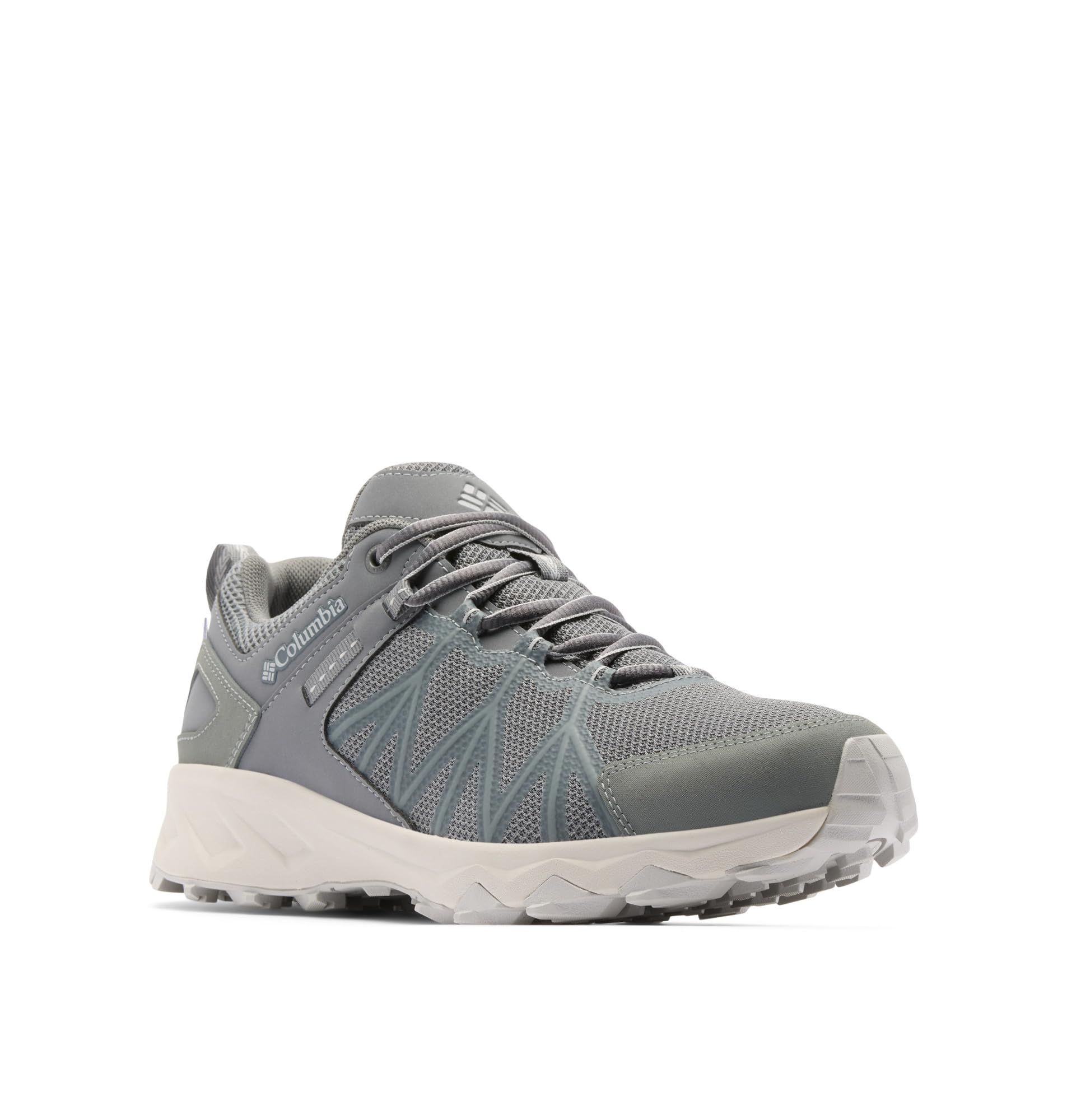
Columbia Peakfreak II Outdry
Key Features
- Fit: Low-profile, slim
- Model number: 2005101
- Waterproofing: Outdry
- Price: Midrange
The Peakfreak II doesn’t feel like a waterproof shoe, which is the nicest thing we can say about it. It’s light, the sole flexes underfoot, and it moves the way a running shoe moves — right up until you stand in a puddle and your socks stay dry.
Outdry is the reason it’s here. The construction keeps water out and still lets the shoe breathe, which is the hard part with a membrane; on a muddy, wet trail it’s the shoe in this guide we trust most to keep feet dry without cooking them. Grip comes with it, on wet roots and slick rock, and without the squeaking you get from some lug patterns on pavement.
Where it gives ground is shape and load. The profile is low and on the slim side, so wide feet belong in the KEEN, and there’s less underfoot than the Moab once a pack gets heavy. For fast, wet day hikes and trips where rain is likely, it’s the one we reach for first.
Pros
- Waterproof Outdry build that still breathes
- Light, flexible running-shoe feel
- Sure grip on wet roots and slick rock
Cons
- Slim, low profile leaves little room for wide feet
For wet-weather day hikes we take the Peakfreak II: it keeps water out, still breathes, and moves like a running shoe — as long as your feet aren’t wide.
Best for Wide Feet
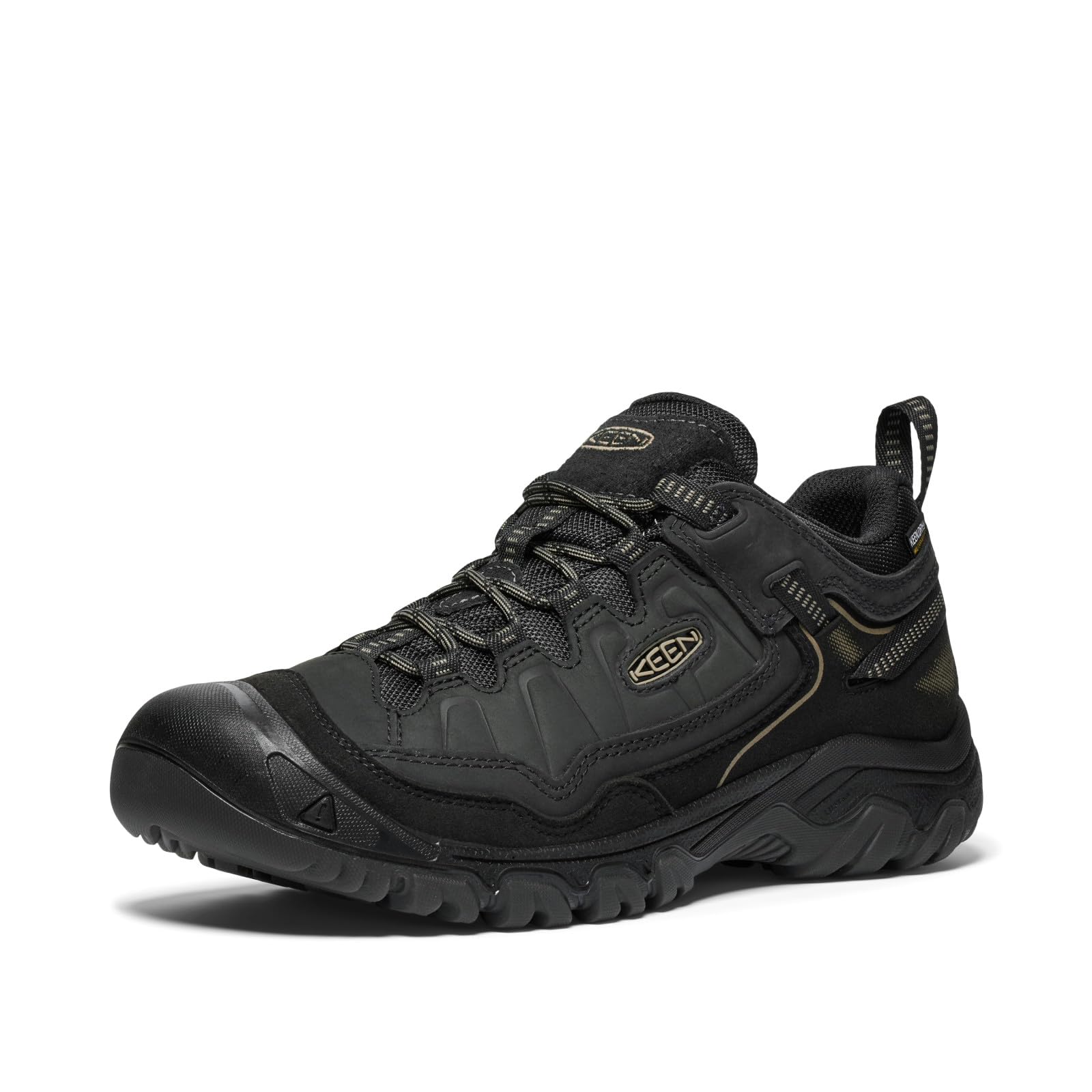
KEEN Targhee 4 Low WP
Key Features
- Cut: Low height
- Toe box: Wide
- Waterproofing: Waterproof
- Price: Premium
Start with the toe box. The Targhee 4 has the most room up front of anything here — genuinely wide rather than merely long — and a bunion is exactly the kind of foot it accommodates. Wide-footed hikers are the ones we point here, and the lacing takes up the slack at the midfoot without squeezing the front of the foot.
The waterproof upper does what its name promises on a wet trail, and the build is the most confidence-inspiring in this guide: soles stay attached, the upper keeps its shape, and pairs take a beating across three seasons without looking finished. That durability is what the extra money buys.
The cost is weight and stiffness. These are the heaviest, most rigid shoes we recommend here, and on a fast, hot day you feel the difference next to the Peakfreak. Narrow feet will swim in them too, and sizing down doesn’t fix a shape mismatch.
On a wet, loaded day the weight stops mattering, and the structure is the reason your feet arrive back at the car intact.
Pros
- Roomiest toe box in this guide
- Waterproof upper that keeps water out
- Durable build that holds its shape
Cons
- Heavy and stiff next to the light picks
- Too roomy for narrow feet
Wide feet, bunions and wet trails are what the Targhee 4 is for, and we haven’t found anything here that fits that foot better or lasts as well.
Best for Travel and Paths
Columbia Fairbanks Low

Key Features
- Cut: Low-cut
- Sole: Flat, low profile
- Model number: 1826371
- Price: Midrange
This is not the shoe for a rocky, wet, all-day mountain hike, and it doesn’t pretend to be. The Fairbanks Low is a light, flat, sneaker-shaped shoe with a soft sole and a low profile, and for a gravel path, a towpath or a week of city travel it’s genuinely pleasant — the kind you forget you’re wearing.
We kept reaching for it as a travel shoe. It packs flat, reads as a sneaker rather than hiking kit, and feels broken in the moment you put it on. What it doesn’t have is much underfoot, so keep it for easy ground and short days rather than rocky descents.
One practical note: pairs can arrive smelling strongly of rubber and adhesive. Leave them outside for a few days before the first wear and it fades; if it doesn’t, send them back.
Pros
- Light and comfortable from the first wear
- Looks like a sneaker and packs flat
Cons
- Midsole and outsole can separate
- Thin underfoot on rough ground
The Fairbanks Low earns its place as a light travel and easy-trail shoe; take something with more underfoot once the ground turns rocky.
How We Tested Men’s Hiking Shoes
We started with a list of roughly 60 shoes from brands we’ve had good luck with, then narrowed it using the specs that matter on a trail: lug depth, weight, whether a shoe came in wide sizes, and price. Anything offered in only one width, or that weighed in closer to a boot, got cut early. That left 12 pairs, which we bought ourselves so no brand had a say in the results.
Each pair went on real hikes over six months — two-mile after-work loops, rocky ridgelines, and a handful of 12-mile days with a loaded pack — plus the unglamorous stuff, like dog walks and long airport days. We weighed every shoe on a kitchen scale before its first hike, then paid attention to how it felt at mile eight rather than mile one. For water resistance, we stood each shoe in a running stream for two minutes and checked whether the socks underneath stayed dry; for arch support, we tracked how our flat-footed and high-arched testers felt on long descents.
Comfort came down to break-in: how many miles before a shoe stopped rubbing, and where it rubbed. Fit we checked by lacing up with the socks we’d actually wear, and in a few cases sizing up a half. After six months we looked at heel and toe tread wear, frayed seams, and crushed toe caps to see what was holding up. We also wore pairs on back-to-back humid days without letting them air out, then gave them a sniff, and took each one to the grocery store to see whether it read as a hiking shoe or a clown shoe.
How to Choose Men’s Hiking Shoes
Fit decides more of your comfort than any figure on the box: get the width and the heel right, and every other choice gets easier.
Fit, width and toe box
A hiking shoe should hold your heel without pinching the front, which is a narrower ask than it sounds. Try shoes on late in the day, with the socks you actually hike in, and leave roughly a thumb’s width between your longest toe and the front of the shoe. Feet swell and slide forward on descents, so a shoe that fits exactly in the shop is the one that bruises a toenail on a long downhill.
Width is where most men get stuck. Lasts vary between brands, so start with the width you wear in a running shoe and go wider only if the sides of your feet feel pressure. Half sizes and wide options earn their keep here — the Merrell Moab 3 comes in both, and the KEEN Targhee 4 has the roomiest toe box in this guide. With a bunion or a very wide forefoot, fit the front of the foot and accept a slightly looser midfoot, because lacing can take up slack the upper cannot give.
Waterproof, or fast-drying
A membrane keeps water out and heat in. That trade is worth it in mud, wet grass and cold rain, and it is a penalty on a hot, dry hike where an unlined shoe breathes and dries within an hour. Match the shoe to the weather you actually hike in rather than the worst weather you can imagine.
One trap: a low-cut shoe only keeps water out as high as the collar. A membrane will not get you across a stream above the ankle, so buy waterproofing for rain and puddles, not for wading. Where a membrane is the whole point, the Columbia Peakfreak II Outdry is the shoe here that keeps water out without turning into a sauna.
Tread and grip
Lug depth is a compromise. Deep, open lugs clear mud and bite into loose gravel; shallower, flatter patterns are steadier on rock and pavement and don’t feel like walking on studs at the trailhead. The rubber matters as much as the shape — softer compounds hold wet rock better and wear out faster.
The trap is judging tread by the pattern alone. Once the lugs’ edges are rounded and the grooves are shallow, a shoe has lost most of the grip it was designed with, whatever the tread looks like in a photo. Check the edges on the pair you own: if they’re smooth, that answers the replacement question better than the calendar does.
How much shoe you need
A low-cut hiking shoe gives up ankle coverage and gains savings in weight and heat, which is why most day hikers are better off in one than in a boot. What it should not give up is underfoot support: a stiffer midsole and a wider platform carry a loaded pack better, while a lighter, more flexible shoe is less tiring on fast, unloaded hikes.
Be honest about the load and the ground. Day trips with water and a shell are well served by the light shoes here; weight over rough terrain is where the structure of the KEEN Targhee 4 earns its place. Listed weight is not a proxy for support either — a heavy shoe with a soft midsole tires you more than a lighter, stiffer one.
Frequently Asked Questions
Can I use my own insoles or orthotics in hiking shoes?
Yes, and it’s worth doing if you already wear them. Before you buy, check that the factory insole lifts out — most do, but a glued-in one leaves you no room to work with — then try the shoe with your orthotic in place, because it adds volume and can push you up a half size.
Size on the combination, not the shoe alone, and take the orthotic with you if you’re trying anything on in a store.
How do I know when hiking shoes need replacing?
Check two things. Press your thumb into the midsole under the heel: if it compresses easily and creases, the foam has packed out and no new insole will bring the cushioning back, even with tread left. Then look at the outsole lugs — once their edges are rounded and shallow, grip on wet rock is mostly gone.
Either sign means it’s time, and a peeling toe cap usually turns up around the same point.
Do new hiking shoes need breaking in?
Less than they used to, but run a test anyway. Wear them around the house for an hour, then take a short, easy hike before a long one.
The signal to watch is a hot spot in the first mile: that’s a fit problem rather than a break-in problem, and it won’t resolve, so return the pair while you still can. Wear the socks you’ll hike in for the test, since a thin sock can hide a fit that’s too roomy.
Final Verdict
Buy the Merrell Moab 3 unless something specific sends you elsewhere. It’s the easiest shoe here to fit — half sizes, wide widths, a roomy toe box — and the Vibram outsole handles wet rock and dry dirt without drama, at a price that sits in the middle of this group.
If your feet are wide or the forecast is grim, the KEEN Targhee 4 is the better buy: more room up front, a genuinely waterproof upper and a build that holds together. For fast, light day hikes in the rain, take the Columbia Peakfreak II.