This post contains affiliate links. We may earn a small commission when you buy through our links — at no extra cost to you.
A life jacket that rides up around a kid’s ears the second they jump in isn’t safety gear — it’s a false sense of it. Too big a vest can slide off a small body, and one that’s too snug turns every launch into a wrestling match with a zipper. What a good jacket actually buys you is a kid who stays face-up and calm in the water, and an adult who can look away for a minute without their stomach dropping.
Since May, I’ve been living with 14 kids’ life jackets — pool afternoons, lake weekends, a couple of boat rides — and the gap between the good ones and the rest shows up fast. One thing worth knowing before you shop: fit is a weight-and-chest question, not an age question. A vest may be sized for 30 to 50 pounds and still sit wrong on a stocky four-year-old, and the lift test (grab the shoulders, pull up) tells you more than any size chart does. The ones below are what stayed put, kept heads up, and left no red marks after an hour.



Best for Face-Up Flotation
Stearns Heads-Up Child
Key Features
- Flotation: Heads-up neck float
- Leg strap: Lined leg strap
- USCG type: Type II
- Weight range: 30-50 lb
- Price: Premium
The heads-up collar is the reason this Stearns earns the top spot. Type II flotation is built to help a child turn face-up, and the raised neck support gives a tired or frightened kid something to lean into. For general boating, lake days, and a first life jacket, that is the behavior we want. It is not the low-bulk vest for a confident wakeboarder, but it is the one we choose when the child is still learning to be comfortable in the water.
The fit details back up the safety design. The lined leg strap is the part we appreciate most: it keeps the vest from sliding up and reduces the chafe that makes kids fuss. The adjustable straps and zipper-and-buckle closure take a little patience to dial in, but they hold once you do. The bright green shell also makes a child easier to spot against water and boat upholstery.
The main limit is the size band. This vest is built for 30-50 pounds, so it is not the answer for a small infant or a child who has moved into youth sizes. It also carries a premium over the basic open-side vests here, which is the trade-off for the Type II collar and the more supportive shape. For the right weight range, we think that trade is worth making. It is the vest we leave in the boat bag for visiting cousins, because the adjustment range covers a useful spread of 30-50 pound kids without a fight.
Pros
- Face-up Type II flotation with head support
- Lined leg strap reduces chafe and lift
- High-visibility green shell
- Consistent fit for its stated weight range
Cons
- Only rated for 30-50 pounds
For kids in the 30-50 pound range, we recommend this first: the heads-up Type II collar and lined leg strap make face-up flotation easier to live with.
Best for Budget Boating
Aqua Oceans 7
Key Features
- Design: Open-side, 3 straps
- Closure: Buckle and zipper
- Weight range: 30-50 lb
- USCG approval: Yes
- Price: Budget
The first thing that stands out is the value. This Aqua Oceans vest is the least expensive USCG-approved option in this group, and it still gives you an open-side cut with three adjustable straps. For a spare vest on the boat, a growing kid who needs a second jacket, or a family that wants to keep one at the grandparents’ house, that is a sensible way to spend less.
The open sides make it easy to pull on and adjust, and the longer chest straps help it cover a wider range. On the water, that design depends on a snug leg strap and tight buckles; when the vest is loose, it can lift instead of staying down around the waist. We treat it as a budget spare rather than the first choice for a nervous swimmer or a child who will be in chop.
The bright pink shell is easy to spot, and the nylon-and-foam build is simple to wipe down. It is not the plushest vest here, but it does the basic job for less. Keep it in the car for pool afternoons and it will earn its place.
Pros
- Budget-friendly USCG-approved option
- Open-side design with three adjustable straps
- Bright pink shell is easy to spot
- Simple to wipe down
Cons
- Sizing runs small for some children
This is our budget pick: a USCG-approved open-side vest for 30-50 pound kids, with simple straps and a bright shell that is easy to spot.
Best for All-Day Comfort
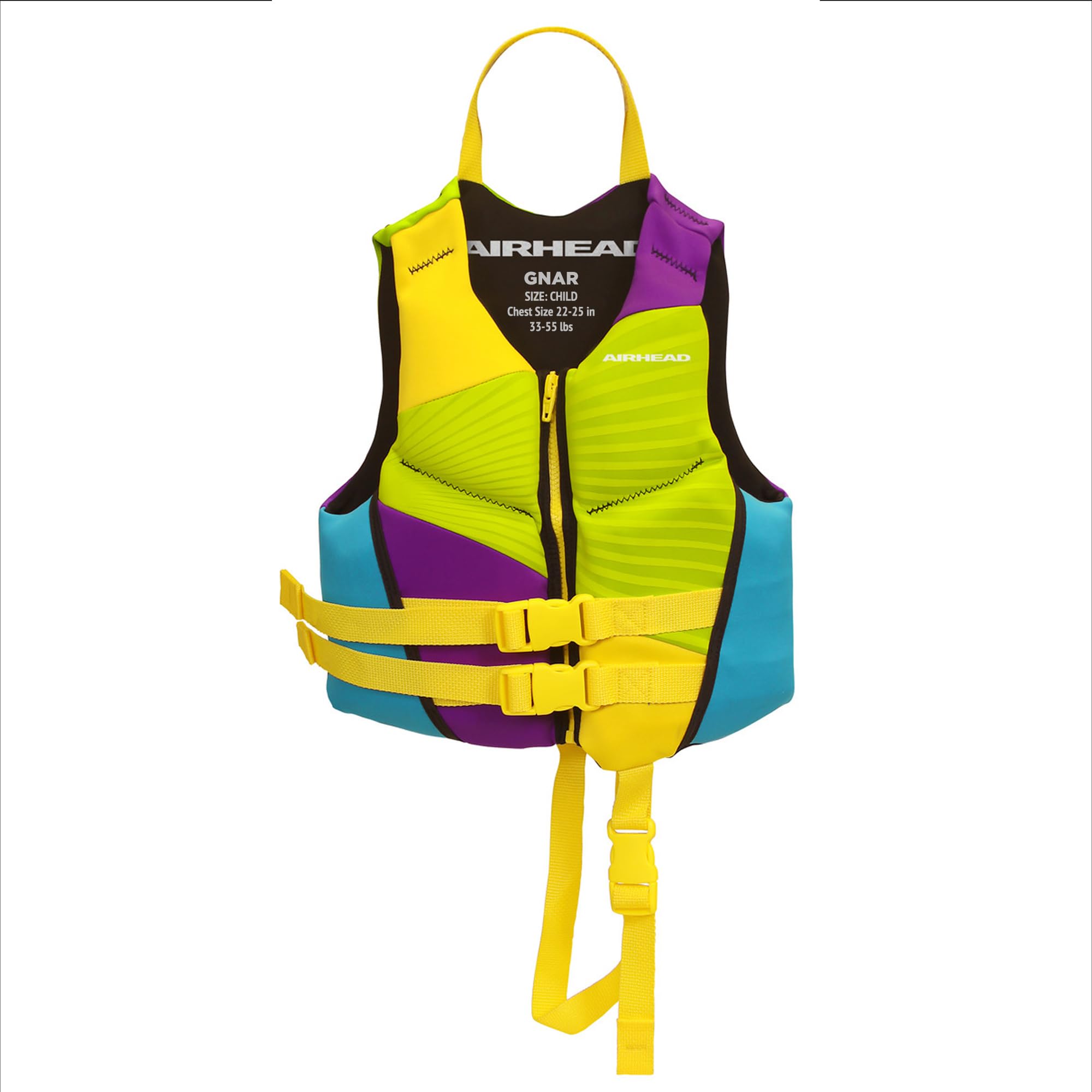
Airhead Gnar
Key Features
- Shell: Quick-dry Neolite
- Closure: Zipper, buckle, crotch strap
- USCG type: Type II infant / III child
- Weight range: 30-50 lb
- Price: Premium
The softness is the first thing we noticed. The Neolite shell is quick-drying and feels more like a rash guard than the stiff nylon on a basic vest, which matters when a child is wearing it for hours. The closed sides, zipper, and crotch strap keep it in place, and the cut leaves the arms free for swimming and climbing back on the boat.
This is our pick for kids who are already comfortable in the water and need a vest that will not fight them all day. It is a Type III design for the 30-50 pound child size, so it does not have the heads-up collar of our top pick. For a non-swimmer who needs face-up flotation, the Stearns is the better shape; for a kid who wants to move, this is the one we grab.
The bright colors are a bonus in a crowded swim area, and the quick-dry fabric means it is not soggy for the ride home. We have seen enough kids relax once the scratchy vest comes off that the softness alone earns it a place. It is the vest we pack when the day includes both swimming and boat time, because it handles both without feeling like a penalty.
Pros
- Soft, quick-dry Neolite shell
- Closed sides and crotch strap stay in place
- Leaves arms free for swimming
- Bright color options
Cons
- Runs small across the chest
For a 30-50 pound child who hates stiff foam, this soft, quick-dry vest is the one we reach for on long boat days.
Best for Older Infants
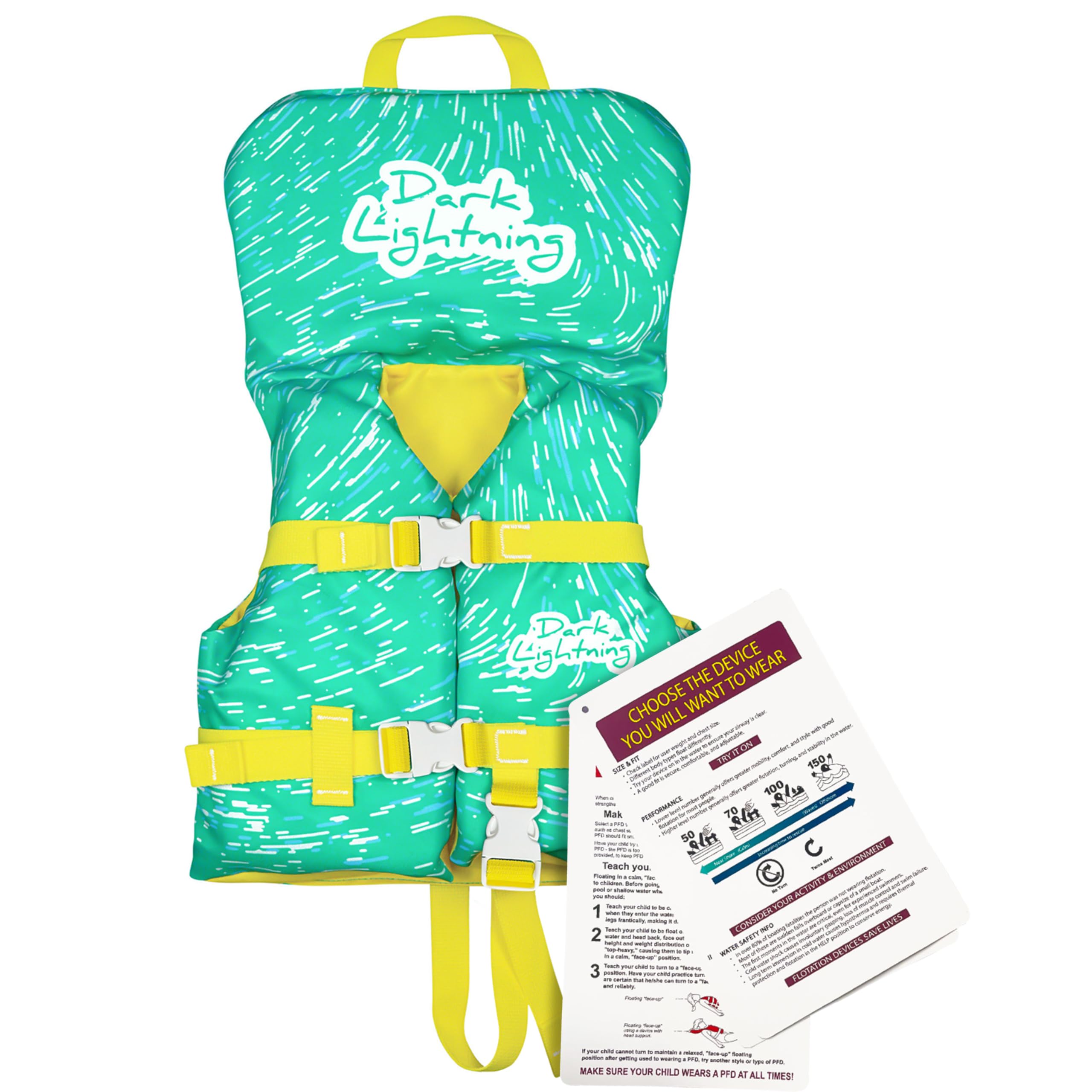
Dark Lightning Infant
Key Features
- Support: Headrest, leg strap, grab handle
- Material: Foam
- Weight range: 0-30 lb
- USCG approval: Yes
- Price: Budget
The grab handle is the detail that makes this vest useful on a dock or in a pool. You can lift a toddler without pawing at wet straps, and the headrest gives a tired baby somewhere to settle. The adjustable leg strap keeps the vest from sliding up, which is the main thing we look for in an infant PFD.
The 0-30 pound label covers a wide spread, and this vest is built for the upper end of it. It is a better match for a 20-30 pound toddler or an older infant than for a small baby; the foam and headrest can overwhelm a tiny frame. Check the fit with the child seated and standing, and make sure the headrest sits behind the neck rather than pushing the chin forward.
The USCG-approved foam flotation is simple and reliable, and the green shell is easy to spot. It is the one we reach for when the outing involves a lot of lifting in and out of the boat, because the top handle gives you a clean grab point. For that toddler window, it is a practical vest.
Pros
- Headrest and leg strap support
- Top grab handle for lifting
- USCG-approved foam flotation
- Good for older infants and toddlers
Cons
- Rated only to 30 pounds
We like this for older infants and 20-30 pound toddlers: the headrest, leg strap, and grab handle make water handling easier.
Best for Active Big Kids
Stohlquist Kids 50-90
Key Features
- Closure: Three-buckle front
- USCG type: Type III
- Back panel: Thin back panel
- Weight range: 50-90 lb
- Price: Midrange
The thin back panel is the smartest part of this Stohlquist. It keeps foam out of the way when a child leans back in a boat seat or kayak, and the sculpted front panels leave the arms free for paddling. For a 50-90 pound kid who has outgrown the toddler vests, that is a more comfortable shape than a boxy Type III.
The three-buckle front is straightforward to adjust, and the 200D nylon shell is light enough to wear all day. It suits active families who are already comfortable on the water. It does not have the heads-up collar of our top pick, so it is not the first choice for a non-swimmer who needs face-up flotation.
It can slide up when a child floats instead of swimming, which is worth watching in deep water. For the right kid, the freedom of movement is worth that compromise. It is the vest we hand to a kid who complains that every other jacket feels like a box.
Pros
- Thin back panel for seat comfort
- Three-buckle front adjusts quickly
- Lightweight 200D nylon dries fast
- Good arm movement for active kids
Cons
- Runs small for the 50-90 range
For bigger kids who want to paddle and swim without a bulky vest, we like this thin-backed Type III and its easy three-buckle front.
Best for Fun Boat Days
Sportstuff Stars & Stripes

Key Features
- Design: Open-side, 3 buckles
- Extras: Crotch strap
- Weight range: 30-50 lb
- USCG approval: Yes
- Price: Budget
The stars-and-stripes print is the first thing a kid notices, but the crotch strap is the detail that matters. It keeps the vest from riding up, and the three body belts let you snug it down over a swimsuit or rash guard.
For a 30-50 pound child, that is a useful combination at the budget end of the group. The open sides let air move, which helps on a hot boat, and the cut leaves enough room to move.
The shell is 200-denier polyester with poly-E foam, so it is not as soft as the Neolite vests here. It suits families who want a simple, bright vest that a child will actually pick out of the bag.
The print is the fun part, but the color is not permanent. The red in the flag can fade after time in sun and water, so rinse it and dry it in the shade if you want it to stay bright. It is the one we bring out for the Fourth of July boat ride, because the kid and the grandparents both get a kick out of it.
Pros
- Crotch strap keeps the vest down
- Three body belts adjust quickly
- Stars-and-stripes print is easy to spot
- USCG-approved Type III
Cons
- Flag colors can fade in sun and water
We like this classic open-side vest for pool and boat days: the crotch strap adds security and the flag print is easy to spot.
Best for Budget Youth
Airhead General Purpose

Key Features
- Design: Open-side, 3 belts
- Weight: 12 oz
- USCG type: Type III
- Weight range: 50-90 lb
- Price: Budget
The appeal here is simple: a USCG-approved Type III vest for older kids at the lowest end of the youth price range. The open-side cut with three body belts is easy to adjust, and the 12-ounce build is light enough to keep in a boat bag without noticing it.
For a spare vest or a first youth jacket, that is useful. It is not a plush vest: the polyester shell and poly-E foam are basic, and the open sides depend on the belts being tight. It makes sense for fishing, crabbing, and general boat duty rather than all-day swimming. A kid who wants to move freely will appreciate the cut, but a nervous swimmer should be in a face-up design.
The blue shell is easy to spot, and the buckles are simple to operate. It is a workhorse, not a comfort pick. It is the vest we leave on the boat for friends’ kids, because it is easy to adjust and nobody worries about keeping it pristine.
Pros
- Budget-friendly youth PFD
- Light 12-ounce build
- Three body belts adjust quickly
- USCG-approved Type III
Cons
- Runs small for the 50-90 range
- Can ride up around the neck
We think this light open-side Airhead is worth a look for a budget youth vest, provided you check the fit and snug the belts.
How We Tested the Best Kids’ Life Jackets
Every vest we tested carries U.S. Coast Guard approval — that was the first filter, and anything sold as a swim aid, floatie, or pool toy never made the cut. From there I narrowed 14 jackets across infant, toddler, and youth sizes to brands I kept seeing on pool decks and boat ramps, and tested them for four months, from late spring through the end of summer. They went to a backyard pool, a lake house, two boat days, and one very windy beach. Each vest was worn by at least two kids in its weight range; the infant models were tested on a 20-pound baby with an adult’s hands never more than an arm’s length away.
Fit got checked twice per child: once in a swimsuit before anyone got wet, and again after twenty minutes in the water. I tightened every strap, lifted each vest by the shoulder panels, and watched whether it slid toward the chin or ears — the clearest sign of a jacket that’s too big or badly cut. For flotation, kids jumped in from the side of the pool and I noted whether the vest rolled them face-up on its own, how quickly their head settled above the waterline, and whether they had to fight the foam to stay upright. Infant vests were judged on the head support behind the neck, a crotch strap that actually stayed fastened, and whether the head cleared the water while the vest floated on its own.
Comfort and functionality were the slow part. Each kid wore their vest for a full hour in and out of the water, including a stretch of sitting on the dock, and I checked necks and armpits for rubbing afterward. I timed how long it took one adult to get a wriggling four-year-old strapped in — zippers versus buckles made a real difference — and whether the straps stayed tight after a second swim. Quality came down to seams, hardware, and foam: whether buckles corroded after a weekend of chlorine, whether the foam bunched into the corners of the shell, and how damp the vest still felt the next morning. Value, in the end, was about how many seasons of growth the adjustments could absorb.
How to Choose a Kids Life Jacket
Start with the weight label and a snug fit, then decide how much face-up flotation and freedom of movement your child needs.
Weight Range Comes First
Age is a poor guide; the label on the PFD is the one that matters. A vest marked for 30-50 pounds is not automatically right for every 40-pound child, because torso length and chest size vary. We start with the weight range, then check that the vest covers the torso and does not cut into the neck. If a child is near the top of a range, try the next size up only if the smaller vest cannot be snugged down; a loose vest is worse than a firm fit. The infant and youth gaps are real, so do not squeeze a child into the wrong band.
Fit Is More Than the Weight Label
Put the vest on over swimwear, fasten every buckle, and tighten the straps until the vest is snug. Then lift the shoulders of the vest; if it slides up toward the chin, it is too loose or too short. A good fit leaves room to breathe but not enough room to pull the vest over the head. Check the leg strap on child and infant models, and make sure the child can still move their arms. We prefer to spend time adjusting a basic vest than accept a roomy one that rides up.
Type II vs. Type III: Face-Up Flotation or Freedom
Type II vests, like the Stearns Heads-Up, have a collar that helps turn a child face-up. That is the safer default for young children, non-swimmers, and open water. Type III vests, like the Airhead Gnar and Stohlquist, cut bulk and free the arms for paddling, tubing, and swimming; they are a better match for older kids who are comfortable in the water. Neither type replaces supervision. If you are choosing one vest for a child who cannot swim, start with the face-up design and accept a little more bulk.
Comfort, Closures, and the Leg Strap
A stiff, scratchy vest ends up on the deck instead of on the child. Soft shells, quick-dry fabrics, and a cut that leaves the arms free make a real difference on a long day. Look for buckles a child can operate with help, a zipper that does not catch, and a leg strap on infant and small-child vests. We also like a grab handle for lifting a toddler out of the water. Bright colors are not a safety feature by themselves, but they make a child easier to spot in a crowded swim area.
Frequently Asked Questions
Are arm floaties or a swim vest as good as a life jacket?
No. Arm wings, floaties, and swim vests are pool aids, not substitutes for a USCG-approved PFD in open water or on a boat. They can slip off or leave a child face-down. For boating, docks, and lakes, look for a USCG approval label with a weight range and a PFD type. Use arm floaties only as a familiar comfort layer in shallow, supervised water.
Can my child use an adult life jacket?
No. Adult vests are cut for adult torsos and weights; on a child they can ride up, cover the face, or fail to keep the head up. Use a PFD labeled for the child’s weight and check the fit. An adult vest is not a spare for a kid, even in an emergency.
How often should I replace a kids life jacket?
There is no fixed expiration date. Check the fit and condition at the start of each season and after any hard use. Replace it when the child moves outside the weight range, the foam is cracked or compressed, the shell is torn, or the straps and buckles no longer hold tight. A vest that has been left in a hot car or stored wet for months deserves a close look.
Final Verdict
For most families with a child in the 30-50 pound window, the Stearns Heads-Up is the jacket we recommend. The Type II collar and lined leg strap give you face-up flotation and a fit that stays put, which is what you want when the water is cold or the boat is moving.
If your child is already past 50 pounds, switch to the Stohlquist. For an older infant or 20-30 pound toddler, the Dark Lightning has the headrest and handle. The Aqua Oceans is the budget spare, not the first choice for a nervous swimmer.