This post contains affiliate links. We may earn a small commission when you buy through our links — at no extra cost to you.
A calm morning on the water is the whole point of a kayak. Getting it there—strapped to a roof rack, inflated in a parking lot, or dragged down a bank—is where the fantasy usually dies. I’ve spent enough weekends wrestling borrowed boats to know the best kayak is the one you’ll actually use. Over the past six months, we’ve paddled eight kayaks—sit-on-tops, sit-insides, and inflatables—on flatwater, slow rivers, and a few breezy afternoons. The right one makes the trip from car to water feel like part of the outing, not a chore.
What separates a good kayak from a frustrating one comes down to small things: how stable it feels when you shift your weight to climb in, how quickly an inflatable reaches full pressure, and whether the included accessories are actually usable. We noted how each hull tracked in a crosswind, how it handled scraping over gravel at the launch, and whether the seat stayed comfortable past the first hour. A few needed several trips to reveal a leaky valve or a flimsy paddle. The picks below are the ones we kept reaching for.




Best for Everyday Paddling
Pelican Argo 100X
Key Features
- Hull: Sit-in, single
- Length: 10 ft
- Weight: 36 lb
- Capacity: 275 lb
- Price: Midrange
Thirty-six pounds is the number that decides whether a kayak gets used, and it is the first thing we mention about the Argo 100X. It is light enough to shoulder and walk to the water alone, and light enough to load on a roof rack without waiting for a second pair of hands. The hull backs that up: the twin-arched shape carries its width at your hips, so it settles the moment you sit down. Of everything here, this is the one we recommend to a friend who wants to be paddling this weekend.
The sit-in cockpit is what makes it comfortable in cool weather. You are out of the wind and spray, the molded footrests need no adjusting, and a waterproof hatch up front takes keys, a phone and a layer. The trade is a low deck that can ship water over the coaming when chop picks up. A spray skirt solves it, and so does choosing a calmer launch.
Ten feet is a recreational length, and that is the honest boundary: lakes, slow rivers, sheltered bays. In surf or a hard headwind it takes real work to hold a line, and no amount of enthusiasm changes that. For the paddling most of us do on a weekend, this sits on the right side of the line.
Pros
- 36 pounds loads on a rack solo
- Wide hip-level hull feels stable at once
- Waterproof front hatch and bottle holders
Cons
- 275-pound capacity leaves little margin for gear
- Sold without a paddle
For lakes, slow rivers and anyone who loads a boat alone, the Argo 100X is the kayak we point to first: light, stable and quick to paddle.
Best for Budget Solo Trips
Intex Challenger K1
Key Features
- Hull: Inflatable, single
- Length: 9 ft
- Weight: 26 lb
- Capacity: 220 lb
- Price: Budget
The Challenger K1 is the least expensive way onto the water in this group, and it does not pretend to be anything else. Twenty-six pounds of PVC, a paddle, a pump and a skeg, all of it folding into a bag you can carry up a stairwell. If you live in an apartment or drive a small car, that package is the entire argument.
For flat water and short trips, we think it earns its place. Inflation takes minutes, and the skeg is what makes it track — without it the boat wanders, with it you can hold a line across a lake. What you give up is speed and composure: it sits high, wind pushes it around, and it is not a boat for open water or a stiff breeze.
Care is part of the deal with any vinyl boat. Dry it before it goes into the bag, keep it off gravel launches and oyster bars, and carry a patch kit. None of that is difficult, and it is what keeps a cheap kayak cheap.
Pros
- Packs into a bag that fits a closet
- Paddle and high-output pump included
- Skeg keeps it tracking straight
Cons
- 220-pound capacity is the lowest here
- Vinyl seams can leak with hard use
The Challenger K1 is the cheapest way to start paddling here, and for a small car and an apartment it is enough — just keep it out of wind and open water.
Best for Two-Up Lake Days
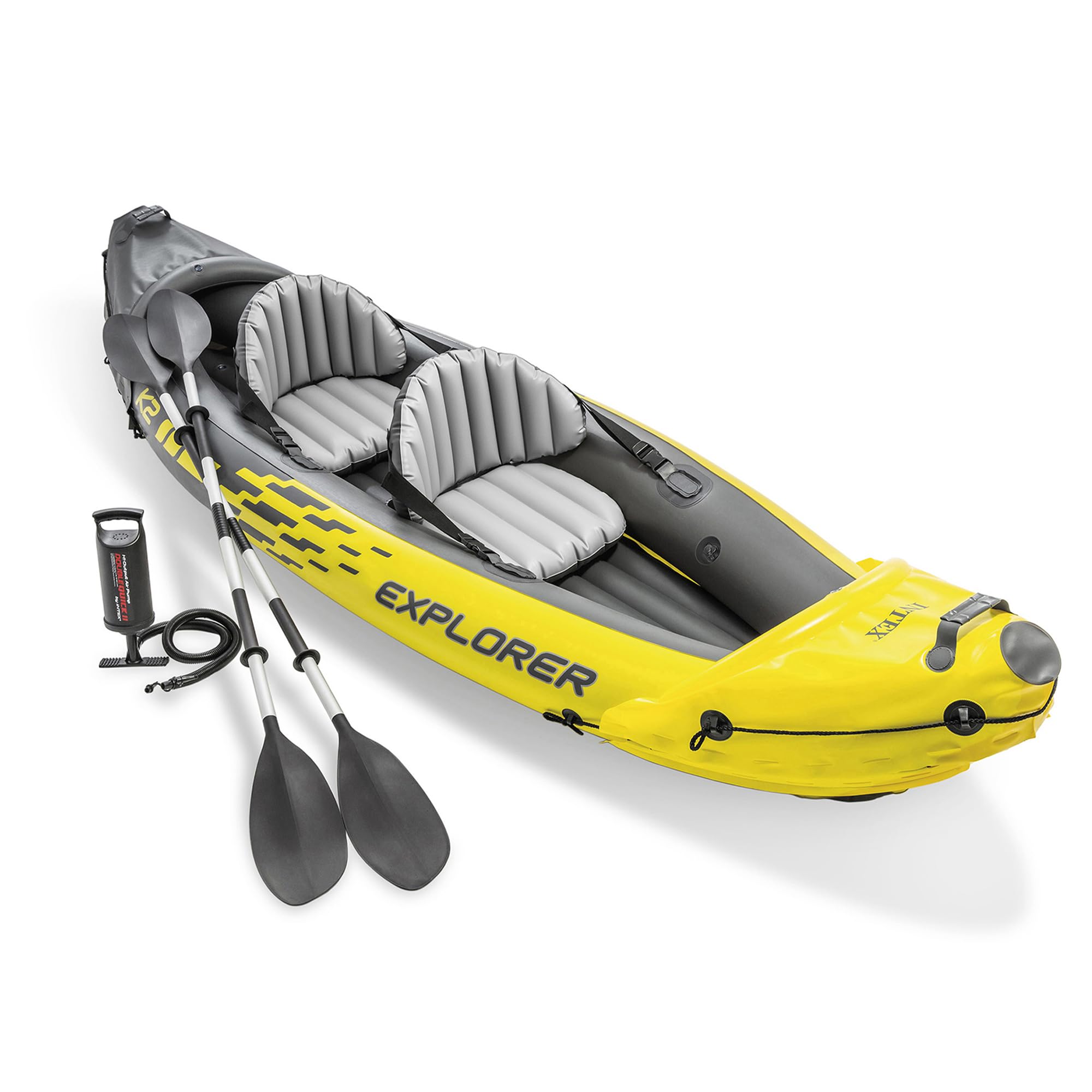
Intex Explorer K2
Key Features
- Seats: 2
- Length: 10 ft 3 in
- Weight: 35 lb
- Capacity: 400 lb
- Price: Budget
Two seats, two paddles, a pump and a ten-foot boat that goes back into a tote bag: the Explorer K2 is the tandem for people with a trunk instead of a garage. Inflated, it is three feet wide and rated for 400 pounds, which is enough for two adults — add a cooler and dry bags and do the arithmetic first, because 400 pounds is everything aboard, not per seat. That caveat aside, we like it for exactly that: a friend, a kid, a cooler, an afternoon.
On the water it behaves like a good recreational inflatable. It floats high, turns easily and shrugs off a small chop, and the two bow and stern handholds make it a two-person carry from the car. It is not fast, and two paddlers who will not share a rhythm will feel the hull waddle.
The included paddles work but flex, and the seats are the weak link — the backrests are thin and the front seat offers little support after an hour, so bring a pad or upgrade the paddles before your second season. Dry it thoroughly before it goes into the bag and it returns the favor.
Pros
- Packs into a tote bag for the trunk
- 400-pound capacity for two adults
- Two paddles, seats and pump included
- Stable and easy to turn on lakes
Cons
- Thin backrests offer little support
- Bottom seam and seats can develop leaks
Two people, one tote bag: the Explorer K2 is the tandem for a trunk and a lake, and the least expensive way to get a friend onto the water.
Best for First Fishing Kayak
Lifetime Tamarack Angler 100
Key Features
- Length: 10 ft
- Weight: 51 lb
- Capacity: 275 lb
- Warranty: 5-year limited
- Price: Midrange
Against the Pelican Catch Mode 110, the Tamarack gives up a rudder and a deck you can stand on, and gains the two things a beginner actually needs: a paddle in the box and a five-year hull warranty. On a ten-foot sit-on-top with three rod holders, a paddle keeper and two storage compartments, that is a fair trade.
On flat water it does the job. The flat bottom and deep tracking channels hold a line, the adjustable seat back is comfortable for a few hours, and the bow and stern handles make it a two-person lift at 51 pounds. The paddle keeper with its shock cord is the detail we appreciated most — your paddle stays put while you tie on a lure instead of sliding into the water.
We rate it the best first fishing kayak in this group, mostly because nothing needs adding before your first trip. Fish it as it comes for a season, then decide whether you want a rudder, a fish finder or a wider deck to stand on.
Pros
- Three rod holders plus a paddle keeper
- Five-year hull warranty
- Stable flat-bottom hull tracks straight
Cons
- Seat clips and trim are the weak points
- Included paddle is short and flexes
For a first fishing kayak on lakes and slow rivers, the Tamarack Angler covers the basics — rod holders, a paddle and a long warranty — with no accessories to add.
Best for Tandem Day Trips
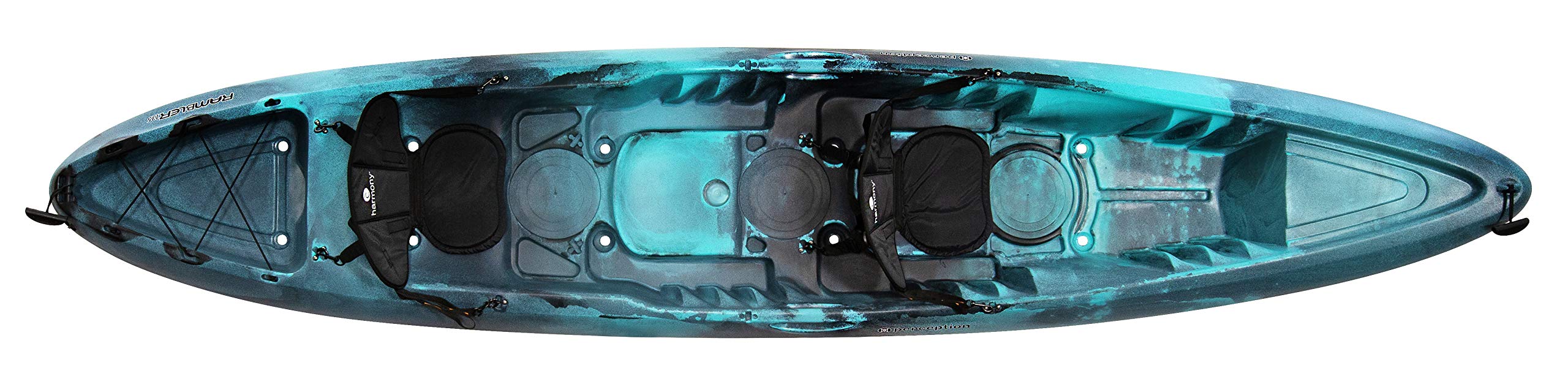
Perception Rambler 13.5
Key Features
- Seats: 2
- Length: 13 ft 6 in
- Weight: 78 lb
- Capacity: 550 lb
- Price: Premium
At 78 pounds, the Rambler is not a boat you carry. It is a boat you and someone else carry, or one you slide off the back of a truck. That is the cost of a 13.5-foot tandem hull rated for 550 pounds, the highest capacity in this group, and it is worth knowing before the idea of a two-person kayak gets romantic.
Get it to the water and the case is straightforward. Two adults and a cooler fit with room to spare, the sit-on-top deck lets you swing your legs over the side for a swim, and with two paddlers aboard it tracks straight and steady through chop. Of the tandems here, this is the one we recommend for two adults who paddle together regularly, because it is the only one that does not run out of capacity.
Solo, it is a different boat. With one paddler aboard it weathercocks and you correct on every stroke, so pair it with a second paddler or plan on a rudder. Water also comes up through the scupper holes on a choppy day; the plugs are a separate purchase and worth adding to the order.
Pros
- 550-pound capacity for two adults and gear
- Tracks straight with two aboard
- Sit-on-top deck is easy to re-enter
- Five-year hull warranty
Cons
- 78-pound hull takes two people or a cart
- Sold without paddles
The Rambler is the tandem to buy if two adults will paddle it regularly — 550 pounds of capacity, steady in chop, as long as you have help getting it to the water.
Best for Stand-Up Fishing
Pelican Catch Mode 110
Key Features
- Length: 10 ft 8 in
- Weight: 75 lb
- Capacity: 375 lb
- Rod holders: 3
- Price: Premium
A 34.5-inch beam is what lets you stand up in a fishing kayak, and the Catch Mode 110 uses every inch of it: a wide, flat deck underfoot and traction pads with a built-in ruler, so the fish you are about to release gets measured without hunting for a tape.
The seat is the other half of the pitch. The Ergoboost frame adjusts from a low, stable paddling position to a high one for spotting fish and casting, and it is comfortable enough that a slow morning does not turn into a backache. Two 4-inch gear rails take a fish finder and a rod holder, three flush rod holders sit behind the seat, and a retractable skeg handles a windy crossing.
We think this is the fishing kayak to buy if you want to stand, cast and rig electronics. At 375 pounds of capacity a big angler plus a crate of gear still fits, and the layout reads like it was drawn by someone who actually fishes rather than someone filling a specification sheet.
There is room behind the seat for a crate and room at your feet for a tackle bag, so the working deck feels larger than 10 feet 8 inches. That usable space is the thing you notice after a couple of hours, long after you have stopped thinking about the hull.
Pros
- Wide, stable deck you can stand on
- Adjustable seat raises for casting
- Three rod holders and two gear rails
- 375-pound capacity for angler and gear
Cons
- 75 pounds is a two-person lift onto a rack
- Slow hull with high sides that catch wind
If you fish from a lake or a sheltered bay and want to stand, sight-cast and mount a fish finder, the Catch Mode 110 is the platform we recommend.
Best for Small-Space Storage
Reel Yaks Raptor
Key Features
- Drive: Fin pedal
- Length: 9 ft 7 in
- Weight: 62 lb
- Capacity: 380 lb
- Price: Premium
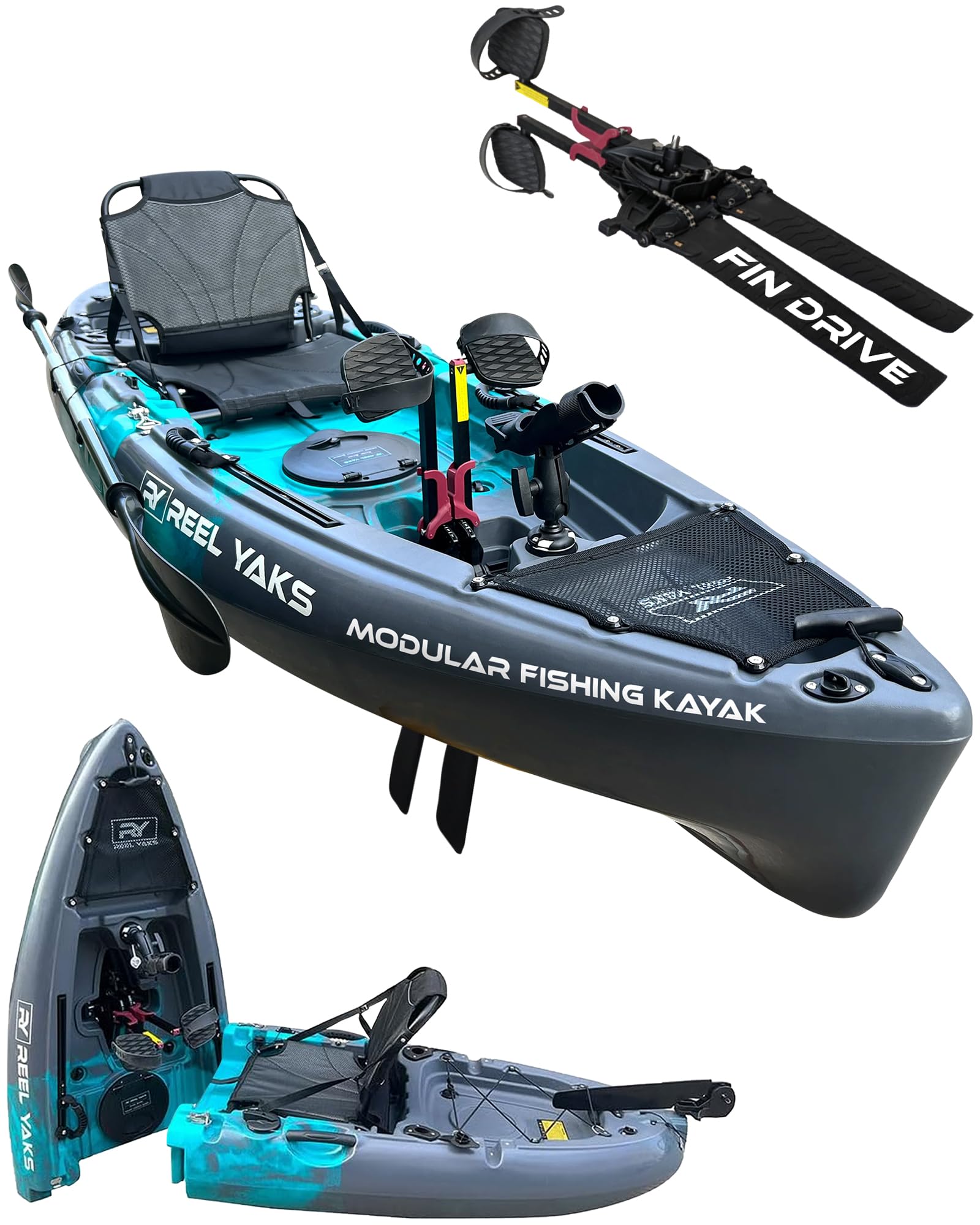
A fin drive is the reason to look at the Raptor. You pedal, both hands stay free for a rod, and the fin pushes through the weeds that would foul a propeller. Add 380 pounds of capacity and a stadium seat that sits high enough to see into the water, and you have a fishing boat that works the way a boat should.
What makes it unusual here is the two-piece hull. It separates into halves that go in the back of a mid-size SUV or a closet, which answers the problem that keeps a lot of people out of kayak fishing: nowhere to keep a ten-foot boat and no rack to carry one.
The halves go together quickly, the seat and drive drop in, and 62 pounds split between two loads is manageable one at a time down a bank. The rudder takes a little fiddling to set right and the instructions are thin, so plan the first assembly at home rather than at the launch.
We rate it the specialist of this group rather than the default. It solves a storage problem better than any other boat here and it fishes well from a seated, hands-free position. If your paddling is a calm home lake and your car is a hatchback, that is the whole case.
Pros
- Two-piece hull fits an SUV or closet
- Hands-free fin drive for fishing
- 380-pound capacity on a 9.5-foot hull
- Quick to assemble at the launch
Cons
- Tender in chop on a narrow beam
- One-year hull warranty is the shortest here
For an angler with no roof rack and no garage, the Raptor’s two-piece hull and fin drive earn their keep; it is a specialist, not an all-rounder.
How We Tested the Best Kayaks
We started by researching the kayak market—sit-on-tops, sit-insides, and inflatables—and narrowed a long list of models by reading owner reviews and comparing specs like weight capacity, hull length, and packed size. We also factored in price to make sure we had options at a few different budgets. From there, we selected eight kayaks that seemed to represent the best of each category and spent six months using them as our own.
Testing happened on flatwater, slow rivers, and a few breezy afternoons—the kind of conditions most recreational paddlers actually see. We launched from gravel ramps, mud banks, and docks, and we loaded every boat onto a roof rack and carried each one from car to water. For inflatables, we timed how long it took to reach full pressure with the included pump and how long deflation and packing took at the end of the day. We also noted whether the pump felt sturdy or flimsy, and whether the carry bag had real shoulder straps or just a thin handle.
On the water, we paid attention to stability by shifting our weight side to side and climbing back in from the water after a deliberate capsize. We tracked how each hull handled a crosswind, how quickly it turned in tight spots, and whether the seat stayed comfortable after an hour. Durability got checked by dragging hulls over gravel and bumping them against rocks at the launch. We also evaluated the included accessories—paddles, pumps, seats, and bags—for actual usability, not just whether they were in the box. Value came down to whether the boat felt worth its price after all that use, and fun was simple: which ones we wanted to take out again.
How to Choose a Kayak
The kayak you paddle most is the one you can move, store and load without help, so settle those three things before you fall for a hull shape.
Start with the hull, not the photo
Sit-in kayaks keep you out of wind and spray and are the warmer, drier choice for cool mornings; the trade is a wet exit and a cockpit that can ship water when chop comes over the coaming. Sit-on-tops are easier to climb back onto and better for fishing, but you sit in whatever water comes aboard. Inflatables solve storage and give up speed and wind resistance to do it.
If your paddling is a lake or a slow river within an hour of home, all three work. Pick the one that matches where the boat will live, and the rest of the decision gets much shorter.
Weight decides how often it leaves the garage
A 26-pound inflatable goes up a stairwell and into a car trunk; a 78-pound tandem needs two people or a cart. Our test is simple: can you lift it to your shoulder and walk to the water? If not, plan on a cart before you plan on the boat.
Treat the word lightweight carefully in a listing, because it is relative to other kayaks rather than to a bicycle. A hull you cannot shoulder alone is a hull that needs help every single time, and that is the detail that decides whether a good kayak spends the summer in the garage.
Capacity counts you, your gear and the dog
Every hull here states a maximum, and that number covers everything aboard. Two 180-pound adults in a 400-pound tandem leave about 40 pounds for a cooler and dry bags, which is why our rule of thumb is your own weight plus 50 pounds of gear, compared against the capacity rather than against the number of seats.
A bigger paddler with a tackle crate should be looking at 375 pounds and up. The number is a ceiling for calm water, not a target.
Tracking, skegs and what the wind does
A skeg drops at the stern and stops the boat turning into the wind; a rudder lets you steer without correcting every stroke. Longer hulls track better and turn more slowly, which is why a 13.5-foot tandem with one paddler aboard feels like it has a mind of its own.
If you paddle open water or a river with current, a skeg or rudder earns its keep. On a pond or a sheltered lake you will rarely drop one, so do not pay for steering you will not use — but do not buy a long hull and then complain about the wind.
Fishing extras worth paying for
Rod holders, gear rails and a standing deck are what separate a fishing kayak from a recreational one, and the deck matters most. A rod holder can be bolted on later; the stability to stand and cast cannot.
Buy the hull that suits your water, then add a fish finder, a crate and a rudder over a season. If you fish sitting down, save the weight and the money and take a lighter boat.
Frequently Asked Questions
How do I store a kayak in an apartment?
Measure your longest clear wall first: a ten-foot hull needs ten feet of it, plus room to walk past. Inflatables are the small-space answer, and both Intex boats here fold into a bag that fits a closet.
If you have a garage but no floor space, a wall-mount or ceiling hoist handles a hardshell, and the two-piece Reel Yaks Raptor splits into halves that fit a hallway or a car trunk.
Is a ten-foot kayak too small for a lake?
No. Ten feet is the standard recreational length and it handles lakes and slow rivers comfortably. What limits a short boat is wind and distance, not the size of the water.
If there are whitecaps on the lake or a steady breeze is forecast, pick another day or hug the sheltered shoreline. That advice holds for every hull in this guide, including the thirteen-and-a-half-foot tandem.
Do I need to register a kayak?
A paddle-only kayak usually does not need registration, but adding a motor changes the rules in many places, and several fishing hulls here are rigged to take one.
Check with your state boating or wildlife agency before you mount a motor, and keep the paperwork with the boat.
Final Verdict
The Pelican Argo 100X is the kayak we recommend to most people because it is the one that gets used: 36 pounds, stable under a beginner, and quick enough to feel like paddling rather than pushing.
Paddle with a partner and the Rambler 13.5 carries two adults and a cooler. Have nowhere to keep a ten-foot hull, and the Challenger K1 bags up in a closet while the Raptor splits in two for a trunk.