This post contains affiliate links. We may earn a small commission when you buy through our links — at no extra cost to you.
The first time you hoist a kayak onto a roof rack alone, you learn that weight matters more than most specs. A good sit-on-top should make a day on the water feel simple—slide it off the car, carry it to the launch, and paddle away—without turning your back into a question mark. The catch is that the easiest kayaks to live with aren’t always the most stable or comfortable, and the ones that feel rock-solid on the water can be a bear to move on land. The right one fixes that: a stable platform for paddling or fishing, a seat that doesn’t punish you after an hour, and a weight you can manage solo.
Over eight months, my team and I paddled seven sit-on-top kayaks on flat lakes, slow rivers, and a shallow bay, watching for stability, seat comfort, size, included accessories, durability, and value. A wider hull feels reassuring at the launch but can make for a slow paddle if the seat sits low—so the best picks split the difference. The list below reflects that.



Best for All-Around Paddling
Perception Tribe 9.5
Key Features
- Seat: Framed high-back, reclining
- Length: 9 ft 5 in
- Weight: 46 lb
- Max capacity: 300 lb
- Price: Midrange
Sit-on-top kayaks are usually sold on hull shape, and the Tribe 9.5 is the one we kept coming back to for a different reason: the chair. The high-back frame seatback reclines through several positions, so you can sit upright to paddle and lean back when you stop to drift a bait or eat lunch. That sounds like a small thing until hour three, when you are shifting around in every other boat on this page. For all-around flat-water paddling, this is the boat we recommend first.
Underneath it is a 9-foot-5 hull, 31.5 inches wide, with 300 pounds of capacity that leaves room for a cooler and a dry bag alongside a full-size paddler. It turns with a couple of strokes in a creek and still holds a line across a lake, which is the compromise most recreational hulls get wrong in one direction or the other. The rear well is open and lashed with bungee, big enough for a crate, with a little deck rigging forward.
Forty-six pounds is the number to plan around. That is light enough for one person to carry from the car to the water, but car-topping it alone means pushing the hull overhead, and a cart or a second pair of hands is the difference between paddling and skipping it. Perception molds it to stack, which matters if two boats share a garage wall.
Coverage runs five years on the hull and one on the fittings, and the fittings are where a sit-on-top usually ages: seat clips, hatch covers, bungee. That warranty is a real part of what the extra money buys over the budget boats here, and it is the reason we stop worrying about this one after the first season.
Pros
- Framed seat reclines for long days
- 300 lb capacity leaves room for gear
- Turns easily and still tracks
- Stacks, and carries at 46 lb
Cons
- Paddle sold separately
Our pick for most paddlers: the framed, reclining seat and 300-pound capacity make a long day comfortable, and 46 pounds still goes on the roof.
Best for Budget Fishing
Pelican Sentinel 100X Angler
Key Features
- Length: 9 ft 6 in
- Weight: 44 lb
- Rod holders: Two flush-mount
- Max capacity: 275 lb
- Price: Budget
Pelican rigs this one at the factory rather than leaving you to drill it. There are two flush-mount rod holders behind the seat, a front platform under a mesh cover, and the ExoPak, a removable compartment that drops into the rear tank well and lifts out with your tackle still inside it. For a 9-foot-6 boat weighing 44 pounds, that is a lot of fishing kit built in.
The hull is a multi-chine flat bottom, and flat is the point: it settles quickly when you shift weight to reach a rod or swing a fish aboard, which is exactly what you want from a boat you fish sitting down. Nothing about the deck feels unfinished, and the layout reads like it came from someone who has actually fished from a kayak. For anyone whose main goal is fishing rather than paddling, we think it is the smartest buy in this group.
Where it stops is open water. Nine and a half feet with a flat bottom is a pond, small-lake and slow-river boat; across a big bay with chop building, the longer Tarpon is the tool you want. For the water most people actually paddle on a Saturday morning, this is plenty of boat.
Pros
- Two flush-mount rod holders built in
- ExoPak lift-out tackle storage
- Flat hull stays settled while casting
- 44 lb for a 9 ft 6 in boat
Cons
- 275 lb capacity leaves little margin
- Thin seat cushion wants a pad
The cheapest way into a rigged fishing kayak here: two flush-mount rod holders, a lift-out tackle box and a stable flat hull for ponds and small lakes.
Best for Two Paddlers
Perception Rambler
Key Features
- Seats: Two, removable padded backrests
- Length: 13 ft 6 in
- Weight: 78 lb
- Max capacity: 550 lb
- Price: Midrange
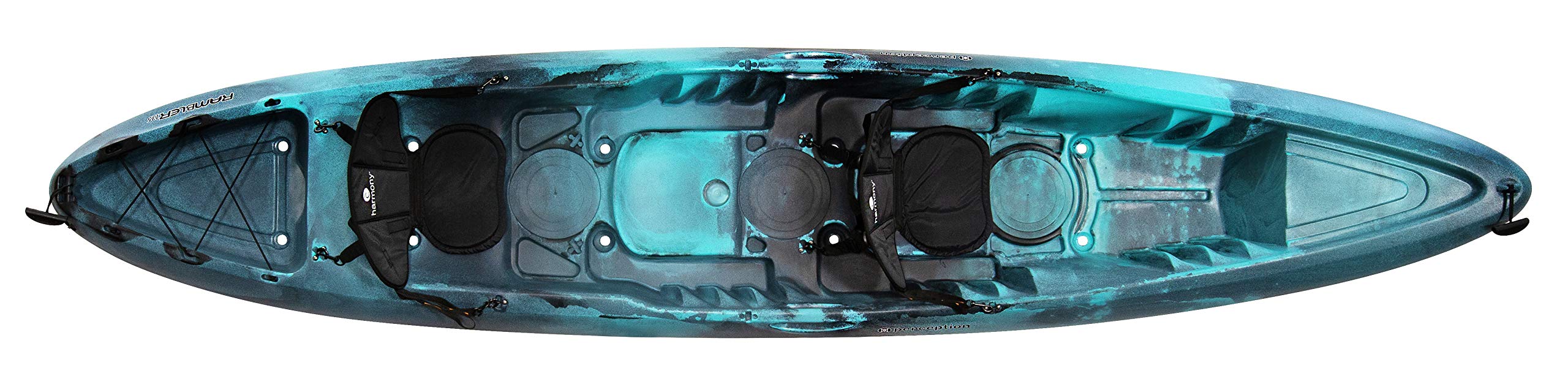
Thirteen and a half feet long and 34 inches wide, the Rambler carries 550 pounds across two molded seats with removable padded backrests, enough for two adults and a cooler or one adult and a boatload of gear. Nothing else here offers that. The seats sit down inside molded wells, so getting in from a dock or a shallow bank is a sit-down-and-swing-your-legs move rather than a balancing act.
Paddle it solo from the rear seat and it sits high and wanders, because the hull is designed for weight at both ends. That is normal for a tandem this wide, and it is worth knowing before you buy one intending to use it alone half the time. With two aboard it settles and tracks the way it should.
Where it earns its place is a river float or a lake afternoon with someone else along, when the stability and the open layout let you turn around to reach the cooler or hand a kid a paddle. It is a recreational tandem and it does not pretend to be a touring boat, which is why we like it for families rather than for expeditions.
Pros
- 550 lb capacity for two and gear
- Molded seats easy to get in and out
- Stable even with a heavier paddler
Cons
- 78 lb, so moving it takes two
- Paddles and scupper plugs not included
The only two-person boat in this group, and 550 pounds of capacity means two adults, a cooler and a dog can all go.
Best for Lightweight Day Trips
Lifetime Lotus
Key Features
- Length: 8 ft
- Weight: 39 lb
- Included: Paddle and adjustable backrest
- Max capacity: 250 lb
- Price: Budget
Thirty-nine pounds, 8 feet long, and a paddle included: the Lotus is the boat we hand to anyone who has to do the whole job alone, lifting it off the car, carrying it to the water and getting it back up again at the end. That is a short list of requirements and this meets all of them at the lowest price of anything we are recommending.
Eight feet is short and you feel it. On a pond or a slow river it spins on command and handles like a toy; point it across a lake and you will be making correction strokes the whole way. The 250-pound capacity is the other number to check carefully, because a big paddler plus a cooler is already at the limit and there is no room to grow into the boat.
The hull sits low and runs straight enough for flat water, and the backrest is a hard adjustable shell rather than a pad, so it supports instead of squashing. It drops into a truck bed or onto a small car’s roof without a loader. For a first kayak, a spare boat for guests, or a short paddle after work, that is the whole case.
Pros
- 39 lb, the lightest boat here
- Paddle and backrest included
- Turns instantly on small water
Cons
- 250 lb capacity is the lowest here
At 39 pounds with a paddle in the box, this is the boat to buy if you load and launch alone and paddle small water.
Best for Stand-Up Fishing
Pelican Catch Mode 110
Key Features
- Seat: Adjustable Ergoboost
- Gear tracks: Two 4 in rails
- Motor mount: Stern transom, 2.5 hp max
- Rod holders: Three flush-mount
- Price: Midrange
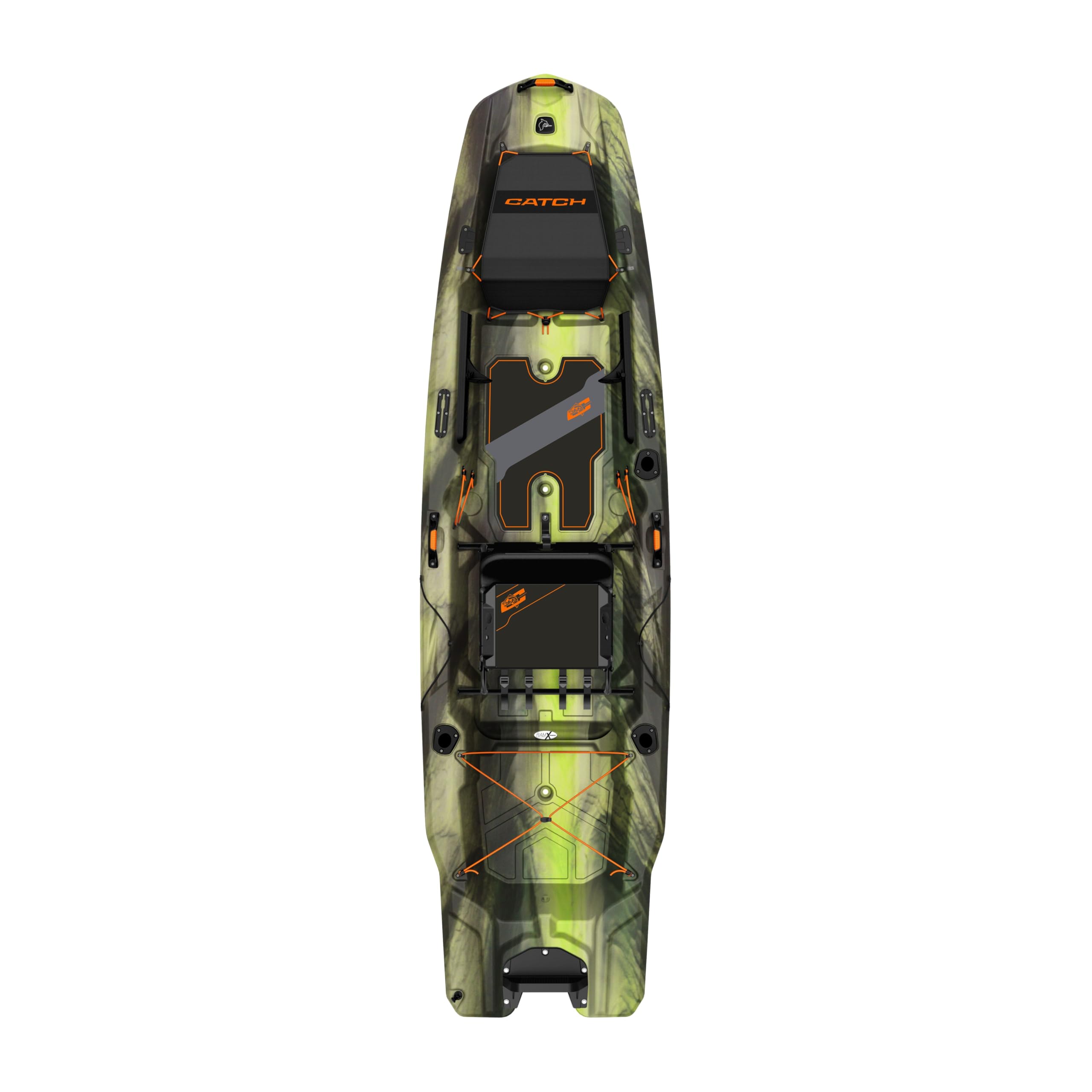
Standing in a kayak is a different sport, and the Catch Mode is built around it. The Ergoboost seat adjusts upward as well as back, so you can perch high enough to see into the water and then drop down to paddle, and the deck fore and aft is covered in anti-slip pads with a ruler printed into them. That ruler is the sort of detail that tells you an angler designed the layout.
Three flush-mount rod holders and two 4-inch gear tracks give you somewhere to put rods and a fish finder, and the stern transom takes an outboard up to 2.5 horsepower, the only boat here rated for a motor. That turns a paddle boat into something you can run across a lake and fish from without wearing out your shoulders.
We think of it as the boat for the angler who has already fished from a kayak and knows they want to stand and cast: stable enough to do it, laid out for tackle, and priced like a serious fishing platform. If you are new to this and mostly paddle, the Sentinel gets you on the water for a lot less.
Pros
- Raised, adjustable seat for sighting
- Three rod holders and two gear tracks
- Transom rated for a 2.5 hp outboard
- Anti-slip deck with a built-in ruler
Cons
- Seat can shift sideways on its track
- Motor and paddle both sold separately
For anglers who want to stand and sight-cast, this is the platform: a raised adjustable seat, a padded deck and a transom rated for a small outboard.
Best for Distance and Comfort
Wilderness Systems Tarpon 105
Key Features
- Seat: Phase 3 AirPro
- Length: 10 ft 6 in
- Weight: 55 lb
- Max capacity: 325 lb
- Price: Premium
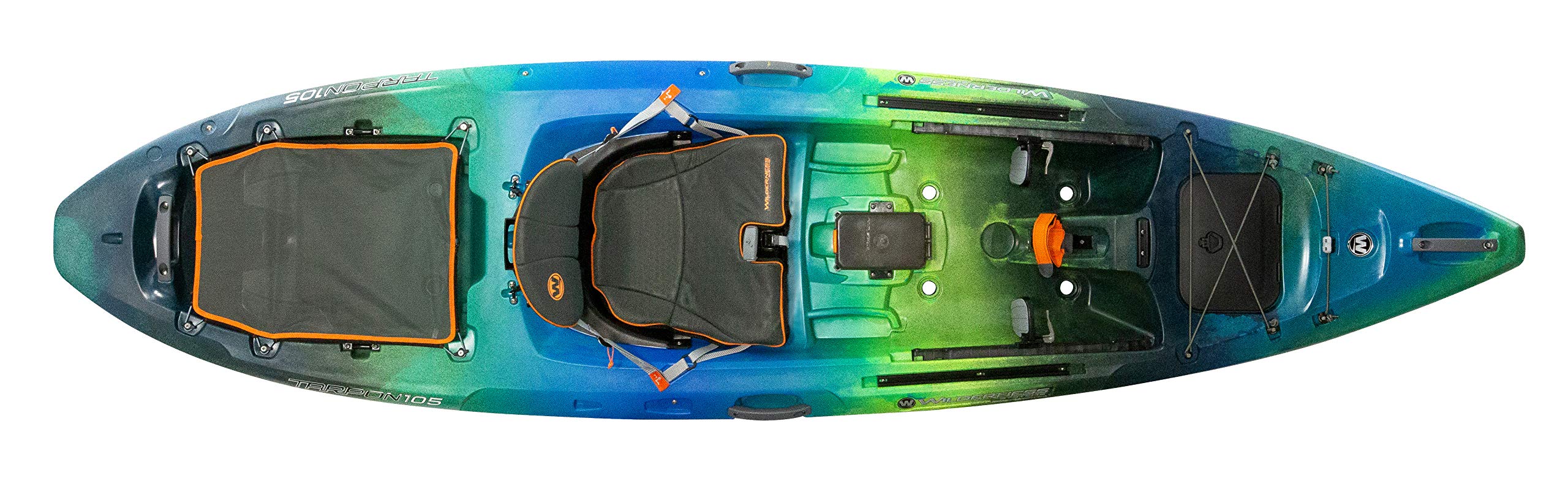
Ten and a half feet, 32 inches wide, 325 pounds of capacity. The Tarpon 105 is the boat here that makes distance feel easy: it is built to run fast and track straight, and it does, holding a line across a lake where the shorter hulls wander and keeping momentum between strokes. If your paddle is a two-mile crossing rather than a lap of a pond, that difference is the whole purchase.
The Phase 3 AirPro seat is the most adjustable of the seats here, with a locking lever that slides the seat and the padded footrests to fit a taller or shorter paddler without tools, and cool-touch fabric that is a small mercy on a hot afternoon. Bracing against those footrests is what lets you put real power into a stroke, and it matters more than it sounds on a long day.
Storage is the compromise: a large rear well for a crate or cooler and a front hatch for dry bags, though a 10-foot-6 hull does not leave much of either. The hull carries a limited lifetime warranty, the longest coverage in this group, and that is a fair part of what the premium buys.
Pros
- Holds a line and carries speed
- Phase 3 AirPro seat adjusts without tools
- 325 lb capacity and a dry front hatch
Cons
- 55 lb to lift onto a roof alone
- Front hatch is small for the hull
The most efficient hull here: a 10-foot-6 boat that holds a straight line, with the most adjustable seat in this group.
Best for Rigged Fishing
Lifetime Tamarack Pro 103

Key Features
- Length: 10 ft 3 in
- Weight: 57.5 lb
- Rod holders: One adjustable, two flush-mount
- Max capacity: 300 lb
- Price: Midrange
There is a ruler molded into the deck of the Tamarack Pro 103, and a center hatch sized for a bucket. Both tell you what kind of boat it is: 10 feet 3 inches, 31 inches wide, 300 pounds of capacity, built for sitting still and casting at fish you intend to keep.
One adjustable rod holder sits where you can swing a lure under it, two more are flush-mounted behind the seat, and there is tackle box storage plus front and rear bungee for lashing a crate down on the drive home. The tank well behind the seat is deep enough to matter, which is the sort of thing you notice on the second trip when the first one had you balancing a bag between your feet.
Deep hull channels and chine rails do the stability and tracking work, so it sits flat and paddles straight, and the framed seat with adjustable footrests lets you set a position you can hold for hours. Of the fishing boats here, this is the one whose seat we rate most comfortable for a long sit-and-cast morning.
Where it lands against the Sentinel is weight and money: you get the framed seat, the hatch with a bucket and the deeper well, and you pay for all three. If the boat lives on a trailer or a rack near the water, that trade is easy to make; if you are car-topping from a third-floor apartment, it is not.
Pros
- Three rod holders, tackle storage, ruler
- Framed seat with adjustable footrests
- Center hatch takes a bucket
Cons
- 57.5 lb is a lot to car-top alone
- Costs more than the Sentinel for similar water
The best-rigged fishing boat here for sitting and casting, with three rod holders and a framed seat, if you can handle the weight.
Best for Trunk Storage
Reel Yaks Raptor
Key Features
- Drive: Fin pedal drive
- Length: 9 ft 7 in
- Weight: 62 lb
- Max capacity: 380 lb
- Price: Premium
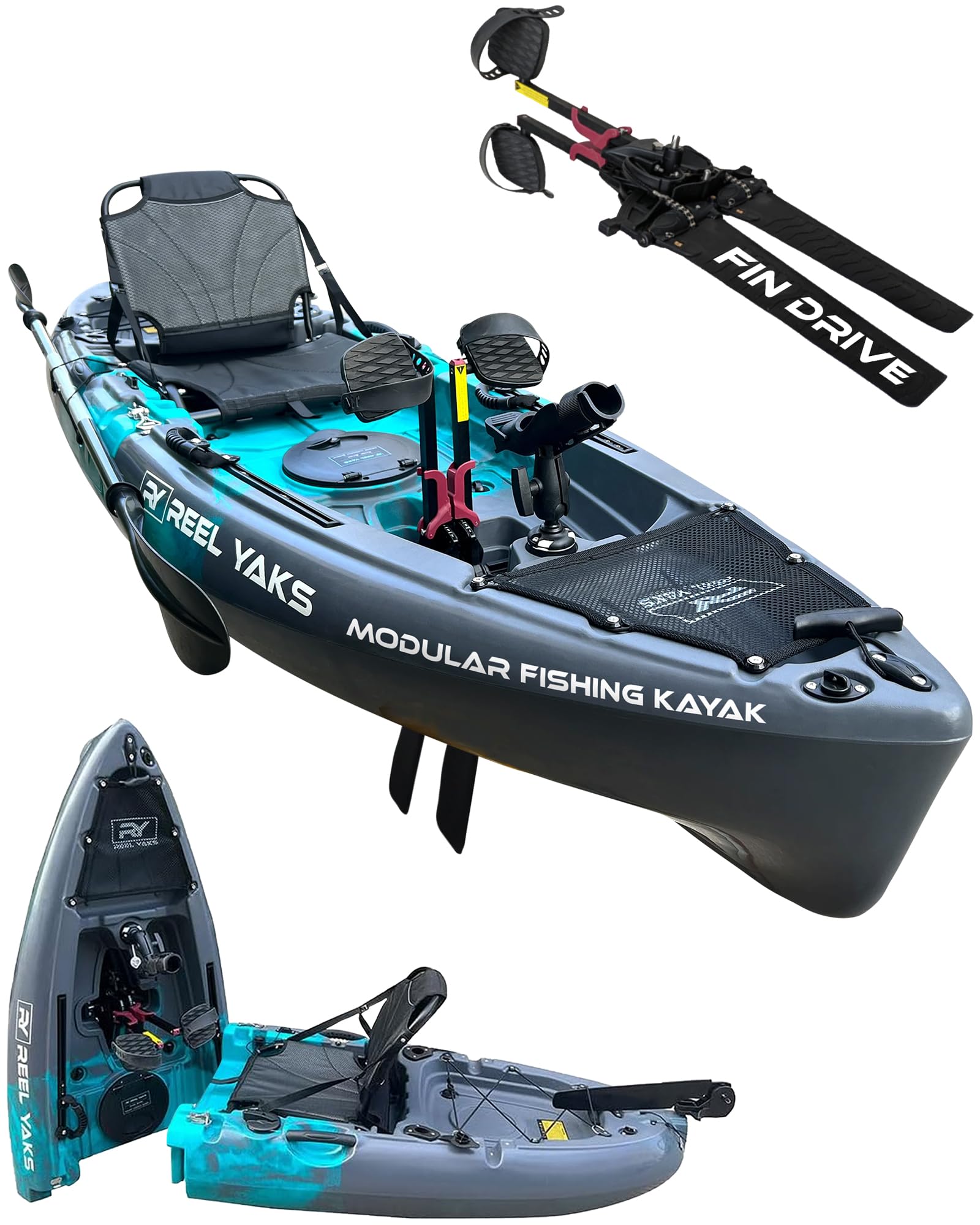
The Raptor splits in two. That single fact does more for it than anything else on the spec sheet: each section is manageable on its own, the pair goes in the back of a small SUV or a closet, and you never touch a roof rack. For anyone who has ruled out kayaking because of where the boat would live, this is the answer.
Assembled, there is a fin pedal drive that leaves both hands for a rod, flush-mount rod holders and track rails for accessories, and 380 pounds of capacity that leaves real room for gear. A paddle and a stadium seat come in the box, which is more than most of this group manages.
Stability is where it gives ground. A two-piece hull with an 11.5-inch deck height does not settle under you the way a wide one-piece fishing boat does, and the joints and drive add parts to check before each launch, the fin hardware in particular. We did not find any of that disqualifying; it makes this a boat with a specific trade rather than a flawed one.
What it buys is a fishing kayak you can own without a garage, a rack or a truck, with a pedal drive that keeps your hands free. If storage or a long carry has been the thing keeping you off the water, the Raptor is the boat here that removes it; if you paddle open water and want the most settled hull, the Tribe or the Tarpon will feel steadier under you.
Pros
- Splits into two sections for trunk storage
- Fin pedal drive keeps hands free
- 380 lb capacity with track rails
Cons
- Less settled at rest than one-piece boats
- Hull joints and fin hardware need checking
The only pedal kayak here, and the only one that comes apart to fit in a trunk, so buy it for the storage as much as the drive.
How We Chose and Tested the Best Sit-On-Top Kayaks
We started by pulling together the sit-on-top kayaks that show up again and again in owner reviews and paddling forums, then narrowed the shortlist by hull shape, weight capacity, seat design, and price. We ended up with seven kayaks and spent eight months using them the way most people actually do: solo car-topping, carrying them from the parking lot to the launch, and paddling flat lakes, slow rivers, and a shallow bay.
On the water, I leaned hard to one side to grab a dry bag, practiced climbing back aboard in deeper water, and noted whether the kayak tracked straight or spun with each stroke. I also loaded a day bag, a small cooler, and a fishing crate to see whether the hatches, deck rigging, and scupper plugs made sense in use. Seat comfort got its own test: three-hour paddles, with notes on pressure points, back support, and whether water pooled under the seat.
Back on land, I weighed each kayak and timed how long it took to load and unload solo; a boat that paddles beautifully but fights you on a roof rack lost points. I dragged hulls over gravel launches, left them on the roof between trips, and checked hatch covers, foot braces, and seat hardware for flex or rattle. Finally, I compared what came in the box—paddle, seat, dry storage, scupper plugs—against the price, because a value kayak with a useless paddle isn’t a value at all.
How to Choose a Sit-On-Top Kayak
Hull shape gets the marketing, but weight and the seat decide how often the boat actually leaves the garage, so start there and work back to the water you paddle.
Start with the lift, not the hull
The single-person boats here run from 39 to 62 pounds, and that range sounds narrow until you are pushing one overhead in a parking lot at the end of a day. Around 45 pounds, most people can still car-top a kayak without a fight; past 55, a loader, a cart or a second pair of hands stops being optional.
If you paddle alone and drive a small car, weight should outrank hull shape on your shortlist. That is the entire case for the Lotus and the Sentinel, and it is why the heavier fishing boats here make more sense for someone with a truck bed or a trailer.
Match length to the water you actually paddle
Short hulls turn; long hulls track. An 8-foot boat spins on a pond and makes you work across a lake, while a 10-and-a-half-foot hull holds a line and feels clumsy in a tight creek. The middle, around 9 feet 5 to 9 feet 7, is where most recreational paddling lands.
Be honest about the biggest water you will paddle, not the average one. A boat bought for a pond and then taken into a bay with chop building is a miserable afternoon, and no amount of storage or rod holders fixes it.
The seat is the upgrade you feel every trip
A molded seat well with a pad and a strap is fine for an hour and punishing by three. A framed seat with a high back and adjustable recline is the biggest comfort difference between these boats, and it is usually what separates a budget hull from a mid-range one.
If you are buying a boat with a thin cushion, plan on a clip-on pad; it is the cheapest upgrade you will make. We rate the Tribe’s reclining frame and the Tarpon’s Phase 3 AirPro as the two most comfortable seats here, and the budget angling boats as the ones that need help.
Fishing features worth paying for
Two flush-mount rod holders and a tank well cover the basics of fishing from a seat, which is the Sentinel’s whole case. Gear tracks, a standing deck and a motor transom are a different purchase: they are for anglers who already know they will stand to cast or hang a small outboard off the stern.
Buy the standing deck only if standing is genuinely the plan. It adds height, cost and windage, and a seated fishing boat does the same job on a pond for less.
Capacity is paddler plus everything else
Every boat here lists a maximum, from 250 to 550 pounds, and it covers you, your gear, your cooler and the dog. Add it up honestly before you choose: a 250-pound ceiling leaves a big paddler no margin, while 300 pounds and up lets you bring a crate and an anchor along.
Leave some room. A boat loaded to its limit sits low, paddles wet and feels less stable than the same hull with a hundred pounds of headroom.
Frequently Asked Questions
Is a sit-on-top or a sit-inside kayak better for a beginner?
A sit-on-top is easier to live with: it drains through its scupper holes, you can slide back aboard from deep water, and there is no cockpit to fill. You trade some speed and a drier ride, since a sit-inside with a spray skirt is faster and warmer in cold weather. For warm water, fishing and casual paddling, start with a sit-on-top.
What else do I need to buy with the kayak?
A paddle, a PFD and a way to carry the boat. Only the Lotus and the Raptor include a paddle; for the rest, budget for a decent one rather than the shortest cheap option, because a flexing paddle wastes energy on every stroke.
Add a cart if the hull is over about 50 pounds, and straps or foam blocks if you are car-topping.
Can I put a motor on a sit-on-top kayak?
Only on a hull with a rated transom. The Catch Mode 110 is the one here with a stern mount, rated to 2.5 horsepower; bolting a motor to a kayak that was not designed for one puts the mount and the hull under loads they were not built for. If a motor is the plan, buy the boat that already has the transom.
Where can I store a sit-on-top kayak?
Eight to ten feet of hull will hang from ceiling straps in a garage, stand on end against a wall, or sit on two padded brackets outdoors. The tight cases are an apartment or a small SUV: the Raptor splits into two sections for exactly that, and the 8-foot Lotus is the shortest single-piece boat here. Measure the wall and the vehicle before you order.
Final Verdict
The Perception Tribe 9.5 is the boat we point most people to. Its framed, reclining seat and 300-pound capacity make a full day comfortable in a way the cheaper hulls do not, and at 46 pounds it is still a one-person carry from car to water.
If fishing is the point rather than paddling, the Pelican Sentinel 100X Angler comes rigged for it and asks less of your budget. And if you load and launch alone every time, the 39-pound Lotus is the one that will actually get used.