This post contains affiliate links. We may earn a small commission when you buy through our links — at no extra cost to you.
You can usually tell how a camping trip went by the second morning. If you woke up every hour because a root was digging into your back, or your hips ached from a pad that had already flattened out, you know the feeling. A sleeping pad is the one thing standing between you and the ground, and the right one fixes all of it: cushioning that holds through the night, a valve that doesn’t fight you at bedtime, and not so much bulk that you resent carrying it in.
Over the past eight months, my team and I have slept on 14 pads — inflatable, self-inflating, and closed-cell foam — in tents, on a guest-room floor, and in the back of a car at a trailhead. Thickness is what every pad advertises, but warmth rating is what decides whether you’re shivering at 3 a.m. Comfort got the most scrutiny, though value and reliability counted just as much; a leaky pad is useless no matter how plush it feels, and the picks below are the ones we’d sleep on again.




Best for Backpacking
Gear Doctors ApolloAir
Key Features
- Weight: 1.1 lb
- R-value: 5.2
- Packed size: 8.5 x 3 in
- Inflated size: 72 x 22 x 3.25 in
- Price: Midrange
A 5.2 R-value at 1.1 pounds is the combination that earns the ApolloAir our top pick. For three-season backpacking, that is the sweet spot: enough insulation for frosty mornings and cold ground, but light enough that you will not resent it on a long climb. The 3.25-inch air chamber gives you real cushioning, and the 72 x 22-inch surface is wide enough for most back sleepers without turning into a raft.
The pump sack is the detail we appreciated most. It inflates the pad in under 90 seconds without mouth breathing or a separate pump, and the whole thing packs to roughly the size of a water bottle. The horizontal air chambers feel stable, and the 40D nylon top has a water-resistant coating that shrugs off tent-floor damp. The pad also comes with a carry bag and a repair patch, which is the right kit for an air chamber.
Treat it like an air pad: clear sharp rocks and stakes, use the repair patch, and do not overinflate. The 250-pound weight limit is a real ceiling to check before you buy, and the 22-inch width is standard backpacking sizing rather than a roomy car mattress.
If you want a pad that never needs inflation, the Z Lite Sol is the obvious alternative. But for most backpackers who want comfort and warmth in a compact package, the ApolloAir is the one we recommend first.
Pros
- 5.2 R-value handles cold ground
- 1.1-pound packed weight
- Pump sack inflates without extra gear
- 3.25-inch surface adds cushioning
Cons
- 250-pound weight limit
- 22-inch width is not roomy
We recommend the ApolloAir as the best all-around backpacking pad here because it pairs a 5.2 R-value with a packable 1.1-pound build and real 3.25-inch cushioning.
Best for Ultralight Trips
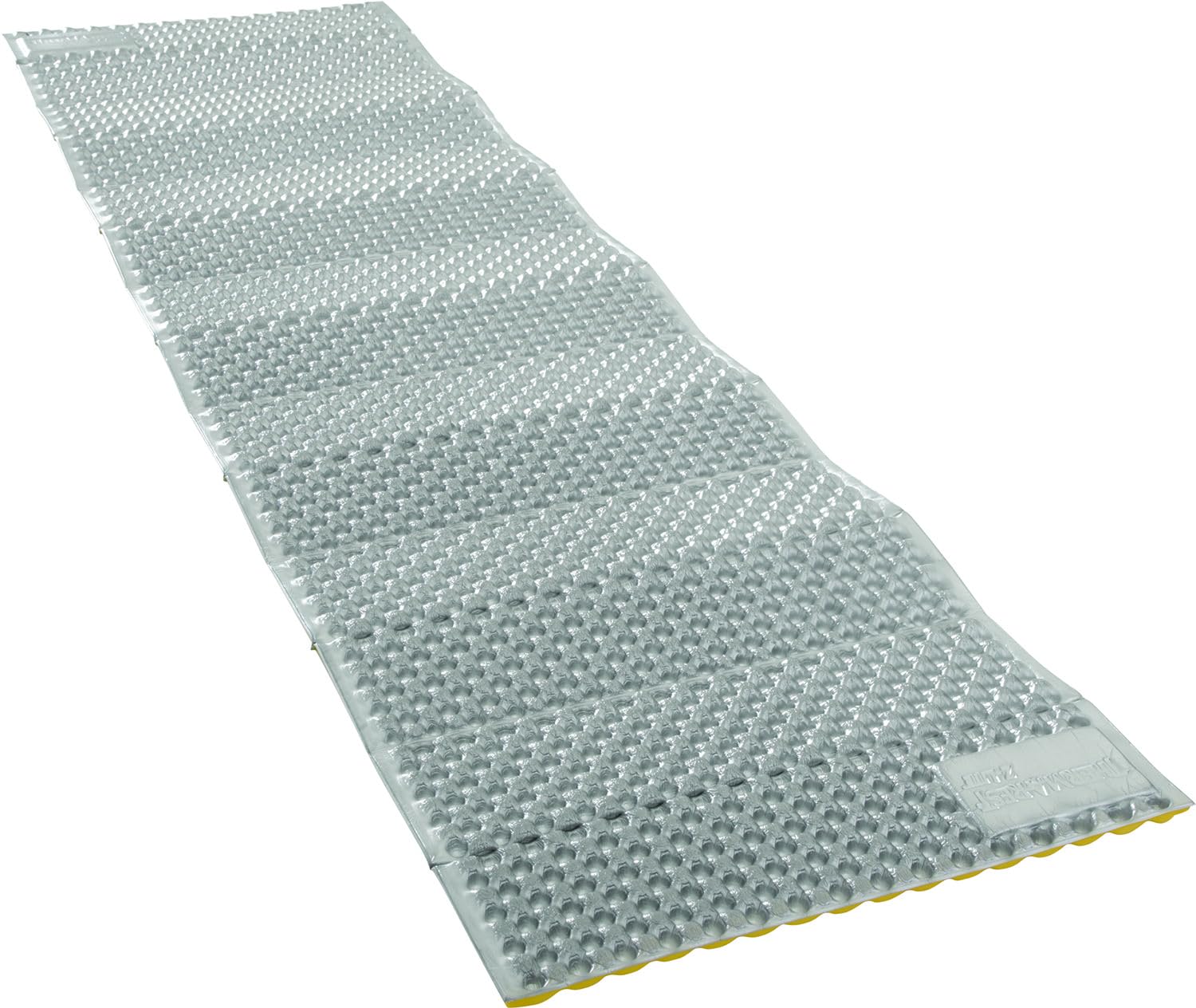
Therm-a-Rest Z Lite Sol
Key Features
- Type: Closed-cell foam
- Weight: 14 oz
- R-value: 2.6
- Inflated size: 72 x 20 x 0.75 in
- Price: Midrange
The Z Lite Sol is the pad we grab when we want zero risk of a leak: it is closed-cell foam, so there is nothing to inflate and nothing to puncture. The accordion folds open to a 72 x 20-inch surface, and the whole pad weighs 14 ounces. Folded, it measures about 20 x 5 x 5.5 inches, which is why it straps to the outside of a pack so easily. We have used it as a camp seat and as a ground layer under another pad, which is the kind of double duty a foam mat does better than an air chamber.
What we appreciate is the simplicity: unroll it, sleep, fold it up. The accordion folds are faster than rolling and stuffing, and the 14-ounce weight disappears on the outside of a pack. The reflective ThermaCapture coating and dimples give it an R-value of 2.6, so it handles summer and shoulder-season ground for most sleepers. The 0.75-inch foam is firm, and the 20-inch width is standard rather than generous, so it rewards sleepers who do not need a plush surface.
Against the NEMO Switchback, the Z Lite is warmer and a bit more supportive; the NEMO feels more cushioned. Against an air pad, the Z Lite is less comfortable but far more forgiving of rough ground, sharp sticks, and a careless pitch. That trade-off is why it stays in our kit as a backup, a summer pad, and a seat.
Pros
- Cannot leak or puncture
- 14 oz and folds accordion-style
- R2.6 with reflective coating
- Doubles as a camp seat
Cons
- Firm 0.75-inch foam
- 20-inch width feels narrow
For backpackers who want a pad that cannot leak, the Z Lite Sol is the reliable choice, provided you accept firm foam and a narrow 20-inch surface.
Best for Cot Camping
Teton Outfitter XXL
Key Features
- Fill: Polyurethane foam
- Cover: Canvas
- Weight: 9 lb
- Inflated size: 82 x 38 x 2.5 in
- Price: Premium
The Outfitter XXL is sized like a mattress, not a backpacking pad: 82 inches long, 38 inches wide, and 2.5 inches thick. It is built to fit the Teton Outfitter cot, but the size also works on a large cot or as a ground pad for car camping. At 9 pounds, it makes no pretense of being a packable pad.
The open-cell foam and canvas shell are what make it comfortable. The pad softens the bars of a cot and gives you enough width to roll over without hitting the edge. The canvas cover slips off for cleaning, which matters if you camp with kids or dogs, and the roll-up straps with compression buckles keep the whole thing manageable in the car.
It rolls into a large bundle, and you will want to store it flat or loosely rolled between trips rather than cramming it into a stuff sack. The 2.5-inch foam is supportive rather than sink-in soft, so it suits sleepers who want a firm cot surface. It is the priciest pad here, which is easier to justify if you sleep on a cot often.
We recommend it to car campers and cot sleepers who want a bed-like surface and do not have to carry it far. For a couple who wants one big surface, the Pretyw double is lighter and easier to pack; for a solo cot, the Teton is the more bed-like pad.
Pros
- 82 x 38 surface fits an XXL cot
- 2.5-inch foam softens cot bars
- Canvas cover removes for cleaning
- Compression straps keep it manageable
Cons
- 9-pound weight
- Large packed footprint
Buy the Outfitter XXL if your sleeping setup is a cot or a vehicle; it is the most bed-like pad here, and the 9-pound weight only matters if you carry it.
Best for Car Camping
CYMULA Memory Foam Pad
Key Features
- Base: Waterproof non-slip
- Material: Memory foam
- Certification: OEKO-TEX
- Inflated size: 72 x 24 x 3 in
- Price: Midrange
Memory foam is the reason to choose the CYMULA over an air pad: there is no inflation, no leak, and no cold spot from a slow deflation at 2 a.m. The 3-inch foam is dense enough to cushion hips and shoulders, and the soft fleece cover feels warmer and less clammy than a nylon air chamber. The bottom is waterproof and non-slip, which helps on a tent floor or a smooth cot. The 72 x 24-inch surface gives you more width than a standard backpacking pad.
We think it is the most comfortable pad here for car camping. The memory foam absorbs pressure points instead of bouncing you around, and the 3-inch thickness keeps you clear of roots and small rocks. It is not a backpacking pad: it rolls into a bulky bundle, and you will want the whole trunk for it. The lack of inflation also means there is no valve to fail or pump to forget.
For guests, car camping, or a tent you drive to, that bulk is a fair trade. The cover wipes clean, the straps make storage tidy, and the OEKO-TEX certification is reassuring if the pad will double as a guest bed. It comes in several sizes; the 72 x 24 is the one we tested, so check the chart if you want more width or a longer surface.
Pros
- 3-inch memory foam cushions pressure points
- No inflation or leak risk
- Waterproof non-slip base
- OEKO-TEX certified materials
Cons
- Bulky when rolled
We point car campers to the CYMULA for its 3-inch memory-foam comfort and leak-free construction, as long as the bulky roll fits in your vehicle.
Best for Budget Backpacking
FUN PAC Camping Pad
Key Features
- Weight: 1.5 lb
- Material: 40D nylon and TPU
- Inflation: Built-in foot pump
- Inflated size: 78 x 27 x 3 in
- Price: Budget
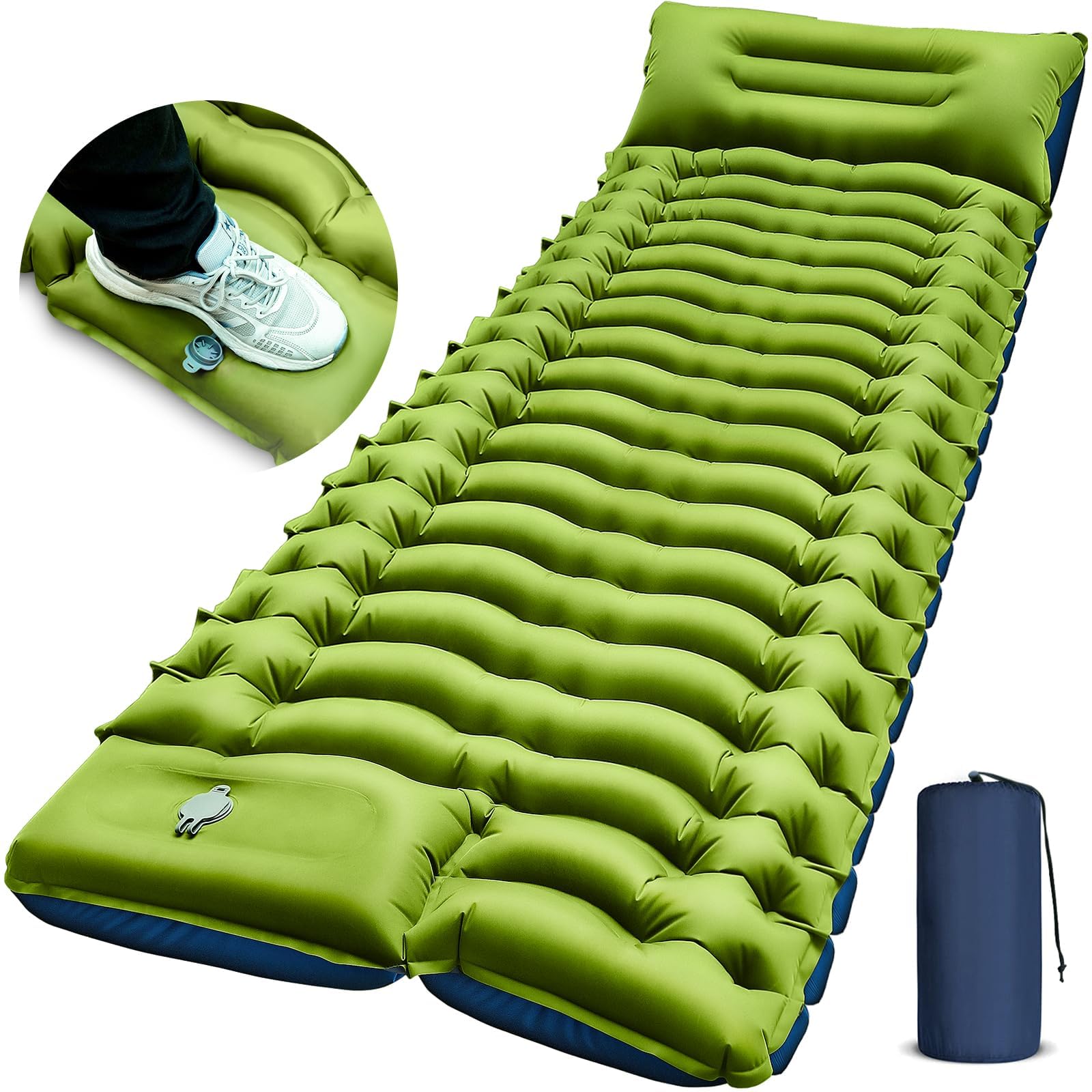
The FUN PAC’s built-in foot pump and pillow are the two features that make it an easy budget pick. At 1.5 pounds and 78 inches long, it packs small enough for a backpack yet gives you a full-length surface. The pump takes 30 to 60 seconds of stepping, deflation is quick, and the pillow saves you from carrying a separate camp pillow. The 27-inch width gives you more room than a standard 20-inch pad.
The 40D nylon and TPU shell feels more substantial than the price suggests, and the waterproof surface handles damp ground. We like it for short backpacking trips, car camping, and as a spare pad for guests. The caveat is long-term durability: the seams and valve are the wear points, and this is not the pad we count on for a month-long thru-hike. The built-in pump also adds a component that can fail, so test it before you leave.
If you want a set-and-forget pad, the Z Lite Sol is the safer buy; if you want a budget air pad with an easy setup, the FUN PAC is a sensible choice. Test it at home before a trip, and carry the repair patch. For occasional weekends and a tight budget, it does the job without making you dread bedtime.
Pros
- Built-in pump and pillow
- 1.5 lb and 78-inch length
- Packs small for backpacking
- Budget-friendly
Cons
- Seams and valve are wear points
The FUN PAC is the budget inflatable we suggest for short trips, thanks to its built-in pump, pillow, and 1.5-pound pack weight.
Best for Couples
Pretyw Double Pad
Key Features
- Weight: 3 lb
- Capacity: 660 lb
- Inflation: Built-in foot pump
- Inflated size: 78 x 54 x 4 in
- Price: Midrange
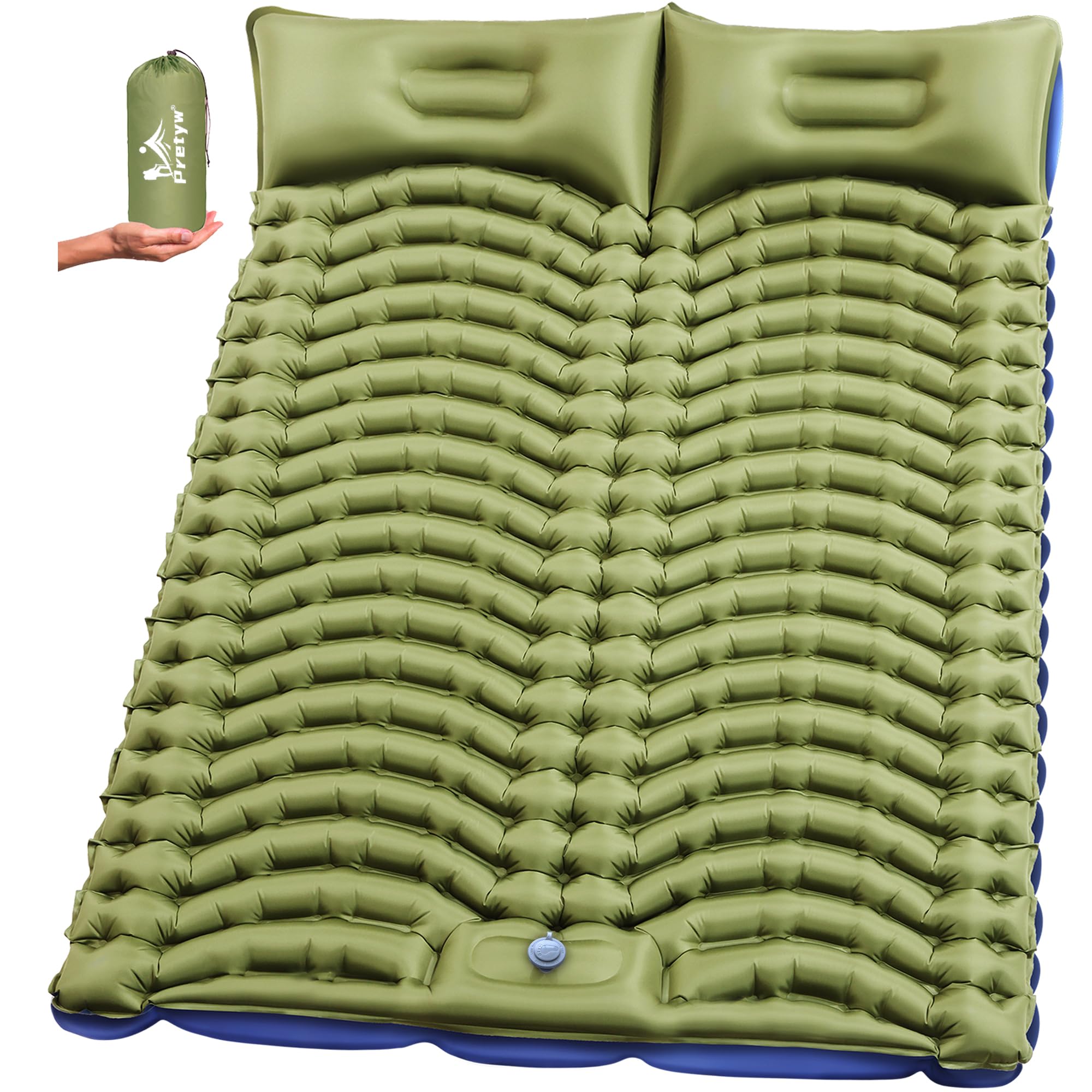
A 54-inch width is the whole point of the Pretyw: it gives two adults a shared surface without the gap you get from pushing two singles together. It inflates to 78 x 54 x 4 inches, so there is enough length for most couples and enough thickness to keep hips off the ground. The built-in foot pump means you do not need to pack a separate pump. The 4-inch thickness also helps on uneven ground.
At 3 pounds, it is light for a double pad, and it packs into a 10 x 5.9-inch bag. The 40D nylon and TPU shell is waterproof, and the 660-pound capacity gives it a sturdy feel. The pillow section is a nice extra; you can leave the camp pillows at home. The trade-off is that it is still a double: it takes up more tent floor than two singles and is not a backpacking pad for two people.
We recommend it for couples who car camp, for a family tent, or for a guest bed that needs to pack away. The foot pump is easy to use, and the deflation valve empties the pad quickly when you are packing up in the rain. For two backpackers, two single pads are lighter and more flexible; for two car campers, this is the simpler setup.
Pros
- 78 x 54 surface fits two adults
- 4-inch thickness
- Built-in foot pump
- Packs to 10 x 5.9 in
Cons
- Double size is car-camping only
Couples who drive to camp should choose the Pretyw for its 54-inch-wide, 4-inch-thick surface and built-in foot pump.
Best for Cold Car Camping
Coleman Silver Springs
Key Features
- Type: Self-inflating foam
- Weight: 4 lb
- R-value: 5+
- Inflated size: 72 x 20 x 3 in
- Price: Midrange
The Silver Springs is one of the few pads here with a 5-plus R-value and a self-inflating foam core, which makes it a natural fit for cold-weather car camping. The 3-inch foam and 75D polyester top give you more cushioning than a closed-cell mat, and the PVC coating adds abrasion resistance. At 4 pounds, it is a car-camping pad, not a backpacking one. The 72 x 20-inch surface is a standard single size.
Open the valve, let the foam pull in air, and then add a few breaths to get it firm. The self-inflating design does most of the work, but it does not always reach full firmness on its own. We found that a little extra air made a big difference in comfort, especially for side sleeping. The strap is the part to watch when you roll it up; keep it clear of the valve and the foam edges.
We recommend it for cold-weather car camping and for anyone who wants foam insulation without an air pump. The R5 rating is the reason to choose it over a summer air pad, and the self-inflating foam is simpler than a pump sack. If you want a pad that never needs inflation, the Z Lite Sol is lighter and simpler; if you want more room, the Teton Outfitter XXL is wider and plusher.
Pros
- R5 insulation for cold ground
- 3-inch self-inflating foam
- PVC-coated shell resists abrasion
- Simple valve setup
Cons
- May need extra air to firm up
- 4-pound weight limits backpacking
The Silver Springs is our pick for cold-weather car camping, with a 5-plus R-value and self-inflating foam, but it is too heavy for backpacking.
Best for Summer Backpacking
NEMO Switchback

Key Features
- Foam: Dual-density
- Type: Closed-cell foam
- Weight: 14.8 oz
- R-value: 2
- Price: Midrange
The Switchback’s hexagonal node pattern is not just cosmetic: the taller nodes leave more room for your sleeping bag to loft, and the surface feels more cushioned than a flat foam mat. The dual-density foam puts a supple layer on top and a firmer layer underneath, and the metallized film reflects heat back toward you. The result is a foam pad that feels less like a board than the classic closed-cell mats.
At 0.42 kilograms, it is light enough for backpacking, and it folds down to a compact package. The R-value is 2, so it is a summer and warm-weather pad rather than a cold-ground insulator. The foam does not bottom out under a hip or shoulder, but it is still a foam pad, not an air mattress.
Against the Z Lite Sol, the Switchback feels a little plusher and packs similarly; the Z Lite is warmer with an R-value of 2.6. Against an air pad, the Switchback gives up cushioning but gains the same no-leak reliability. It is also easier to fold and store than a rolled foam mat, and it makes a useful seat or standing pad at camp.
We see it as the foam pad for someone who wants a little more comfort than the Z Lite without giving up the simplicity of closed-cell foam. For cold-weather trips, step up to an insulated air pad or the Coleman Silver Springs. For summer backpacking, it is a comfortable middle ground.
Pros
- Hexagonal nodes add cushioning
- No inflation or leak risk
- 0.42 kg is easy to carry
- Dual-density foam supports hips
Cons
- R2 is summer-oriented
The Switchback is the foam pad for summer backpackers who want more cushioning than the Z Lite, with the same no-leak simplicity.
How We Tested the Best Sleeping Pads
We started by gathering every pad with a real following, reading spec sheets and long-term customer reviews, then narrowing by packed size, weight, thickness, and warmth rating so the shortlist covered budget pads and cold-weather pads alike. That left 14: inflatables, self-inflating versions, and a couple of closed-cell foam pads for comparison. Each got at least three nights of sleep, and several came with us for longer stretches over the eight months.
Comfort was judged in the least scientific way possible — we slept on them, on our sides and our backs, and noted each morning whether a hip or shoulder had bottomed out against the floor. Inflation got timed: how many breaths it took by mouth, how long with a pump sack, and whether the valve held air overnight without a top-up. We also stuffed each pad into its sack, weighed it on a kitchen scale, and compared the packed bundle against a one-liter water bottle to judge bulk.
Durability and reliability took the longest. Every pad was inflated and deflated daily for a week, dragged in and out of a tent, and left inflated in a hot car, after which we checked baffles, seams, and valves for grit, slow leaks, and thinning foam. For value, we compared price against how a pad felt on night three rather than night one, since plenty of them impress once and flatten after.
How to Choose a Sleeping Pad
The right pad is the one that matches how you sleep and how far you carry it; start with the trip, then work backward to insulation, size, and inflation.
Match the pad to the trip first
Backpacking puts a premium on packed weight and size. We treat one to two pounds and a stuff sack near bottle size as the practical target; the Gear Doctors ApolloAir and FUN PAC fit that brief, while the Z Lite Sol straps to the outside of a pack. Car camping and cot sleeping flip the priority: a thicker, wider pad is worth the bulk. The Teton Outfitter XXL and CYMULA memory-foam pad are built for that kind of use. Do not buy a nine-pound pad for a long hike or a bottle-size pad for a cot and expect either to feel right.
Read R-value as ground insulation
R-value measures how well a pad resists heat loss to the ground. For summer and warm-weather trips, an R-value around 2 is enough; for three-season camping, look for roughly 3 to 5; for snow or freezing ground, 5 and up is the safer zone. The pad does not warm the air; it stops the ground from pulling heat out of you. A sleeping bag’s underside insulation compresses, so the pad is doing that job. Match the rating to the coldest ground you expect, not the air temperature in the forecast.
Width and thickness matter more than the number
Thickness is only half the comfort story. A 3-inch pad that is 20 inches wide can still feel cramped, while a 24- or 27-inch pad gives side sleepers room to roll without falling off. Foam pads use thickness differently: 0.75 inch of closed-cell foam is supportive but firm, while 2.5 to 4 inches of air or memory foam feels plusher. If you sleep on your side or move a lot, prioritize width first, then thickness. Couples should look at a true double like the Pretyw rather than pushing two singles together.
Choose an inflation style you’ll live with
Air pads pack small but depend on a pump, a valve, and a leak-free chamber. A pump sack is fast and avoids mouth moisture; a built-in foot pump is convenient but adds a failure point; self-inflating foam is simple but often needs a top-off. Closed-cell foam has no inflation at all and cannot leak, which is why it remains the choice for rough ground and emergency use. We treat inflatable pads as the comfort choice and foam as the reliability choice. Whichever you pick, test it at home before a trip and carry a repair patch.
Frequently Asked Questions
Can I use a backpacking pad on a cot?
You can, but match the pad to the cot. A narrow 20-inch backpacking pad can slide or leave bars exposed; a cot pad with loops or a non-slip base stays put. For an XXL cot, the Teton Outfitter XXL is sized for it; for a standard cot, measure the sleeping surface before buying. A pad that overhangs is less stable than one that fits.
How do I keep a sleeping pad from sliding in the tent?
Start with a clean, dry floor and put the pad down before the bag. A non-slip base helps, and a thin sheet or pad liner adds grip without much weight. On a cot, look for loops or straps that wrap the frame; a slick nylon pad on a slick cot is the worst combination. If the pad still slides, a small foam mat underneath can add friction.
How do I clean a memory-foam camping pad?
Spot-clean the cover with mild soap and water, then air-dry it completely before rolling. Memory foam itself should not go in a washing machine unless the maker says so; moisture trapped inside can turn musty. Use a removable cover or a thin sheet if you camp often, and store the pad unrolled or loosely rolled so the foam recovers.
Final Verdict
For most backpackers, the Gear Doctors ApolloAir is the pad we recommend first. It pairs a 5.2 R-value with a 1.1-pound carry weight and a 3.25-inch surface, so it works from summer to frost without turning your pack into a burden. If your trips are car-based or cot-based, the Teton Outfitter XXL is the more comfortable buy, and the Z Lite Sol remains the pad we trust when a leak would ruin the trip.