This post contains affiliate links. We may earn a small commission when you buy through our links — at no extra cost to you.
The first chair on a powder morning is the best part of skiing — right up until your fingers go numb halfway up. Mittens beat gloves for a simple reason: fingers share heat instead of each one fighting the cold alone. The trouble is that a pair warm enough for a windy lift ride often turns your hands into paddles when it’s time to buckle a boot, and plenty that promise waterproofing are damp inside by the third run.
I run cold, so I’ve spent years stuffing hand warmers into mittens that should have been enough on their own. This winter my team and I skied, shoveled, and dragged sleds in 12 pairs to sort out which ones hold heat without costing you your grip. Worth knowing before you buy: cuff length matters as much as insulation, because a gap at the sleeve makes even the warmest mitten feel cold. The picks below run from spring-skiing lightweights to the ones I’d trust on a single-digit morning.




Best for All-Round Skiing
Hestra Army Leather Heli Ski Mitt
Key Features
- Liner: Removable
- Shell: Army leather
- Wrist leashes: Included
- Price: Premium
The cuff is what sells these. Hestra’s Army Leather Heli Ski Mitt reaches well up over a jacket sleeve, so the snow that slides down your arm on a storm day stops at leather instead of at your wrist. We hand them to anyone who skis often enough that cold hands would cut a day short, and the warmth holds up in the wind that makes people quit early.
Leather does two jobs at once here: it blocks wind completely, and it stays supple in the cold rather than stiffening up the way a coated shell does. The liner pulls out for drying, which is the difference between damp mitts at breakfast and dry ones on the first lift. There’s a tube of leather conditioner in the box, the wrist leashes let you dangle them from the lift without watching one drop, and the leather takes a fresh coat without drama.
Fit is the one thing to think through before ordering: the shell is cut generously while the liner’s thumb runs snug, so try them with the liner you plan to ski in and size down if your hands sit between sizes. These sit at the top of this group’s price range, and they are not the mitt to buy for one weekend a year. After a few days the leather takes the shape of your hand, and that’s the point where they stop feeling like an expensive purchase and start feeling like the right one.
Pros
- Warmth holds in cold and wind
- Long cuff covers a jacket sleeve
- Removable liner dries between days
- Wrist leashes keep them off the snow
Cons
- The most expensive mitt in this group
Our pick for most skiers: soft leather, a long gauntlet, and warmth that holds on cold, windy days — worth it if you ski often.
Best for Value and Durability
Kinco 901T Ski Mitt
Key Features
- Model: 901T
- Shell: Pigskin leather
- Waterproofing: Nikwax wax included
- Price: Midrange
Kinco’s 901T turns up as a plain pigskin mitt with a packet of Nikwax wax in the box, and the first job is yours: work the wax into the seams before you ski. That ritual is the price of the toughest waterproofing here. Waxed leather shrugs off rope tows, boot buckles, and the abrasion that eventually wears a fabric shell through.
What we like beyond the price is how little these seem to care about abuse. The wrist has an elastic cuff with a leather strip you can grab to haul the mitt on without stretching it out — a small thing until your hands are wet and everyone else is already clipped in. On a cold day with a thin liner underneath, they were as warm as anything here.
These are work gloves that ski well rather than ski gloves, and that shapes how you wear them: the cuff sits close to the wrist instead of running up the forearm, so pull your jacket sleeve over the top on deep days. They look like work gloves too, which some people like and others don’t. On durability and grip against a pole, nothing here beats them.
Pros
- Waxed pigskin takes real abrasion
- Warm with just a thin liner
- Leather pull strip on the elastic cuff
- Costs far less than our top pick
Cons
- Runs large across the size range
- No wrist leash included
The toughest mitt here for mid-range money: wax it once and it handles rope tows, cold days, and seasons of abuse.
Best for Women’s Fit
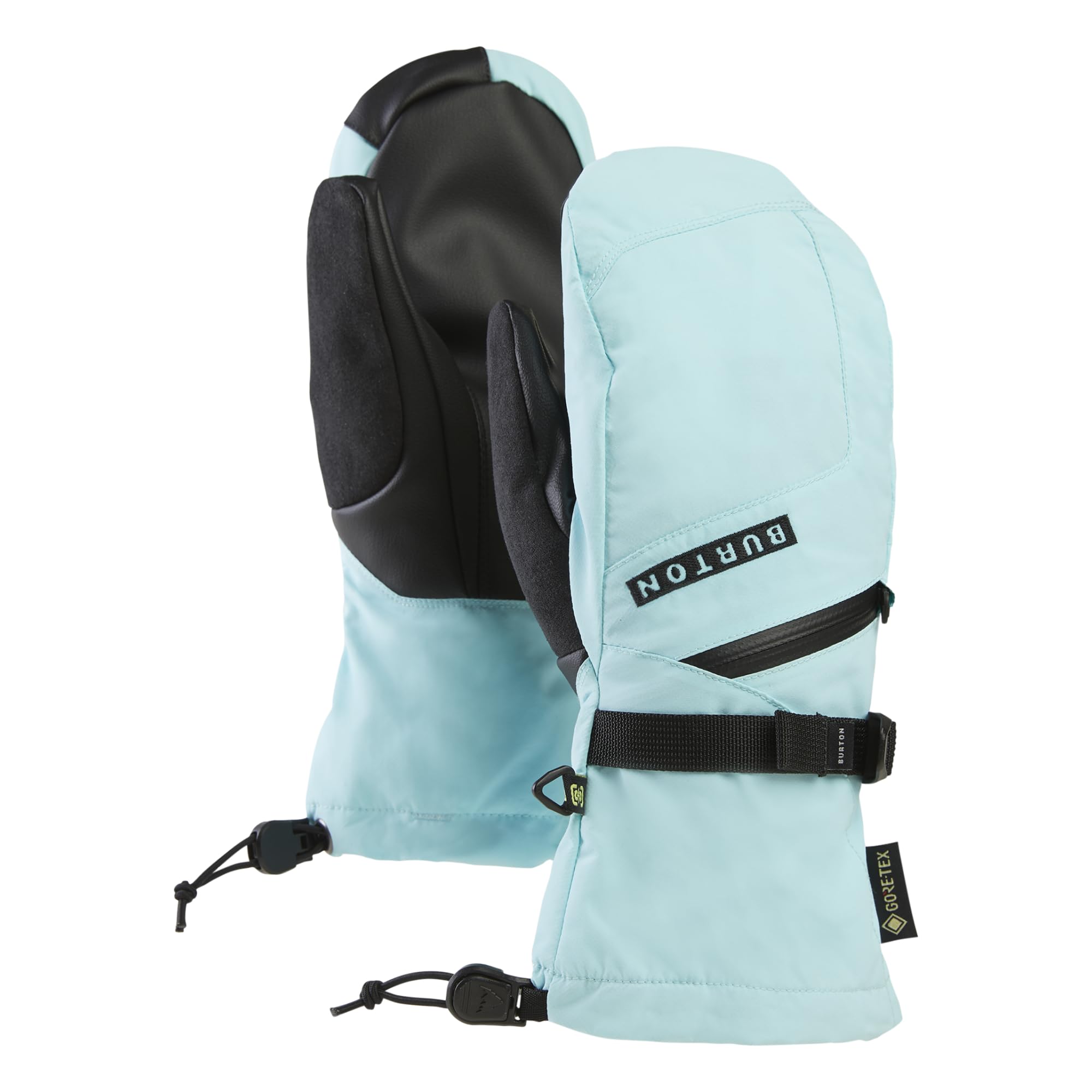
Burton Women’s Gore-TEX Mittens
Key Features
- Liner: Removable
- Pocket: Zip hand-warmer pocket
- Membrane: Gore-Tex
- Price: Midrange
A removable liner is the feature that makes the Burton Women’s Gore-TEX mitts worth their mid-range money: the inner glove has a rubberized grip pattern on the palm, and it comes out for warm spring days, for drying overnight, and for washing. We think that flexibility is why these beat warmer fixed-liner mitts for anyone who skis a full week.
The Gore-Tex membrane is the real thing, and it’s what you want in wet, heavy snow where a coated shell starts soaking through by lunch. The shell cinches at the wrist to keep snow out, there’s a zip pocket on the back of the hand for a hand warmer, and wrist straps let you hang them from the lift. Warmth is solid on genuinely cold days.
Expect mitten-grade dexterity — zipping a jacket is fine, texting isn’t — and check the color before ordering, because the Summit Taupe option reads noticeably pinker in person than it does on screen.
Pros
- Gore-Tex shell handles wet snow
- Removable liner dries overnight
- Zip pocket for a hand warmer
- Wrist straps keep them off the snow
Cons
- Seams are the weak point under hard use
- Sizing runs small in XL
Our women’s pick: a Gore-Tex shell with a liner that comes out for mild days and dries overnight.
Best for Mid-Range Gore-Tex
Dakine Titan Gore-Tex Mitts
Key Features
- Pocket: Hand-warmer pocket
- Membrane: Gore-Tex
- Department: Men’s
- Price: Midrange
Gore-Tex usually turns up at the top of the price range, so finding a genuine Gore-Tex mitt mid-pack is the whole argument for the Dakine Titan. They’re easy to get on and off, and there’s enough room inside for a wrist guard underneath.
The small pocket on the back of the hand got more use from us than anything else on the mitt: it’s sized for a disposable hand warmer, and it also swallows a lift pass so you’re not digging in a chest pocket with a mitt on. Warmth is good for resort days rather than deep cold, which is fine for most lift-served skiing and a reason to look at the Black Diamond Mercury if you ski the top of the mountain in January. The fit runs true.
Pros
- Genuine Gore-Tex at a mid-range price
- Pocket fits a pass or hand warmer
- Easy to pull on and off
Cons
- Men’s sizing only
Genuine Gore-Tex without the premium price, plus a pocket that fits a lift pass or a hand warmer.
Best for Coldest Conditions
Black Diamond Mercury Mitts
Key Features
- Palm: Treated leather
- Liner: Removable
- Membrane: BD.dry
- Price: Premium
The Black Diamond Mercury is built for the person whose hands go numb first. It’s a big, heavily insulated mitt with a removable liner, so you can double up with a thin glove on the worst days and drop to a light liner when the sun comes out.
The waterproof layer is Black Diamond’s own BD.dry rather than Gore-Tex, and on wet, heavy snow the shell shed water without the leather palm going slick on a pole. What surprised us is how much the removable liner adds: it turns a deep-winter mitt into something you can wear in mild spring conditions without cooking your hands.
Bulk comes with the warmth, and this is not a mitt you wear to drive to the hill or walk the dog. For a cold-snow skier who has tried everything else and still finishes the day with numb fingers, it’s where we start.
Pros
- Very warm in wind and sub-zero cold
- Removable liner adds range
- Treated leather palm keeps grip
Cons
- One of the priciest picks here
- Snug through the wrist out of the box
Near the top of this group on warmth, with a removable liner that stretches it into spring.
Best for First-Time Buyers
Tough Outdoors Ski Mittens
Key Features
- Sizing: Runs small
- Waterproofing: Waterproof shell
- Wrist leashes: Included
- Price: Budget
The cheapest way into a proper ski mitt, the Tough Outdoors pair covers what a beginner actually needs: warmth, a shell that holds off snow, and wrist leashes — a feature that usually vanishes at this end of the range. We keep a set as spares for guests, and nobody has handed them back.
There’s genuine room inside for a liner glove, which matters more than the insulation figure: a mitten keeps you warm by trapping air, and these have space for it. The shell wets out on a long day of wet snow — the outside goes dark and heavy — though our hands stayed dry inside, and they’re dry by morning if you let them air rather than parking them on a radiator.
As a first pair, a spare, or a mitt for someone who skis a few weekends a year, they’re easy to recommend: warm enough for a cold resort day, roomy enough to layer, and cheap enough that losing one off a lift isn’t a disaster.
Pros
- Warm for the money
- Room for a liner glove
- Wrist leashes at a budget price
Cons
- Sizing runs small across the range
- Thumb seams can tear with hard use
The best budget mitt here: warm, roomy enough for a liner, and easy to recommend for a first season.
Best for Budget All-Rounder
OutdoorMaster Ski Mittens

Key Features
- Membrane: TPU waterproof
- Warranty: One year
- Insulation: 140g cotton
- Touchscreen: Thumb patch
- Price: Budget
A zipper pocket on the back of the hand is the kind of thing you don’t know you want until you’ve spent a lift ride with your pass buried in a chest pocket. The OutdoorMaster mitt has one, and it’s the detail that lifts it clear of the plain budget mitts here.
The rest is competent rather than clever: 140g of insulation, a TPU membrane under a water-repellent shell, adjustable wrist straps to cinch over a sleeve, and a leather thumb patch that works on a phone screen. It’s machine washable and it carries a one-year warranty.
Fit is regular and true to size, with enough room to wiggle fingers without the mitt feeling like a boxing glove. Warmth is solid for a normal winter resort day, and the zipper pocket is there for the mornings when it isn’t.
As a first pair, a spare, or a mitt for someone who skis a handful of days a season, it earns its place — the pocket and the warranty do a lot of work for the money.
Pros
- Pass-sized zipper pocket
- One-year warranty
- Thumb works on a phone screen
Cons
- Stitching and lining are the weak points
- Pocket is too small for a phone
A budget mitt that gets the small things right — a pass pocket, a thumb patch, and a one-year warranty.
Best for Kids and Families
Odtmger Ski Mittens

Key Features
- Shell: Dual-layer waterproof
- Sizes: Toddler to adult
- Insulation: 3M Thinsulate
- Touchscreen: Fingertips
- Price: Budget
Matching sizes is the idea here: the same mitt in sizes that run from toddler to small adult, so a seven-year-old and a parent can end up in the same pair.
For a kid, the useful details are the ones that stop a mitt going missing — an anti-loss rope that threads through a jacket sleeve, a hook-and-loop cuff that’s quick to fasten with cold fingers, and a cuff that sits high enough to keep snow out. Inside there’s 3M Thinsulate and a dual-layer shell, and the fingertips work on a touchscreen, which is genuinely handy for photos at the top of a lift.
These are resort and backyard mitts: fine for a lift-served day, sledding, and a snowball fight, and not the pair to take up a cold ridge in January. The trade for the warmth is the usual mitten clumsiness — nothing about the design changes that.
As a family buy, it makes sense: one design everyone recognises, a rope so the mitts come home, and a spare that doesn’t cost much to replace. It’s the only pick here built for kids first, and that’s the way to use it.
Pros
- Matches across kid and adult sizes
- Anti-loss rope threads through a sleeve
- 3M Thinsulate with a waterproof shell
- Touchscreen fingertips for photos
Cons
- Sizing runs small — order up
- Adult sizes top out around women’s small–medium
The family pick: matching sizes from toddler up, a rope that keeps them attached, and enough warmth for resort days.
How We Tested Ski Mittens, From Lift Lines to the Driveway
We started by gathering the mittens that kept surfacing in gear forums, ski-shop staff recommendations, and customer reviews, then trimmed the list by insulation type, cuff design, palm material, and price so we had a spread from budget-friendly to investment-level. Twelve pairs made the cut. Testing ran the length of one full winter season, from the first cold snap in November through the slushy afternoons in April.
Every pair went to the mountain and to the driveway. We wore them on 20-minute lift rides, in wind-whipped lift lines, while buckling boots in the lodge lot, shoveling out after a 10-inch storm, and towing sleds back up the hill. On cold days we noted whether fingers stayed warm and how quickly they recovered after we pulled a mitten off to check a phone. On wet, heavy-snow days we packed a snowball into each palm and checked the lining for damp 10 minutes later.
Fit and handling got the same treatment. We tried each pair on with and without a thin liner glove, measured hand length against the maker’s size chart, and checked whether the thumb webbing pulled or the cuff left a gap at the jacket sleeve. Then we did the things you actually do in mittens: zipped a jacket, buckled a boot, opened a granola bar, fished a pass out of a chest pocket. Wrist leashes, pass pockets, and hand-warmer slots were noted as we used them, not from the spec sheet.
Durability and value we judged at the end, not the start. Leather palms and seams were inspected after each trip for abrasion, stitching wear, and stretched-out cuffs, and we weighed what each pair cost against how warm it actually kept us across a full season of use.
How to Choose Ski Mittens
The waterproofing method decides more than any other single choice — how warm the mitt feels, how much upkeep it needs, and how long it lasts.
Warmth Is Mostly Trapped Air
Insulation gets advertised as if warmth were a number, but a mitten works by holding a layer of warmed air around your fingers, and that only happens if the fit leaves room. A tight mitt conducts heat away no matter how thick the fill. Size for the liner you actually wear, whether that’s a thin silk glove or a wool one, and expect the mitt to feel slightly loose over a bare hand.
The payoff is the reason mittens beat gloves in the cold: four fingers sharing one warm pocket instead of four separate ones. If you’re between sizes, the larger shell plus a thin liner is usually the warmer combination.
How They Keep Water Out
Two approaches, and they fail differently. A bonded membrane — Gore-Tex, BD.dry, or a TPU insert — sits inside the shell and needs no maintenance, but it can wear at the seams over several seasons. Waxed or oiled leather has no membrane to fail; it needs re-waxing when water stops beading, and it stands up to abrasion better than any fabric.
Match it to your snow. Wet, heavy coastal snow favors a membrane, while cold dry snow, rope tows, and rocky lift corrals favor leather you maintain yourself.
Cuffs, Leashes, and the Features Worth Paying For
A long gauntlet that pulls up over the jacket sleeve keeps snow out better than any cinch, though a close cuff with a strap is easier to wear underneath a shell. Wrist leashes cost nearly nothing and save you from a lost mitt on a lift; if a pair doesn’t come with one, a loop of cord does the job.
We put more value on a leash and a pass-sized zip pocket than on any other small feature, and both are cheap to add.
Plan Around the Lost Dexterity
Any mitten costs you fingers, and how much you notice depends on bulk. The workaround is a thin liner glove, so you can bare a hand for ten seconds to sort a buckle without paying for it the rest of the day.
Palm material matters too. Leather and rubberized patches grip a pole better than a soft nylon shell, and they’re what stops the mitt twisting on your hand when you push off.
Frequently Asked Questions
How do I dry ski mittens overnight?
Pull the liners out if they come out, shake off loose snow, and stand the mitts cuff-down somewhere warm but not hot — a radiator or a hot boot dryer stiffens leather and weakens seam tape. Stuffing the shells with newspaper pulls moisture from the inside.
Two pairs alternating beat one pair dried hard, and if the shell stops beading water, it needs a fresh coat of wax or a spray-on treatment before the next ski day.
Can I use ski mittens for snowboarding?
Yes — the shape works the same on a board — but the palm takes abuse that skiing never gives it, and binding straps and toe-edge grabs wear through a soft shell fast. Leather or a rubberized palm holds up and can be conditioned; coated fabric scuffs through.
If you adjust bindings all day, carry a thin liner glove so you can bare a hand for the buckles instead of fighting them with a mitt on.
Do touchscreen mittens actually work?
The thumb patch is the useful part: enough to answer a call or check lift status, not to type on. It has to touch skin, so a patch does nothing through a liner, and cold fingers make taps unreliable anyway.
Keep the phone in an inside jacket pocket so the battery and screen stay warm, and plan on taking the mitt off for anything longer than a single tap.
Final Verdict
We recommend the Hestra Army Leather Heli Ski Mitt to most skiers. The leather shell blocks wind, the gauntlet covers a jacket sleeve, and the removable liner dries overnight, which is what makes back-to-back days comfortable rather than a test of endurance.
If that’s more than you want to put into your hands, the Kinco 901T does nearly the same work in waxed pigskin for a fraction of the money — you trade a ski-specific shape and the finish for leather that outlasts everything else here. And if your hands go numb on every cold day no matter what you wear, go straight to the Black Diamond Mercury.