This post contains affiliate links. We may earn a small commission when you buy through our links — at no extra cost to you.
A winter coat is a bundle of compromises you wear. Buy for warmth and you end up looking like a sleeping bag with arms; buy for looks and you find out in February that the wind goes straight through it. I’ve made both mistakes — one winter I wore a coat that photographed beautifully and did nothing below 25 degrees. What a good coat fixes is simpler than the marketing suggests: it keeps you warm while you’re standing still, doesn’t turn into a sauna when you step onto a crowded train, and still looks like something you chose on purpose.
So we went looking for the ones that get the balance right. Over the past five months my team and I wore 14 men’s winter coats through bus stops, freezing-rain dog walks, and long sideline afternoons where you don’t move for two hours. The surprise: warmth and price barely track together, and a coat you can actually move in gets worn far more than one you can’t. The picks below are the ones we kept reaching for.


Best for Cold Outdoor Work
Carhartt Washed Duck Bartlett
Key Features
- Shell: Washed duck cotton
- Lining: Fleece
- Weight: 4.65 lb
- Price: Premium
The number that says the most about the Bartlett is 4.65 pounds. Lift it off a rail and it feels closer to equipment than clothing, and that is the deal it offers: a washed duck shell that stops wind at the fabric instead of letting it seep through, a fleece lining that is already warm before your body heat has done any work, and enough insulation that a flannel underneath carried us through freezing mornings without a second thought.
Duck canvas is why it keeps coming back out of the closet. It shrugs off brush, grit, and the rough edges you meet in a garage or a woodpile, and wet snow sits on the surface and dries instead of soaking through the way it does on thin nylon. The cuffs close down properly, the hood stays where you put it, and the whole thing is built to be worn hard. Nobody mistakes it for city outerwear, which is a fair trade for how little it asks of you.
Roomy through the chest and shoulders is the right way to put it — there’s space for a hoodie or a heavy sweater without the coat pulling across your back, and the tall sizes cover longer arms. What you give up is speed. Four and a half pounds of duck does not want to hike, and you’ll feel every one of them on a climb or a long stride.
For a real winter — a windy walk to the train, shoveling, standing around in the cold — this is the coat we hand people. It is the warmest thing in this guide and the one we trust most when the wind picks up, and it is the coat here we expect to still be in service long after the cheaper shells have gone.
Pros
- Very warm with just a sweater on
- Duck canvas handles brush, grit, and wet snow
- Roomy for a heavy layer, with tall sizes
- Hood and cuffs seal out wind
Cons
- Heavy at 4.65 pounds on the scale
- Hand pockets are shallow for keys and a phone
Buy the Bartlett if you want one coat for a genuine winter and can live with the weight; nothing else here is this warm or this tough.
Best for Budget Snow Days
CAMEL CROWN Mountain Ski Jacket
Key Features
- Hood: Detachable
- Weight: 2.73 lb
- Waterproofing: Waterproof shell
- Price: Budget
Waterproof, hooded, and 2.73 pounds — the CAMEL CROWN is the lowest-priced route into a real winter shell here, and it doesn’t feel like a compromise on the basics. The collar stands high enough to cover your chin, the hood zips off when you don’t want it, and the cuffs close down over gloves. Insulation is spread thin and even, so it’s warm without the puffed-up bulk that makes a cheap coat feel like a sleeping bag with sleeves.
Where it earns its place is weatherproofing for the money. Rain and wet snow stay out, wind doesn’t cut through the front, and it packs down small enough to live behind a car seat. It’s the coat we suggest to someone who needs a winter coat now and would rather not spend much on one — a first proper coat, a coat for a teenager, a coat that stays in the trunk. Check the size chart against your chest rather than trusting the letter on your usual jacket.
Pros
- Waterproof against rain and wet snow
- Warm without puffy bulk
- Light at 2.73 pounds
- Detachable hood and high collar
Cons
- Pocket zippers are the weak point
We point first-time and budget buyers here: a waterproof, hooded shell for snow and rain without the bulk or the outlay of the specialist coats.
Best for Daily Commuting
Amazon Essentials Puffer Coat
Key Features
- Hood: Attached and lined
- Pockets: Zippered, fleece-lined
- Insulation: Down alternative
- Price: Budget
Picture the coat most people actually need: warm enough for a commute, a dog walk, and a cold parking lot, light enough to wear in a car, and not priced like outerwear for a summit attempt. We think this Amazon Essentials puffer is the best value in this guide for exactly that job, and the fleece-lined hood and pockets are most of the reason — those are the first details to get cut from a cheap coat.
The synthetic fill lofts properly and the snug cuffs stop wind running up your sleeves, so it holds heat far better than its weight suggests. Worn over a sweater it handles a hard freeze, and unlike a big duck coat it doesn’t leave you sweating the moment you step indoors. The hood is lined too, which matters more than it sounds on a windy platform.
Treat it as a town coat, though. The outer fabric is thin, and a snagged branch or a rough brick wall will leave a mark where a canvas shell would shrug it off. As a second coat, a coat for a mild city winter, or the one you keep by the door, it’s hard to argue with.
Pros
- Warm for its weight below freezing
- Fleece-lined hood and hand pockets
- Light and not bulky in a car
- Good value as a second coat
Cons
- Small hand pockets, no inside pocket
For commuting and errands in a cold city, this is the puffer we recommend — warm, light, fleece-lined where it counts, and inexpensive enough to be a second coat.
Best for Windy Cold Walks
TACVASEN Hooded Parka
Key Features
- Care: Hand wash
- Hood: Attached
- Water resistance: Water repellent
- Price: Budget
The neck is where most budget parkas lose the fight: the collar flops open, the hood sits back, and cold air finds the gap. This TACVASEN stands its collar up high, the hood sits over the top of it, and the front closes tight — on a windy morning it is the coat here we reach for first.
There’s genuine insulation in it, and because the sleeve lining is smooth it slides on over a heavy sweater instead of dragging the sleeves up your arm. The pockets are deep enough for gloves and a hat, the exterior chest pocket takes a phone, and the cut is neat enough that it doesn’t announce itself as hiking gear when you walk into a shop.
For an exposed walk — a platform, a dog loop across open ground, the trudge from a car park — it is the best balance of wind protection and price in this group. Layer a sweater underneath and it keeps going comfortably below freezing, which is more than the light puffers here manage.
Pros
- High collar and hood seal the neck
- Warm below freezing without heavy bulk
- Deep pockets and smooth sleeves for layering
Cons
- Hand wash only, no machine cycle
- Sizing runs small for broad shoulders
If wind is the problem, this is the coat to buy: the collar and hood close the neck properly, and it stays warm below freezing without workwear weight.
Best for Office and Town
Tommy Hilfiger Hooded Puffer
Key Features
- Sizing: Standard and Big & Tall
- Weight: 2.6 lb
- Insulation: Down alternative
Most coats here are built to survive something. This one is built to look good while you’re at it: the Tommy Hilfiger puffer is a tidy, low-bulk jacket that reads as office wear rather than trail wear, and at 2.6 pounds it’s light enough to keep on for the whole commute instead of wrestling it off at the door.
We think it’s the best-looking coat in this guide, and the warmth is real rather than implied — well insulated for its weight, with a hood that doesn’t look like an afterthought. It suits a man who wears a coat over a shirt, sometimes over a jacket, and wants one that doesn’t look like it came off a job site.
The Big & Tall range is the part that gets overlooked. The tall sizes add length in the body and sleeves rather than just width, which is the fix if you’ve given up on puffer sleeves reaching your wrists. It also rolls up small enough to sit on a back seat without taking the whole seat.
Pros
- Dressy enough for the office
- Warm and light at 2.6 pounds
- Big & Tall sizing with real sleeve length
Cons
- Runs large, snug through the arms
- Pale colors read grayer than the photos
Buy it if the coat has to look good in an office and still be warm on the walk there; it’s the sharpest-looking jacket here, in real Big & Tall sizes.
Best for Tall, Long-Line Wear
TACVASEN Waterproof Ski Jacket

Key Features
- Hood: Detachable
- Insulation: Thermal
- Waterproofing: Waterproof
- Price: Budget
The hem drops low enough to cover your seat, and the sleeves run long. That sounds like a small thing until you’ve stood at a cold bus stop or sat down on a snow-covered bench, and it’s the reason this one suits tall men and anyone who hates a draft working its way up the back of a jacket.
It’s waterproof and windproof in the way a ski shell should be, the hood comes off, and there are pockets inside and out — enough that gloves, a phone, and a lift pass each have a home. The body is lined, so it doesn’t have the cold-plastic feel that some budget shells have when you pull one on in a parking lot.
There’s a lot of coat here for what it costs: longer, roomier, and more weatherproof than the everyday puffers. It is also unmistakably a ski jacket, so if the coat has to work at dinner as well as on a slushy walk, the Tommy puffer or the TACVASEN parka will serve you better.
Pros
- Long hem covers the seat
- Waterproof and windproof shell
- Pockets inside and out
- Warm with a layer in real cold
Cons
- Inner pocket zippers are the fragile part
Choose this one for the long hem and roomy cut — it is the best coat here for tall men and anyone who feels a draft around the waist.
Best for First Winter Coat
Yufawow Insulated Ski Jacket

Key Features
- Lining: Fleece
- Waterproofing: Waterproof
- Wind protection: Windproof
- Price: Budget
The Yufawow is the newest coat in this guide and has the shortest track record of the group, which is the only thing holding it below the others. We think it’s a sound buy anyway: fleece lining, a waterproof and windproof shell, and a cut that runs true to size — the three things budget shells most often get wrong.
The lining is what you notice first. It’s soft against a t-shirt, so you can wear it over something light in early winter and over a sweater in January without the coat fighting you. Wind doesn’t come through the front, wet snow beads off the shoulders, and the zippered hand pockets are deep enough to be genuinely useful rather than decorative.
Against the CAMEL CROWN it’s a slightly more substantial coat with less of a ski-specific cut; against the parka it’s lighter and less of a wind fortress. That puts it in the middle of the budget group, which is a good place to be if you’re buying your first proper winter coat.
Pros
- Waterproof and windproof shell
- Fleece lining is soft against skin
- Runs true to size
- Deep zippered hand pockets
Cons
- Zippers can stick and jam
We recommend it as a first real winter coat: warm, waterproof, and true to size, and the fleece lining makes it easy to wear over just a t-shirt.
Best for Mild Winters, Layering
Carhartt Gilliam Jacket
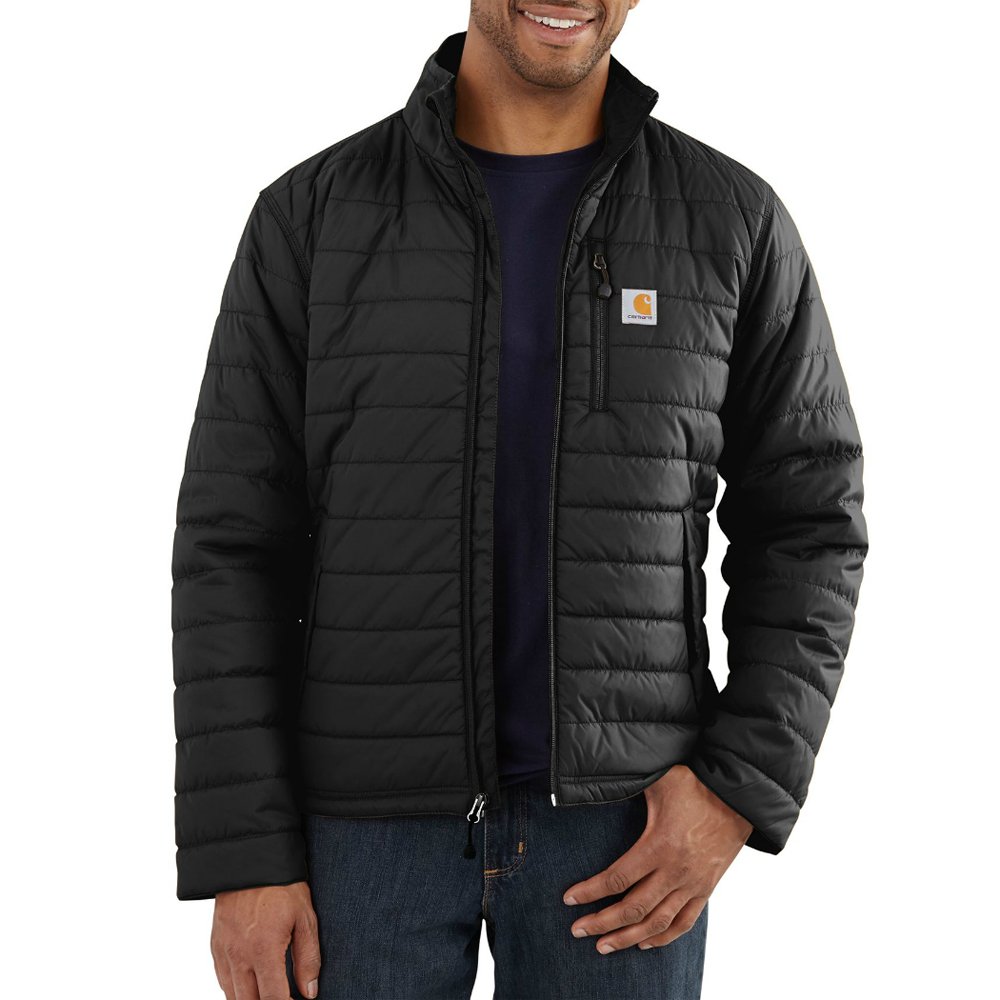
Key Features
- Fit: Relaxed
- Weight: 1.2 lb
- Water resistance: Water repellent
- Price: Midrange
Start with what the Gilliam is not: a deep-winter coat. At 1.2 pounds it’s a light insulated jacket for the low 40s and the wet, windy days around them, and if you buy it expecting a January coat in a cold climate you’ll be disappointed.
What it does, it does well. Wind stays out, light rain beads off the shell, and it packs down small enough to live in a bag or under a seat. The relaxed cut leaves room for a sweater, and the cuffs adjust down over gloves instead of gaping.
That relaxed fit is generous over layers and loose over a t-shirt, and the tall sizes cover longer torsos. It’s also the least coat-like coat here, which is the point — it goes from a trailhead to a pub without announcing either.
Where it earns its place is as the second coat: the one for a mild winter, a warmer climate, or that stretch of autumn when a puffer is already too much. Wear it under a shell and it goes colder than its weight suggests, which is more than most light jackets manage.
Pros
- Light at 1.2 pounds
- Blocks wind and sheds light rain
- Packs small enough to carry
- Tall sizes for longer torsos
Cons
- Relaxed fit runs large
Buy the Gilliam for a mild winter or as a layer under a shell — it sheds wind and light rain at 1.2 pounds, as long as you don’t ask it for January.
How We Chose and Tested 14 Men’s Winter Coats
We started with roughly 60 men’s winter coats and, over five months, cut the list to 14 worth actually wearing. That meant sorting by insulation type and fill weight, checking whether the shell blocked wind or just looked like it would, comparing size charts and whether extended sizing existed, and looking past the usual black and navy. Price mattered, but only against how many winters a coat could plausibly survive.
Warmth got tested the way coats actually get used: standing still. We waited at bus stops, watched two-hour games from a folding chair, and walked dogs in freezing rain, layering each coat over everything from a T-shirt to a heavy sweater to find where it stopped being enough. Then we wore each one into a heated office or a packed train to see how quickly it turned into a sauna, and noted whether the collar chafed when we turned our heads.
Fit was judged on testers of different heights and builds, with a few sizing up to layer and one sizing down to wear over a suit. Zippers got their own attention because they fail first: we zipped each coat one-handed with gloves on, counted snags, and checked whether the storm flap actually covered the teeth. For quality, we watched the seams at the shoulders and pockets, looked for down leaking at the baffles, and checked for pilling and cuff wear after a few weeks.
Appearance we judged by wearing each coat to dinner, to the office, and to the hardware store, since one that works with a single outfit isn’t good value. Most colors we expected to look tired by February did.
How to Choose a Men’s Winter Coat
The coat that keeps you warmest standing still is rarely the coat you want to walk a mile in, so settle which kind of winter you actually have before you compare anything else.
Buy for how you’ll spend the cold
Two men can face the same forecast and need different coats. If your winter is a platform, a parking lot, and a dog that stops to sniff everything, you want insulation and a wind-blocking shell — the heavyweight duck coat here exists for exactly that man. If you generate heat on the move, the same coat will have you unzipped and steaming within ten minutes, and a lighter shell over a fleece will be the more comfortable choice at the same temperature.
We think this is the single decision that matters most, and it is the one most shoppers skip. Work out whether you are standing or moving before you read another specification.
Waterproof, water-repellent, and windproof are three different promises
A waterproof ski shell keeps rain and wet snow out. A water-repellent jacket sheds a shower and then soaks through in a steady one. A duck canvas work coat shrugs off snow but takes on water in prolonged rain, and it will feel damp and heavy afterwards if you don’t dry it out.
Wind is the quieter issue: a coat that blocks it feels far warmer than one that doesn’t, whatever the insulation inside. Match the promise to your weather — wet coastal winters want the waterproof shell, dry cold wants insulation and a closure that seals.
Size for the layers you’ll really wear
Sizing is the most inconsistent thing about this group. The same letter can be roomy in one coat and tight across the shoulders in another, and several of these run small or large enough that your usual size is the wrong starting point. Measure your chest, add room for the thickest sweater you’ll wear underneath, and go by the size chart rather than the label in the coat you already own.
If you’re tall, look for tall sizing specifically — it adds length in the body and sleeves rather than just width, which is the difference between a coat that covers your wrists and one that doesn’t.
Zippers and hoods fail before the fabric does
On a budget coat, the shell usually outlives the hardware. The main zip carries all the load, so check that it runs cleanly on the first try and that there’s a storm flap or a row of snaps behind it as a backup. Then look at the pockets, because those zips are smaller, take more abuse, and are the first thing to go.
Detachable hoods are handy and add a second zip at the collar. Try the coat with the hood off: a collar that won’t stand on its own means a cold neck all winter, and that is worth more thought than the hood itself.
Read the care label before you commit
A winter coat gets dirty, and the care label decides whether you’ll actually clean it or live with the marks. One parka here is hand wash only, which is a real commitment for a coat you wear every day. Check the label before you fall for the cut — on a coat that sees road salt and wood smoke, easy care is worth more than an extra pocket.
Frequently Asked Questions
Is down alternative as warm as real down?
For a coat you wear around town, yes. The synthetic fills in these jackets loft well, keep some warmth if they get damp, and are easier to clean than down. Real down is warmer for its weight and packs smaller, which matters if you’re counting ounces in a pack rather than walking to a car.
Unless you’re carrying the coat more than wearing it, synthetic is the sensible choice.
Can I wear a ski jacket as an everyday winter coat?
You can, and plenty of people do. The ski shells here run long and roomy, which is comfortable over a sweater, and their hoods come off when you don’t want the look. Try yours on over the thickest layer you’ll actually wear, then take the hood off and check that the collar still stands up on its own.
Will a winter coat fit over a suit jacket?
It can, but size for the jacket, not the shirt. A relaxed parka or a Big & Tall puffer leaves the room you need; a boxy work coat will close but pull across the back when you reach for something. Put the suit jacket on first, then check the shoulder seam sits at the edge of your shoulder rather than past it.
Final Verdict
The Carhartt Washed Duck Bartlett is what we recommend to most men facing a real winter: warmest here, toughest here, and the one still doing the job when a cheaper shell has been replaced. If the weight is too much, the Gilliam handles mild winters and layering at a fraction of the bulk, and the CAMEL CROWN is the budget answer for snow and rain.
Buy for the cold you have, not the cold on the forecast graphic, and any of these three will serve you well.