This post contains affiliate links. We may earn a small commission when you buy through our links — at no extra cost to you.
Waterproof boots make a promise that’s easy to keep in a store and hard to keep in a puddle. The pairs that keep water out most reliably are usually stiff bricks you dread lacing up, and the ones that feel broken-in on day one are often the ones that leak by February. What you want is rarer than it should be: a boot that stays dry through a slushy commute, grips a wet platform, looks fine with jeans, and doesn’t make you count the minutes until you can take it off.
I’ve lost more socks to leaky boots than I care to admit, and waterproofing lives in the details — a sealed tongue gusset, a real bootie lining, taped seams — not the word stamped on the box. Over eight months my team and I wore 12 pairs through rain, slush, wet grass, and one flooded parking lot, tracking which kept our socks dry and which we reached for anyway. The overlap is smaller than you’d think, and it’s what these picks share.




Best for All-Around Wet Hikes
Timberland White Ledge Mid
Key Features
- Use: Hiking
- Boot height: Mid
- Waterproofing: Waterproof
- Package weight: 1.1 lb
- Price: Midrange
The White Ledge is the pair we point to when someone wants one waterproof boot for wet hikes, dog walks, and the occasional muddy errand. The mid cut gives you ankle coverage without the stiffness of a mountaineering boot, and the lace-up fit is easy to dial in. We like that it feels broken in quickly rather than asking for a long series of short walks.
This is the pair we recommend first for wet-weather hiking. It handles wet grass, puddles, and rain without turning into a sweaty brick, and the sole has enough bite for packed dirt and roots. The waterproofing has a limit: standing water above the lower laces is not its job. We also noticed the tongue runs a little short, so if you have a high instep, take a moment with the top lacing rather than cranking it down.
If you want a lighter, cheaper hiking boot, the Skechers is the alternative. If you want a stiffer trail boot for rough ground, the Columbia is the step up. Otherwise, this is the pair we keep by the door when the forecast is uncertain.
Pros
- Balanced comfort for wet trails and errands
- Waterproofing for rain, puddles, and wet grass
- Light enough for longer walks
- Good grip on snow and ice
Cons
- Sole and seam durability is the weak point
The White Ledge is our default waterproof hiker for most men: comfortable, light enough for long walks, and dry in rain and puddles.
Best for Long Trail Days
Columbia Newton Ridge Plus II
Key Features
- Use: Hiking
- Model: Newton Ridge Plus II
- Waterproofing: Waterproof
- Package weight: 4.94 lb
- Price: Midrange
If the White Ledge is the easy default, the Newton Ridge Plus II is the boot for days when you know you will be out longer. We rate it the best long-walk comfort in this set: the sole feels planted on loose gravel, and the ankle collar holds without pinching. It also looks like a proper hiking boot rather than a sneaker with lugs.
The waterproofing is dependable for wet grass, shallow puddles, and a soggy commute. It is not a wading boot; treat the collar as the waterline. The toe box has decent room, and the heel is secure enough for steep sections. On loose dirt and gravel, the sole is the part we trust most.
For hikers who want support and a structured fit, this is an easy recommendation. The White Ledge is more forgiving for wide feet; the Mt. Maddsen is lighter. The Newton Ridge is the one we choose when the day is long and the ground is rough.
Pros
- Planted, supportive ride on rough trails
- Waterproof for wet grass and shallow puddles
- Classic hiking-boot look
Cons
- Runs narrow through the midfoot
For long trail days, we take the Newton Ridge Plus II for its planted ride and supportive fit, though wide feet should look elsewhere.
Best for Lightweight Hiking
Timberland Mt. Maddsen
Key Features
- Use: Hiking
- Model: Mt. Maddsen
- Waterproofing: Waterproof
- Package weight: 3 lb
- Price: Midrange
The Mt. Maddsen is the lightest leather hiker in this group, and that is the reason to consider it. It carries less bulk than the White Ledge and Columbia without feeling like a trail runner, and the open eyelets make lacing quick. We noticed the difference most on long approach walks, where a heavier boot starts to feel like a chore.
Waterproofing is solid for wet grass, shallow puddles, and sloppy trail sections. The boot has a comfortable, soft feel out of the box, and the toe box leaves room for thicker socks. Traction is fine on packed dirt and gravel, not a specialized mud or snow sole. Sizing is close to standard, though the ankle volume is generous.
We recommend it for the hiker who counts grams and wants leather rather than synthetic. The White Ledge and Columbia are the more planted choices for rough ground, but they ask you to carry more boot. If your days are mostly day hikes, the Mt. Maddsen is the lighter way in.
Pros
- Light leather build for day hikes
- Waterproofing for wet grass and puddles
- Comfortable without a long break-in
- Quick lacing with open eyelets
Cons
- Seams can come apart with hard use
We like the Mt. Maddsen for day hikers who want leather protection with less weight; heavy packs and rough ground call for more boot.
Best for Wet Decks
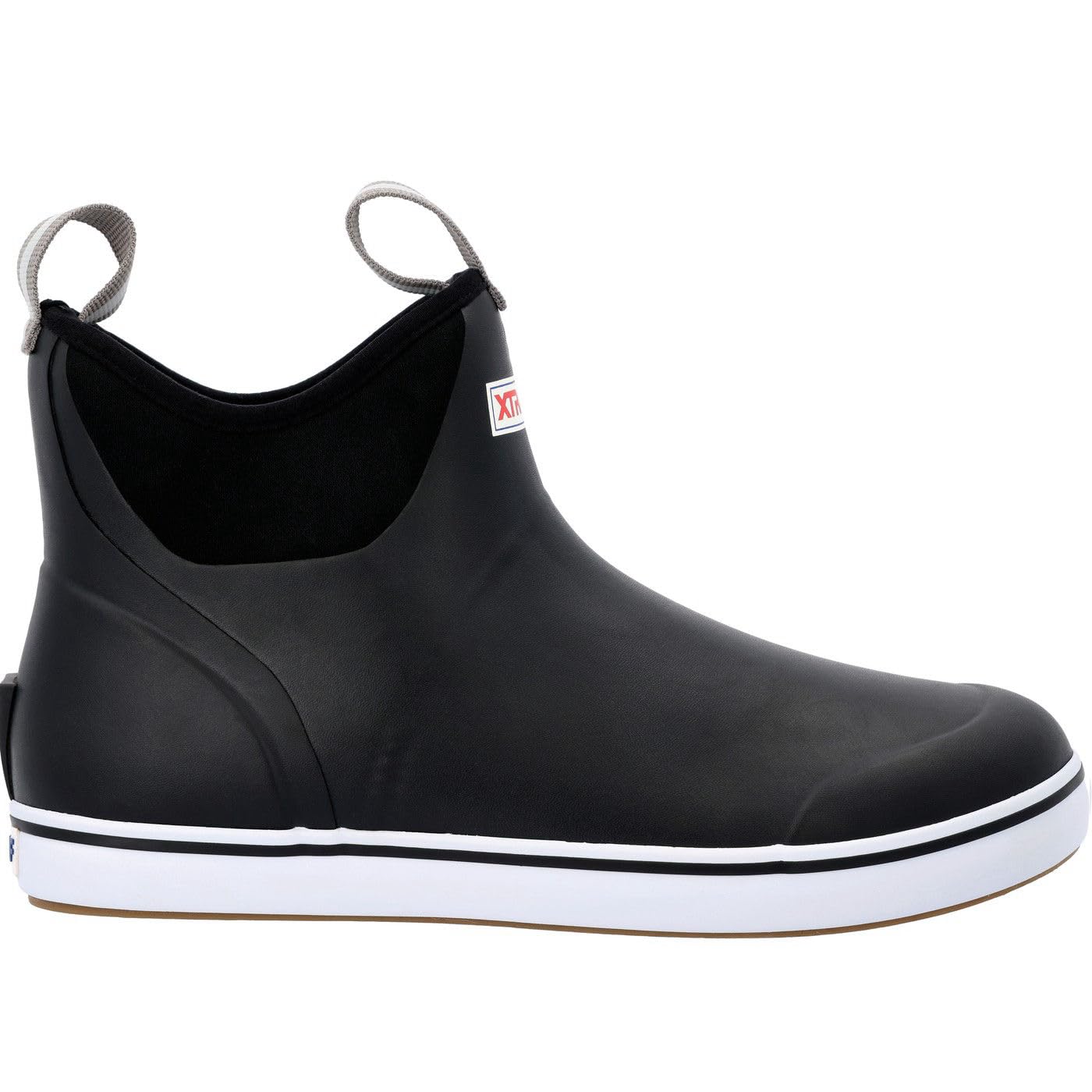
XTRATUF Ankle Deck
Key Features
- Use: Rain and deck
- Style: Ankle deck
- Closure: Slip-on
- Waterproofing: Waterproof
- Price: Midrange
A wet dock, a boat ramp, a rainy dog walk: the Ankle Deck Boot is built for the places where laces are a nuisance. The slip-on shaft is low enough to step into without sitting down, and the heel tab gives you something to pull. We like it for those quick wet jobs where a hiking boot is more shoe than you need.
The waterproofing is the main event. It keeps feet dry in rain, puddles, and spray, and the low cut means you can move your ankle freely when you are working. The coverage stops at the ankle, so it is a wet-deck boot rather than a wading boot. For long standing shifts, the cushioning is comfortable enough that we did not think about our feet.
We recommend it for boaters, dock workers, and anyone who wants a rain boot that slips on in seconds. It is not a trail boot; the low cut and soft sole are for wet, flat ground. If you need ankle support on rough ground, go with a hiking boot. If you want the easiest on-and-off pair here for a wet deck, this is it.
Pros
- Slips on fast with a useful heel tab
- Keeps feet dry on wet decks and in rain
- Comfortable for long standing
Cons
- Tread is poor on snow and ice
- Sizing runs small; no wide options
When the wet is a deck, a ramp, or a rainy sidewalk, we reach for the Ankle Deck Boot because it slips on fast and keeps feet dry.
Best for Cold Snowy Walks
NORTIV 8 Winter Snow
Key Features
- Use: Winter and snow
- Warmth: Insulated
- Boot type: Snow boot
- Waterproofing: Waterproof
- Price: Budget
The first cold snap is where the NORTIV 8 winter boot earns its place. We rate it the best budget winter boot here: the lining traps warmth quickly, the waterproof upper handles snow and slush, and the roomy toe box leaves space for thick socks. It is the pair to keep by the door for a snowy driveway or a cold walk.
The flip side is that this is a winter boot, not an all-season hiker. It runs warm, so it feels stifling on a mild day, and the bulky shape is not what you want for a fast summer trail. Sizing is mixed; some men need to go up, especially with thick socks. For deep snow and cold commutes, though, the warmth is the point.
We recommend it for anyone who wants a warm, waterproof boot without paying hiking-boot money. It is not the most refined walker here, and the White Ledge is the better choice for actual trail miles. But for snow, slush, and yard work in the cold, it does the job for a lot less.
Pros
- Warm lining for cold weather
- Waterproof in snow and slush
- Roomy toe box for thick socks
- Budget-friendly for winter use
Cons
- Sole separation can occur over time
The NORTIV 8 winter boot is our budget pick for cold, snowy commutes and yard work, with the caveat that it is strictly a winter boot.
Best for Muddy Yard Work
Dunlop Chesapeake
Key Features
- Closure: Slip-on
- Toe style: Plain toe
- Shaft height: Mid-calf
- Waterproofing: 100% waterproof PVC
- Price: Budget
Some boots are for trails; the Dunlop Chesapeake is for the job you dread doing in your good shoes. We reach for it for muddy yard work, chicken coops, pressure washing, and any wet mess that ends with a hose. The PVC shell is fully waterproof, and the mid-calf shaft keeps splashes off your socks.
We rate it the best cheap mud-and-yard boot here. It is the least expensive pair in this group, and it does not pretend to be a hiking boot. The wide calf makes it easy to pull on over jeans, and the plain toe is easy to rinse clean. The flat sole is for flat, messy ground, not rocky trails. If you need ankle support, look at the White Ledge.
For a boot that lives by the back door, that is enough. It will not win a comfort contest on a long walk, and the fit is not precise, but it saves your everyday shoes from the worst of the yard. We keep a pair for exactly that.
Pros
- Fully waterproof PVC shell
- Easy to hose clean
- Wide calf fits over jeans
- Least expensive boot here
Cons
- Hard to pull on in larger sizes
We keep the Chesapeake for mud, muck, and yard work that ruins everyday shoes; it is the cheap boot that does not pretend to be a hiker.
Best for Deep Cold Work
TIDEWE Rubber Work Boot
The TIDEWE work boot starts with a number that matters: a stated comfort range of -4°F to 50°F. That is a cold-weather boot, not a three-season hiker. The 6mm neoprene shell is meant to flex and retain heat, and the rubber outer keeps water out when you are standing in slush, mud, or a wet barn aisle.
We like the reinforced toe and the heel protrusion for kicking the boot off at the end of the day. The mid-calf height gives more coverage than an ankle boot, and the rubber sole has enough grip for wet grass and packed snow. It feels like a piece of work gear rather than a fashion boot, which is the right call for the job.
The cost is bulk. At 2.14 kg, it is a heavy boot to walk any distance in, and the stiff shell takes a moment to get used to. It is not the pair for a fast hike or a summer trail. For standing, stomping, and cold wet work, the weight is the price of the warmth.
We recommend it for hunters, farm workers, and anyone who spends winter days in wet, cold conditions. The NORTIV 8 winter boot is the casual snow-walk alternative; the TIDEWE is the more serious cold-weather shell. If your day involves standing around in slush, this is the one we choose.
Pros
- Stated -4°F to 50°F comfort range
- Fully waterproof neoprene and rubber
- Reinforced toe and easy-off heel
- Mid-calf coverage for wet work
Cons
- Sizing can run inconsistent
For standing around in winter slush, we choose the TIDEWE: warm, fully waterproof, and more work gear than walking boot.
Best for Budget Light Hikes
Skechers Relment-Pelmo

Key Features
- Use: Hiking
- Weight: Lightweight
- Boot height: Ankle-high
- Water resistance: Waterproof
- Price: Budget
The Skechers Relment-Pelmo is the boot we suggest when the budget is tight and the hikes are short. It is light, roomy, and waterproof enough for a wet commute or a muddy path. It is not a mountain boot, but it does not ask to be one.
The fit is friendly to wider feet, with plenty of room in the toe box, and the ankle cut is low enough to feel like a high-top shoe rather than a stiff hiker. The waterproofing handles rain and shallow puddles, and the sole is flexible right away. For a budget pair, it is easy to put on and easy to forget about.
The stock footbed is flat, so add an insole if you need arch support. Durability is the bigger question: the upper and laces are the parts to watch, and hard daily use can wear them quickly. Traction is fine on easy trails and wet pavement, not on steep, loose ground.
We recommend it for light hiking, wet commutes, and anyone who wants a cheap second pair for travel. The White Ledge is the more durable all-rounder, and the Mt. Maddsen is the lighter leather step up. If you need a boot for real trail miles, spend more; if you need a dry, comfortable knockaround pair, this one is easy to justify.
Pros
- Light and roomy for easy walks
- Waterproof for wet commutes
- Budget-friendly second pair
Cons
- Durability is the main reservation
We recommend the Relment-Pelmo for light hikes and wet commutes on a tight budget, not for steep or rocky trails.
How We Tested Men’s Waterproof Boots
We began with a shortlist of about 40 styles and cut it down by reading construction specs rather than marketing copy. If a boot’s water resistance came from a sprayed-on coating with no membrane or bootie behind it, or if it came only in whole sizes with no wide option, it didn’t make the list. Price mattered too: we stuck to what most people actually spend on a good pair and set aside anything where the waterproof version cost roughly double the plain one. Twelve pairs made the cut, and we wore them for eight months, from the first cold rain through the spring thaw.
Each pair got the same treatment. We stood in a basin of water up to the ankle for ten minutes and checked our socks afterward, walked a mile through wet grass, slush, and standing puddles, and stood on wet tile, a slick wooden deck, and packed snow to see how quickly the sole let go. For fit and sizing, we wore each boot with thin socks and with thick wool socks, tried half sizes where they existed, and noted heel slip, toe room, and whether the instep pressed.
Comfort got judged on ordinary days: full workdays on concrete floors, dog walks, and a couple of long airport days. We wore each pair with jeans and with chinos to see whether it read as a boot you’d wear out or only to the garden, then looked at what happens after the shine wears off — flexing the toe box, checking seam tape and stitching, and comparing sole wear after eight months against what each pair cost.
How to Choose Waterproof Boots for Men
The first decision is not the brand or the price tier; it is where the water is coming from and how far you plan to walk once your feet are wet.
Match the boot to the wet, not the label
Waterproof is a broad promise. A hiking boot like the White Ledge is built to keep rain and puddles out while you walk over roots and gravel. A rubber boot like the Dunlop is built for standing in muck and hosing off afterward. A deck boot like the XTRATUF stops at the ankle because you need to step in and out of a boat, not wade a creek. None of them is a diving boot, and none stays dry if water pours over the collar.
Choose the lowest boot that covers the water you actually meet. If you regularly step into calf-deep mud, a mid-calf rubber boot makes sense; if you are walking a wet trail, a lace-up hiker gives you support that a rubber shell cannot. The label says waterproof; the design tells you where that waterproofing stops.
Fit with the socks you will wear
Waterproof boots have less give than mesh trainers, so fit is the place to be picky. Try them with the socks you plan to use: a thin liner in summer, a thicker wool sock in winter. A roomy toe box is good; a loose heel is not. Width matters as much as length, and several boots here run narrow or small, so check the size chart and expect to adjust.
If you are between sizes, go with the boot that fits your wider foot, not the one that feels snug in the store. The Columbia runs narrow through the midfoot; the White Ledge and NORTIV 8 winter boot are more forgiving. A boot that pinches on day one rarely relaxes into the right shape.
Traction follows the ground
Lug depth and rubber hardness decide what a boot does on wet roots, gravel, snow, or a boat deck. A hiking boot needs a lugged sole that bites into soft ground and sheds mud. A deck boot needs a flatter, grippier sole that does not trap water and still holds on wet fiberglass. A yard boot can be flat because the ground is flat.
Do not ask one sole to do all three. The XTRATUF is the easy choice for a wet deck but not for an icy driveway; the Dunlop is for the yard, not a rocky trail. If your week mixes trail and pavement, pick the hiker and keep a rubber pair by the door.
Watch the seams, soles, and liners
The common failure points are not mysterious: the sole, the seam where the upper meets it, and the waterproof liner or membrane. A boot can be dry on day one and leak later at a flex point. Rinse rubber boots after mud, dry leather away from direct heat, and check the seams before a long trip. Treatment helps leather; it does not rescue a split rubber shell.
We treat durability as a budget line, not a brand promise. The White Ledge and Mt. Maddsen are comfortable leather hikers, but their soles and seams are the parts to monitor. If you need a boot for daily hard use, choose the design that matches the ground and accept that no waterproof boot lasts forever.
Frequently Asked Questions
Are waterproof boots too hot for summer hiking?
They can be. A waterproof membrane reduces airflow, so on a hot, dry day a breathable non-waterproof trail shoe is often more comfortable. Save the waterproof pair for wet forecasts, stream crossings, or cold mornings. If you run hot, choose a lighter hiker and thin wool socks rather than an insulated winter boot.
Can I wear waterproof boots in snow?
Only if they are insulated. A waterproof leather hiker keeps snowmelt out, but it will not keep your feet warm for long in deep cold. The NORTIV 8 winter boot and TIDEWE are the cold-weather picks here; the others are for wet, not frozen. Pair them with warm socks and check the sole for ice grip.
What socks work best with waterproof boots?
Wool or a wool-synthetic blend manages moisture better than cotton, which holds sweat and gets cold. Use a thin liner in mild weather and a thicker sock in winter, but keep the fit consistent so the boot does not become too tight. If your feet sweat heavily, a moisture-wicking sock matters as much as the boot’s membrane.
Final Verdict
For most men, the Timberland White Ledge Mid is the pair to buy first: it handles wet trails, rain, and everyday wear without asking for a long break-in, and its comfort is the reason it stays on top of this list. If your days are long and rough, the Columbia Newton Ridge Plus II is the more planted trail boot. For a cheap muddy-yard pair, take the Dunlop; for deep cold and wet work, the TIDEWE. Start with the White Ledge unless your wet is specifically a deck, a yard, or a snowbank.