This post contains affiliate links. We may earn a small commission when you buy through our links — at no extra cost to you.
My first time on a paddle board, I spent more time in the water than on it. The board was tippy, the pump was a workout before the workout, and by the time I got going, I was too tired to enjoy the view. A good beginner board should do the opposite: feel steady underfoot, inflate without drama, and pack down small enough to fit in a trunk. That combination of stability and convenience is what turns a stressful first attempt into a hobby you actually want to keep.
Over the past six months, I’ve paddled 10 beginner paddle boards on flat lake water and a slow river. The standouts felt stable without being sluggish, inflated in a few minutes without a fight, and packed down small enough to carry solo. Durability mattered too: beginners bump docks and drag boards up sandy banks, so I watched how materials held up. One tip: don’t chase the widest board; a well-shaped 32-inch deck often feels more secure than a bargain-bin 34-inch that flexes underfoot. The picks below made paddling feel fun from the first stroke.


Best for All-Around Beginner
Roc Inflatable SUP 10’6"
Key Features
- Warranty: 3 years
- Deck size: 126"L x 33"W
- Thickness: 6 inches
- Weight capacity: 350 lb
- Price: Midrange
The board we point a first-timer toward is the Roc 10’6. Thirty-three inches of deck is the forgiving middle of this group, and six inches of thickness gives it the planted, boxy feel that turns a nervous first stand into a second attempt. Add a 350-pound capacity and a three-year warranty, and you have a board that does not ask you to be careful with it.
What separates it from the cheaper boards here is the finish. The EVA deck pad is soft enough to kneel on while you sort your feet out, the three fins include a removable center one, and the package arrives with a paddle, ankle leash, pump and a backpack that swallows the lot. We came away without a list of things to upgrade, which is rare for a complete kit.
The hand pump is the part we minded. Reaching full pressure takes steady work, and the last stretch is where the effort lands, right when you are sweating and the board still is not hard. If you will be inflating every weekend, an electric pump earns its keep quickly.
Where it stops being the right answer is weight. A heavier paddler will find the deck sits lower than they want, and there is no room in the rating for an adult passenger. The Skatinger’s 35 inches and 450 pounds solve both; short of that, this is the board that gets you standing with the least fuss.
Pros
- 33-inch deck is stable without feeling sluggish
- 350-pound capacity covers most adults and gear
- Paddle, pump, leash and backpack all included
- Three-year manufacturer warranty
Cons
- Hand pump takes real effort at full pressure
We recommend the Roc as the default first board: a 33-inch deck that forgives a shaky stance, a 350-pound capacity, and a complete kit that gets you on the water the same day.
Best for Bigger Riders, Two-Up
Skatinger 11’6" Inflatable SUP
Key Features
- Warranty: 2 years
- Deck size: 138"L x 35"W
- Board weight: 19.8 lb
- Weight capacity: 450 lb
- Price: Premium
Most beginner boards stop at 32 or 33 inches of deck. The Skatinger goes to 35 on an 11’6 hull and rates for 450 pounds, which changes who can use it: an adult with a child aboard, two adults sitting, or one big paddler with a dog all fit inside what the board is built to carry.
We like it best for heavier riders, who often find standard beginner boards sit low and answer every weight shift. The extra width and the volume that comes with the length give it a settled, barge-like ride, so you can move around on the deck without the board reacting to each step. Three handles at the nose, middle and tail are the detail we appreciated most at the water’s edge: two people can carry it without a conversation about who lifts first.
The cost of all that deck is size. It is the priciest board here, and 35 inches takes more paddle to turn than a 33, which you feel on a small lake where you are constantly correcting. The 1680D backpack and padded shoulder strap make the carry easier than the weight suggests, and the two-year warranty is a step down from the Roc’s three.
Pros
- Widest deck here at 35 inches
- 450-pound capacity handles two riders
- Three handles and a padded shoulder strap
Cons
- Premium price for a first board
- Wide, long hull turns slowly
If you are a heavier paddler or you want company aboard, we recommend the Skatinger: 35 inches of deck, a 450-pound rating, and a backpack that swallows the whole kit.
Best for Cheapest Start
SereneLife 10′ Inflatable SUP
Key Features
- Deck size: 120"L x 32"W
- Thickness: 6 inches
- Max pressure: 15 psi
- Weight capacity: 275 lb
- Price: Budget
The SereneLife is the least expensive way onto the water here, and it does not feel like a punishment. You get a 10-foot board with a 32-inch deck and a six-inch core, a non-slip EVA pad, three fins, an aluminum paddle, an ankle leash, a repair kit and a backpack, which is the entire first-season shopping list in one box.
We paid close attention to the capacity, because that is where this board is most likely to disappoint. The title claims 350 pounds; the board’s own specifications put the maximum at 275. Plan around the lower number. That is a comfortable single adult with a dry bag, and it is not the board for a big rider plus a child.
The savings show up in the details. The aluminum paddle is heavier in the hand than the paddles in the pricier kits, and the warranty runs a year instead of three. Neither keeps you off the water. If the budget is the deciding factor, this is the board we point you to, and 32 inches is stable enough that your first hour will not be spent swimming.
Pros
- Least expensive complete kit here
- 32-inch deck is stable for its size
- Paddle, leash, fins, repair kit and backpack included
Cons
- 275-pound capacity limits bigger riders
- One-year warranty
The SereneLife is the one we hand to a buyer with a fixed budget: a stable 10-foot board and a complete kit, provided you plan around its 275-pound capacity.
Best for Progressing Past Beginner
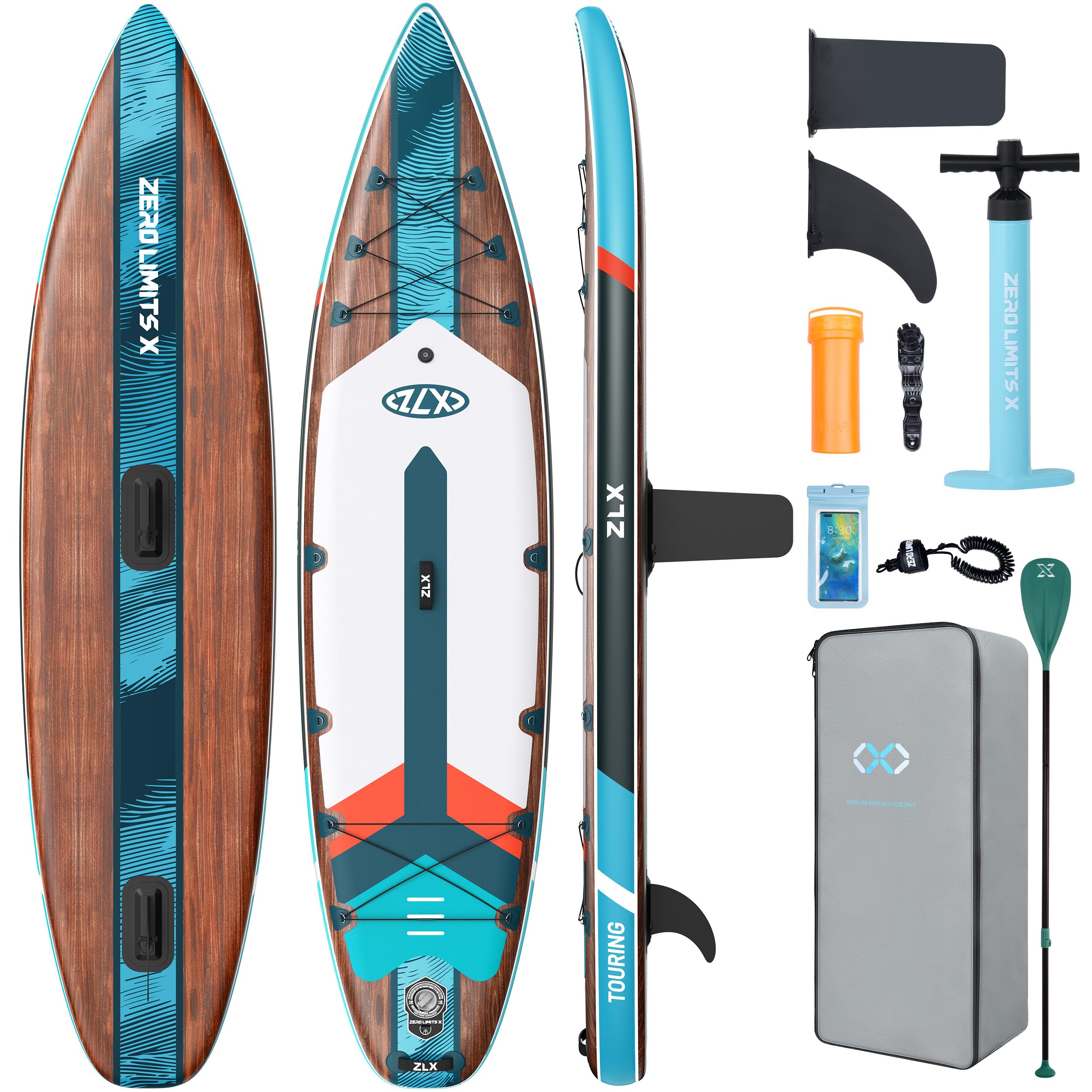
ZLX 11’6" Inflatable SUP
Key Features
- Deck size: 138"L x 33"W
- Thickness: 6 inches
- Max pressure: 15 psi
- Weight capacity: 507.1 lb
- Price: Midrange
The ZLX’s party trick is a removable center fin it calls StabilTrac, added to give a beginner something to push against sideways. We think it is the most useful learning feature in this group, because it targets the actual failure mode of a first season: the lateral wobble that ends a stand-up attempt before it starts.
Underneath the fin is a board you will not outgrow quickly. Eleven and a half feet at 33 inches wide is a touring-leaning shape, long enough to cover water without the ploughing feel of a short all-arounder and wide enough that removing the extra fin does not turn it into a bucking horse. You get a three-year warranty, 15 psi, and a kit with the pump, leash, backpack, a balance fin and a surfing fin.
The trade is weight. ZLX puts the board and accessories at 28.2 pounds in total, the heaviest carry in this group: fine from a car boot to the beach, tiring on a long walk. If you launch from a parking lot it is a non-issue; if you hike in, the Highpi is the better partner.
Pros
- Removable center fin adds beginner stability
- 11’6 touring length keeps it interesting
- Three-year warranty
Cons
- Heaviest packed kit here at 28.2 pounds
Our pick for a board you will not outgrow: the ZLX pairs an 11’6 touring hull with a beginner fin you can take off once your balance arrives.
Best for Paddle and Kayak
iTAOSTAR 11’6" SUP
Key Features
- Deck size: 138"L x 35"W
- Kayak kit: Seat, footrest, paddle
- Max pressure: 15 psi
- Weight capacity: 450 lb
- Price: Premium
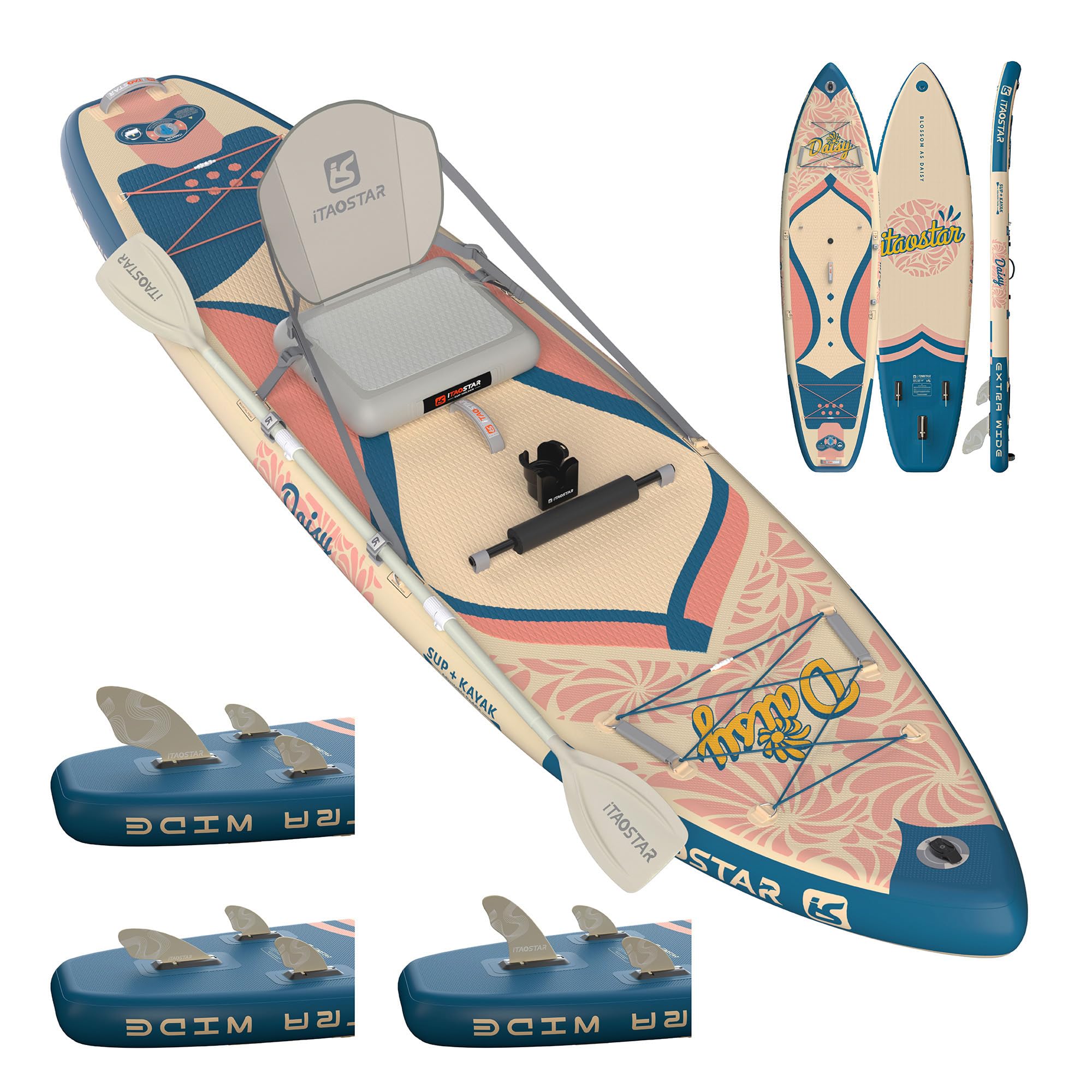
The iTAOSTAR ships with a seat, a footrest and a paddle conversion kit, so the board you stand on can also be paddled like a kayak. On an 11’6 by 35-inch deck rated for 450 pounds, that makes it a family board in the most literal sense: one person stands and paddles while another sits, or the whole thing becomes a fishing platform.
We think the seat is the smartest extra in this roundup for households where nobody is sure they want to stand. A nervous beginner can sit, paddle and feel how the board responds before trying it on their feet, and five removable fins let you tune tracking for flat water or current. The camera mount and cup holder are the sort of small additions that actually get used.
It is the most expensive board here, and the extras are also the catch: five fins, a seat, a footrest and a dry bag mean more pieces to keep track of and more to leave on the dock. The board itself is 9.3 kg, so it is not the burden the accessory count suggests. If you only ever stand on a calm lake, you are paying for a kayak you will not use.
Pros
- Converts to a kayak with seat and footrest
- 35-inch deck and 450-pound capacity
- Five removable fins for different water
- Camera mount and cup holder included
Cons
- Most expensive board here
- Many small parts to keep track of
We like the iTAOSTAR for families who want the option to sit: a 35-inch, 450-pound deck that converts to a kayak with the seat and footrest included.
Best for Lighter Paddlers
Highpi 10’6" Inflatable SUP

Key Features
- Deck size: 126"L x 31"W
- Board weight: 18.5 lb
- Max pressure: 15 psi
- Weight capacity: 300 lb
- Price: Midrange
At 31 inches, the Highpi has the narrowest deck in this group, and that one number changes who it is for. Every other board here gives you 32 or 33 inches minimum; the Highpi trims the deck and lands at 18.5 pounds, the lightest listed board in the set.
The construction is not the compromise. It is rated to 15 psi, carries 300 pounds, and uses double-layer PVC with seam sealing. What you notice on the water is response: a narrower board goes edge to edge faster, which a light, confident paddler enjoys and a heavy beginner does not.
That is why we list it as a consider rather than a blanket recommendation. A teenager, a smaller adult, or someone who has paddled before and wants something easy to keep in an apartment will get along with it, and the sea-creature graphics drew more comments in our group than any other finish here. If you are a big rider who has never stood on a board, take the Roc instead.
Pros
- Lightest listed board here at 18.5 pounds
- Distinctive sea-creature graphics
- 15 psi and 300-pound capacity
Cons
- Narrowest deck here at 31 inches
- 300-pound capacity ceiling
A light, good-looking board for smaller paddlers — the Highpi makes sense for a teenager or a lightweight adult, and not as a heavyweight’s first SUP.
Best for Firm Deck, Good Value
Niphean 10’6" Inflatable SUP
Key Features
- Deck size: 126"L x 33"W
- Board weight: 19 lb
- Max pressure: 20 psi
- Weight capacity: 450 lb
- Price: Midrange
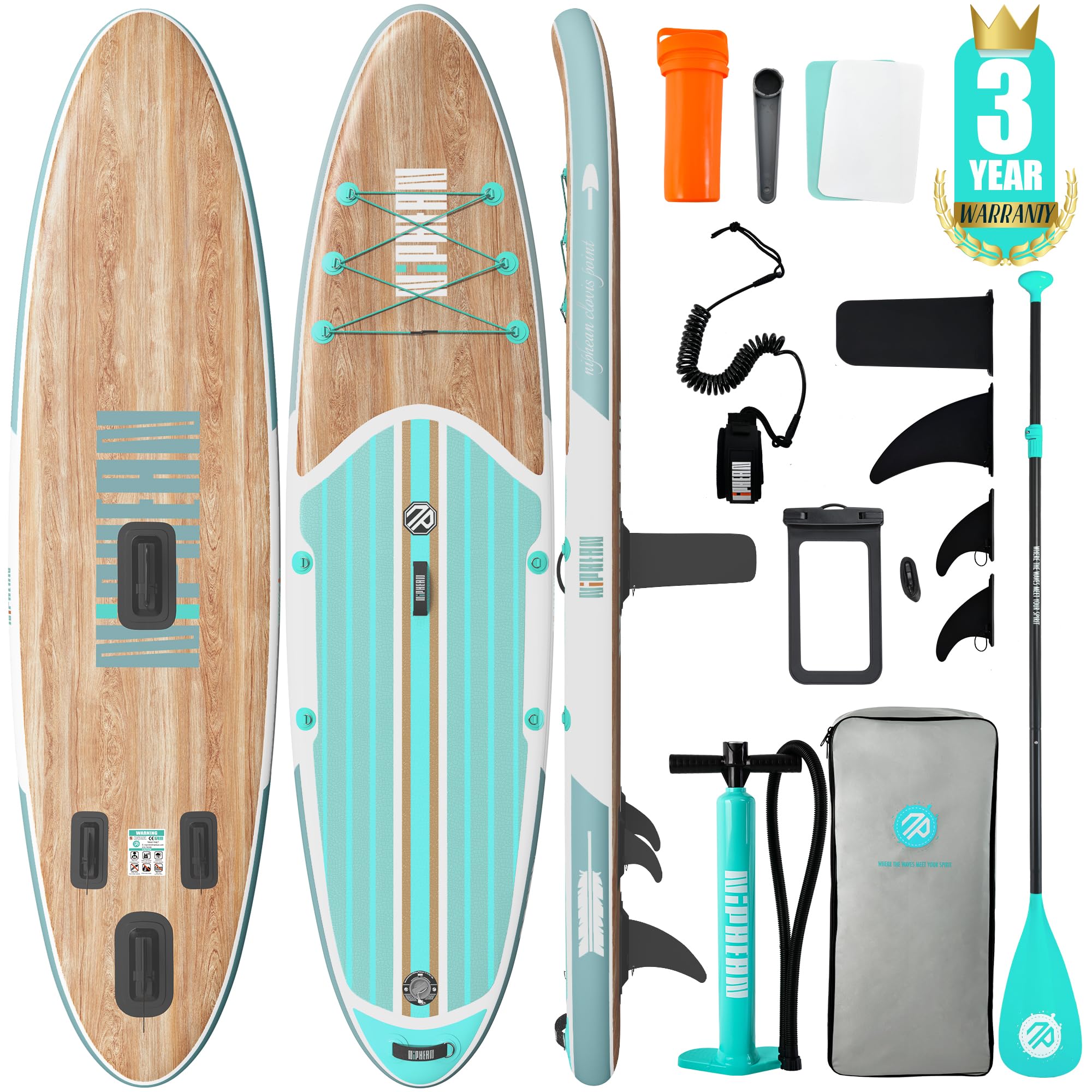
Twenty psi is what makes the Niphean worth a look. Most boards here cap at 15, and pressure is what stops an inflatable feeling vague underfoot; the higher ceiling means you can run it firmer, and firmness is most of what a beginner reads as stability. At 10’6 by 33 inches with a 450-pound rating, it sits right in the beginner band.
The kit is complete and then some: paddle, three detachable fins, leash, pump, backpack, waterproof phone bag and a repair kit, plus handles at the nose and middle for a two-person carry. Nineteen pounds is manageable, and the 33-inch width is the same forgiving number the Roc uses.
The caveat is the pump. The gauge and the hose fitting are the parts that fail, and a dial reading zero leaves you guessing at pressure on the one board here where the top of the range matters most. If yours arrives dead, ask for a replacement before your first launch instead of inflating by feel.
Where it lands for us is a value alternative: more capacity and a higher pressure ceiling than the top pick, for less money, in a shorter hull that turns quickly and tracks less eagerly. If your priority is a firm deck that carries a big paddler, it is a sensible buy.
Pros
- 20 psi rating is the highest here
- 450-pound capacity in a 10’6 board
- 19 pounds with a full accessory kit
Cons
- Short hull for a 450-pound rating
Our value alternative for heavier paddlers: 450-pound capacity and a 20 psi deck for less money than the top pick.
How We Chose and Tested Beginner Paddle Boards
To build the shortlist, I spent a few weeks reading specs and customer reviews, filtering out boards narrower than 31 inches (too tippy for beginners) and anything that cost more than a first-timer would reasonably spend. That left 10 boards—eight inflatables and two solid—which I paddled over six months on a flat lake and a slow-moving river. I also inflated and deflated each one at home, packed it into its carry bag, and hauled it from car to launch to see how manageable it felt solo.
At the water, I started by standing in the shallows and stepping onto each board, noting how much it rocked before I even pushed off. Once underway, I shifted my weight side to side, practiced stepping back for a turn, and paid attention to whether the board felt stable or skittish. For inflation, I timed how long it took with the included hand pump and noted how much effort the last few PSI required—some boards take a lot of muscle to reach 15 PSI.
Durability testing wasn’t gentle: I dragged each board a few feet up a sandy bank, bumped the nose against a dock, and checked seams and valves after every session. Quality showed up in details—whether the fin clicked in securely, whether the handle felt solid, and whether the deck pad stayed put. Fun is hard to measure, but I kept a simple log: which boards I looked forward to taking out again, and which felt like a chore. The ones that scored highest were the ones that made me forget I was testing.
How to Choose a Beginner Paddle Board
Deck width buys more confidence than any other number on the page, and the kit in the box decides how soon you are actually paddling.
Width keeps you upright; length mostly buys speed
The beginner band is 32 to 33 inches of deck. That is where the Roc, the ZLX and the SereneLife sit, and it is wide enough that a shaky stance has somewhere to go without turning the board into a raft. Step up to 35 inches, as the Skatinger and the iTAOSTAR do, and you get a platform that tolerates a big rider, a child or a dog, along with more board to turn. Below 32 inches, a light paddler notices quicker response and a heavy beginner notices the tippiness.
The trap is assuming longer means steadier. It does not. An 11’6 board at 33 inches wide is not more stable than a 10’6 at the same width; it is faster in a straight line and harder to turn. Pick width for stability, length for the water you plan to cover.
Capacity is a ceiling, not a target
Read the rated maximum as headroom. A 275-pound board like the SereneLife carries one average adult and a dry bag comfortably and runs out of margin with a second person aboard. If you want a small passenger, a dog pacing the deck, or you are a big paddler yourself, look at 400 pounds and up; the Skatinger and iTAOSTAR both clear 450.
One more check before you order: trust the board’s own rated maximum rather than the headline in the title. The two do not always agree, and the board’s specification is the number that keeps you dry.
The pump is the weak link, so test it first
Rigidity comes from pressure, and a board that feels vague or tippy is often simply underinflated. Pump to the rated maximum, usually 15 psi, and let the board sit a few minutes before you launch. On these kits the gauge is the first part to fail: a dial that never moves, or a hose that pops off the valve, leaves you guessing at the one number that matters.
Inflate at home before your first trip. If the gauge is dead, ask for a replacement rather than pumping by eye, and if you plan to paddle weekly, an electric pump earns its cost quickly.
Packed weight decides how often you go
The board you can carry easily is the board you use. An 18-to-20-pound kit goes under one arm from the car to the water; a 28-pound kit like the ZLX’s is a two-hand carry or a two-person job. Walk your usual route from parking spot to launch before you buy, and weigh that against the extra volume a bigger board gives you on the water.
If you paddle alone and park far away, the lighter board wins even when the heavier one is the better board.
Frequently Asked Questions
Is an inflatable paddle board good enough for a beginner?
Yes, and for most first buyers it is the better choice. An inflatable rolls into a backpack, lives in a closet and travels in a car trunk, which is why nearly every board here is one. You give up some glide compared with a hard board.
If you have a garage, a roof rack and one lake you visit every week, a hard board is worth a look. Otherwise inflatable is the practical answer.
Do I need a life jacket for paddle boarding?
Plan on having one aboard and wearing it. Many states and managed lakes require a wearable, Coast Guard-approved personal flotation device, and the rules change with the water.
Check the rules for your lake or coastline before you launch, and size the PFD to the smallest paddler in the family. The ankle leash that comes with these kits keeps the board near you; it is not flotation.
How should I store an inflatable paddle board between trips?
Dry it completely, deflate it, roll it loosely rather than tight, and store it indoors in its bag with nothing heavy on top. Mildew is the enemy of a rolled-up board, so wipe the deck and let it dry in the shade before packing.
Keep it out of a hot car or a sun-baked dock for long stretches; heat is hard on the PVC and the seams.
Final Verdict
The Roc 10’6 is the board we recommend to most first-timers. Thirty-three inches of deck, a 350-pound capacity and a complete kit solve the two things that stop beginners: balance and shopping. It is not the widest or the cheapest board here, but it is the one with the fewest ways to go wrong.
Step up to the Skatinger if you are a heavier paddler or want company aboard, and take the ZLX if you already know you will want to tour. Everyone else can stop comparing and go paddling.