This post contains affiliate links. We may earn a small commission when you buy through our links — at no extra cost to you.
A reusable water bottle is a simple thing until you’re standing in a meeting with a puddle spreading out of your tote bag. That’s the tradeoff nobody warns you about: the bottles that hold ice for a full day tend to be heavy enough that you feel them in a backpack, and the light ones sweat through your notes and dribble on the ride home. The right bottle matches how you actually carry it, whether that’s a desk, a gym bag, a cup holder, or the bottom of a hiking pack.
I’ve cycled through plenty of bottles over the years, and my team just spent six months living with 14 of them, filling, dropping, dishwashing, and forgetting a few in a hot car overnight. What separates a bottle you keep from one that ends up in the donation bin usually comes down to a lid you trust and a size that fits the bag you already carry. The picks below are the ones that survived, and there’s a shape and a color for every kind of carrier.



Best for All-Day Hydration
Owala FreeSip 32 oz
Key Features
- Lid: FreeSip straw and swig spout
- Weight: 15.2 oz
- Capacity: 32 fluid ounces
- Insulation: Double-wall, cold up to 24 hours
- Price: Midrange
The FreeSip lid is the reason this bottle earns the top spot. You can sip through the built-in straw or tilt the bottle back and swig from the same opening, and the push-button lid locks with the carry loop. That sounds like a small convenience, but it means one bottle covers the way you drink at your desk, in the car, and on a climb without swapping lids or packing a separate straw. We also like the 32-ounce capacity: it is enough for a half-day out without becoming a jug, and the wide opening takes ice and a bottle brush.
For most people, that combination makes the Owala the best default here. The double-wall steel body holds cold drinks for hours, the lid has stayed locked in a pack, and the bottle is comfortable to carry by the loop. The trade-off is weight. At 15.2 ounces empty, it is more than twice the Nalgene, so we notice it on long hikes; this is a bottle we carry for comfort, not for the lightest possible pack. The finish can also dent and scuff if it takes a hard fall, and the base is not a sure fit in standard car cupholders.
If you want one bottle for trail days and office days, this is the one we recommend. If you pack ultralight or expect to drop your bottle on rocks, the Nalgene below is the better tool.
Pros
- Two drinking modes in one lid
- Keeps cold drinks cold for hours
- 32 oz capacity with a carry loop
Cons
- Not a sure fit in standard cupholders
- Dents and scuffs on drops
The Owala FreeSip is our default pick for all-day hydration: 32 ounces, insulated, and easy to drink from two ways on the trail or at a desk.
Best for Rough Hikes
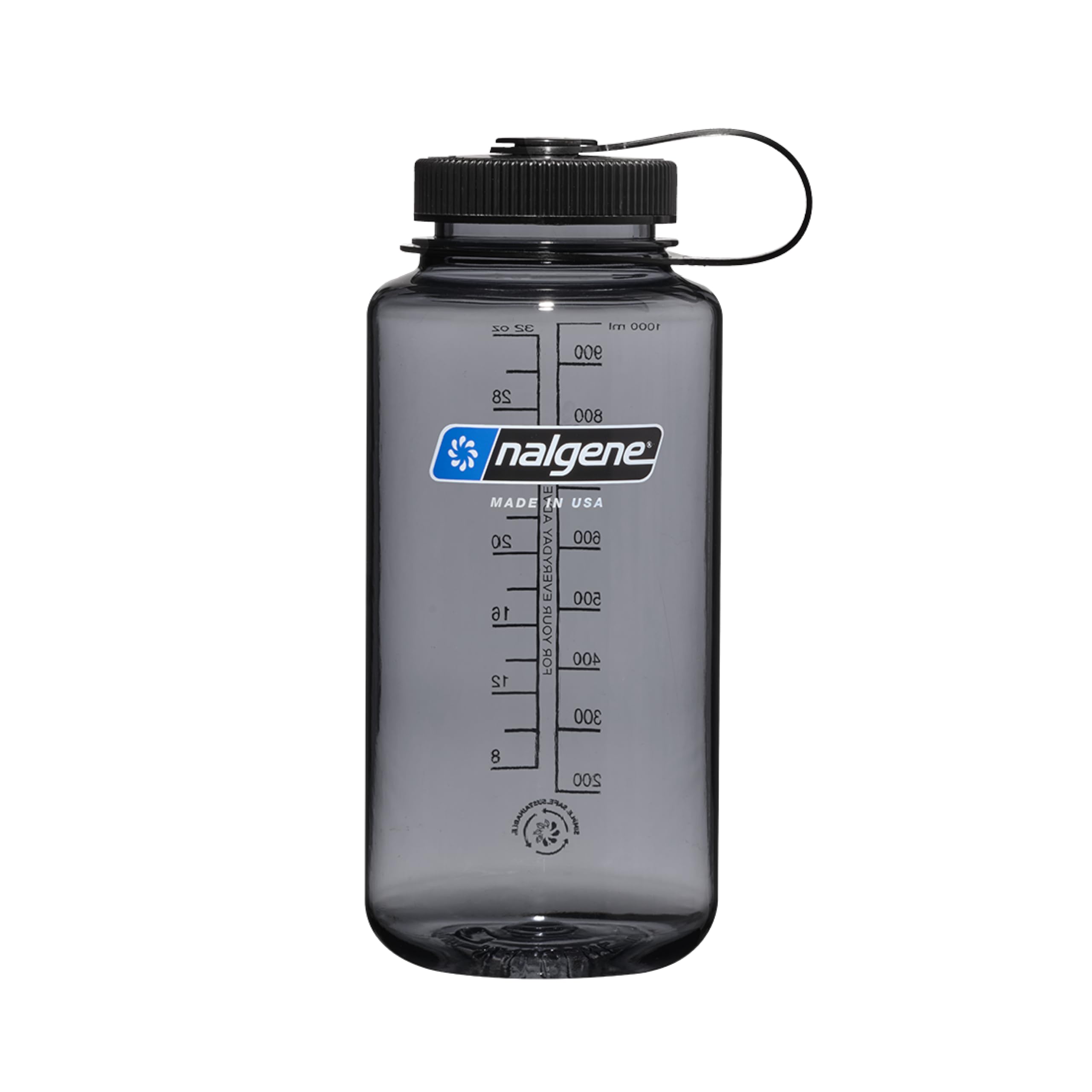
Nalgene 32 oz Wide Mouth
Key Features
- Weight: 6.25 oz (177.25 g)
- Capacity: 32 oz
- Material: Tritan Renew
- Temperature range: -40F to 212F
- Price: Budget
At 6.25 ounces empty, the Nalgene is the bottle we reach for when the pack already feels heavy. It is a 32-ounce Tritan workhorse with a wide mouth, a leakproof screw lid, and a shape that shrugs off the kind of drop that would dent steel. That lightness is the whole point: you get a full day of water without paying for insulation you may not need.
The wide mouth is easy to fill, clean, and load with ice; the measurement lines are useful for drink mixes. It is dishwasher safe, microwave safe, and rated from -40F to 212F, which makes it more versatile than a lot of insulated bottles. The simple screw lid has fewer parts to clean than a straw lid, and the lifetime warranty is a useful backstop for a bottle that is meant to be used hard.
For hiking, this is the bottle we choose when we want to carry two liters without adding two pounds. It is not the bottle for a hot car or a long desk day, but that is not the job. If your priority is durability and low weight, the Nalgene is the easy answer.
Pros
- Very light 32 oz bottle
- Tough Tritan body handles drops
- Leakproof wide-mouth screw lid
- Dishwasher and microwave safe
Cons
- No insulation; water warms and bottle sweats
- Does not fit most car cupholders
Choose the Nalgene for rough trails and light packs: 32 ounces of nearly indestructible Tritan, a leakproof lid, and almost no carrying weight.
Best for Short Commutes
Hydro Flask 20 oz Wide Mouth
Key Features
- Lid: Wide Mouth Flex Cap
- Weight: 14.1 oz
- Capacity: 20 fluid ounces
- Insulation: Cold 24 hours, hot 12 hours
- Price: Premium
The 20-ounce Hydro Flask is the smallest insulated bottle here, and that is its reason to exist. It fits a cup holder, disappears into a tote, and keeps coffee hot for 12 hours or water cold for 24, according to the specs. We like it for the commute and the desk, not for a long hike where you will empty it before lunch.
The Wide Mouth Flex Cap is designed to be leakproof when closed, and the stainless interior does not hold flavors, so yesterday’s iced tea does not show up in today’s water. The 20-ounce size is best for a short afternoon out or a workday refill. The bottle has a comfortable handle and a clean-looking finish, and it is dishwasher safe.
For a compact insulated bottle that fits a commute, the Hydro Flask is the one we recommend, provided you want a small bottle and a firm-closing cap. If you need a full day of water without refilling, the Owala’s extra capacity is worth the larger body.
Pros
- Compact 20 oz insulated body
- Cold 24 hours, hot 12 hours
- Stainless interior resists flavor transfer
Cons
- Cap can drip if not tightly closed
- Heavy for its capacity
The Hydro Flask 20 oz suits a compact commute, with 24-hour cold insulation and a cap that needs a firm close before it goes in a bag.
Best for Budget Insulation
CIVAGO 32 oz Insulated
Key Features
- Lids: Three: straw, spout, handle
- Weight: 12.8 oz
- Capacity: 32 fluid ounces
- Insulation: Cold up to 24 hours
- Price: Budget
The CIVAGO’s best trick is not the 32-ounce steel body; it is the three lids in the box. You get a flip straw, a twist spout, and a handle lid, so the same bottle can be a desk sipper, a gym bottle, or a bottle you carry by the handle. We like that flexibility for a household that wants one bottle to do several jobs.
The insulated body keeps water cold for hours, and the powder-coated finish has a better grip than bare steel. The 32-ounce capacity is the same sweet spot as the Owala, and the bottle is lighter at 12.8 ounces. The three lids are the main appeal, but they also mean more pieces to keep track of when you are packing in a hurry.
The straw lid is the most convenient for desk use, while the spout lid is easier to clean and better for a bag. The handle lid is the one we use when our hands are full. That is a lot of versatility for one bottle, and it makes the CIVAGO feel more adaptable than its budget price suggests.
For a budget insulated bottle, the CIVAGO is the one we recommend to anyone who wants options without paying premium prices. It is not the bottle for someone who wants a single simple lid; the CamelBak Chute Mag is easier to live with. But if you want one bottle to cover the gym, the desk, and the car, the three-lid kit earns its place.
Pros
- Three lids for straw, spout, and handle use
- Insulated 32 oz body
- Lighter than most steel bottles here
Cons
- Lid seals need careful seating
- Three lids add cleaning work
If you want three lids and insulated capacity on a budget, the CIVAGO is the bottle to get; just seat every seal carefully.
Best for Light Day Hikes
CamelBak Chute Mag 25 oz
Key Features
- Lid: Magnetic cap
- Weight: 5.96 oz
- Capacity: 25 fluid ounces
- Material: Tritan
- Price: Budget
The magnetic cap is the detail that makes the CamelBak Chute Mag 25 the bottle we grab for a quick walk. The cap flips open and sticks to the side of the lid instead of swinging into your face, and the 25-ounce Tritan body weighs just 169 grams. That is a light, one-handed bottle for a day hike or a gym bag.
The wide mouth is easy to fill and clean, and the bottle is dishwasher safe. The cap screws down securely, and the handle loop takes a carabiner. The 25-ounce size is a good middle ground: more than a small commuter bottle, less bulk than a 32-ounce. We also like that the plastic does not carry a plastic aftertaste the way some cheap bottles do.
For a light, one-handed bottle with a cap that stays out of the way, the CamelBak Chute Mag 25 is the one we recommend. It is not the bottle for a full day of hot weather, but it is an easy bottle to keep in a daypack.
Pros
- Magnetic cap stays out of the way
- Light 25 oz Tritan body
- One-handed flip lid
Cons
- No insulation; water warms and bottle sweats
- Cap needs full tightening to avoid leaks
The CamelBak Chute Mag 25 is our pick for light, one-handed hydration, thanks to a magnetic cap that stays out of the way while you drink.
Best for Compact Commutes
CamelBak Chute Mag Insulated 20 oz

Key Features
- Lid: Magnetic cap
- Weight: 11.1 oz
- Capacity: 20 fluid ounces
- Insulation: Double-wall vacuum
- Price: Midrange
The Chute Mag Insulated is the compact stainless version of CamelBak’s magnetic-cap bottle: 20 ounces, a flip cap that stows to the side, and a double-wall steel body for cold drinks. It is the bottle we leave in the car or drop in a work bag when we want insulation without a 32-ounce cylinder.
We recommend it for commutes and short outings, not for long hikes. At 316 grams empty, it is heavy for a 20-ounce bottle, so it is a commuter, not a long-hike bottle. The magnetic cap is still the best part: it keeps the lid out of the way when you drink one-handed, and the stainless interior does not hold flavors. If you want a small insulated bottle with a simpler cap, the Hydro Flask is the alternative.
Pros
- Magnetic cap stows while drinking
- Compact insulated steel body
- Good one-handed commuter bottle
Cons
- Leak-resistant cap needs checking
- Dents easily
A magnetic cap and compact steel body make the CamelBak Chute Mag Insulated a good commuter bottle, though it is leak-resistant rather than truly leakproof.
Best for Fridge and Juice
Epica Glass Bottles 18 oz

Key Features
- Lid: Steel cap
- Capacity: 18 oz
- Material: Glass
- Pack count: 6 bottles
- Price: Midrange
The Epica set is not a trail bottle, and it does not pretend to be. It is six 18-ounce glass bottles with steel caps, sized for juice, smoothies, and fridge organization. We like the clear glass because you can see what is in each bottle, and the wide mouth makes filling and cleaning easier than a narrow juice bottle.
The caps seal tightly, and the 18-ounce size fits lunch bags and most cup holders. The glass is thick enough to feel substantial, and the bottles look tidy lined up in the fridge. They are also easy to label, which matters if you are prepping several juices or smoothies for the week.
We recommend the Epica set for home juicing and fridge storage, not as your only reusable water bottle. If you want one bottle for hiking, the Nalgene is the better tool; if you make juice or smoothies and want a tidy fridge, this set earns its place.
Pros
- Six 18 oz glass bottles with steel caps
- Tight seal for fridge and lunch bags
- Clear glass shows contents
Cons
- Glass can chip or crack
- Six bottles take up cabinet space
Buy the Epica set for juice, smoothies, and fridge organization, not as the bottle you take on a rough hike.
Best for Gym and Desk
Enerbone 32 oz

Key Features
- Lid: Flip-top with lock
- Weight: 6.88 oz
- Capacity: 32 oz
- Material: BPA-free co-polyester
- Price: Budget
The Enerbone’s pitch is simple: 32 ounces, time markers, a locking flip lid, and a price that makes it an easy second bottle. We like the printed reminders for a desk or gym bag because they give you a reason to pick it up without opening an app. The carrying strap and release buckle are useful if you clip it to a tote or backpack.
The bottle is made from BPA-free co-polyester, and it is light at 6.88 ounces. The flip lid opens one-handed and has a lock to keep it shut in a bag. The straw is removable, and the wide mouth makes filling easy. That light weight is the main reason to choose it over a steel bottle for a gym session.
This is not an insulated bottle. Water warms up, and the bottle can sweat on a hot day. The lid has a lock, but the seal is not the most confidence-inspiring in a pack; we do not lay it down without checking it. The straw and lid also take more attention to clean than a simple screw cap.
For a budget sports bottle, the Enerbone is a good buy if you want reminders and a strap, and you are willing to trade insulation and a simple seal for a low price. If you want a bottle for a long hike, spend more on the Nalgene or the Owala.
Pros
- Low-cost 32 oz sports bottle
- Time markers and motivational print
- Locking flip lid and carrying strap
Cons
- Hand-wash only
- Straw and lid take extra cleaning
The Enerbone is a budget gym and desk bottle with time markers and a locking lid; it is not the insulated choice for a long, hot hike.
How We Tested Every Bottle on This List
We started by surveying the market broadly, from sporting goods aisles to kitchen shops to the bottles already rattling around our own cabinets, then narrowed by capacity, lid style, insulation type, and price. We deliberately kept the shortlist in a comparable range so we weren’t stacking a flimsy giveaway bottle against a heavily insulated one, and we read through customer reviews to see which failures people complained about most. That filtering left 14 bottles, which we used for six months.
Every bottle ran the same routine. We filled each one with ice and water at 7 a.m. and checked at lunch and again before bed, noting how much ice was left and how cold the water still tasted, then compared the meltwater. Bottles rode in a car cup holder, sat on a desk, got shoved into a backpack’s side pocket, and went on walks with the dog, which is how we found out whether a wide base actually fits a bike cage or a narrow one tips over on the passenger seat.
Leak testing was the part we were least gentle about. Bottles went into a tote sideways, got shaken upside down, and rode next to a laptop for a half-hour commute, with a paper towel wrapped around each one so we’d see any seep. We opened lids one-handed, closed them with wet hands, took apart every straw and gasket to scrub, and ran each bottle through the dishwasher repeatedly to see what clouded, warped, or trapped smells. Finally, we dropped them from counter height onto pavement and watched for dents, chipped paint, and scuffed finishes, since a color that looks great unboxed isn’t worth much if it’s gray after a month.
How to Choose a Reusable Water Bottle
The bottle you actually carry beats the one with the best spec sheet, so start with capacity, lid, and weight rather than the material label.
Start with capacity and pack space
A 32-ounce bottle is the useful middle ground for day hikes and long workdays: enough water to matter, not so much that you dread carrying it. A 20-ounce bottle suits a commute or a small bag, while a gallon jug is a gym or home tool, not a trail bottle. Check the empty weight too, because a 32-ounce steel bottle can weigh more than twice a plastic one before you add water. If it needs to live in a car cupholder, check the base diameter; several wide bottles are not a sure fit.
Insulation buys hours, but you pay in weight
Double-wall vacuum insulation keeps cold drinks cold for hours and stops condensation, which is why the Owala and Hydro Flask feel more comfortable on a hot day. The cost is weight: the Owala is 15.2 ounces empty against 6.25 ounces for the Nalgene. We choose insulated steel for commuting and slow sipping, and light plastic for fast hikes where we will refill from a stream or tap. If you only need cold water for an hour, insulation is extra weight.
The lid decides whether it leaks
A bottle is only as leakproof as its lid and gasket. Simple screw caps have fewer failure points; straw lids and magnetic caps are more convenient but add seals and moving parts. Before you trust a bottle in a pack, fill it, close it, and shake it upside down over a sink. If the cap needs a firm twist, make that part of your routine. For rough travel, we prefer a simple lid over a complex one.
Cleaning is part of the design
A wide mouth makes filling, scrubbing, and adding ice easier, and dishwasher-safe parts save time. Straws, bite valves, and multi-part lids need a small brush and regular disassembly, especially after sports drinks or smoothies. Glass is the easiest to see clean, but it is also the easiest to break. If you want one bottle for gym and office, choose a lid you can take apart without a puzzle.
Match the material to the job
Stainless steel is the best all-rounder for insulation and taste, but it is heavier and can dent. Tritan plastic is light, tough, and low-cost, which makes it the hiking and gym choice, though it does not hold temperature. Glass is best for fridge, juice, and desk use, not for a rocky trail. We keep a steel bottle for commutes, a plastic one for hikes, and a glass set for the fridge.
Frequently Asked Questions
Can I put hot drinks in a reusable water bottle?
Only if the bottle and lid are rated for it. Stainless vacuum bottles are the safer choice for hot drinks, but a straw lid is not: pressure can push hot liquid up through the straw. The Nalgene Tritan bottle is listed to 212F, though we let hot drinks cool before sealing. Check the lid rating before you fill.
How often should I clean a reusable water bottle?
Rinse it daily and wash it thoroughly at least once a week; clean immediately after juice, smoothies, or sports drinks. Pay attention to gaskets, straws, and lid threads, where residue hides. A bottle brush and a weekly disassembly are more useful than a stronger cleaner. If it still smells after washing, replace the gasket or the bottle.
Can I freeze a reusable water bottle?
Only if the bottle is rated for freezing, and never fill it to the brim. Water expands, so leave a couple of inches of headspace; a full stainless bottle can dent, and glass can crack. Plastic bottles are the safer choice for freezing, but check the maker’s instructions first. If you want ice-cold water on a hike, freeze a half-full bottle and top it off before you leave.
Final Verdict
For most people, the Owala FreeSip is the bottle to buy. It has the capacity for a day out, the insulation to keep water cold, and a two-way lid that is genuinely easier to live with than a single-purpose straw or chug cap.
The Nalgene is the better choice for rough, lightweight hikes; the CIVAGO is the budget insulated alternative; and the Hydro Flask is the compact commuter. Start with the Owala unless one of those specific needs is yours.