This post contains affiliate links. We may earn a small commission when you buy through our links — at no extra cost to you.
A twenty-minute workout at home sounds like the easiest habit you’ll ever build — until the balance ball goes soft behind the sofa and the resistance band rolls up your calves mid-squat. Equipment only earns its floor space if it survives real life: the 6 a.m. session before work, the lunchtime stretch, the closet it gets shoved into after. The right piece removes the excuses — easy to grab, comfortable enough to stay with for a full set, sturdy enough that you aren’t replacing it by spring.
I’ve been assembling a home gym in whatever square footage I’ve had for the better part of a decade, so I’m picky about what stays. My team and I spent six months with 12 pieces of equipment — balls, bands, mats, and a couple of compact machines — and the same pattern kept surfacing: the flimsy versions aren’t just cheaper, they arrive underinflated, or the grip goes slick the moment your hands sweat. Everything below held up. Some picks suit low-impact work, the stiff lower back and the circulation you’re trying to get moving; others are for a genuinely hard session.




Best for Full-Body Strength
TRX All-in-One
Key Features
- Warranty: 1 year limited
- Load rating: 700 lb
- Carrying weight: 1.7 lb
- Price: Premium
A 700-pound tested load rating is more than most home users will ever ask of a suspension trainer, and that is exactly why the TRX All-in-One works as the centerpiece of a home gym: the strap is not the part you worry about. The kit includes a door anchor, a mesh carry bag, a workout guide, and access to TRX’s app workouts.
We like that one strap covers rows, presses, split squats, and core work without a rack, and the whole system weighs 1.7 pounds. That makes it the piece we reach for when we want a real strength session but do not want to leave equipment out. The load rating is the detail that matters: with a solid door or beam, the anchor is the weak link, so check that first.
The door anchor is clever, but the setup rewards a little care: the door must close securely, and you need clear floor space to lean back. We also like that the same strap can go on a rafter or tree, which is why it suits a garage gym or a park workout as well as a spare room.
If you already have a pull-up bar and dumbbells, the TRX still adds a portable pulling and pressing angle. The mesh bag is the tell: this is gear designed to leave the house, not just fill a corner of it.
Pros
- One strap covers full-body strength
- Packs into a small mesh bag
- High 700 lb tested load rating
Cons
- Costs more than band-based kits
The TRX All-in-One earns our top spot because it turns one solid door or beam into a full-body gym, then packs away when the room has to be a room again.
Best for Lower-Body Work
Vergali Fabric Bands
Key Features
- Tension: 14-60 lb
- Material: Cotton-latex blend
- Carry bag: Included
- Resistance levels: 4
- Price: Budget
Fabric loops solve the specific annoyance that makes rubber bands feel cheap: they do not roll into a rope or pinch bare skin. The Vergali set gives you four widths in a cotton-latex blend, with a mesh carry bag and a small exercise guide, and the inside grip is the reason they earn a spot near the top of the budget picks.
We used the lighter loops for warm-ups and the heavier bands for hip thrusts and lateral walks; the resistance ratings are printed as 14-25, 25-35, 25-45, and 45-60 pounds, so it is easy to progress without guessing. The 13.6-inch length is compact enough for a gym bag, and the fabric stays flatter than a rubber loop when you set up.
They add a useful lower-body layer without taking up a drawer. The carry bag matters more than it sounds: these are easy to toss in a backpack and use at a park or a hotel room.
Pros
- Fabric stays put without pinching
- Four marked resistance levels
- Carry bag and guide included
Cons
- Best for hips and legs, not upper-body pulling
For lower-body work at home, we reach for these fabric loops first: they stay put, resist rolling, and cost little enough to keep in a gym bag.
Best for Cable-Style Strength
WHATAFIT Tube Bands
Key Features
- Included: Door anchor, handles, ankle straps, case
- Warranty: 2 years
- Resistance: 10-50 lb per band; 150 lb stacked
- Price: Budget
Stackable tube bands are the closest thing to a cable machine you can hang in a closet. The WHATAFIT set gives you five color-coded tubes rated at 10, 20, 30, 40, and 50 pounds, and you can clip them together for a 150-pound combined pull, which is enough for rows, presses, curls, and face pulls.
We like the cushioned handles more than the usual foam grips because they are wide enough for two hands, and the ankle straps make kickbacks and leg curls possible without a bench. The door anchor is the piece that turns a sturdy doorway into a pulling station; the whole kit weighs about 2 pounds and fits in the included case.
Where this set earns its place is versatility per dollar: one kit covers warm-up band work and heavier rows, and the two-year warranty is longer than most. The included case keeps the tubes, handles, and straps tidy, which matters when the kit lives on a shelf.
Pros
- Five stackable tubes up to 150 lb
- Handles, ankle straps, and door anchor included
- Packs into a small case
- Two-year warranty
Cons
- Door anchor needs a solid, snug-fitting door
If you want a compact cable-style workout, this tube set gives you handles, a door anchor, and stackable resistance without a rack.
Best for Low-Impact Movement
Lifepro Waver
Key Features
- Dimensions: 27"D x 15"W x 6"H
- Speed range: 1-99 rpm
- Machine weight: 27 lb
- User weight limit: 330 lb
- Price: Premium
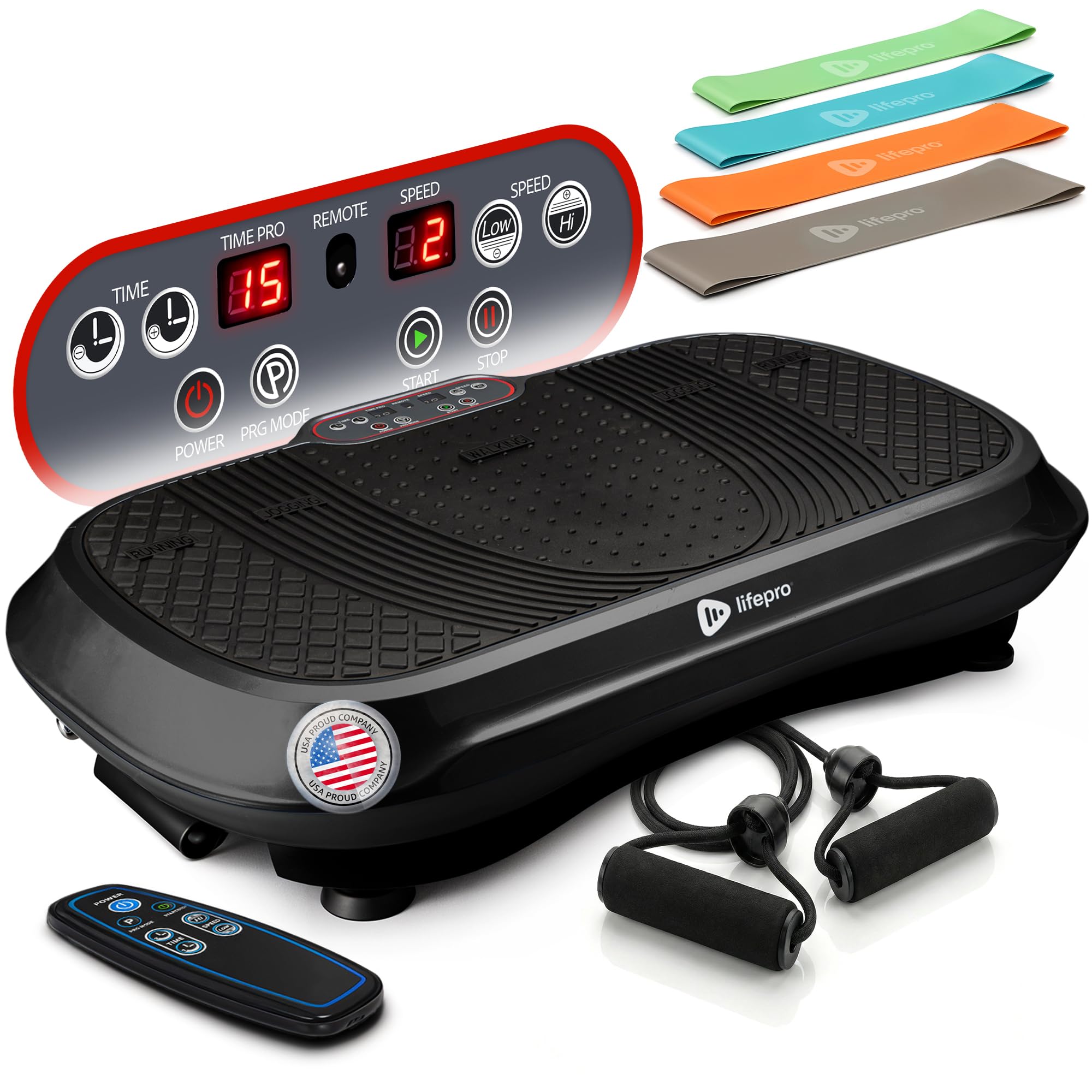
The Waver is not a treadmill and not a strength machine; it is a standing platform that adds low-impact movement to a routine, and that is exactly how we used it. The 330-pound weight limit, anti-slip rubber surface, and 99 speed settings make it feel more serious than the shaky gadgets in this category.
We were surprised by how much the low end matters: the first few speeds are gentle enough for balance work, while the top end is a real challenge to stand through. The remote is a small but useful detail because you do not have to bend down to change speed, and the 27-by-15-inch footprint is compact enough for a corner.
It is not a substitute for progressive strength work, and we do not recommend buying it for that. Think of it as the recovery or low-energy-day tool in a home gym, the one we switch to when a hard session is not on the table.
Pros
- Low-impact standing movement
- 99 speed settings and remote
- 330 lb weight capacity
- Compact for a vibration platform
Cons
- Takes up floor space and is heavy to move
The Waver is the pick for low-impact, standing movement at home, with a 330-pound platform and 99 speeds that let you start gently.
Best for Core Training
Vinsguir Ab Roller
Key Features
- Weight: 1.4 lb
- Included: Knee pad
- Wheel width: 3.2 in
- User weight limit: 440 lb
- Price: Budget
The Vinsguir ab roller’s 3.2-inch dual wheel is the reason it feels less tippy than the single-wheel rollers we have tried: the wider base tracks straighter and gives your shoulders a break. At 1.4 pounds it is light enough to pull out for a five-minute core set, and the 440-pound weight rating means it is not just a toy.
The knee pad is a useful addition, and the whole thing assembles in minutes. The roller works best on a firm, non-slip surface, and the handles are comfortable enough for slow, controlled reps.
This is a core tool, not a full-body solution, and that is fine: it takes up almost no space and adds a hard abdominal exercise that bodyweight crunches do not replicate. If you are new to rollouts, start with a partial range and build up.
Pros
- Wide dual wheel tracks straighter
- High 440 lb weight rating
- Light and easy to store
- Knee pad included
Cons
- Knee pad runs small
- Hard on the lower back if form slips
The wide wheel makes this ab roller easier to control than a narrow one, and it is the core tool we suggest for most home setups.
Best for Joint-Friendly Floor Work
Amazon Basics Yoga Mat
Key Features
- Weight: 2.2 lb
- Material: NBR foam
- Dimensions: 73.2"L x 24.3"W x 0.5"T
- Price: Budget
Half an inch of NBR foam is the whole pitch here, and it is a good one: the Amazon Basics mat is thick enough to take the sting out of a hardwood floor during planks, stretching, and floor work. At 73.2 by 24.3 inches, it gives you a full-length surface without turning the living room into a studio.
We found the texture works better for dry floor work than for a sweaty yoga flow; bare hands and feet can slide once things get damp, so this is the mat we reach for when comfort matters more than grip. The foam is soft under knees and elbows, and it is light enough to roll up and move between rooms.
This is the budget mat we recommend for joint comfort, not the one we recommend for hot yoga or high-impact training. For a spare-room setup where the mat stays on the floor, it is an easy call.
Pros
- Thick 0.5-inch cushioning
- Full 73.2-inch surface
- Light enough to move easily
Cons
- Can tear at high-stress points
This is the mat we recommend when comfort on a hard floor matters more than grip for sweaty yoga, and the low price makes that trade easy.
Best for Balance and Sitting
Trideer Yoga Ball

Key Features
- Pump: Included
- Weight: 2.2 lb
- Diameter: 65 cm
- User weight limit: 330 lb
- Price: Budget
A yoga ball is one of those purchases that looks like fitness equipment but often ends up as a chair, and the Trideer ball is priced to make that experiment easy. It comes in five sizes; the 65 cm model we looked at is the middle of the range, and the 330-pound weight limit makes it usable for more than just stretching.
The surface has a frosted texture that helps with grip, and the slow air release is a reassuring detail if you are using it for balance work. We like it for active sitting breaks, hip openers, and core stability drills, not as a replacement for a desk chair.
The inflation is the part to manage. The ball needs to be firm enough to sit on without sinking, and the included pump gets it there, but you should expect to check the pressure and top it up from time to time.
For the money, it is a low-risk way to add movement to a room that already has a mat and some bands. Just choose the size by your height and use, and keep it away from sharp edges.
Pros
- 330 lb weight capacity
- Textured, non-slip surface
- Pump included
- Works for balance and active sitting
Cons
- Pump can be fussy to use
The Trideer ball is a low-cost way to add balance work and active sitting to a home routine, with a 330-pound capacity and a pump in the box.
Best for Pull-Up Assistance
WSAKOUE Pull-Up Bands

Key Features
- Length: 82 in
- Levels: 5
- Material: Natural latex
- Resistance range: 5-125 lb
- Price: Budget
Five loop bands spanning 5 to 125 pounds is a more useful range than it first sounds: the lightest band is right for shoulder mobility, and the heaviest gives a real pull-up assist. The WSAKOUE set is made from natural latex, and the 82-inch length gives you enough band to anchor over a bar or around a sturdy post.
We like the closed loops for pull-up progressions because you can choke them down on the bar and adjust assistance without a door anchor. The bands are 2 inches wide and 0.2 inch thick, so they feel substantial in hand, and the set comes with a storage bag and a one-year warranty.
The range is the point: you can start with the 5- or 10-pound band for stretching, then move to the heavier bands for assisted pull-ups and squats. We also use them for mobility work, where a long loop is easier to handle than a tube with handles.
This is not a complete gym on its own, but it is one of the most useful small additions you can make if you already have a pull-up bar or a place to anchor them. For a first strength purchase, the WHATAFIT tube set covers more exercises; for pull-up assistance, these are the better fit.
Pros
- Five bands from 5 to 125 lb
- Long 82-inch loops anchor easily
- Natural latex with storage bag
- One-year warranty
Cons
- Latex loops can wear at the anchor point
These loop bands are the simplest way to add pull-up assistance and mobility work to a home gym, especially if you already have a bar.
How We Tested 12 Pieces of Home Exercise Equipment
We started with research, rounding up the balls, bands, mats, and small machines that kept resurfacing across retailer reviews and trainer recommendations, then filtered that list by specs and price. Two things knocked options out early: a footprint that wouldn’t fit a normal living room, and whether a pump or a carrying strap came in the box — a ball sold without a pump means sourcing one separately before you can use it.
Twelve units came in, and each spent six months in a tester’s home. Balls were inflated on arrival day and measured again at 24 hours, one week, and one month, because a ball that quietly loses air is one you stop trusting with your spine. We sat on each for full 30-minute sessions and noted where it pushed back — tailbone, hip flexors, lower back — and whether that pressure eased or worsened by the end. Grip got tested the honest way, 20 minutes into a sweaty workout: did hands slide on the handles, did bands creep up the thigh mid-set. We also carried each piece from closet to living room by its strap where it had one and timed how long setup took solo.
Functionality was the baseline — did the resistance actually hold, did the ball stay firm through a set. Ease of use we judged by whether anyone needed the manual; a partner who’d never touched the thing should be able to adjust it without a tutorial. For durability, we checked seams and stitching weekly and watched how band edges and ball surfaces held up against both carpet and hardwood. The pieces that came through all of it are the ones below.
How to Choose Home Exercise Equipment
The best home gym is the one you can set up without rearranging the furniture, so start with the space and the anchor you actually have.
Start With the Job You Want to Train
Start with the training job, not the machine. If you want one purchase to cover the most ground, a suspension trainer or a tube-band set with a door anchor gives you pulling, pressing, and squatting patterns in a small package. If your goal is narrower—glutes, core, or recovery—buy the focused tool and skip the all-in-one. We favor the TRX for a broad strength setup because one strap covers several movements; the Vergali loops make more sense when lower-body work is the priority.
Measure the Space and Check the Anchor
A doorway is not automatically an anchor. Check that the door closes securely, the frame is solid, and there is clear floor space to lean back. For floor gear, the dimensions matter: the Amazon Basics mat is 73.2 by 24.3 inches, and the Waver takes up 27 by 15 inches. If you cannot anchor safely, choose bands or a mat instead of forcing a suspension trainer onto a hollow door.
Choose Resistance You Can Progress
Fixed bands are fine for light work, but a set with multiple levels lets you add load without buying again. Look at the top end as well as the bottom: the WHATAFIT tubes stack to 150 pounds, while the WSAKOUE loops run from 5 to 125 pounds. For pressing and rows, handles and a door anchor make tube bands more useful; for pull-up assistance, long loop bands are the better shape.
Separate Comfort Gear From Strength Gear
Thick foam, inflatable balls, and vibration plates make a home gym more pleasant, but they do different jobs. A 0.5-inch mat saves knees and elbows on hard floors; a ball adds balance and active sitting; a vibration plate adds low-impact movement. None replaces progressive resistance, so budget for one strength tool first and add comfort gear when the routine sticks.
Inspect the Wear Points
Inspect the wear points before they become failures. Run a hand along bands for nicks, check mat edges for tears, and make sure an inflatable ball holds firmness. Respect the stated limits: 330 pounds for the Waver and Trideer ball, 440 pounds for the ab roller. Replace damaged gear rather than taping it or hoping it holds.
Frequently Asked Questions
Can I use a suspension trainer outdoors?
Yes, if you have a secure anchor at or above shoulder height. TRX lists trees, poles, and rafters alongside doors, and the strap is tested to 700 pounds. Check the anchor before every session and avoid rough bark or sharp edges that can abrade the webbing; a smooth beam or a broad tree trunk is kinder to the material.
How do I clean a foam exercise mat?
The Amazon Basics mat is hand-wash only. Wipe it with a damp cloth and mild soap, then let it air-dry completely before rolling it up; trapping moisture in the foam invites odor and breakdown. Avoid harsh cleaners and do not machine-wash or tumble-dry it.
Do I need a mat if I have carpet?
A thick foam mat is most useful on hard floors; on plush carpet it can bunch and slide. If you train on carpet, test a corner under your feet before committing, and keep the mat off deep-pile rugs where it cannot lie flat. For standing work on carpet, you can skip the mat entirely.
Final Verdict
Our default is the TRX All-in-One because it covers the most strength patterns with the least permanent footprint: anchor it to a solid door or beam, do rows, presses, split squats, and core work, then pack it away. That versatility is why it earns the top spot over the cheaper single-purpose picks.
If you do not have a safe anchor, the WHATAFIT tube set is the better first buy; it still needs a door, but it is more forgiving and covers pulling and pressing. For a lower-body-focused routine, start with the Vergali loops and add the TRX later.