This post contains affiliate links. We may earn a small commission when you buy through our links — at no extra cost to you.
Budget backpacking tents ask you to pick two of three: light, roomy, cheap. That trade-off is real, but it’s also where most of the disappointment lives — the pole that splinters on the second night, the rain fly that stops an inch short of the bathtub floor, the zipper that gives up at 2 a.m. in a downpour. A good budget tent doesn’t pretend to be a four-season mountaineering shelter. It just keeps you dry, sets up without a fight, fits you and your gear, and carries light enough that you forget it’s on your back. That’s the bar, and it’s a bar plenty of tents under a couple hundred dollars clear easily.
We’ve pitched twelve of them since late April — through a soaking weekend, a windy ridge, and a string of frosty October mornings — and the differences showed up fast. My own rule after this season: read the packed weight, not the trail weight, and check the rain fly’s coverage before you check the packed size. The tents below earned their spots by staying dry and staying intact, and there’s a pick here whether you’re splitting the load with someone or carrying it all yourself.




Best for Two-Person Backpacking
BISINNA 2-Person Backpacking Tent
Key Features
- Packed weight: 4.7 lb
- Sleeping capacity: 2 person
- Waterproof rating: 2000 mm
- Doors and vestibules: 2 doors, 2 vestibules
- Price: Budget
Two doors, two vestibules, aluminum poles, and 4.7 pounds: that combination is the whole argument for this tent. The Clostnature beats it on waterproofing and the Naturehike Cloud-Up beats it on weight, but each of those asks you to give something back, and neither puts all four pieces together at this end of the price range.
The layout is what sells it for us. Two people sharing a single-door tent spend the night negotiating who climbs over whom, and their packs end up on the floor between them. Here each side has its own D-shaped door and its own vestibule, so boots, a wet shell, and a loaded pack stay outside the sleeping area. That is the most useful thing a budget tent can do for a trip, and it is the first thing we check now.
Everything else is sensible rather than special. The floor is 82.7 by 55 inches with a 47.2-inch peak, enough for two adults on pads without either of you pressed into a wall, and the inner is mostly mesh, so a warm night does not turn the tent into a sauna. Two aluminum poles and a simple crossing frame mean it goes up quickly once you have done it twice.
The trade-off is in the coating: 2000 mm on the fly and floor is the lowest rating among the two-door tents here. That handles showers and a damp morning; for an all-night soaker, seal the seams before the first trip and pitch with a little natural shelter rather than on an exposed saddle. And at 55 inches wide, plan on two pads rather than two pads plus gear, because the vestibules are where everything else lives.
Pros
- Two doors and two vestibules
- Aluminum poles at 4.7 pounds
- Lowest price in the two-door group
- Mesh inner for warm-weather airflow
Cons
- Floor is pad-width, gear lives outside
Our pick for most people: two doors, two vestibules, aluminum poles, and a packable 4.7 pounds at the low end of this group’s prices, with nothing important missing.
Best for Wet-Weather Camping
Clostnature 2-Person Backpacking Tent
Key Features
- Floor size: 86.6 x 59 in
- Packed weight: 5.3 lb
- Sleeping capacity: 2 person
- Waterproof rating: PU 5000 mm
- Price: Budget
Waterproofing is what actually separates budget tents from one another, and this one leads the group: a PU 5000 coating on the fly, the floor, and the bathtub, with factory-sealed seams, 14 stakes, and four guy lines in the bag. If your trips happen in the forecast rather than around it, this is the tent here we trust for a long, wet night.
The interior earns its keep too. At 86.6 by 59 inches with 45.3 inches of peak, two people can sit up and change without a wrestling match, and the two doors and two vestibules keep wet gear out of the sleeping space. The pitch is a two-pole cross frame with clips, quick the second time and quicker the fifth.
Weight is the honest trade: 5.3 pounds makes this the heaviest two-door tent here, and carried solo you feel it. Split between two packs it comes to a bit over two and a half pounds each, which is how this tent is meant to travel. Buy it as a shared wet-weather shelter rather than a solo luxury.
Pros
- PU 5000 coating on fly and floor
- Two doors with two vestibules
- Factory-sealed seams throughout
Cons
- Included stakes bend on hard ground
For wet climates and shared loads, this is the tent we point at: a 5000 mm coating on fly and floor, sealed seams, and two vestibules at a price still in budget territory.
Best for Shared Lightweight Trips
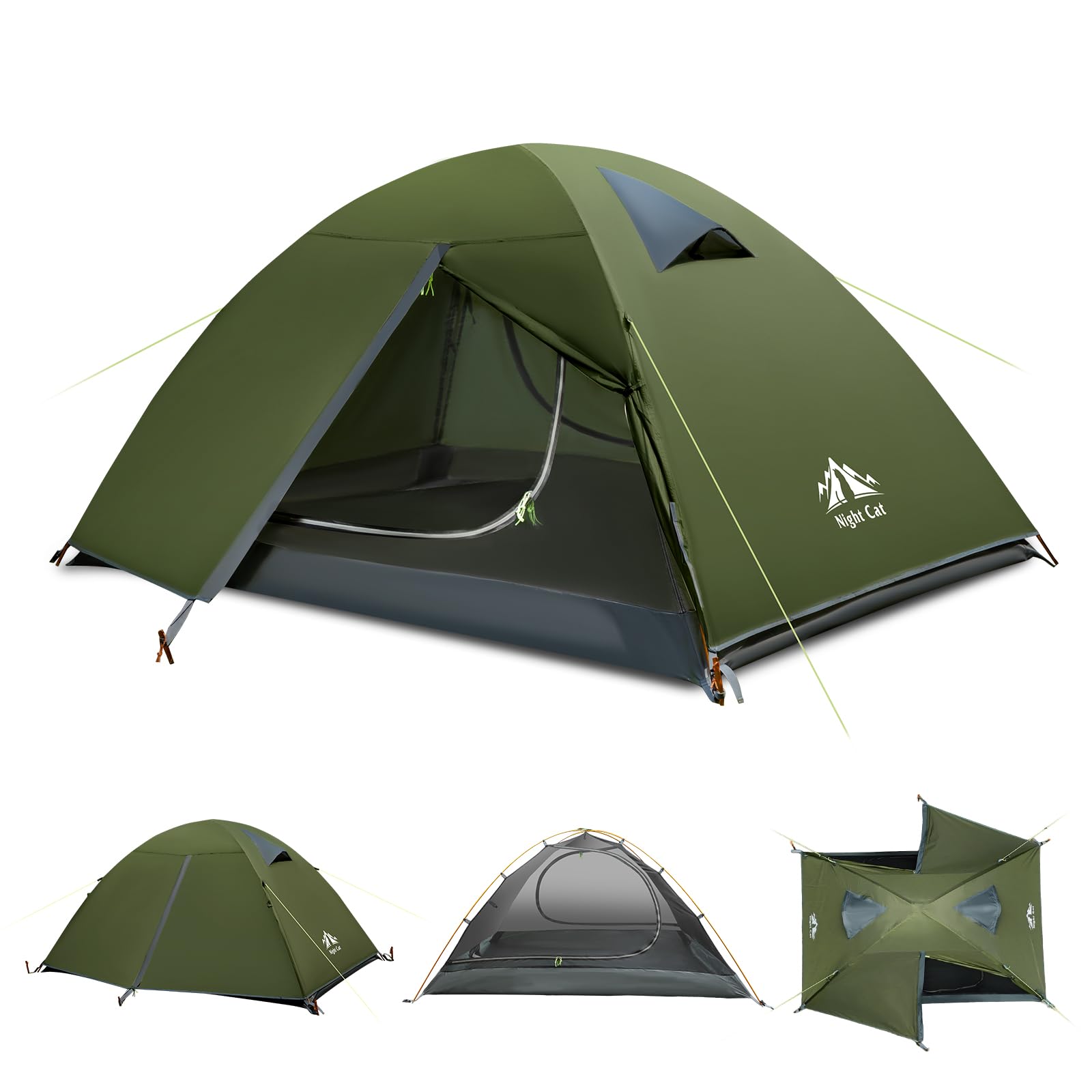
Night Cat 2-Person Backpacking Tent
Key Features
- Packed weight: 4.4 lb
- Pole material: Aluminum
- Sleeping capacity: 2 person
- Doors and vestibules: 2 doors, 2 vestibules
- Price: Budget
A vestibule seems like a small thing until it is raining and your pack has nowhere to go. This tent gives each sleeper one, along with a door of their own, and does it in a 4.4-pound package with aluminum poles and eight stakes.
We rate it as the best of the lighter two-person tents here for anyone camping with a partner who hates the middle-of-the-night crawl over. The floor is 82.6 by 55.1 inches with a 43.3-inch peak, enough to sit up in and not to stand in, and the pitch is a straightforward two-pole frame one person can manage alone. Both vestibules swallow a pack and a pair of boots between them.
Seal the seams before the first trip, and pull the fly taut and clear of the inner: a taut fly sheds water, and a slack one sags into the mesh and wets your bag from the inside. Pitched that way it is a dependable three-season shelter, and it packs small enough to disappear into a weekend pack.
Pros
- Vestibule and door on each side
- 4.4 lb with aluminum poles
- Eight stakes and three guy lines included
Cons
- Fly has no published waterproof rating
A door and a vestibule for each sleeper at 4.4 pounds with aluminum poles, which makes it the lighter way into a genuinely liveable two-person layout.
Best for Solo with Room
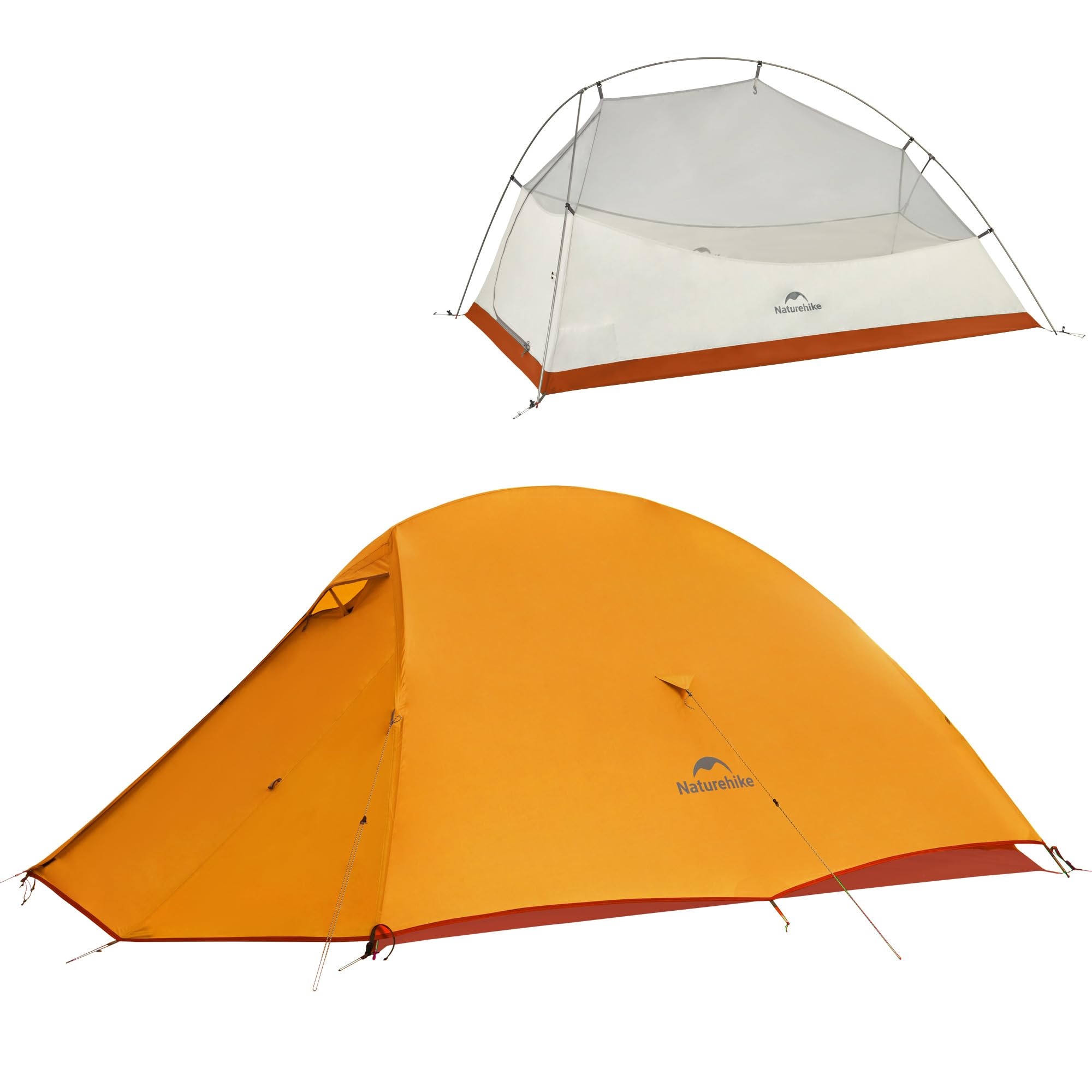
Naturehike Cloud-Up 2
Key Features
- Footprint: Included
- Packed weight: 4.3 lb
- Sleeping capacity: 2 person
- Waterproof rating: 3000 mm+
- Price: Premium
Fifty-one inches of floor is the number that decides this tent. Two 25-inch sleeping pads side by side come to 50 inches, so the Cloud-Up holds two sleepers exactly, pad against pad and wall against wall, with nothing left over for a pack.
What you get above the cheapest tents here: a 3000 mm coating on fly and floor, aluminum poles, 14 stakes, five guy lines, and a footprint in the box, all at 4.3 pounds. That last part matters, because the groundsheet you would otherwise buy is a real cost and a real few ounces, and Naturehike includes it.
For a solo hiker who wants a palace, or a couple who sleep close, we think it is the best two-person buy here. The build is a step above the least expensive tents in the group, the fly reaches low enough to shed weather properly, and it pitches fast enough to be up before the light goes.
Cold weather is where it is least impressive. The fly sits close over the inner, so condensation collects and a still night leaves the walls damp. Vent what you can, sleep with the door cracked, and treat it as a three-season tent rather than a four-season one.
Pros
- Footprint included in the box
- 3000 mm coating and aluminum poles
- 4.3 lb for a two-person tent
Cons
- Single door for two sleepers
- Most expensive two-person pick here
The nicest-built two-person tent in this set, and the dearest: choose it if you want the footprint included and a lighter carry, and you sleep close.
Best for Shoulder-Season Camping
Forceatt 2-Person Tent
Key Features
- Seasons: 3 to 4 season
- Floor length: 88.6 in
- Packed weight: 5.5 lb
- Sleeping capacity: 2 person
- Price: Midrange
Condensation is what quietly ruins cheap tents: you breathe all night, the moisture hits the cold fly, and by morning it is running down the inside wall onto your bag. This one is a double wall, so the mesh inner stands clear of the fly and most of that water forms on a surface that is not touching you.
The floor is the other argument. At 88.6 inches it is the longest two-person floor here, seven feet four, which is what a six-foot-three sleeper needs to stop touching both ends at once. Two doors and two vestibules, a 3000 mm coating with a welded floor, aluminum 7001 poles, and reflective guy lines you will be glad of when you are finding your way back in the dark.
Our take: if you are tall, camp into the shoulder seasons, or share with someone who sprawls, this is the two-person tent here that asks the fewest compromises. It is rated for three to four seasons, and the double wall is what makes that rating mean something instead of being a line on the packaging.
Pros
- Double wall keeps condensation off you
- 88.6-inch floor suits tall sleepers
- Two doors and two vestibules
- Aluminum 7001 poles, welded floor
Cons
- 5.5 lb is heavy to carry far
- 53-inch floor leaves little spare room
The two-person tent here for tall campers and shoulder-season weather, thanks to the longest floor in the group and a double wall that keeps condensation off you.
Best for Tall Solo Hikers
Camppal 1-Person Tent
Key Features
- Seasons: 4 season
- Floor length: 8.2 ft
- Sleeping capacity: 1 person
- Waterproof rating: 3500-4000 mm
- Price: Midrange
If you are over six feet and every solo tent you have tried leaves your head against one door and your feet against the other end, start here: 8.2 feet of floor.
The shape explains it. It is a ridge tent, one aluminum pole running through a sleeve along the top, 35.4 inches wide and 35.4 high, with a door at one end and two small pockets inside. Long, low, and narrow is the trade for that length: you can lie down and change clothes sitting up, but you cannot sit cross-legged with a stove between your knees.
Weather gear is better than the price suggests: a 3500 to 4000 mm coating, a seam-taped zipper, taped corners, and fabric listed as fire retardant with UV protection. For a summer and shoulder-season solo tent, that is more protection than the cheapest tents here offer.
One pole means one line of support, so the pitch does the work. Stake both ends before you tension the ridge and turn the low end into the wind. Close the fly and the venting drops off, which is a fair trade in cold rain and a poor one in a muggy August.
Our view: it is a specialist and we are glad it is in the group. As a tall person’s solo shelter it solves a problem no other tent here addresses; if you want to sit up and spread out through a rainy weekend, the width will push you out of it.
Pros
- 8.2-foot floor fits tall sleepers
- 3500-4000 mm waterproof coating
- Seam-taped zipper and corners
Cons
- 35-inch width feels cramped
A specialist for tall solo campers: eight feet of floor and a 4000 mm coating, as long as you can live with a narrow, single-pole shelter.
Best for Ultralight Solo Trips
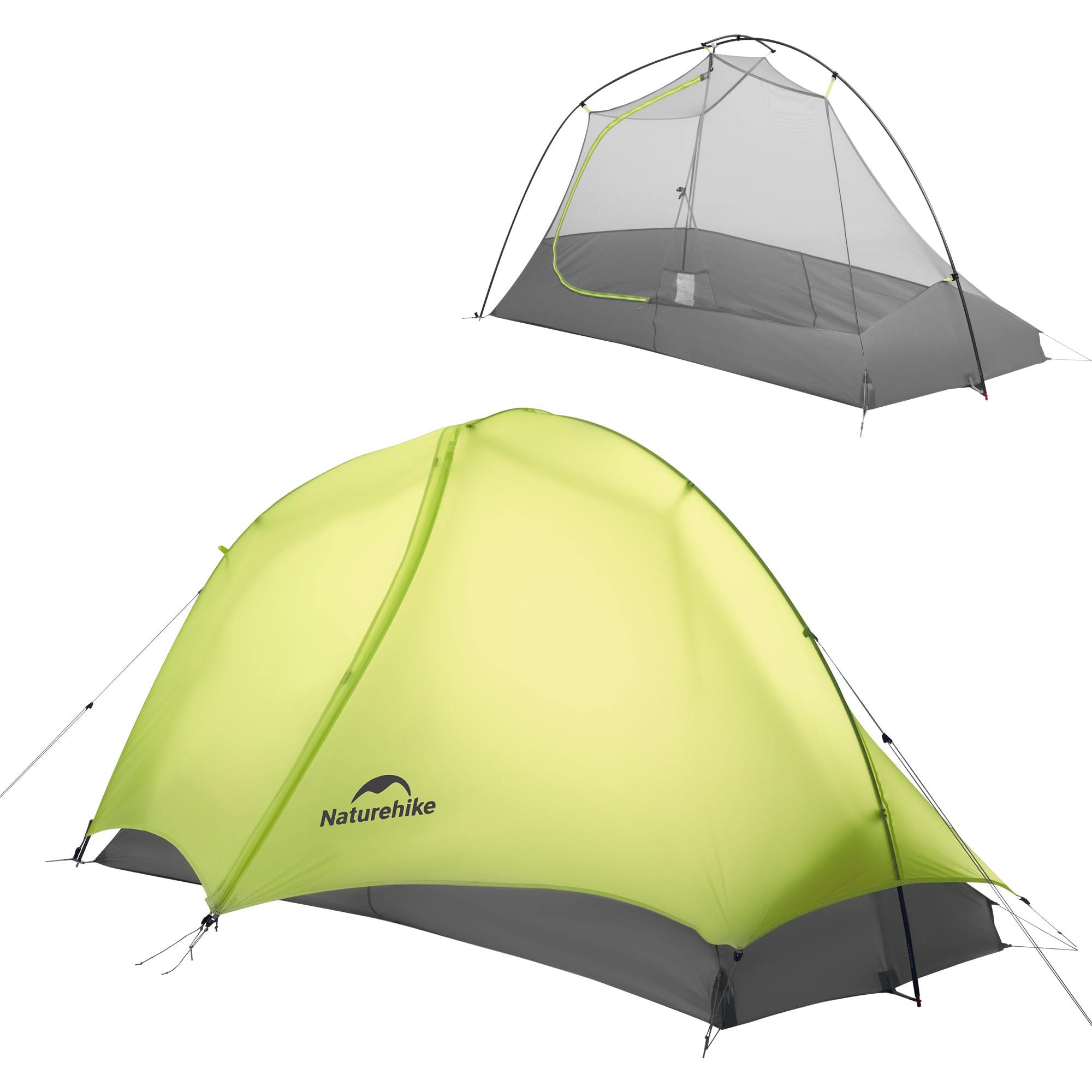
Naturehike Star Trail
Key Features
- Footprint: Included
- Fly rating: 1500 mm+
- Packed weight: 2.3 lb
- Sleeping capacity: 1 person
- Price: Premium
Two and a third pounds, roughly the weight of a one-liter bottle of water, and that figure includes the footprint. Nothing else here is close on weight, and for a solo hiker that is the entire argument.
The number comes out of the fabric. A 10D nylon fly rated to 1500 mm sits over a full mesh inner, with a 20D floor at 3000 mm, two aluminum poles, one door, three guy lines, and nine stakes. Ten-denier nylon is about as light as tent fabric gets, and it behaves like it.
Which means care. That fly is thin enough that a snagged branch or a hard pull on the zip can tear it, so clear your pitch of stones and sticks, use the footprint every time, and carry a patch. It is also the one tent here where the packed volume matches the weight: a short, soft bundle that drops into the bottom of a pack.
Where it lands for us: this is the tent for the hiker whose knees are keeping score, a shelter you can sit up in at 86.6 by 59 inches and 45.3 inches of peak, that then disappears. Hand it to a careless teenager for a festival weekend and it will come back in pieces.
Pros
- 2.3 lb with the footprint included
- Full mesh inner for ventilation
- Aluminum poles and nine stakes
Cons
- Most expensive tent in this set
The lightest real shelter here at 2.3 pounds with the footprint included, built for a careful solo hiker who counts every ounce.
Best for First Overnight Trips
JELUCAMP 2-Person Dome Tent

Key Features
- Peak height: 43.3 in
- Packed weight: 4.3 lb
- Sleeping capacity: 2 person
- Waterproof rating: PU 3000 mm
- Price: Budget
This is the least expensive tent here, and it is the one we point first-time campers at when the budget is the hard limit: 4.3 pounds, a 3000 mm coating, and a two-person floor for less than most of this group.
What you get is a plain two-pole dome: 86.6 by 59.1 inches, 43.3 inches at the peak, one door, one pocket, and a carry bag. One door between two people means somebody climbs over somebody, which you stop noticing on the second trip and resent on the fourth. Seal the seams before the first wet night, because a 3000 mm coating is fine but the stitching is where inexpensive tents leak. It pitches as a simple crossing frame and packs back into its bag without a fight.
Pros
- 4.3 lb at the lowest price here
- 3000 mm coating on a two-person floor
Cons
- Fiberglass poles instead of aluminum
The one to point first-time campers at when the budget is the hard limit: a 4.3-pound two-person dome with a 3000 mm coating and no pretense of being more.
Best for Winter Camping
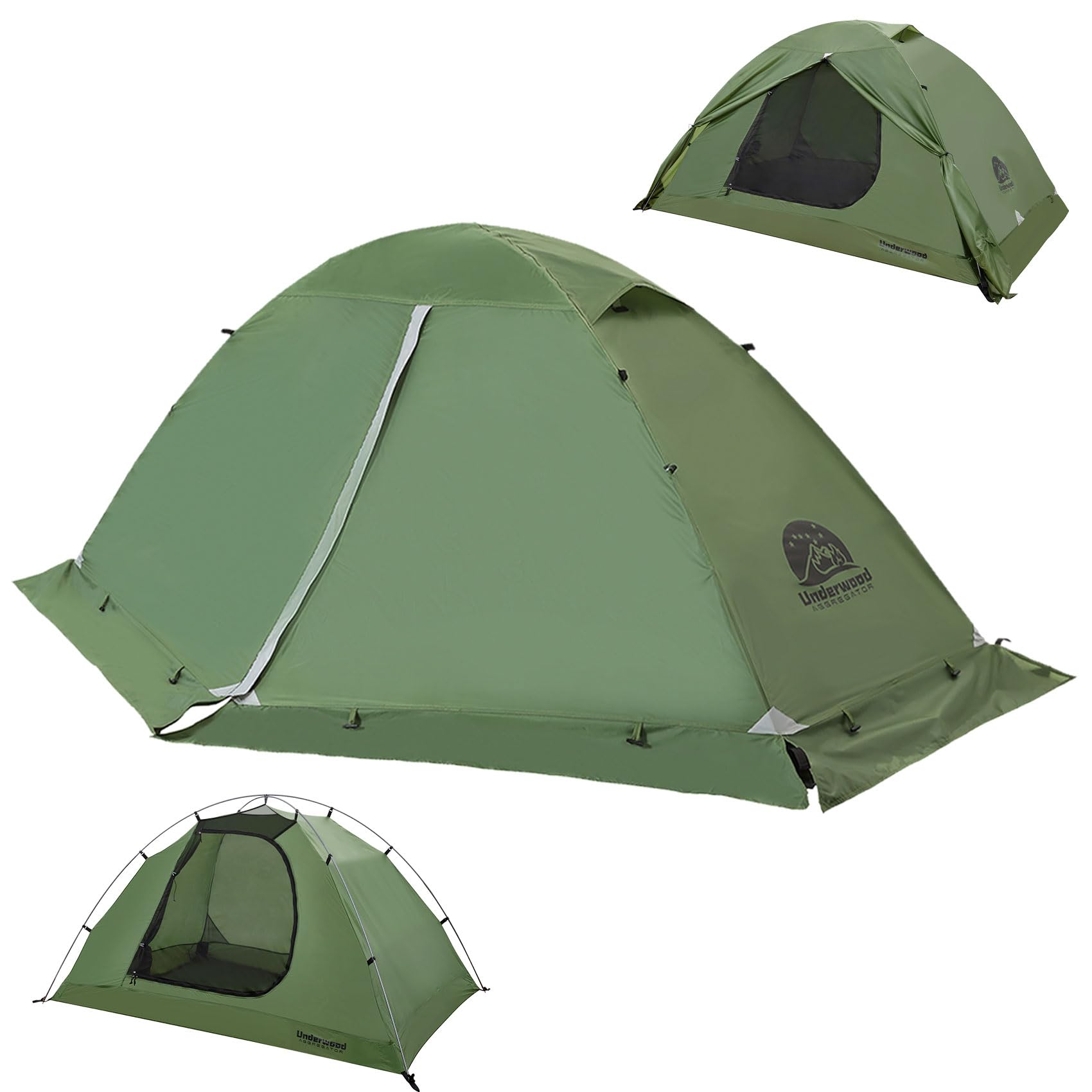
Underwood 4-Season 2-Person Tent
Key Features
- Seasons: 4 season
- Packed weight: 5.7 lb
- Sleeping capacity: 2 person
- Waterproof rating: PU 5000 mm
- Price: Midrange
Most of the tents here are summer tents with a rainfly bolted on. This one is built for the cold half of the year: a four-season double wall with a 5000 mm coating on the fly and floor, four aluminum poles, and 45.3 inches of peak over an 86.6 by 59.1-inch floor.
It behaves like a winter tent should. The inner is closed rather than all mesh, a detail we appreciate on a cold night, so body heat stays where you made it, and two vents at the top give the moisture somewhere to go. Use them, because a sealed four-season box turns your breath into frost on the walls by morning.
The winter failure mode is the poles. Aluminum joints can ice up and refuse to separate, so keep them dry and warm a stuck joint in your hands rather than forcing it. Pack the poles somewhere they will not sit in snow all night.
For snow, hard frost, and late-season trips, this is the one. It gives you a lot of shelter for the money, and the closed inner plus that coating is what you are paying for. It is the wrong tool for July mileage, which is fine, because nobody buys a four-season tent for July.
Pros
- 5000 mm coating on fly and floor
- Closed inner holds warmth
- Two top vents for moisture
Cons
- 5.7 lb is a heavy carry
- One door for two people
The cold-weather option in this group: a four-season double wall with a 5000 mm coating and top vents, built for frost and snow rather than summer mileage.
How We Tested the Best Budget Backpacking Tents
We started with a long list of roughly forty tents sold as budget backpacking shelters, then filtered by a few hard requirements: a real packed weight a solo hiker could carry, a full-coverage rain fly, aluminum rather than fiberglass poles, and enough floor area for an adult plus a pack. Twelve made the cut. We tested them from late April through October, first with backyard pitches to learn each layout, then on actual trips — two-nighters, a car-camp base with a hike-in site, and one memorably wet weekend where the forecast was wrong in our favor.
Setup was timed with a stopwatch, solo, in daylight the first time and then again after dark with a headlamp. We noted where the poles snagged on sleeves, whether the fly needed two people to align, and how many stakes each tent actually required to stand up straight. Every tent was weighed on a kitchen scale in its stuff sack, then loaded into a 40L pack alongside a sleeping bag and pad to see how much room was left over — packed size matters as much as grams when your pack is small.
Inside, we laid out two 25-inch pads and two bags, then had a 6-foot-2 tester and a 5-foot-4 tester sit up, roll over, and change clothes. We checked headroom at the center and at the foot, and whether the vestibule actually swallowed a wet pack. For weather, we ran each fly under a hose for ten minutes and looked for water pooling on the fabric, misting through the ceiling, or wicking at the seams, and we pitched them on an exposed ridge to watch pole flex and see how they handled a gust without guy lines.
Durability and hardware got checked at the end of every trip: pole joints for splitting, floors for abrasion at the door, seam tape for lifting, and mesh for snags. Zippers got the most abuse — dozens of open-and-shut cycles, one-handed from inside, and with cold, wet hands in the dark to see which ones snagged on the fly. Value, in the end, came down to how few of those things went wrong for the money.
How to Choose a Budget Backpacking Tent
The money in a budget tent buys weight, weather protection, or liveable space, and you usually get two of the three, so decide which one your trips actually punish.
Weight, Counted Per Person
Packed weight is the first thing to compare and the easiest to compare unfairly. A 5-pound two-person tent is two and a half pounds in each pack; the same tent carried alone is 5 pounds on one set of shoulders. The two-person tents here run from 4.3 to 5.7 pounds, a workable band for weekend trips as long as two people share the load.
Poles are where the money shows. Aluminum bends and can be splinted in the field; fiberglass snaps and sheds splinters into your hands. If you hike solo in a two-person tent, buy the lightest one your budget allows and stop looking at anything else.
Doors and Vestibules Change the Trip
Count doors before anything else if two of you are sleeping in it. A single-door two-person tent means one person climbs over the other for every midnight exit, and both packs end up on the floor between you.
Two doors and two vestibules turn the same floor area into a calmer space: wet shells, boots, and packs stay outside the sleeping compartment. This is the feature we pay for first, because it improves every night of a trip rather than only the worst one.
What Two Person Means on the Floor
A standard sleeping pad is about 25 inches wide, so two of them need 50 inches. The two-person floors here run from 51 to 59 inches wide, which means the narrow ones hold two pads and nothing else while the wider ones leave room for a dry bag or a dog.
Length matters just as much. Floors in this group run from 82.6 to 88.6 inches, and anyone over six feet should be shopping the long end. Measure your pad, then add whatever you want to keep beside it.
Waterproof Ratings, Seams, and Condensation
Hydrostatic numbers here run from 1500 mm to 5000 mm, and they describe the fabric, not the tent. A high rating on a poorly sealed fly still leaks at the seams, while a modest rating on a full-coverage fly that reaches near the ground keeps you dry through an ordinary night of rain. Look for a bathtub floor and taped or sealed seams.
Condensation is the other half of staying dry. A single-wall design, or a fly pegged tight against the inner, traps the moisture you breathe out. Mesh inner walls and a vent you can crack open matter more than another thousand millimeters on the label.
Match the Season Rating to Your Coldest Night
A three-season tent is the right answer for most of the year: mesh inner, plenty of airflow, a fly for rain. A four-season tent closes the inner to hold warmth and shed snow, which makes it a sauna in July and a heavy thing to carry in August.
Buy for the coldest, wettest night you will actually camp rather than the trip you are dreaming about, and remember the cold-weather tents in this group are also the heaviest.
Frequently Asked Questions
Can one person pitch a two-person backpacking tent alone?
Yes. Stake the four corners before you feed the second pole through, so the shell does not sail away while you are working, and leave the door open until the frame is up. Practice once in the yard.
Most two-person tents in this group are simple two-pole domes, which are the easiest shelters to manage single-handed; the fiddly part is the guy lines, not the poles.
Do I need to buy the matching footprint?
No. A sheet cut from heavy polyethylene or house wrap does the same job for a fraction of the price. Cut it an inch smaller than the floor all the way round so it cannot catch rain and channel water under the tent.
Two picks here, the Naturehike Star Trail and the Cloud-Up 2, ship with a footprint in the box, which is worth counting if you would otherwise buy one.
How long will a cheap backpacking tent last?
The poles and the waterproof coating age before the fabric does. Dry the tent completely before it goes into storage, store it loose rather than compressed, and re-proof the fly once water stops beading and starts soaking in.
Wash off sap and bird droppings with plain water; solvents take the coating with them.
Final Verdict
Our pick for ordinary three-season backpacking is the BISINNA. Two doors, two vestibules, aluminum poles, and 4.7 pounds is the most complete package here, and nothing else in this set gives you all four without taking something back.
If your trips happen in real rain and you have a partner to split the load, the Clostnature’s 5000 mm coating is worth the extra weight. If you hike solo and count ounces, the Star Trail is the shelter that disappears into your pack.